Identification of Cracks
What is the mode of failure or damage of the beams in the figure above? Are the damages repairable? Elaborate
Q.1
Aim:- To identify which type of mode failure occurred and its causes. It is Rpairable or not.
Introduction:- In this question, we identify the types of failure causes, and whether they are repairable or not. cracks are dangerous to our structure. That is why its identification and solution are known as very important.
a)
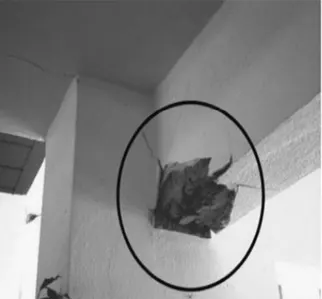
Observation:-
- The cracks developed only beam at the bottom side, not the upper side or not in the column.
- Reinforcement is visible and at the area of the crack, concrete is crushed.
- The cracks are developed from bottom to top means reinforcement yielding occurs in support bottom only.
Conclusion:-
- It's from flexural failure due to the reversal of stress during an earthquake.
- At top of the beam, it experiences compression ( at the top flexure reinforcement is present), and bottom it experiences tension
- Bottom reinforcement is not sufficient to resist the tension in the beam and the top compression resists the slab due to concrete
- since reinforcement got yielded it can not be repaired
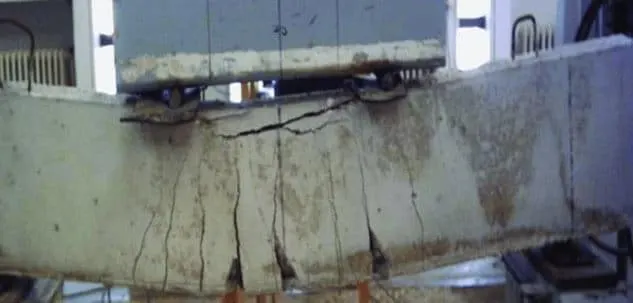 Flexural Failure in Beam
b)
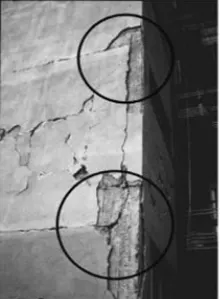
Observation:-
- We see that cracks are developed on the corner of the beam-column
- At the joint of beam-column the cracks the much wider in comparison to far of the joint
- The beam has separated from the column at joint
- The concrete has not been crushed but only crack generated.
Conclusion:
- The Crack is in the lateral displacement of the beam from the column connection. Which is due to the insufficient anchorage length of the reinforcement bar in the beam.
- Due to inadequate reinforcement, the beam is not bonded to the column that’s why the horizontal member gets detached from the vertical member during the earthquake
- Providing Anchorage length between two existing concrete is very difficult. so not repairable
c)
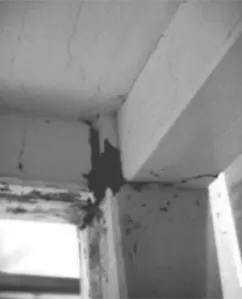
Observation:
- Cracks are developed entirely in the beam-column joints up to the slabe
- Slabe also cracks along the direction of crack
- Cracks are developed entire along the width of beam
Conclusion:
- It is a plastic hinge deformation/failure
- In Plastic hinge failure, they do not resist any bending moment
- The damage occurred only in the joint zone first of all
- Cyclic lateral loading and stress reversal at eh joints led to the damage.
- The slab has under the tension, but it got cracked, so it is clear that the tension is more on the slab and the slab becomes cracked.
- We can strengthen the column-beam junction it means it is repairable
2)
Aim:- To identify which type of mode failure occurred and its causes. It is Rpairable or not.
a)
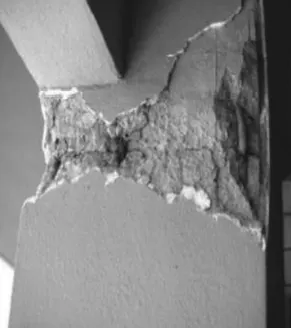
Observation:-
- In this crack, we see cracks are developed only top of the column
- It is not developed on beam
- Reinforcement is visible and cracks are developed on all 4 sides of the column
- No walls are built along the column means it is probably on the ground floor, for parking car movement access
Conclusion:-
- It is a Soft story of failure
- It is a plastic hinge formation
- Due to the absence of an infill wall on the ground floor, the plastic hinge forms at the top of ground-story columns during lateral movement
- Based on the development of the crush of concrete, it can either be repairable or non-repairable.
- It is very difficult to repair or we can say not repairable
b)
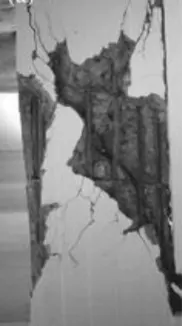
Observation:-
- Cracks and concrete Damage are shown at the top of the column.
- Concrete is damaged on all 4 side
- In this failure the beam is safe
- Longitudinal reinforcement is intact
- Shear reinforcement spacing looks wider(which means probably lesser shear rebar provided)
Conclusion:-
- It is a pure shear failure.
- The crack is in a diagonal direction and the complete concrete had spalled and crushed
- Inadequate shear reinforcement compels concrete to take all the shear stresses.
- It had compelled concrete to break down into pieces.
- It is not repairable because it is a pure shear failure.
c)
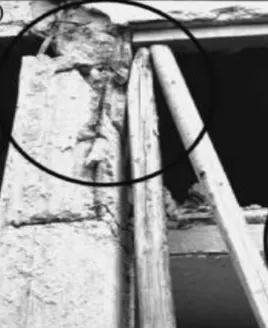
Observation:-
- The column failed completely and it failed at top of the column
- There are two slabs connected to the column probably one at mid-height of the column
- The wooden piles might be post-failure support after the column failed, providing a temporary prop to avoid the collapse of the entire structure
Observation:-
- It is a short column failure
- an additional slab or beam connected to a column in mid-height leads to this effect
- This leads to failure especially if the connection is unintentional and not accounted for in the design
- The failure given in the picture is not repairable