Hood design-Week 2
OBJECTIVE:
Design Hood Outer Panel, Inner Panel and the necessary reinforcements by following the Master Section mentioned in the challenge.
Explain the hood and its components, their parts,
Explain the design methodology and the manufacturing process
And the feature used to design the hood components.
WHAT IS HOOD AND ITS COMPONENETS ?
Car hood/bonnet is a hinged cover that rests over the engine in a front-engine car. A latch is provided under the hood in order to prevent accidental opening during driving. Purpose of hood is to provide access to the engine and battery for repair and maintenance. It also protects these parts from direct sunlight and dust.
A typical hood assembly consist of hood outer panel, inner panel, latch and striker, hinge, hood stay
It is the most critical part of the car as it is always exposed to the frontal crash, climatic conditions, heat generation by the engine compartment, etc.
There are 4 components of the Hood:
Inner panel,
Outer panel,
Hinges and
Latch striker.
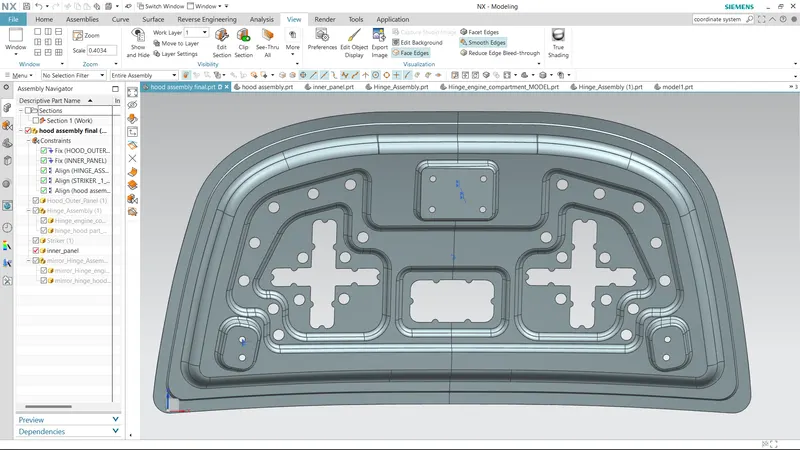
INNER PANEL: The inner panel provides strength and supports the outer panel. It is where hood balancer and hinges are attached.
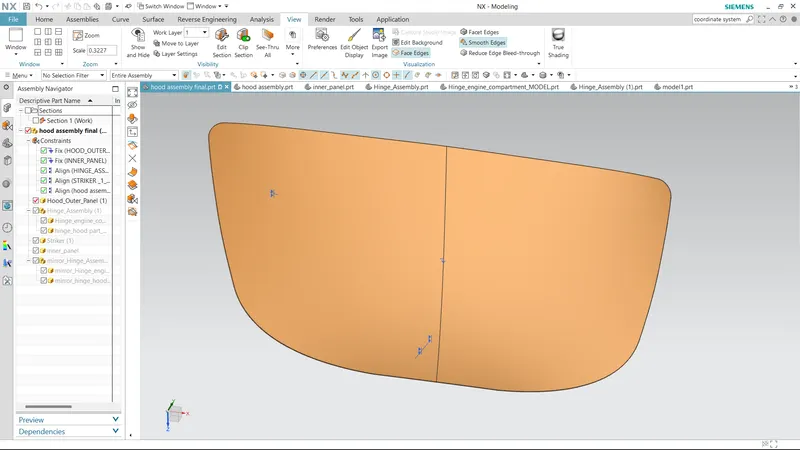
OUTER PANEL: The outer panel works as a metal cover.
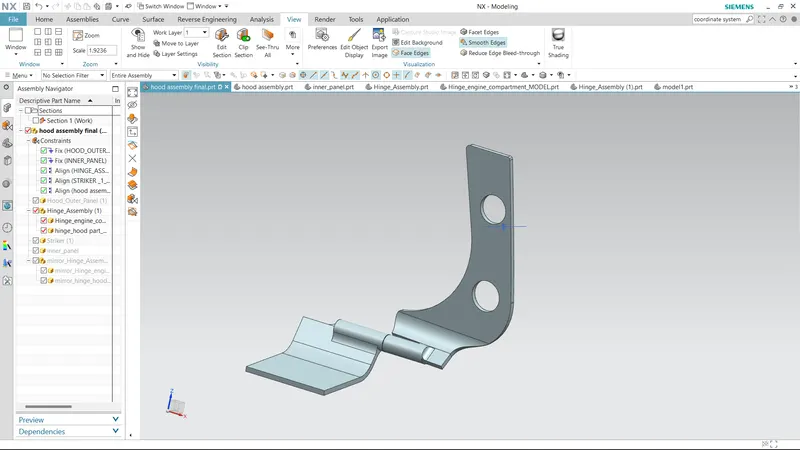
HINGES: These are attached to the hood. Also hinges allows the hood to rotate around a fixed axis for opening and closing movement.
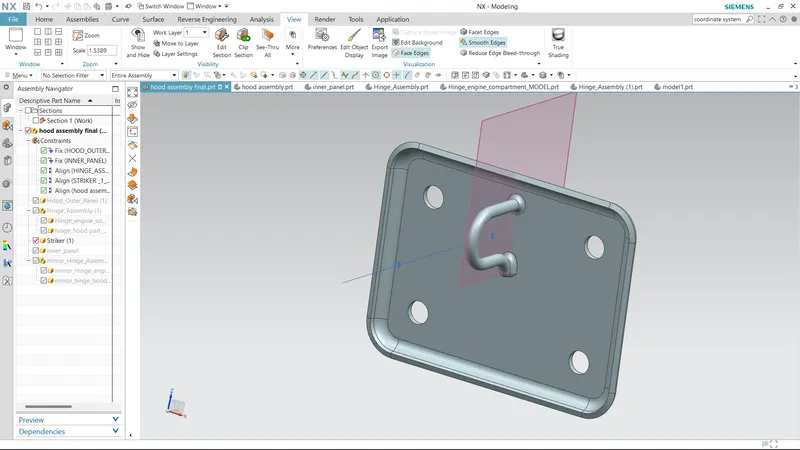
Latch and striker:
striker is also connected with the hood . latch and striker mechanism is provided to lock the hood in order to prevent accidental opening the hood during driving.
LATCH TRAJECTORY: THE latch trajectory perform the very important role of the whole hood part for opening and closing the hood componenet. It is the path along which the hood rotates during opening and closing movement. The striker on the hood follows a particular path while opening or closing the hood, which is along circumference of a circle with center at the hinge axis. This path is nothing but latch trajectory.
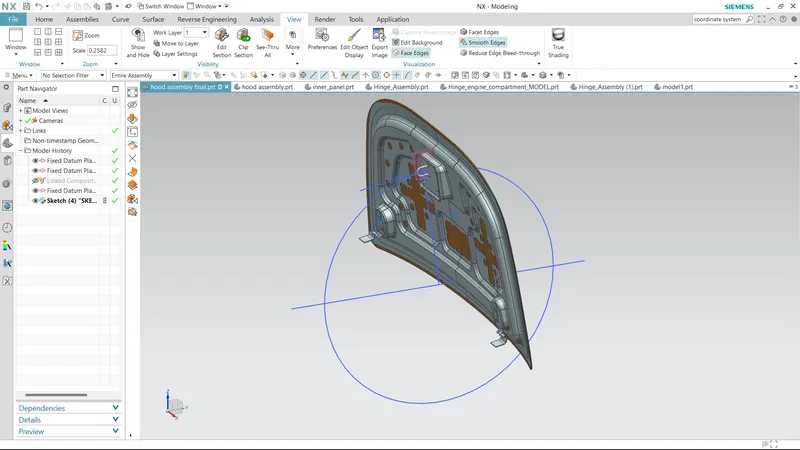
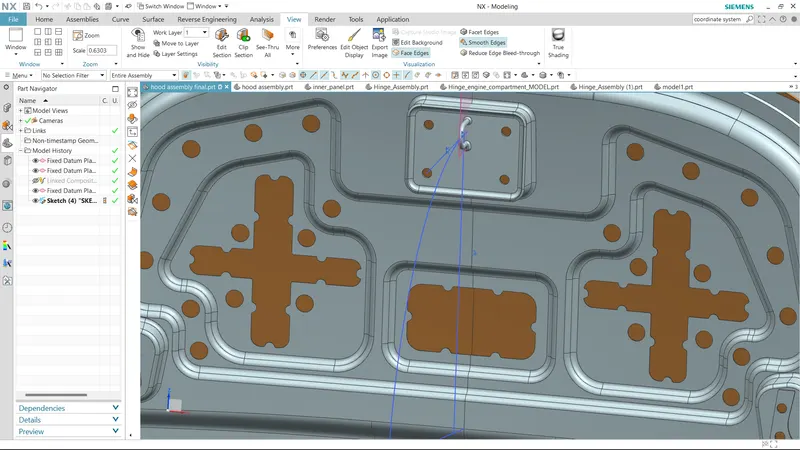
MASTIC SEALANT DATA: Mastic sealant helps to locally improve strength of the hood. It is generally a hard rubber part, which is introduced as a paste in between inner and outer panel of the hood, which will get hardened inside the furnace.
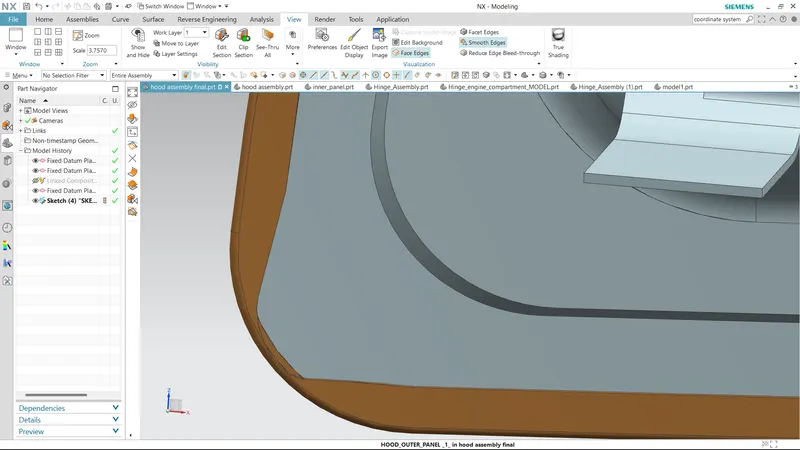
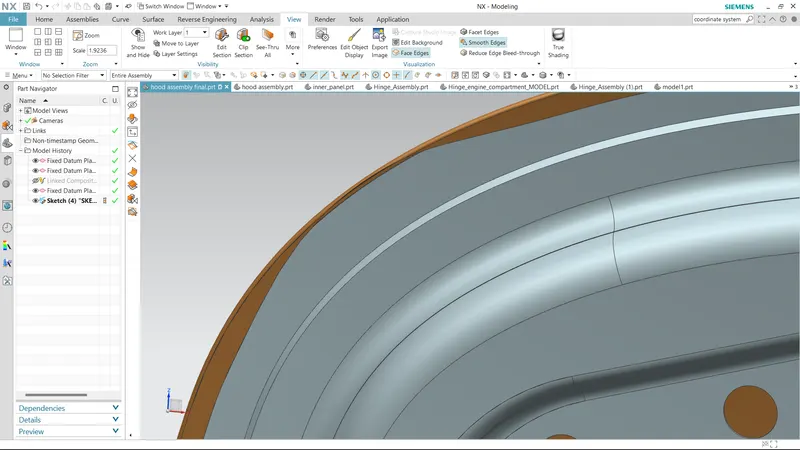
THEUPPER ONE IS THE FRONT RELIEF AND THE LOWER ONE IS BACK RELIEF.....
FEATURE USED TO DESIGN THE HOOD COMPONENET:
OFFSET SURFACE
OFFSET IN FACE CURVE
TRIM SHEET
TRIM BODY
LAW EXTENSION
TRIM AND EXTEND
PROJECTED CURVE
MIRROR GEOMETRY
FACE BLEND
EDGE BLEND
EXTEND SHEET
EMBOSS
WAVE GEOMETRY LINKER
DESIGN PROCESS:
We design the inner panel with the help of class A surface or outer panel according to the master section:
We create emboss using the offset surface from thr original master section.
The create a cuts on the emboss by sketching and using trim surface option.
Now design the outer panelfrom the same master section.
Provide hemming at the corner or on front relief and on rear relief.
The values is already given the in challenges.
Now, on the inner panel, the embossing for hinge and striker are produced by considering their respective dimensions and assembly positions. First the emboss for hinge is created and then by fixing the hinge into its position, we draw an axis passing through both side hinge axes to form a common axis. And then we position the striker such that it will move along circumference of a circle whose center is at midpoint of the common axis. Thus, position of striker is decided and we can create emboss for the same.
Data already given:
Outer panel thickness 0.75mm
Inner panel thickness 0.75mm
Reinforcement thickness 1.5mm
DEEP DRAWING:
It is a sheet metal forming process in which a sheet metal blank is radially drawn into a forming die by the mechanical action of a punch. The process is considered deep drawing when the depth of the drawn part exceeds its diameter.
HEMMING:
Hemming is a forming operation in which the edges of the sheet are folded over other part or simply folded in order to achieve a tight fit. In car part production, hemming is used in assembly as a secondary operation after deep drawing, trimming and flanging operations to join two sheet metal parts together.
EMBOSSING:
Sheet metal embossing is a stamping process for producing raised or sunken designs or relief in sheet metal. This process is carried out by means of matched male and female roller dies, or by passing the sheet or rolls of metal between rolls of desired pattern
THANKYOU.....