Hood design-Week 2
Hood design
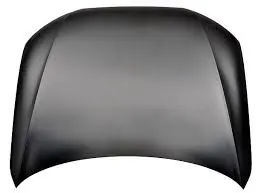
The hood is a hinged cover that encloses the engine in a front engine vehicle whereas it acts as a door for the front trunk in a rear engine vehicle. Hood opens to allow access to engine compartment. Hood is an important component of a vehicle considering the frontal crash and pedestrian safety requirement. The hood consists of Outer hood panel, inner hood panel, Striker- latch mechanism, Hinge, and their reinforcements. The outer panel functions as a metal cover, while the inner panel provides overall strength to the component.
Design Considerations
- Head clearance zone - Head clearance zone is the clearance such that when the hood is in fully open condition it does not touch the person standing next to the hood. This is controlled by the opening angle of the hood and is decided for the region the car is manufactured. It varies from 5.5 foot to 6.5 foot.
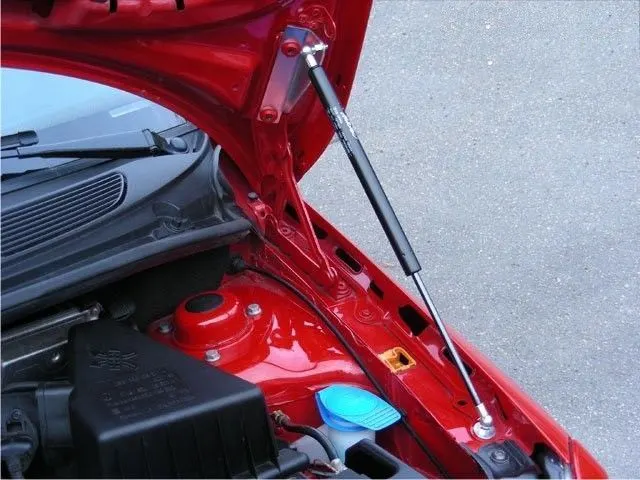
- Hood Stay - A hood stay is a support which is used to keep the hood in an open position. Two types of hood stays can be designed
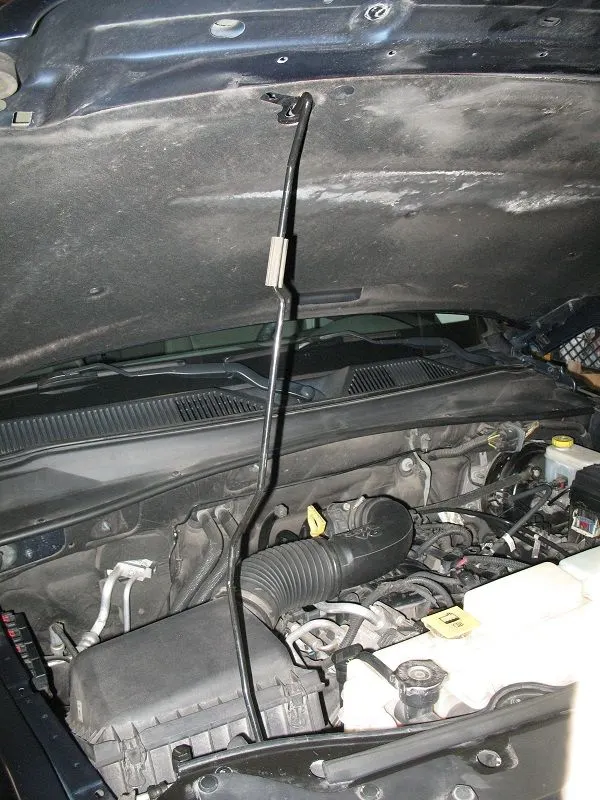
- Support rod – This is usually inside the engine compartment; one end of the support rod attaches to the hood and supports it. Design of support rod is not linear instead it has some bends to increase the rigidity and strength of the rod. The support rod should be mounted on opposite side of battery to avoid interference.
- Gas stay - Gas stay uses an actuator to open and close the hood. One side of gas stay is mounted on body side and other side is mounted on the hood.
- Pedestrian safety
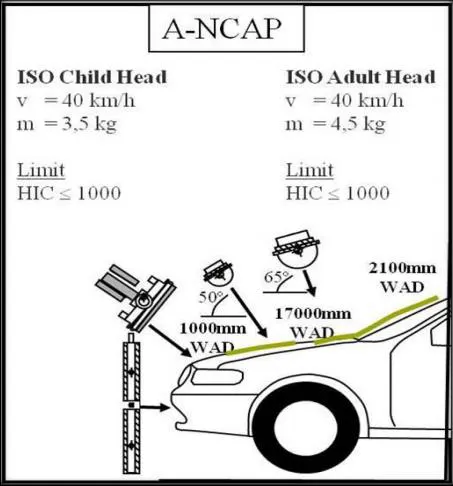
ANCAP provides measures for the assessment of pedestrian protection performance of a passenger car experimentally by firing subsystem impactors representing a child head, adult head, upper leg and lower leg at a specified angle and speed to the front end of a stationary vehicle. The resulting injury measures from these physical tests are assessed.
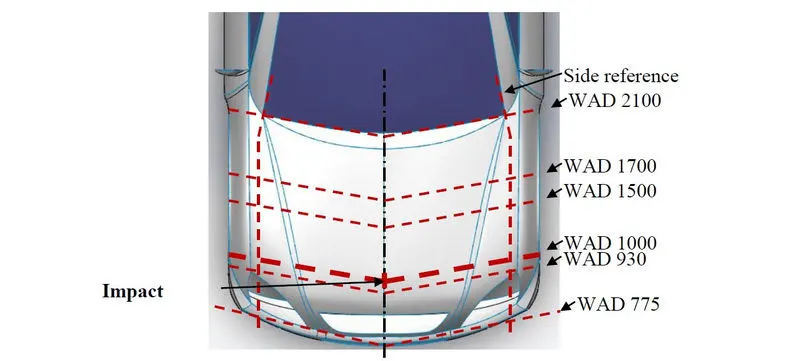
Wrap Around Distance (WAD) is the distance from the ground level to the end of the hood. There are two main zones that are considered while designing stage; Child head impact zone (1000mm to 1700mm WAD) and adult head impact zone (1700mm to 2100mm WAD). If the side reference line is on the fender, the WAD will be more and impact zone will be less and vice versa.
- Occupant safety
The hood panels should be designed in such a way that it diverges the impact force during a collision away from the occupants inside the cabin. The forces should be damped properly to avoid or reduce the risk of injuries and death.
- Styling and Aerodynamics
It is a major factor that often influence the vehicle sales in the market. Since it is the first visual aspect from the front, providing aesthetic look and balancing out the aerodynamics are key factors.
- Ability to manufacture
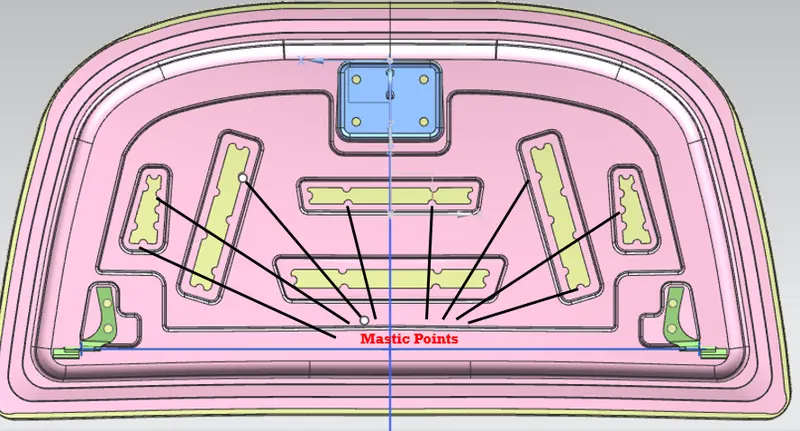
Sheet metal operations such as blanking, piercing, embossing, hemming are used for manufacture hood components. Minimum 7-degree draft angle is maintained with the tooling direction considering the stamping process. Mastic points are provided to join the outer and inner panels as there is no opportunity for spot welding process.
Design Procedure
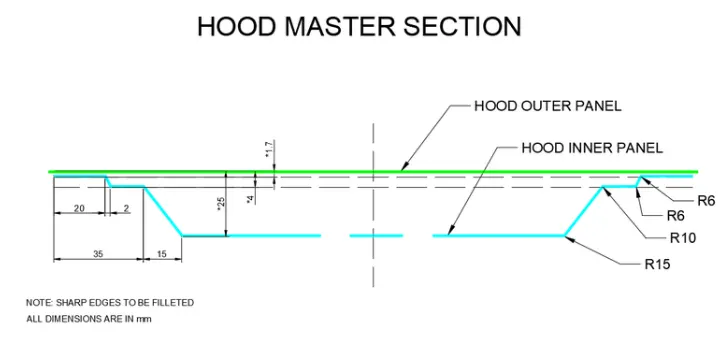
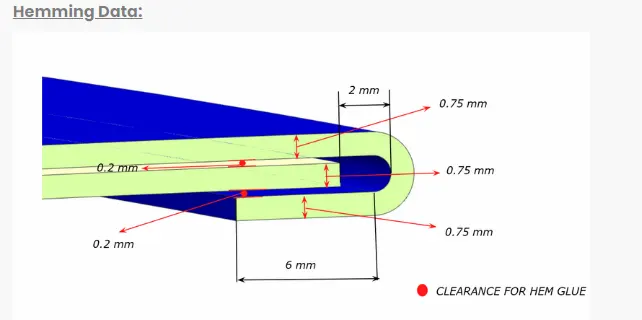
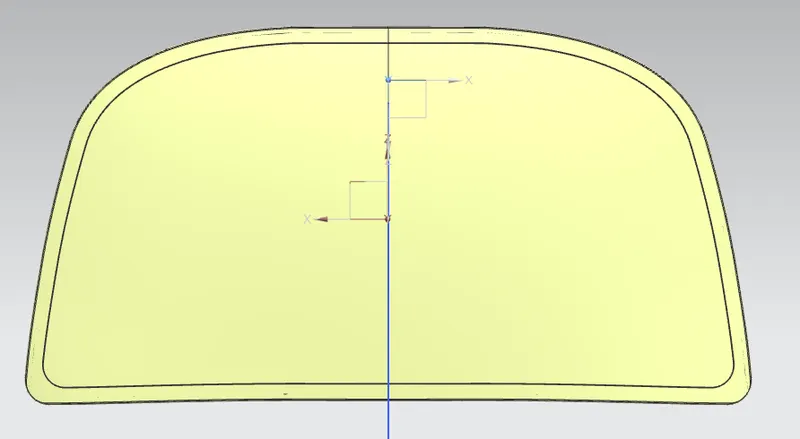
- Outer Panel: Input is the Outer panel Class A surface, and a master section. The outer panel is created for a thickness of 0.75mm and with hemming length of 6mm and at steep corners hemming reliefs are provided.
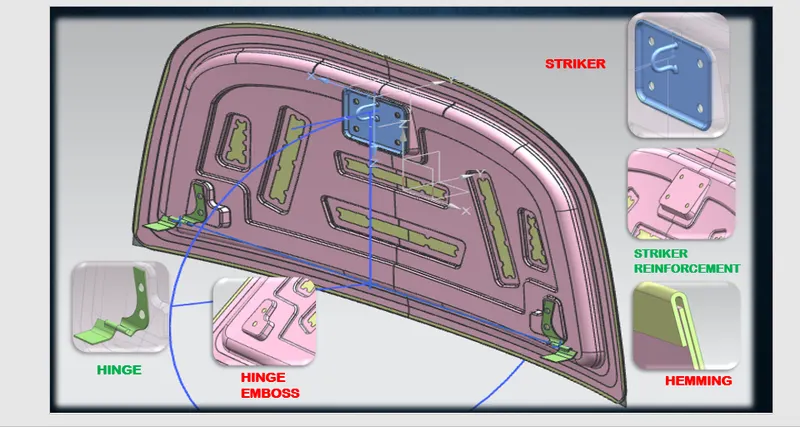
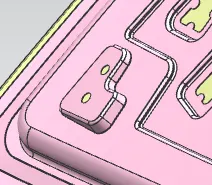
- Inner panel - The inner panel is created with the help of master section provided. The inner panel thickness is kept as 0.75mm. Embosses are created to increase the strength of part and are created such that the forces move towards the hinge or outside of panel. Cut-outs in panel are created to reduce the weight and causes less damage to pedestrian in case of collision. Provisions are made on the inner panel for the application mastic sealants so that it can be joined to the outer panel.Inner panel has two parts assembled on to it. Two hinges and Striker for latch mechanism. Embosses and reinforcements are provided to easy fixation of these two components onto the hood inner panel.
Latch Trajectory:
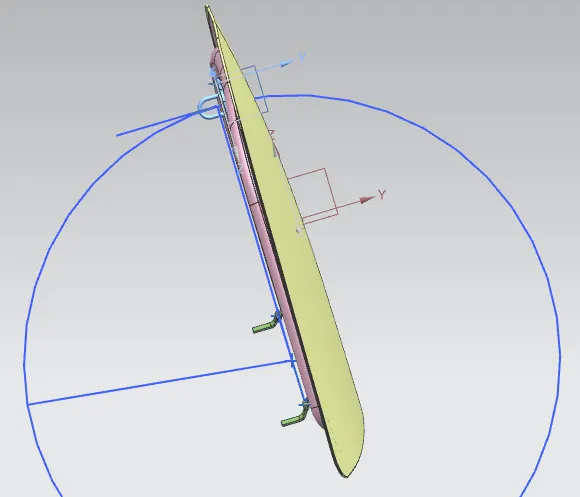
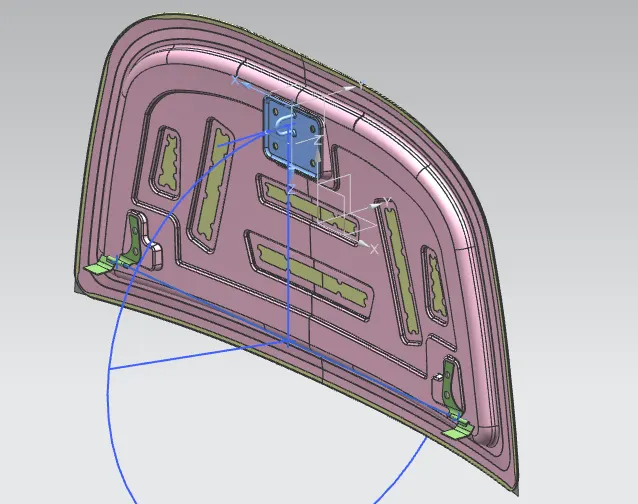
For the proper opening and closing of the hood, the striker should be perpendicular to the trajectory of the hood. For this, hinge is assembled at its position on the inner panel and is constrained with respect to X-axis since hinge/hood motion is along X-axis. Once it is placed,an axis is drawn connecting the hinges. Then the axis is intersected with the center of the hood, a point is formed, taking that point as the center, passing through the striker emboss, a circle is drawn. A radius is drawn which is almost parallel to the hood inner panel in its upright position. And from this point a tangent is drawn to the circle. Finally the latch is positioned in such a way that, it is coincident with this line.
Mastic Sealant:
A mastic sealant is a type of liquid sealant that cures in an elastic state, thus making it flexible while holding the bond of the surfaces that has been attached to it.
Since outer panel is an aesthetic feature, it must be attached to inner panel with the help of hemming and mastic sealants. It is a paste, which hardens upon heating in a furnace. Mastic sealant has the tendency to increase the strength of the panel. Surfaces do not have to be primed when using this type of sealant and has waterproofing quality. Most mastic sealants will work well with metal as they do not corrode over time.
Manufacturing Process involved
- Material - Hood outer panel and inner panel is made of steel, aluminium, or carbon fibre.
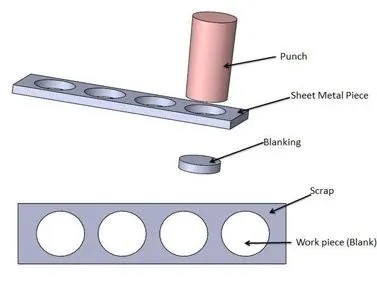
- Blanking - Blanking is a shearing process in which a punch and a die is used to produce parts from the sheet metal. blanking produces the outside feature of the component.
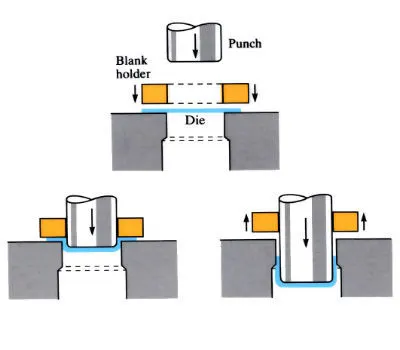
- Deep drawing -Deep drawing is most widely used process in automobile industry. this process occurs under a combination of tensile and compressive conditions. a flat sheet metal blank is formed into a hollow body in deep drawing process.
- Trimming - The excess material in a sheet not required are removed.
- Embossing - Sheet metal embossing is a stamping process for producing raised or sunken designs or relief in sheet metal. This process can be made by means of matched male and female roller dies, or by passing sheet or a strip of metal between rolls of the desired pattern.
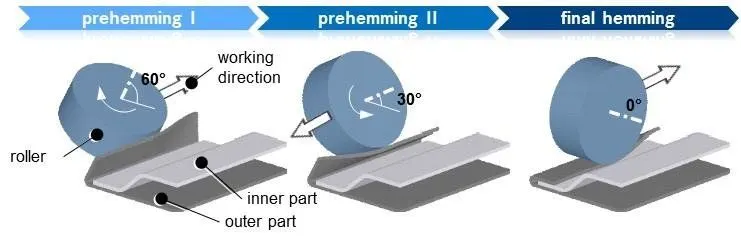
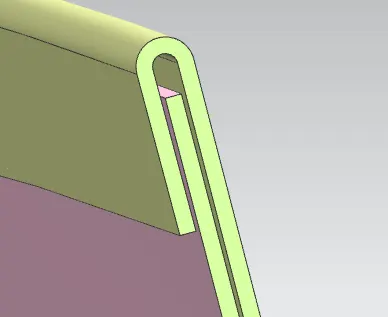
- Hemming - Hemming is the metal working process in which sheet metal edge is rolled onto itself. hems are used to reinforce the edge, hide burrs, and rough edges and improve appearance. Open loop hem and closed loop hem are the two types. Open loop hems have a flush while the closed loop hem is closed with no gap between sheets. The process of hem starts by bending the flange to acute angle and then a flattening die is used to flatten the hem. In hood design, hemming is used in assembly as a secondary operation after deep drawing, trimming and flanging operations to join two sheet metal parts (outer and inner) together.