Hood design-Week 2
- Hood Assembly :
- The Hood also called as Bonet is the hinged cover over the engine of vehicle to allow access to the engine compartment, for maintenance and repair.
- It protects the engine assembly and other vital components, also gives esthetic look to vehicles.
- Components consist in Hood Assembly :
- Hood Outer Panel
- Hood Inner Panel
- Latch (Striker)
- Hinges
- Hood Inner Panel :
- It is a lower part of Hood, which can be visible when hood will open for repair or maintenance of vehicle. It gives protection for front inner parts of vehicles.
- For designing the Hood Inner Panel, here we have Master Section and Class A Surface of Hood.
- So as following the given master section, we can make Inner Hood Panel in Surface Workbench.
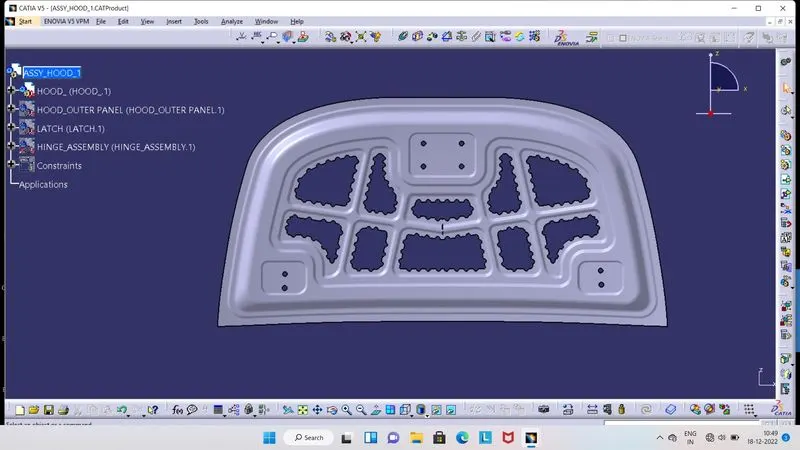
- Above shown is a Inner Hood Panel Image, we can see that there is a kind of structure and hollowness. This structure is provide for the reduce the direct Air Force to the cabin, as Air Force will get dissipate to outer sides as follow the guide ways. In this way inside the cabin area Driver will not feel so much force.
- Hollow portion is for placing the hard kind of rubber for NVH, means reduce the Noise, Vibration and Harshness. In this way weight of Hood also be get reduced.
- Embosses are areas for placement the required components. Like in image we can see that, there are lots of Embosses, in which upper center one for Latch (Striker) and bottom left and right for Hinges and remaining are for the placement of rubbers.
- We have given thickness for this Inner Panel is 0.75 mm.
- Relief given is equal to 3 mm from measuring the edge of outer panel.
- Hood Outer Panel :
- It is a upper part of Hood, which can be easily appear on standing car. Its main purpose is to give esthetic look to vehicle and protection for front inner parts of vehicles.
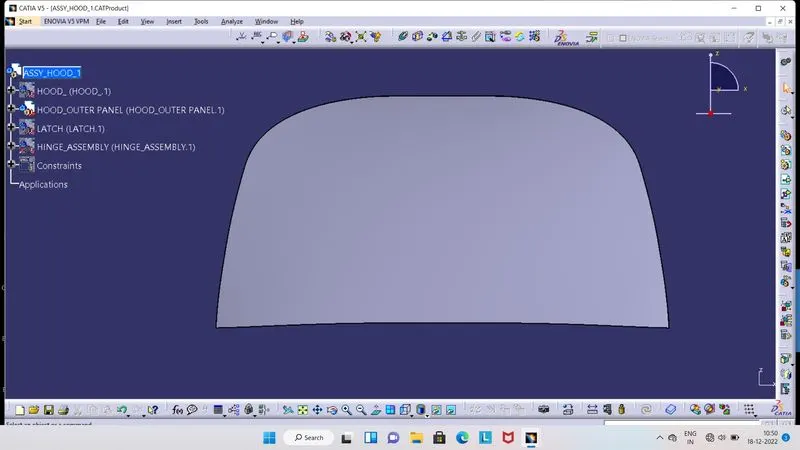
- For create the Outer Panel, we required Class A Surface of it, as by having we have to just give thickness to surface.
- Here we have given 0.75 mm thickness, so our Hood Outer Panel is ready.
- Latch (Striker) :
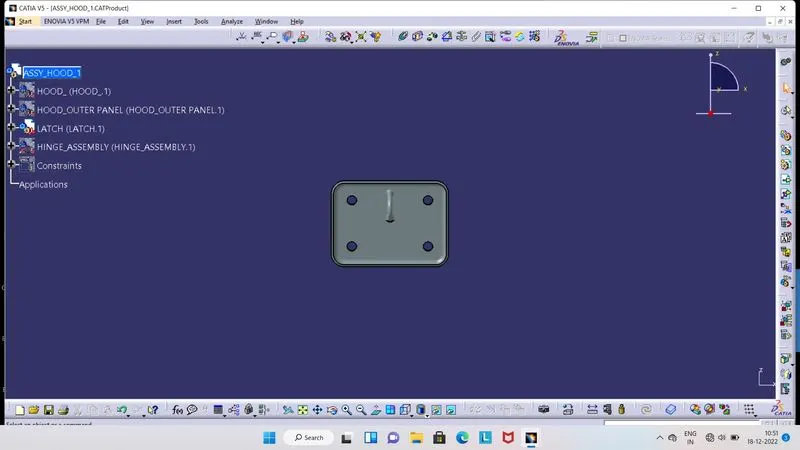
- It is a component that allow the temporary joining of moving parts relative to each other. It actuated to release the coupling and allow the Hood to open and close.
- Generally its location is at bottom center of Hood.
- Hinges :
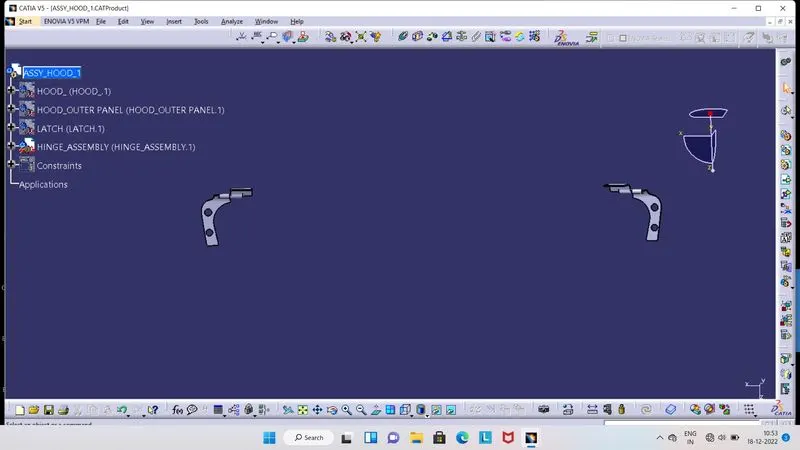
- Hinge is mechanism that make it possible for open and close the Hood. This part allows Hood Panel to move up and down.
- Its location is at top left and right corners of the Hood.
- Assembly of all above parts :
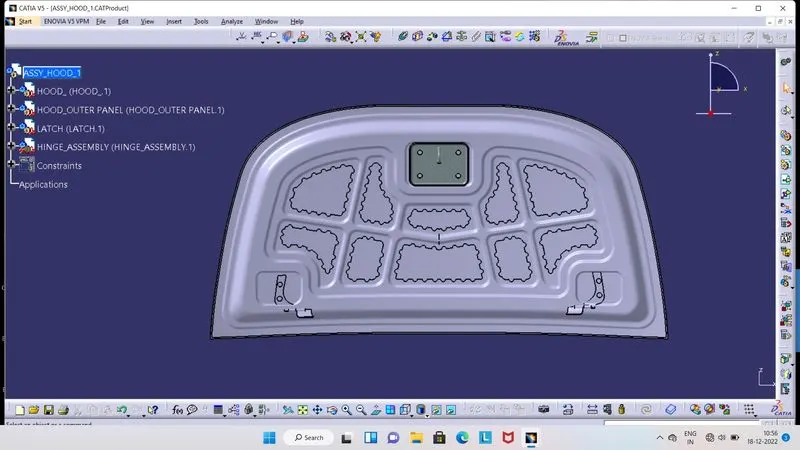
- For assembly of all above parts, we have to switch in Assembly Design Workbench, we have to import this all parts and by using Constraint tool and other Manipulation tool, give respective positions to all parts.
- So, eventually we can see image as shown above.
- For joinnig the Outer and Inner panel of Hood, Hemming Process will be applying. Hemming is a process, in which 2-3 small ball are rolling on edge sides of Inner and outer panel two to three times, in this way the joining may happen between both panels and then sealants are applied.
- Manufacturing Process used :
- Deep-Drawing Manufacturing Parocess :
- Deep drawing is the process of converting blank of Sheet Metal into a cylindrical containers with a flat or hemispherical base.
- It is combination of metal forming process & sheet metal process.
- If the ratio of height to diameter of the product is greater than 0.5 then this drawing operation is known as deep drawing.
- It basically consists of die, punch, blank holders.
- After the application of drawing force, the blank of material forms & takes shape of the punch or shape made onto the punch. To avoid frictional resistance between blank & die, the lubricant is used.
- Hemming :
- Hemming is a sheet metal forming process in which sheets are joined by bending it usually to 180 degrees. Automotive body panels and automotive parts such as deck-lids, trunk-lids, doors, hoods and tailgates are formed by hemming process.
- Purpose of Hemming is a forming operation in which the edges of the sheet are folded or folded over another part in order to achieve a tight fit. Normally Hemming operations are used to connect parts together, to improve the appearance of a part and to reinforce part edges.
- The edges of thin sheet metals can be extremely sharp and dangerous, especially when cut, so often need to be made safe. The simplest way to achieve this is to fold the metal over on itself along the edge. This is known as making a Safe Edge (or Hemming ).