Hood design-Week 2
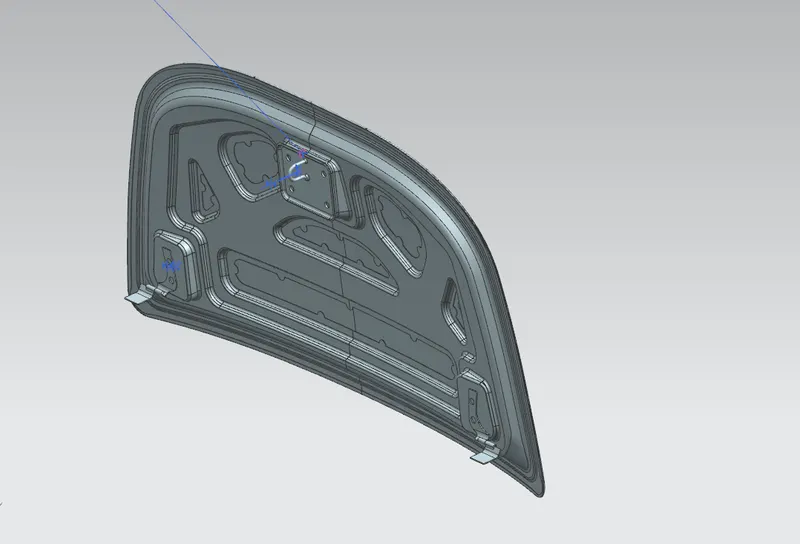
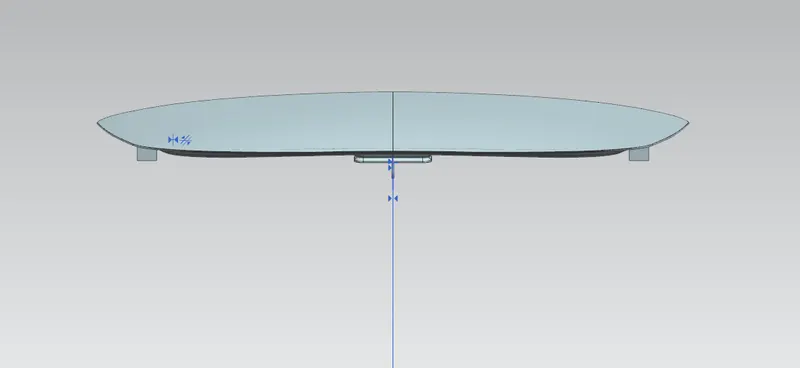
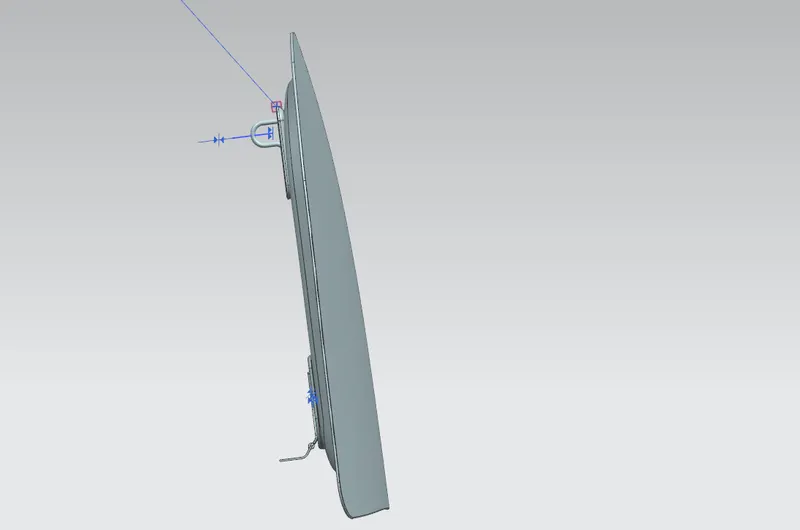
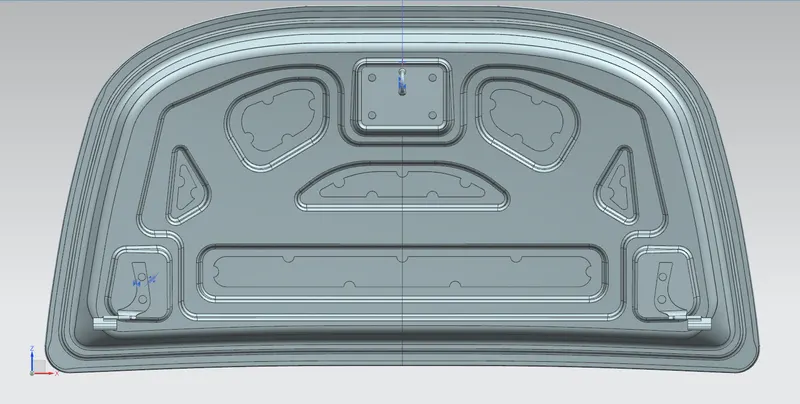
Aim: To create a Hood Assembly which consists of a Hood Inner Panel, Outer panel, hinge assembly, and striker by using the UGNX tool.
Hood:
- The Hood is a hinged part that acts as a cover for the engine compartment which also creates easy access for the engine compartment.
The manufacturing procedure of a hood:
- The Hood consists of four sheet metal parts they are HOOD OUTER PANEL, HOOD INNER PANEL, HINGES, and STRIKER.
- The outer and inner panel of the hood is manufactured by STAMPING operation in a sheet metal workshop.
- The Hinges and striker are cast in a foundry.
- The Inner panel and outer panel are attached by a process called Hemming.
- The surface of the outer panel and inner panel is attached by the Mastic sealant.
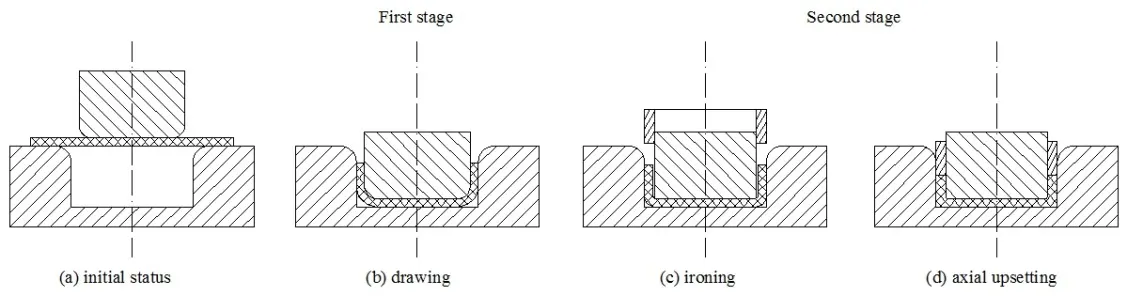
Stamping Operation:
- The process of turning sheets of metal into a useful part or component is called sheet metal stamping. The metal is fed into a press, where the stamping tool, also known as a die, creates the desired shape. The die is pressed into or through the metal with tremendous force
- There are basically only three components to sheet metal stamping—the sheet metal, die, and press machine.
- We should give a draft with respect to the tooling axis and the min draft angle is 7degress
Hemming:
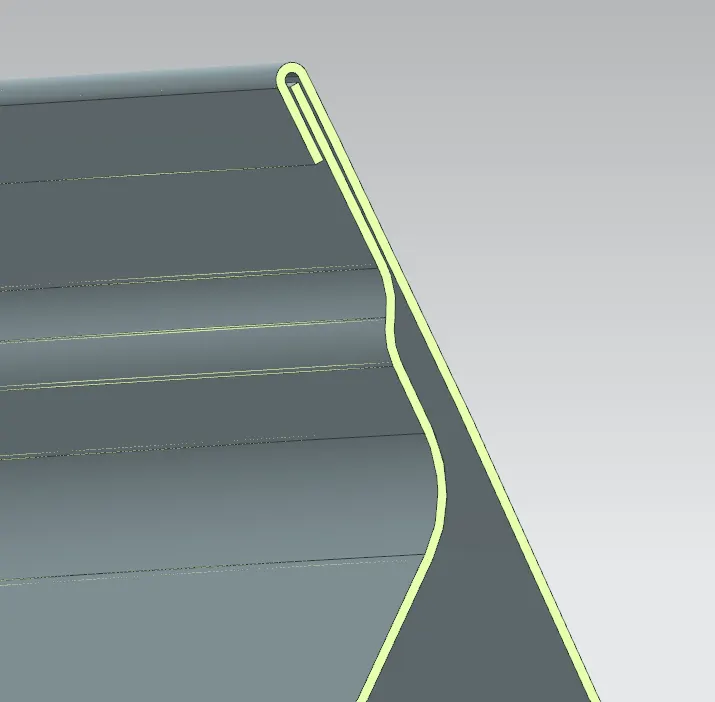
- Hemming is a forming operation in which the edges of the sheet are folded or folded over another part in order to achieve a tight fit. Normally hemming operations are used to connect parts together, improve the appearance of a part, and reinforce part edges.
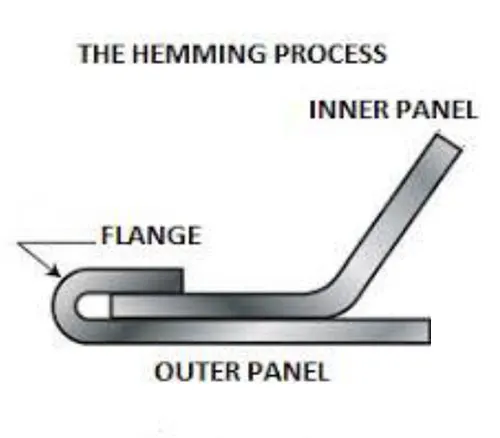
- The accuracy of the hemming operation is very important since it affects the appearance of the surface and surface quality. Material deformations, which occur during the hemming process, can lead to dimensional variations and other defects in parts. Typical hemming defects are splits or wrinkles in the flange, material overlaps in the corner areas to avoid the overlap relief provided for the hemming at the corners.
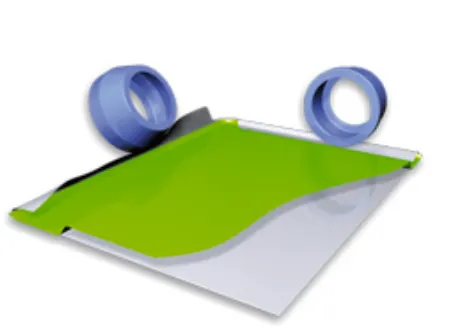
- Rolling hemming is done for the Hood's outer panel edges towards the inner panel so as to achieve the joining.
Mastic Points:
-
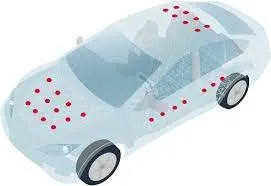
Mastic is a form of sealant or adhesive used to fill the joints or as a bond for different materials and gaps. It is an elastic and flexible material used to create a durable bond between two different surfaces or to protect a particular surface.
- Cyanoacrylates are used extensively in the automotive industry, in large part because of their bond strength. They can also withstand extreme conditions, facilitating use in temperatures ranging from -40° to 250° F. Cyanoacrylates may be used in other cases where other glues or fasteners are not an option, as well.
- Application of adhesives and sealants enables automakers to simplify their assembly processes. Parts that are bonded together don't need holes to be drilled or punched, and assemblers don't need to measure torque or double-check fastening operations.
Design Considerations of Hood:
- Pedestrian safety requirements- Padestruan rating depends on the below factors
- Wrap-around distance (WAD) means the trace of the points received on the front structure when one end of the flexible tape of the required length is held at ground reference level and another end is in contact with the front structure
- Child Head Impact Zone: 1000 WAD to 1500 WAD
- Adult Head Impact Zone: 1500 WAD to 2100 WAD
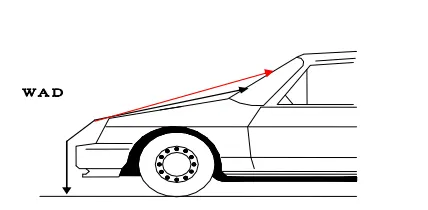
- Side Reference Line means the trace of the highest point between the straight edge inclined at an angle of the 45deg and side of the vehicle
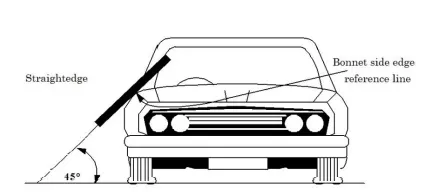
- The side reference line is the line that is formed with respect to the ground and it makes a 45deg angle that should touch the endpoint of the hood.
- Frontal Crash-On a frontal crash the hood embosses should dissipate the impact force towards outside the car body rather than sending it inside the car body which will reduce the impact on the passengers inside the car. The only logic to create a emboss is to dissipate the impact force toward the hinges.
- Gap and flushness requirement.
- Hemming.
- Region(country) in which region the hood is developed-Hood's opening angle varies from country to country according to avg. height of a human more the height more the angle will be. The support rod or gas stay length is varied according to the angle.
- There should be clearance between the tipping point of the hood to the striker.
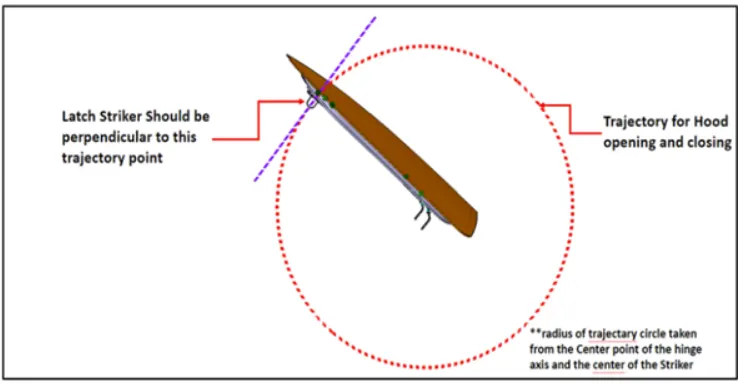
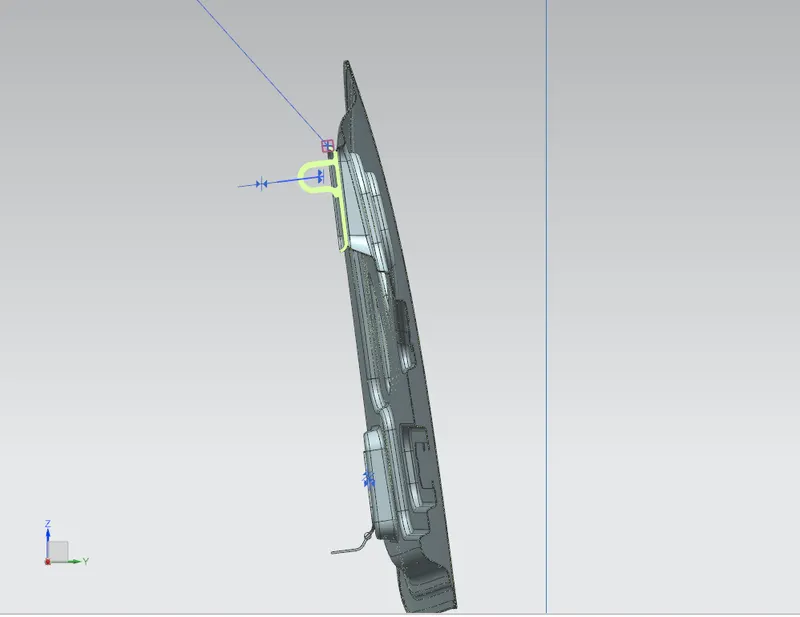
- Striker Positioning-Striker is a point that will attach to the hood for the locking purpose.
- Mastic points - positioning of mastic points as they have a support dia of 80mm.
- Support rod design and placement.
Hood Stay:
- Hood Stay is a device that supports the hood in its open position.
Support rod and its design considerations:
- When it comes to supporting rod design the mounted and unmounted positions of the support rod.
- The support rod used to have different bend shapes along its length the bends will make the rod more strong and there is no specific way for that bend and make sure the support rod won’t make any collision while it is dissembled.
- Support rod curvature can’t be more than 35mm and that is a standard after lot of experience.
- Place the support rod on the other side of the battery for making things easy for accessing the battery.
- Grommet is the part used to fix the support rod.
Gas stay:
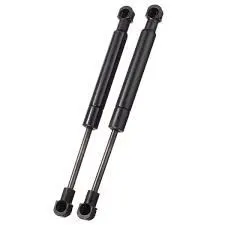
- Gay stay operator on Hydraulic or pneumatic application.
- Stud ball is used to fix the gas stay on both sides.
- Gas Stay will add weight to the car.
- Gas stay is preferred when the weight of the hood is heavy.
- Gas stay Brackets are used to reinforce the compartment when the gas stay is used
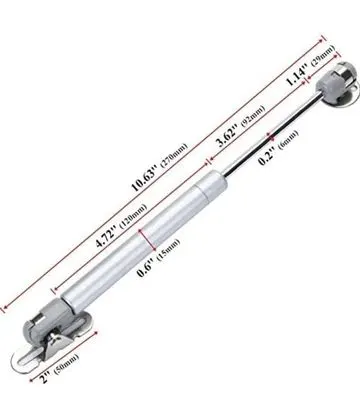
- A- gas Stay length in fully closed condition
- B- Gas stay length in fully open condition
- C- the fixing end towards the engine compartment
- D- the fixing end towards the hood
NVH - Noise, Vibration, and Harshness.
- Every vehicle should have less NVH for that there are different procedures followed by the industry as below
Reinforcement:
- As we use attachment features like hinges and strikers, and for the hood to attach to the engine compartment we should increase the strength of the hood that reduces the vibration so that we will provide reinforcement.
A stiffener :
- Pad is a kind of sponge that is a bit hard to improve the strength of the hood from the vibration while the vehicle is in motion. Stiffener pads don’t have any predefined shape.
Mastic Sealant:
- Mastic is a form of sealant or adhesive used to fill the joints or as a bond for different materials and gaps. It is an elastic and flexible material used to create a durable bond between two different surfaces or to protect a particular surface.
- Mastic Sealant stiffens an effective area of 80mm diameter.
- The mastic sealants should be provided in such a way that most of the regions of the hood are covered.
Why we should use mastic Sealants?
- We are not supposed to use any kind of spot weld or Revit that might damage the aesthetic surface of the hood.
Joining Technics of the hood.
- Hemming
- Gloving
- Mastic Sealant
- Hinges
Procedure to position the Striker on the Hood:
- Tentatively the hinges are placed and the on the hood by making sure they are on the same axis.
- Create a line that passes through both the axis of the hinges and that line is called HINGE AXIS
- Create a line that is perpendicular to the axis line.
- Take the side view datum of the line so that we can only see the point of the line and create a sketch and draw a circle with a random dimension
- Draw a line at the junction point of all these sketches with an angle to the perpendicular line.
- Create a line tangential to the circle.
- Create a line on the center of the striker by selecting the plane
- Now using constraints in assembly use touch/align constrain and select the endpoint on the line over the striker and select the intersection line on the circle and tangent line
- Finally the position of the striker is made by giving parallel constrain for the datum and the Coordinate system
-
Sectional View:
Hood: