Hood design-Week 2
HOOD DESIGN :
AIM :Design Hood Outer Panel, Inner Panel and the necessary reinforcements by
following the Master Section mentioned with the Design parameters explained in the videos.
A detailed report about the Hood Design which includes a detailed explanation about hood
and its components, Latch Trajectory, Mastic Data, Emboss Definitions, Manufacturing process
like Deep-Drawing and Hemming, and all the parameters followed in the design.
INTRODUCTION :
Although the number of pedestrian fatalities and injuries is steadily declining worldwide,
pedestrian protection is still an important issue. Extensive researches have been carried out
for pedestrian protection in order to establish regulations for pedestrian safety. The automobile
hoods which pedestrians frequently collide into during accidents, should be designed for the
safety of the pedestrians.
Hood Thickness Information :
Outer Panel Thickness = 0.75mm
Inner Panel Thickness = 0.75mm
Reinforcement Thickness = 1.5mm
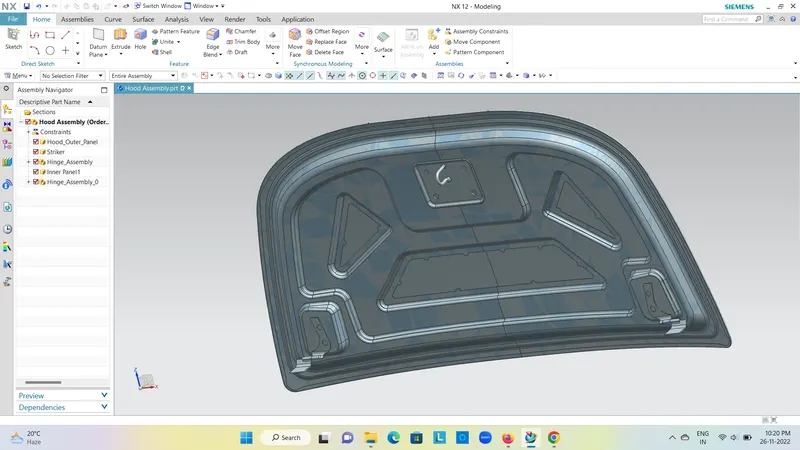
INNER AND OUTER PANELS :
A car hood panel is one of the most important components of the BIW(body in white),
it is considered as the closure sheet metal component. A hood panel consists of two panels
that are hemmed together to form the automotive hood assembly.
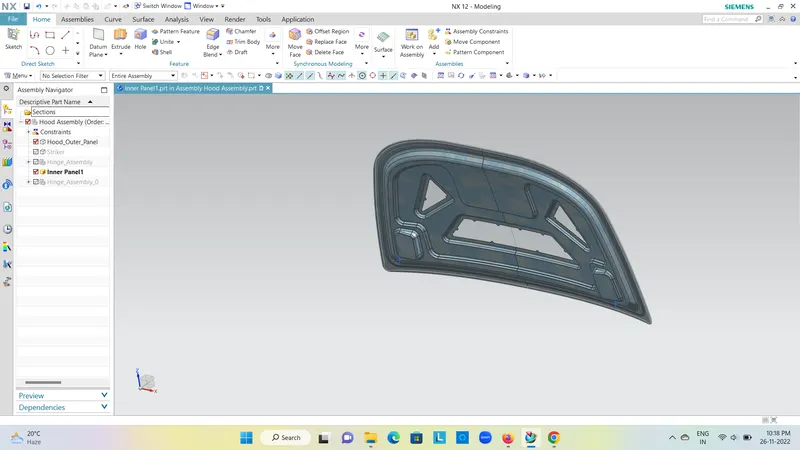
The inner panel of the hood is not visible , but it is most effectively strength to the
inside with embosses and mestic sealant.
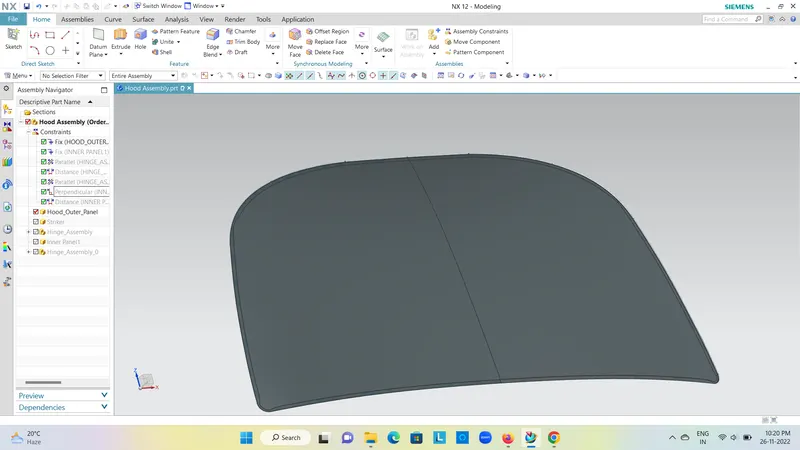
The outer panel has the aesthetik look to it but on its own is very weak and not
capable of handling force during impact.
HINGE
A hood hinge mechanism having a pivot pin having a cross sectional shape positioned within a recess.
The hood and pin are pivotal to a position whereat the D-shaped cross section is oriented to pass through
a slotted opening to the recess to thereby allow the hood to be removed or installed on the vehicle.
LATCH TRAJECTORY :
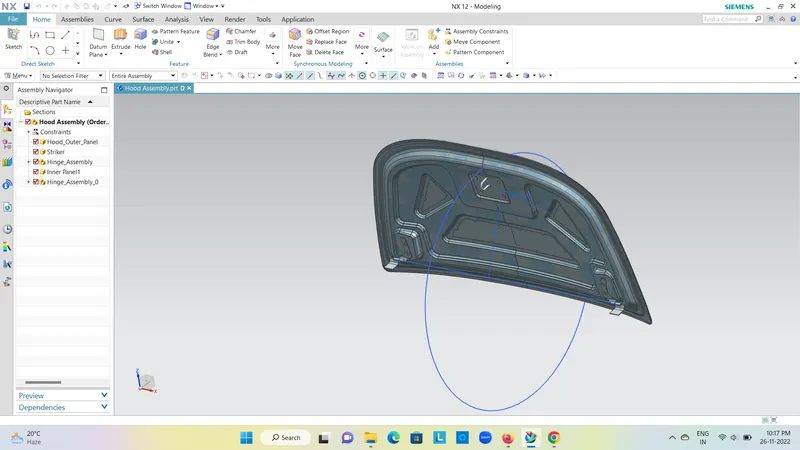
The other major functional of the hood is the opening and closing of the hood. This is done
with the help of the latch and striker. To position the latch and striker effectively, we position
the hinge and draw the hinge axis. Now, using the hinge axis as the center we draw a big circle
to the position where we need the latch to be placed. Then, we draw a perpendicular line to the
circle at that point and place the latch in that region
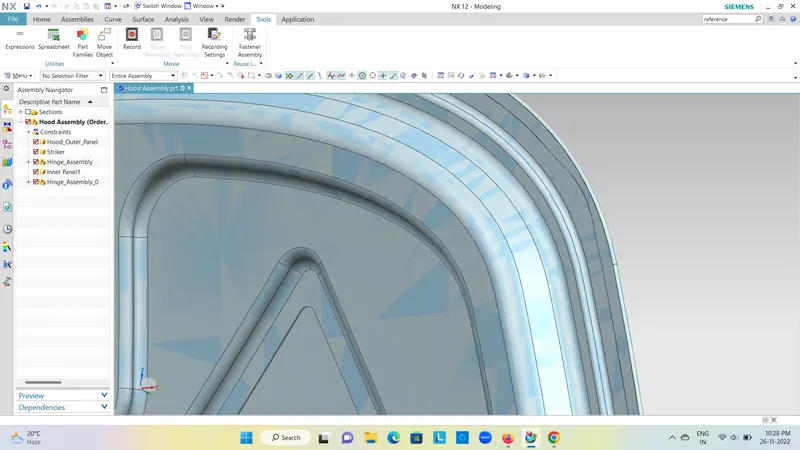
FRONT RELIEF :
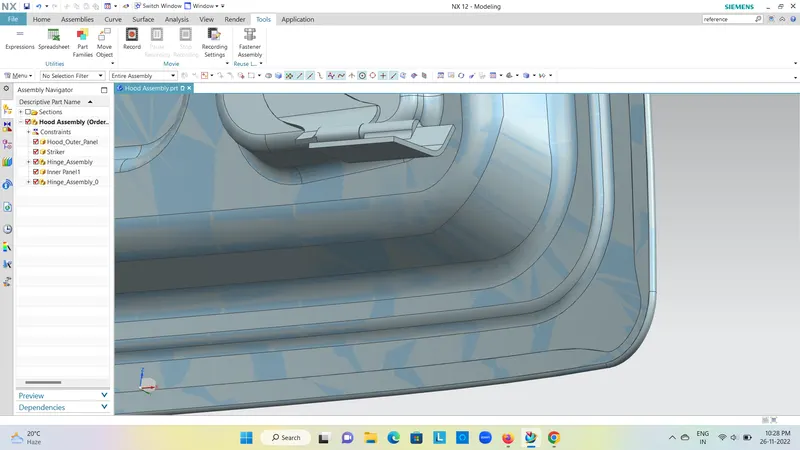
REAR RELIEF :
Mastic Sealant:
The Mastic sealant or the Mastic point is an elastic compound that behaves like a rubber.
The mastic points are defined on the hood inner panel where the hood can easily deform.
They help the hood outer panel to come back to its original shape after it gets deformed.
The mastic has an influence area of 80mm.
EMBOSS :
Emboss is created such that when force induced in middle of the hood which directly transmitted
to the hinge point to provide better safety. If this type of emboss not provided the force transmission
towards the centre of hood or vehicle which causes serious damages
DEEP DRAWING :
The deep drawing process is a forming process which occurs under a combination of tensile and compressive
conditions. A flat sheet metal blank is formed into a hollow body open on one side or a hollow body is formed
into a hollow body with a smaller cross-section.
Hemming:
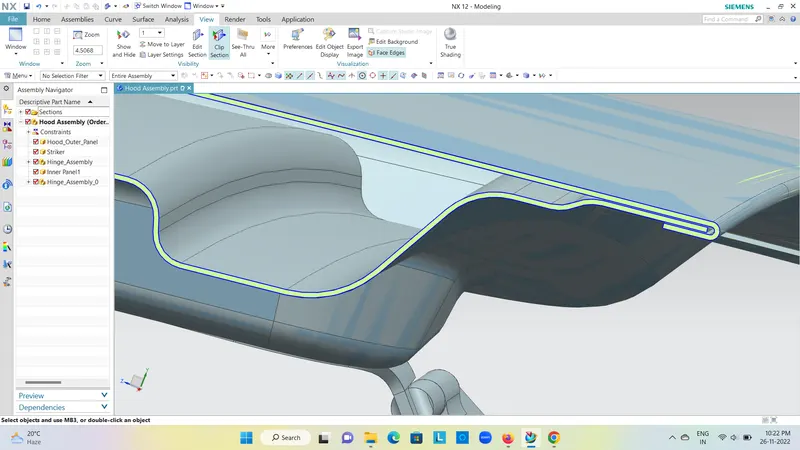
Hemming is the process of joining both the outer and inner panel together. The hemming
process roles and wraps the hood outer panel around the inner panel and holds it tightly together.
The following are the dimensions followed for hemming.