Hood design-Week 2
Report-
Hood-
It a type of door for engine, also known as bonet. It has main two components, Inner and Outer panel.
It has three main purposes-
- To divert frontal crash and
- for pedestrian safety
- to dissipate heat outside from engine compartment.
Design Criterion-
- Head zone Criterion- I n case of collision of pedestrian, possible position of Head impact is decided, to have lowest damage to the person and to automobile body too.
- Open and close Criterion- Hood open angel – based of Person height. So that striker must not hit the head of person while working.
Also striker assembly should follow the trajectory in order to align at any angle.
- NVH criterion. – Noise-Vibration – Hardness criterion should be as low as possible.
Components Of a hood assembly-
Outer Panel
Inner Panel
Striker
Hinge assembly
Support Rods- For keeping hood assembly open.
It does not have any specific rules and regulations for this. but it should be ideal for use and it should not create any noise..
Position of Support rod should not interfere battery and other engine compartment parts.
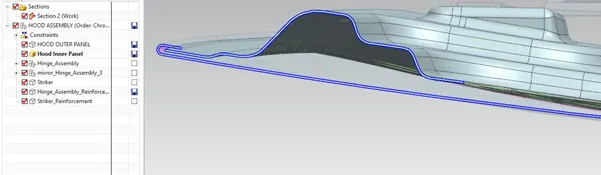
Outer panel is wrapped around inner panel using a hemming process.
For proper joint between outer and inner panels, Mastics are used.
Being light weight, they provide a full proof joint between parts.
Also they absorb Noise and Vibrations.
Hood assembly is connected to engine compartment using a hinge assembly.
For locking, two stage lock is provided, Striker is latching component.
Design of Hood Outer Panel:
Hood Outer Panel was provided as class A surface.
Some operations performed in order to avoid sharp edges. Like smoothening of curves at corners by corner rad 30 mm.
Necessary simulation for Hemming operation -
- Outer surface is offset by (0.75+0.75+0.75+0.2 + 0.2) mm. for sufficient clearance for gluing material between mating surfaces.
- For simulating rolling , surface Blend (3 faces), gg Three faces were- outer surface of outer panel, offset surface and Law Extension (vertical surface).
Hemming-
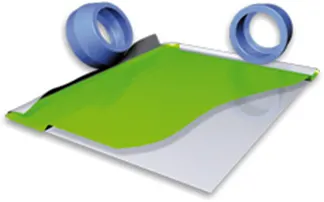
In sheet meatal, hemming is used to connect parts together, to improve the appearance, and to reinforce part edges, by bending.
The edges of the sheet are folded or folded over another part. A tight fit is achieved in this process.
One of the hemming processes is roll hemming. Where a set of rolls are forming desired shape at edges.
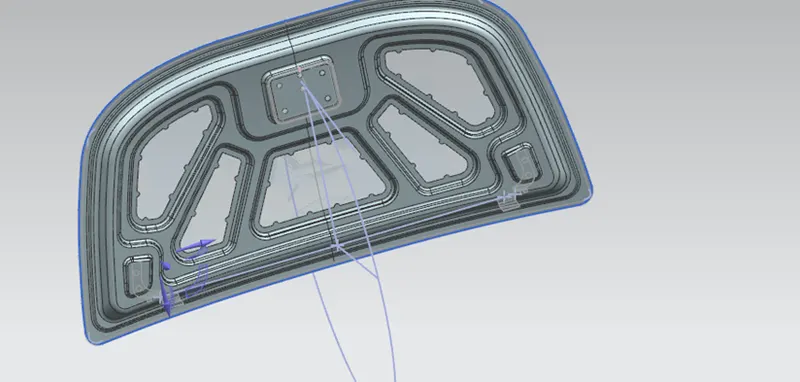
Corner Relief:- To avoid stress concentration after hemming operation at the coners, due to overlapping of sheet metal, a corner relief is provided.
It is nothing but removing of extra material at corners.
Design of Hood Inner Panel:
Hood Inner Panel is an engineering feature for outer panel. From provided master section, Inner panel is designed.
It is strengthening feature of Hood, in case of Impact.
In case of collision, panel should transfer /divert impact force towards as early as possible towards, A pillar instead of passenger cabin. It may reduce intensity of collision.
From master section dimensions, two levels emboss are created so that it will add strength to panel. Shape of embosses is decided in such a way that impact force will divert to hinges/ A pillar.
Total Height of emboss is limited to 18.5 (25-.75-.75-5 mm), first emboss height 9 mm, second emboss height is 9.5 mm.
At these second emboss, to provide gap, material os removed. At this stage provision for mastics is done. So that mastics will cover major area and will not overlap much.
Mastics - A pasty, gluing material, just like rubber, to join Inner and Outer panel, is used.
It is used as protective coatings on the surfaces of metals to prevent corrosion.
In addition to corrosion resistance, these materials provide abrasion and scratch resistance.
Also provide tight fit joint between inner and outer panel.
This is solid at room temp. But as it is heated, it expands and while cooling to room temp, converted into a stiff material, bonding two surfaces.
Provision to hold these Mastics point is also done on the embosses.
Around a periphery of 80 mm , number of mastics points are designed.
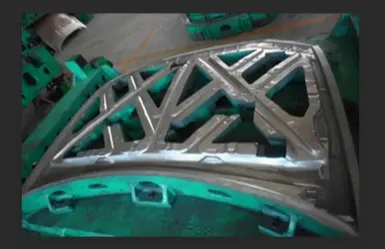
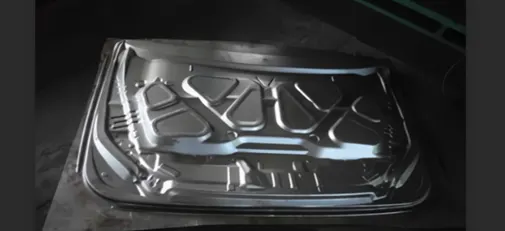
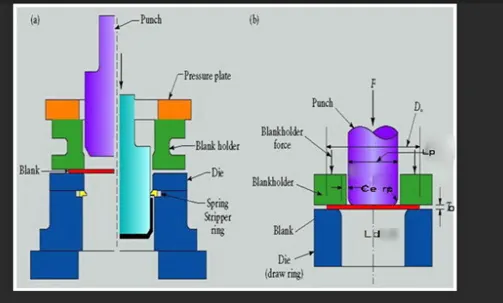
The Inner Panel is manufacture using Deep Drawing operation.
Deep Drawing- another forming operation in sheet metal. It is a forming process which gives desired shape to sheet metal with combination of tensile and compressive forces.
A sheet metal blank is formed into a hollow body or a hollow to hollow shape is also possible.
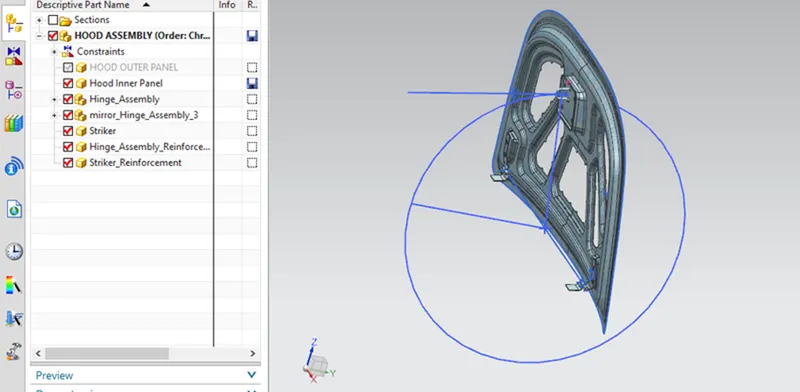
Positin for striker in inner panel is decided by a small construction -
Trajectory for Striker - is created by creation center on hinge axis point. and approximate radius. So that we can edit it, if needed.
On this circle, a tangent line is nothing but the path of hook/ latch.
At every position of hood, this relation will be maintained.
Mounting Data-
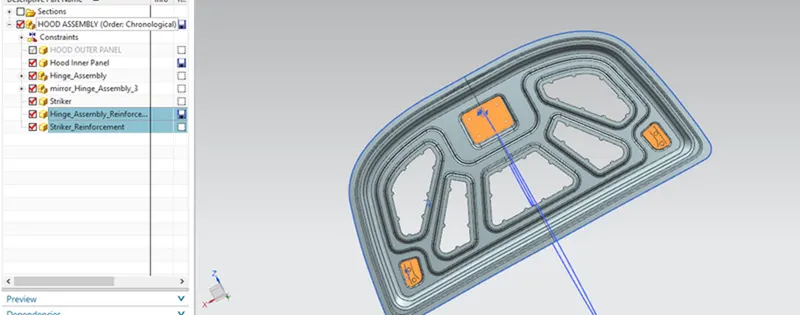
Mountings for Hinge Assembly- For both the assemblies, a flat surface is created , in the direction opposite to emboss direction.
Mounting For striker - possible position for striker is fixed.
For this Trajectory of Inner panel in for striker path is created. With reference to this path, position of striker on inner panel is fixed.
From this position, using base surface dimensions, mounting for striker is created using
Law extension and trimming operation.
Reinforcements- For hinge assembly and striker mountings, as removing material, reduced strength.
In order to improve strength, to inner panel at these areas, reinforcements are created.
They might be of Aluminum.
Thickness of reinforcement is 1.5 mm.
Stiffener Pad- It acts as vibration absorber. It will reduce NVR
Hinge assembly and Striker part are assembled as provided.
Hood Design for better pedestrian rating- As par EURO ENCAP rating.
Deformable Mountings
Mica Brackets are provided, in case of collision, they will deform and reduce the reaction impact to to pedestrian.
Wrap around Distance.