Forces Acting on a Vehicle
Aim:
To find the maximum speed of the motor (driver) & propulsion power of electric scooter.
Theory:
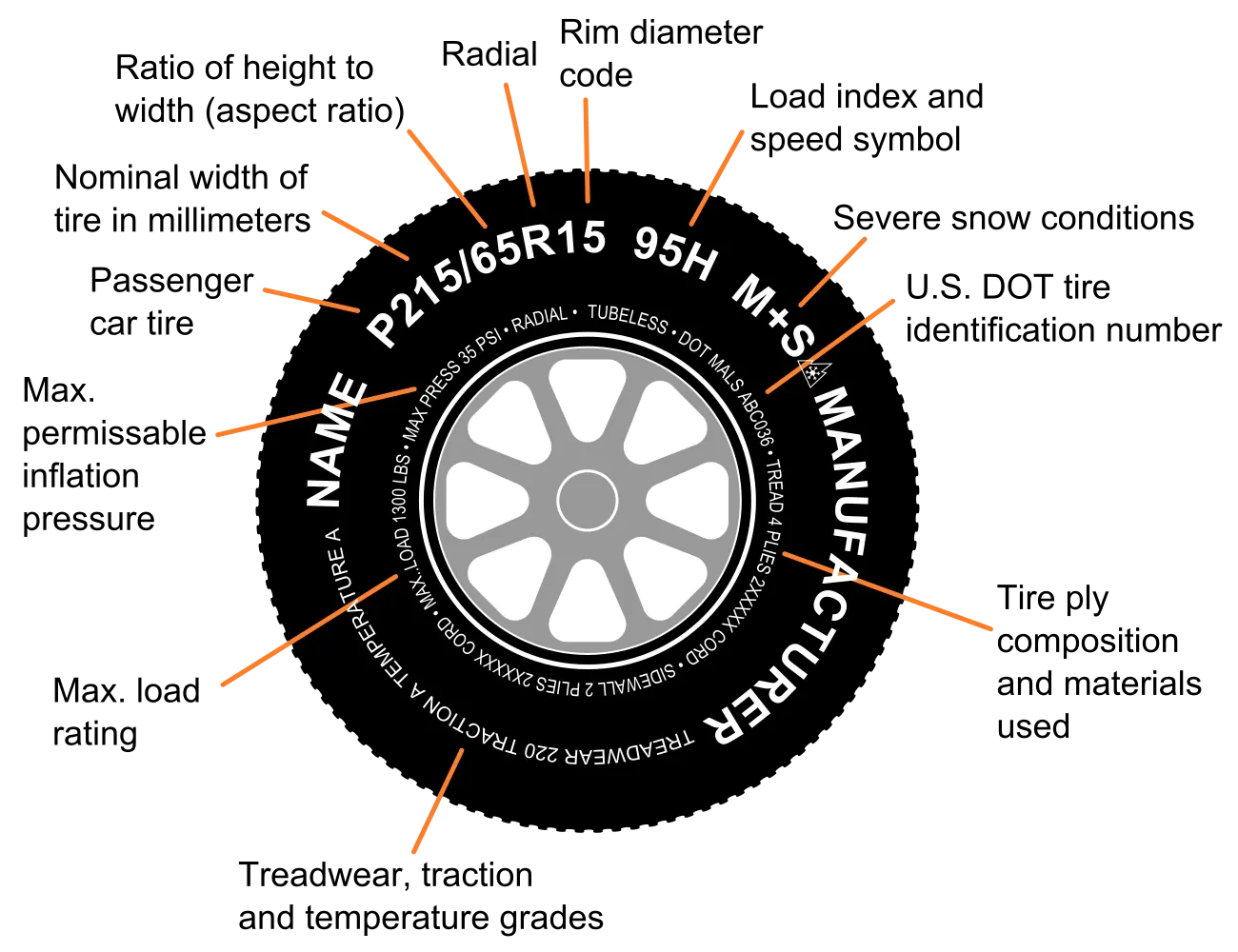
Tire nomenclature:
Load Index:
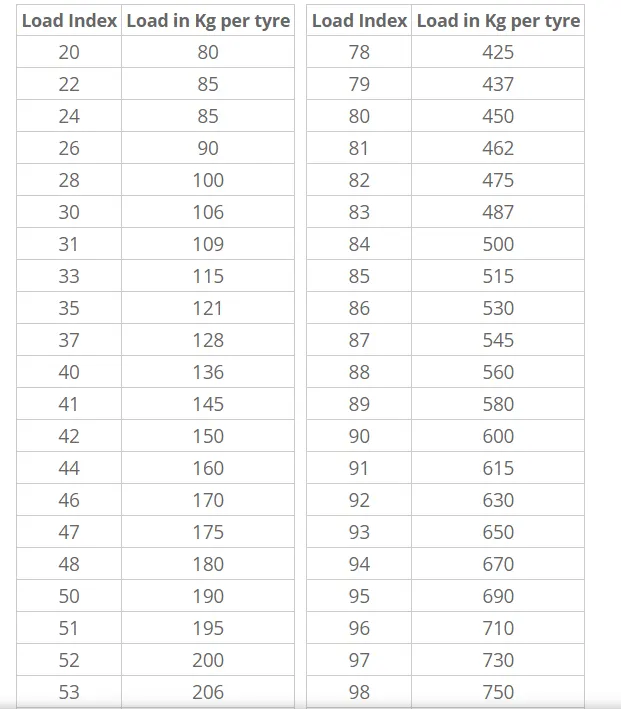
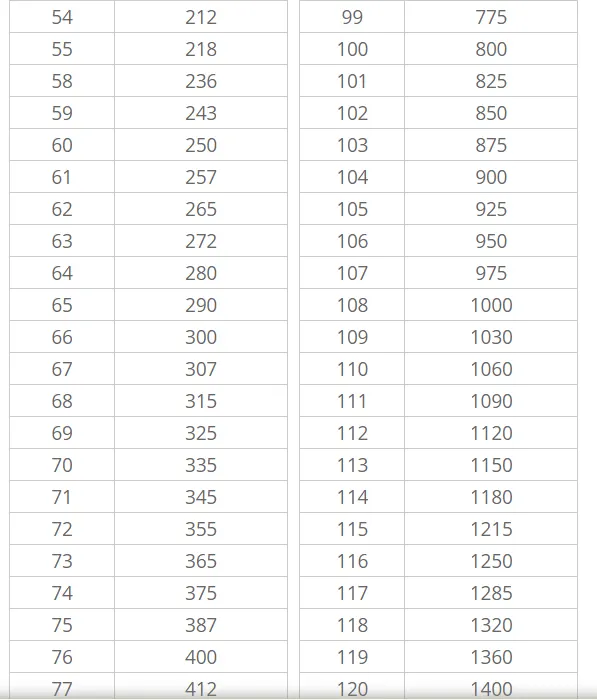
Load Index is the numerical value representing the maximum weight, a tire can carry. For the selected tyre, Load Index is 53, which corresponds to a load capacity of 206kg. Most passenger vehicles have a Load Index value ranging from 20 to 120.
Speed symbol:
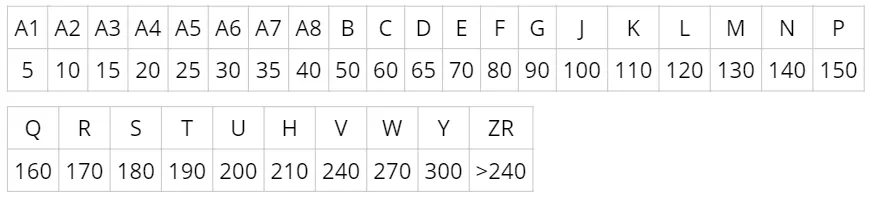
Speed Rating, represented by an alphabet, denotes the maximum ‘vehicle speed’ a tire can withstand, while carrying a load corresponding to its Load Index. Speed Rating of the selected tyre is 'J', which refers to a maximum speed capacity of 100km/h.
Governing Equations:
- Diameter of tire`(Dt):`
`Dt=Dr+2*Hs`
Where,
`Dr=RimDiameter (m)`
`Hs=sectionHeight (m)`
`Ws=sectionWidth(m)`
- Aspect ratio `(AR):`
`R= (Hs)/(Ws)`
- Angular Velocity `(ω):`
`ω=vr*G Radian`
Where,
`v=velocity(m/s)`
`r=Radius (m2)`
- Relation between Speed & Gear Ratio:
`S1.T1=S2.T2`
Where,
`S1=Speed of Driven Wheel (Tire)`
`S2=Speed of Driver Wheel` ``(Motor)`
`T1=Teeth of Driven Gear`
`T2=Teeth of Driver Gear`
- Gear Ratio`(G):`
`(G)=(T1)/(T2)`
- Rolling Resistance Force `(Frr):`
`Frr=μrr+m.g (N)`
Where,
`μrr=`Coefficient of rolling resistance
`m= mass (kg)``
`g=9.81 (m/s^2)`
- Aerodynamic Drag Force `(Fad):`
`Fad=0.5⋅ρ⋅A⋅Cd⋅v2 (N)`
Where,
`ρ=Air Density ((kg)/m^3)`
`A=Frontal Area (m^2)`
`Cd=Drag Coefficient`
`v=Velocity(m/s)`
- Hill Climbing Force`(Fh):`
`Fh=m.g.sin(θ) (N)`
Where,
`theta =` Angle of Inclination
- Total Tractive Force in case of no inclination`(Fte):`
`Fte=Frr+Fad`
- Power `(P)= Fte.v`
1. Maximum Speed of the motor of an electric scooter:
The given data,
- Gear Ratio (G)= 7
- Maximum Speed of scooter (S2)= 90kmph = 25 m/s
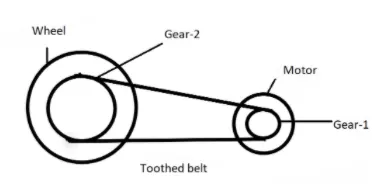
We know that, `G=(T2)/(T1) = 7`
The Maximum Speed of the Motor `(S1):`
`S1.T1=S2.T2`
`S1=S2⋅(T2)/(T1)`
`S1=90⋅7=630kmph`
- Tire size is 90/100 R10 53J
`Section width(Ws)=90mm`
`Aspect Ratio(AR)=100%`
`Diameter of Rim=10′=254mm=0.254m`
`Load Index=53=206kg`
`Speed Index =J = 100kmph`
`sectionHeight(Hs)=AR⋅(Ws)=1⋅0.09=0.09m`
`Diameter of tire `(Dt):``
`Dt=Dr+2*Hs`
`Dt=0.254+2*0.09=0.434 m`
b. Tire size is 90/90 R18 51P
`sectionWidth(Ws)=90mm=0.09m`
`AspectRatio(AR)=90%`
`Diameter of Rim=18=0.4572m`
`Load Index = 51 = 195 kg``
`Speed Index = J = 150 kmph``
`Section Height (Hs) = AR * (Ws) = 0.9 * 0.09 = 0.081 m`
`Diameteroftire (Dt):`
`Dt=Dr+2*Hs`
`Dt=0.4572+2*0.081=0.6192m`
Note: For bot the tires the Maximum Speed of the motor is same i.e.; `630kmph`
2. Vehicle Propulsion Power Power using Excel calculator :
Inputs:
- Kerb Weight (kg)
- Payload (kg),
- Coefficient of rolling resistance
- Air density (kg/m3), Width (m)
- Height (m), Drag coefficient
- Acceleration (0 to top speed in specified seconds)
- Hill climbing angle
- Speed
Output:
- Total power in kW
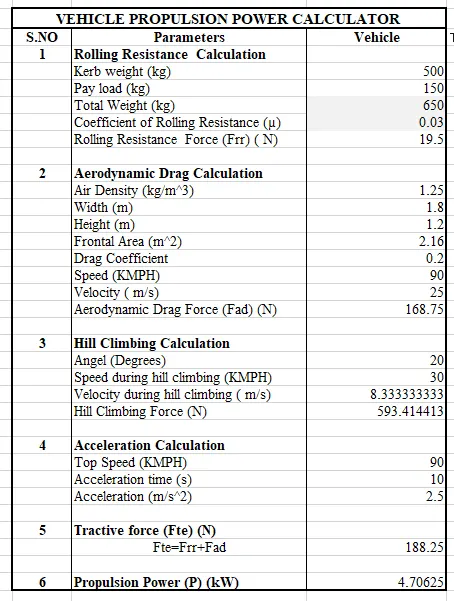
- `Total Power = 4.70625(kW)`
3. Tire pressure reduction by 15% results in increase of rolling resistance effect by 2 times,
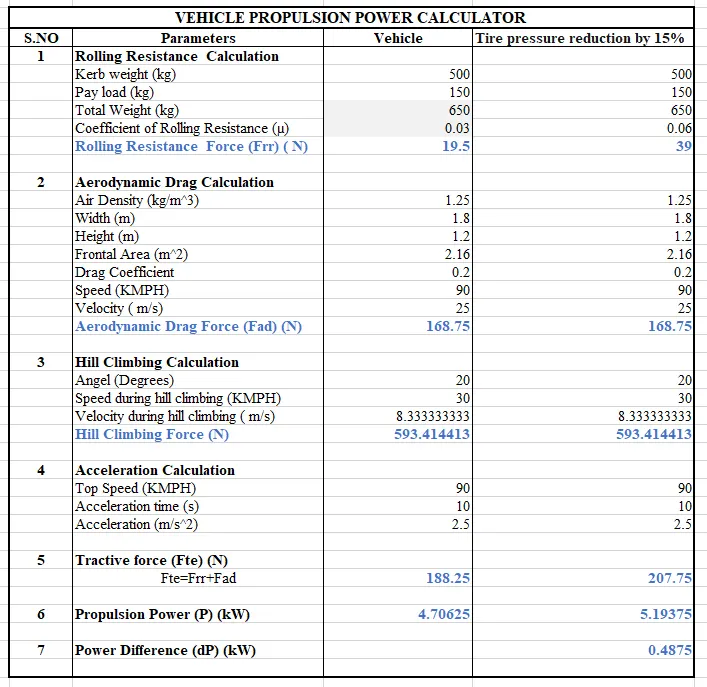
- The difference in total traction power keeping all other parameters same is 0.4875kW">0.4875kW0.4875kW
4. Range rover sport dragon challenge:

- Gradeability is:
The angle of 45 Degrees and 99 turns and 999 steps in 22 min 41 sec ie.; 100% gradability
b. The average speed is:
- On Turnings the average speed is 87kmph
- On Steps the average speed maitained is 42kmph
c. Forces acting on car are:
- Rolling Resistance Force
- Arodynamic Drag Force
- Hill Climbing Force
- Acceleration Force
References: