FINAL TEST
AIM - PFI ENGINE AND DIESEL ENGINE:-
PFI Engine:-
Q1. What is the Compression ratio for the engine ?
(A) The compression ratio is the ratio between the volume of the cylinder and combustion chamber in an internal combustion engine at their maximum and minimum values.
A fundamental specification for such engines, it is measured two ways: the static compression ratio, calculated based on the relative volumes of the combustion chamber and the cylinder when the piston is at the bottom of its stroke, and the volume of the combustion chamber when the piston is at the top of its stroke
The dynamic compression ratio is a more advanced calculation which also takes into account gasses entering and exiting the cylinder during the compression phase.
CR= (V_d+V_c)/V_c Where:
- {\displaystyle V_{d}}
 = displacement volume. This is the volume inside the cylinder displaced by the piston from the beginning of the compression stroke to the end of the stroke.
 - {\displaystyle V_{c}}
 = clearance volume. This is the volume of the space in the cylinder left at the end of the compression stroke.
{\displaystyle V_{d}} can be estimated by the cylinder volume formula
- {\displaystyle V_{d}={\tfrac {\pi }{4}}b^{2}s}

Where:
 =
=  =
= Because of the complex shape of {\displaystyle V_{c}} it is usually measured directly. This is often done by filling the cylinder with liquid and then measuring the volume of the used liquid.
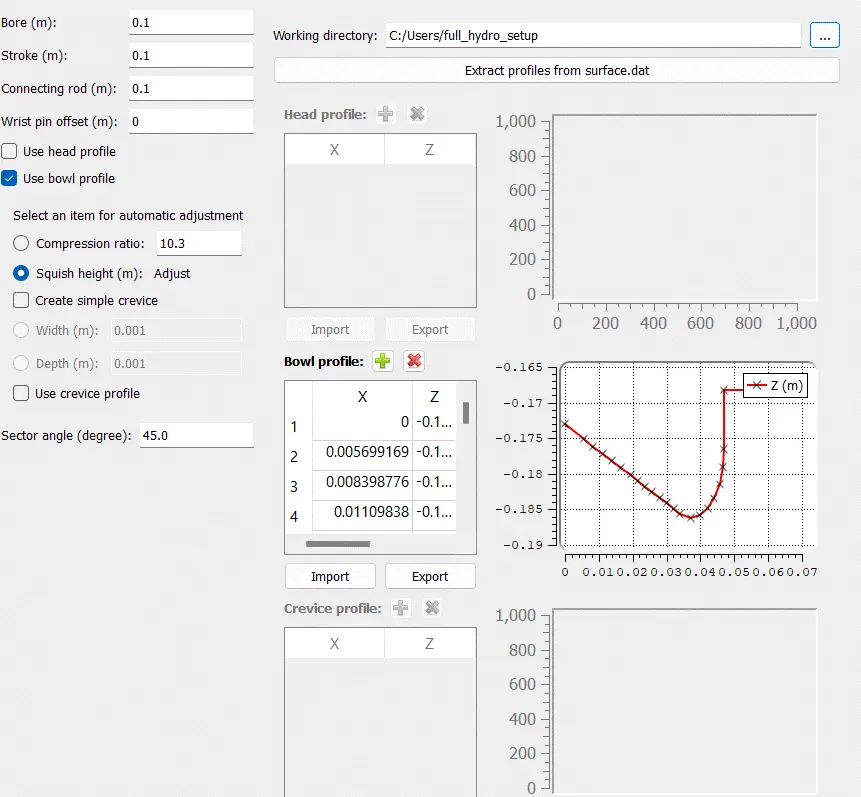
Q2. Modify the compression ratio for this engine to 10.3 without changing geometrical parameters.
Just need to show the calculation ?
(A) To change compression ratio without changing geometrical parameters is possible only by changing clearance or swept volume. maximum volume is clearance volume plus displacement volume clearance volume is the minimum volume and equals 5.70e-5
Vmax = Vc + Vd V. 1 Vd where - Vc is the clearance volume and Vd is the displacement volume.
The compression ratio should be 10.3 therefore ratio = Vd + Vc / Vc = 10.3 therefore Vc is replaced to be 5.55e -5, Furthermore we can change Vd which will be 5.336e-3 to get the compression ratio of 10.3
Q3. Calculate Volumetric Efficiency for this engine ?
(A) Volumetric efficiency 71 volume of air-fuel mix sucked into the cylinder/displacement volume is the maximum volume of the cylinder substituted to clearance volume therefore in our case displacement volume Vd= 5.17e -4 m^3
According to the ideal gas equation, we can determine the volume of the sucked air. According to the output files sucked mass is approximately 0.0005kg.
According to the ideal gas equation v = mRT/ P where - m is mass, R is the universal gas constant, T is the temperature in Kelvins and P is the ambient pressure
Efficiency = 4.149e -4 / 5.17e-4 * 100 = 80%
Q4. Measure the air mass flow rate for this engine in kg/s ?
(A) The mass of air during the 360 degrees of the crank angle is 0.0005kg. RPM in our case is 3000, therefore RPS will be 3000/60=50.
50 revolution per second in other words equals 50*60=18000degrees per second. mass per 18000degrees will be 18000*0.0005/360 = 0.025kg/s
Q5.Why is the cell count varying during the simulation ?
(A) During the combustion process or fuel injection process we have temperature and velocity second derivative curvatures, therefore, we need refined mesh within some specific areas to appropriately predict the flow structure or temperature development, therefore we use AMR for proper calculations.
Q6. In a real engine, valves are in contact with the cylinder head but while running simulation, there is a small gap ?
(A) What happens if this gap is big? ?
in real live valves are in contact with the cylinder head in order to seal the combustion cylinder to prevent excessive heat transfer and therefore thermal losses.
In the simulation, we have a gap because we are using the disconnect triangle concept which ensures sealing while we are using the "VALVE' option in the "EVENT" section in the "Converge CFD.
Q7. How many seconds does combustion last in this case?
stroke through 240degrees, thus we should determine the time needed for 240degrees of the crank angle.
As we know engine covers 18000degrees within 1 second, therefore to cover 240degrees the time
t = 240/ 18000= 0.013sec
DIESEL Engine :-
Q1. What is an advantage of SECTOR Simulation ?
(A) it's computational efficiency we are simulate the one sector of the domain which is going to lead faster the run time for sector simulation.
Q2. When will the sector approach not work ?
(A) when the sector not approach for the simulation , it's going to takes the long time for the simulation(or) not able to run the simulation in sector simulation.
Q3. How to choose Start Crank Angle (SCA) and End Crank Angle (ECA) for a sector simulation ?
(A)simulation? The start angle should be when the volume is maximum and the end angle should be when the piston reaches TDC in other words the clearance volume.
Q4. Can we convert the PFI case into a SECTOR case? Explain your answer ?
(A) No, to simulate port fuel injection we should use open-cycle analysis since the air-fuel mixture is injected from the intake port and the distribution of this mixture is not equal throughout the cylinder, also we can't control the flow of charge, since in closed cycle analysis we can't control the translation of intake and exhaust port.
In case if we use direct and indirect fuel injection in which the fuel is injected inside the cylinder we can use a sector approach.