Fender Design Challenge
FENDER DESIGN
( https://drive.google.com/drive/folders/1uj2IN4su_dCaBw2260sKUQK-DiZca5lm?usp=sharing)
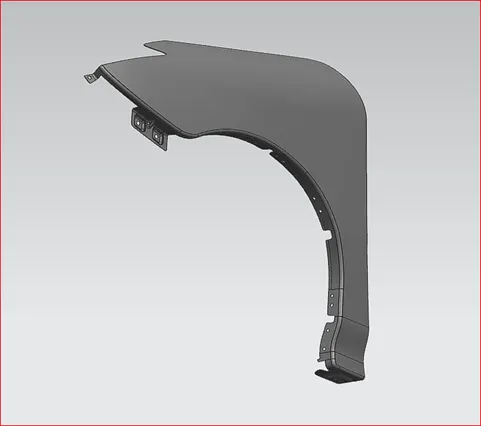
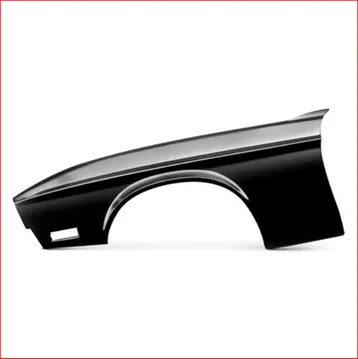
Fender is the sheet metal body part located in the front portion of the car. It exactly located above the front wheels of the car which covers it completely and protects and prevents the mud, dirt, and sand particles to enter the engine component during the running of the vehicle.
FENDER MOUNTINGS
The fender is attached to the other sheet metal parts of the car. So, it needs a certain mounting to ensure the firm and stable attach of the fender to the car. The important mountings of the fender are
- Drip area
- ‘A’ pillar mount
- Sil mount
- Baffle area
- Bumper mount
These are the mounting regions needs to be considered during the design.
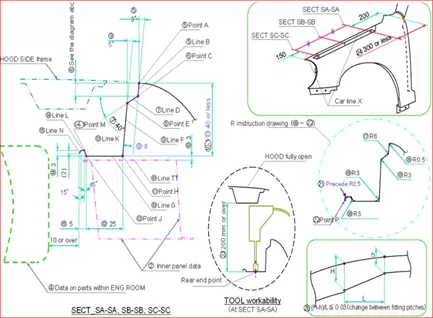
DRIP AREA MASTER SECTION
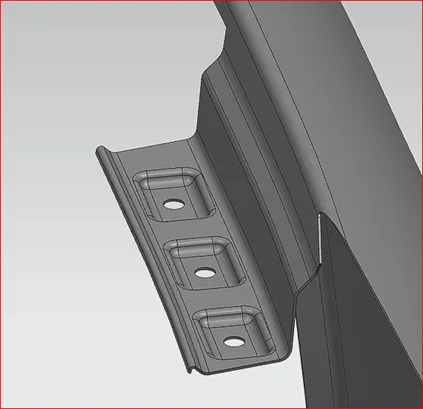
the above master section is given for the drip area which is located on the side of engine component.
FEATURES USED
- offset curve on surface
- curve on surface
- trim sheet
- intersection curve
- law extension
- extend sheet
- bridge curve
- sketch
- project curve
- datum plane
- emboss
- face blend
- edge blend
- dart
- thicken
DESIGN METHODOLOGY
The skin data of the fender is provided to proceed with mountings and other cut outs.
- OFFSET CURVE ON SURFACE feature is used to offset the edge curves to give the reliefs and to create the mountings over the fender.
- CURVE ON SURFACE is used to create the curve on the fender wherever necessary to design the emboss and other trims
- TRIM SHEET is used often to remove the unwanted or extra portions in the fender to get the desired shape.
- INTERSECTION CURVE is used to create the curve with the reference of two objects. Here the feature is used to create the line between datum plane and offset curve while designing the drip area start and end point.
- LAW EXTENSION is one of the important and handy tools used to create the surface over other with desired dimensions. Here the law extensions are used to create the flange for mountings.
- EXTEND SHEET is simple and useful tool to extend the surface in its own direction up to desired length.
- BRIDGE CURVE is used to connect two curves on the edge and trimmed for smooth corners of the mountings.
- SKETCH tool is used to create the sketch for emboss in the mountings and circles trims.
- Project curve is used to project the sketch drawn on the plane to the object on the fender after sketching the geometry.
- DATUM PLANE is often created on the flange of the mountings to get the flat surface of the emboss created over it.
- EMBOSS is the extra portion or extruded portion on the flange to fit with the other parts of the car sheet metal parts like bumper and engine components.
- FACE BLEND and EDGE BLEND are created between two faces of the flange and edges of the mountings or the fender to create the tangent faces to avoid the sharp corners or edges.
- DART is an additional feature in the model whereas triangle like structure which is mounted between two faces of the flange to give more support and strength.
- THICKEN feature is used to thick the sheet for desired value to get the originality of the model.
CONSIDERATIONS OF THE DESIGN
All the mounting regions should be proprely designed with engineering standards.
The hole created in the mountings should have at least 5mm of flat surface around the region.
There should be minimum distance maintained between mounting portionand engine component.
The sharp corners should be properly trimmed.
Corner relief should be given to avoid the corner stress. So that the stress could be equally distributed.
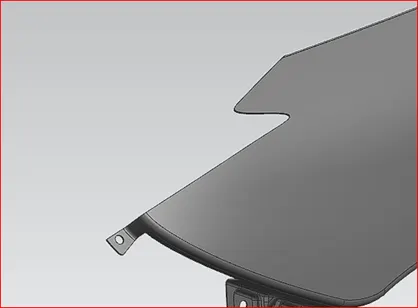
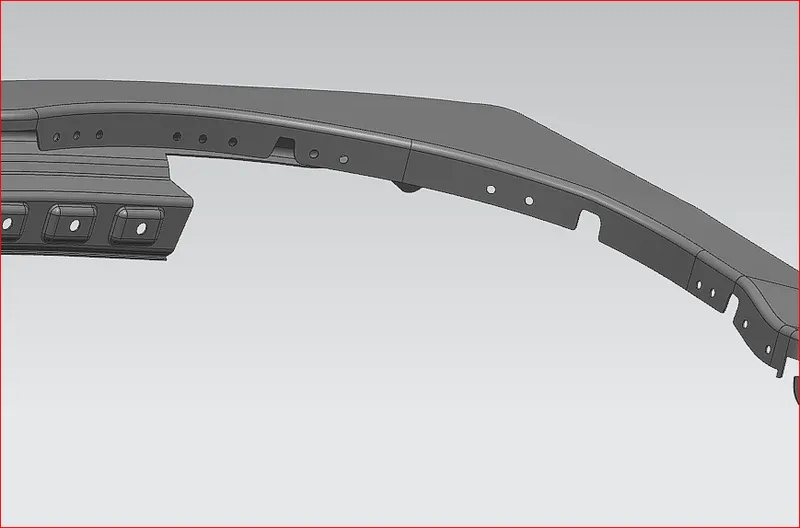
The trimmed portion of the above image is to mount the headlight. The operation is done using curve on surface, bridge surface and trim sheet.
MOUNTING PORTIONS
DRIP AREA
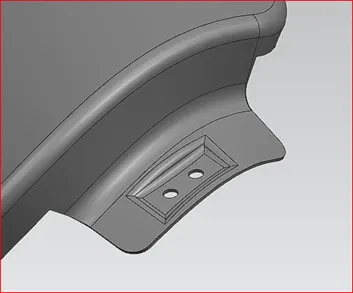
A PILLAR MOUNT
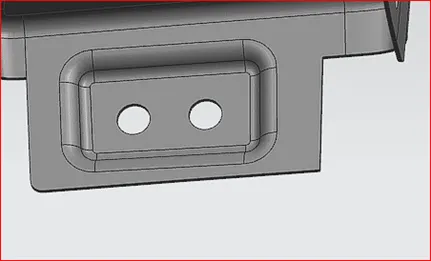
SIL MOUNT
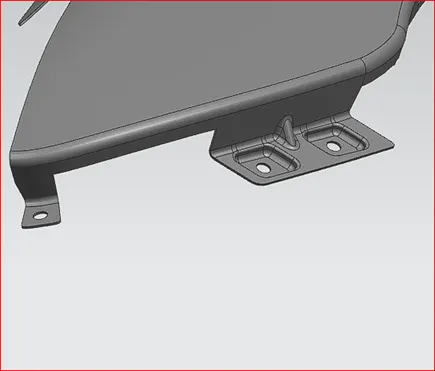
BUMPER MOUNT
BAFFLE AREA
OUTER VIEW
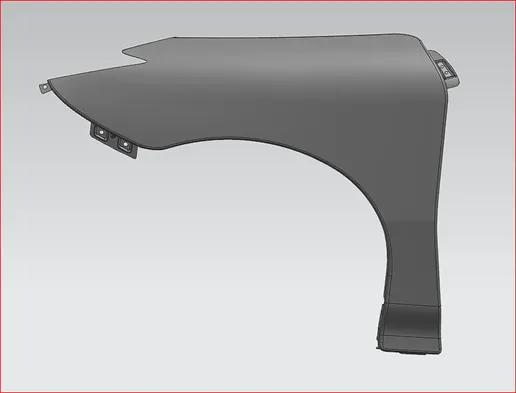
INNER VIEW
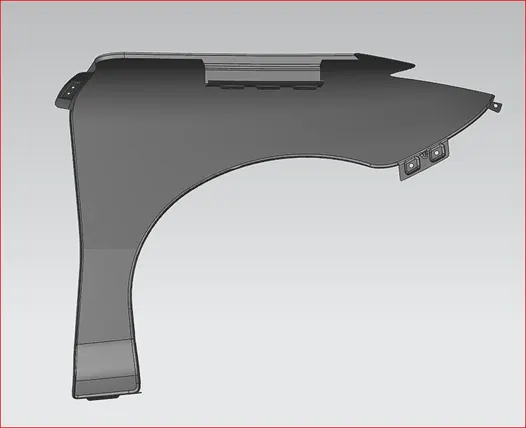
ISOMETRIC VIEW