DFMA STUDY AND IMPLEMENTATION ON HOSPITAL BED DESIGN
ABSTRACT
As a part of my Internship with Skill-Lync, I was offered to do a project which involves the concepts of DFMA which has to be implemented in the Design of an Hospital bed. A model of an actual hospital bed was created using CATIA V5.
Design for manufacturing and assembly is widely used by product designers and engineers to design products with lesser number of parts which helps in ease of assembly and thereby reducing the overall cost. This project gives an overview on Design for manufacturing and assembly, an application that can be used throughout various industries to reduce the overall costing of a product, hence helping to improve the overall company productivity.
Initially the existing design of the Hospital bed was analysed and the areas where DFMA principles can be implemented were identified. Further, individual components were created as sub-assemblies and were finally assembled together.
1. DESIGN FOR MANUFACTURING AND ASSEMBLY (DFMA)
DFMA stands for Design for Manufacturing and Assembly. It is an engineering methodology that focuses on optimising the manufacturing and assembly aspects of a product. Both of these aspects have a high impact on the final product’s quality and cost.
Factors such as raw materials, manufacturing processes, volume, machinery, tooling, precision, number of parts and their complexity, labour and skills, automation potential, etc, are all very influential in product development. By optimising these factors alone, companies can drop the initial cost estimates by over 50%. This is the main intention of implementing DFMA principles.
In DFMA, the product design is continuously modified while keeping certain end goals in mind to arrive at a product that requires less time, money and effort to produce.
2. DFM AND DFA
Design for Manufacturing is concerned with maximising the manufacturing ease of a product. It employs techniques that make manufacturing faster, cheaper, and easier by improving the design and the manufacturing process.
On the other hand, Design for Assembly works to simplify, shorten and mistake-proof the assembly process. Principles such as poka-yoke, combining and standardising parts are all examples of DFA application.
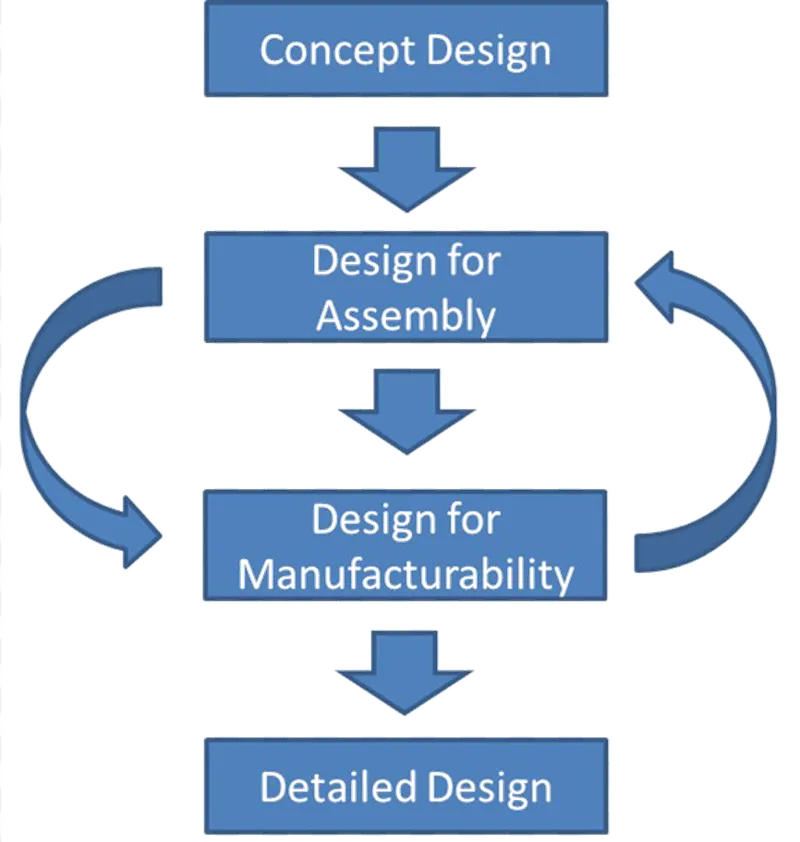
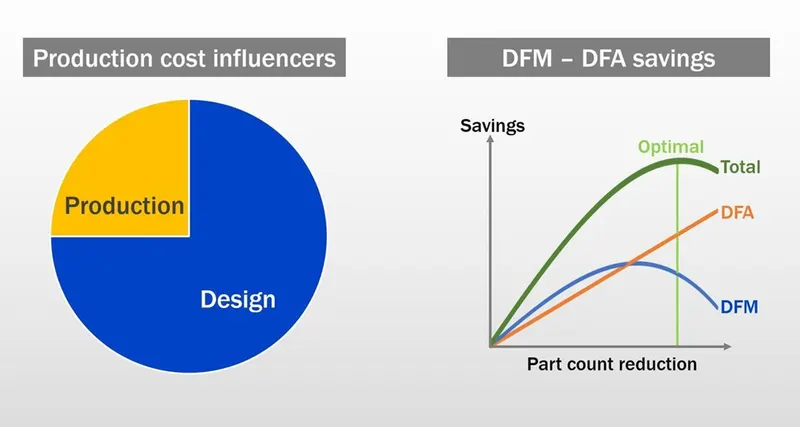
Both DFM and DFA have similar objectives. They both aim to reduce material requirements, cost and time-to-market. But there are times when the two may work against each other. A net gain from DFM could lead to a net loss in DFA, essentially making the gain worthless.
Let’s take the example of combining parts from DFA “guidebook”. If fewer individual parts lead to a part that is expensive or difficult to manufacture, we gain little benefit from this DFA technique as DFM is affected negatively. Similarly, many DFM guidelines can reduce the effectiveness of a DFA technique.
To avoid such occurrences, it was prudent to look at the two methodologies of DFM and DFA together. This is how DFMA came to be. It uses DFA and DFM in tandem to arrive at an optimum product design. DFMA can help us leverage the advantages of both these methodologies without the disadvantages of either.
3. ADVANTAGES OF DFMA
A well-structured DFMA application provides both short-term and long-term advantages. These advantages are indispensable to the creation of a sound product that can beat modern-day competitors. Some of the advantages of DFMA are as follows,
- Shorter time to market
- Reducing the product development cost
- Reducing the wastage
- Greater product reliability
- Quality control
3.1 Shorter Time to Market
Time to market is defined as the duration between the idea generation phase and the introduction of a product to the market. Ideally, you’d want this time to be as short as possible. DFMA significantly reduces the time to market by simplifying the manufacturing processes and the assembly steps.
3.2 Reducing the Product development cost
An efficient DFMA at the initial phase reduces the development costs by thinking ahead of time and resolving possible issues that may crop up later. DFMA removes the need for downstream design changes. It also recommends adding provisions for features that the manufacturer may want to add to a product at a later point in time.
3. Reducing the wastage
DFMA aims to eliminate waste from the product and assembly design. It reduces the wastage of materials, motion, inventory and overprocessing. It also minimises defect risks and wait time by eliminating redundant manufacturing and assembly steps and unnecessary features.
3.4 Greater product reliability
Due to the high focus on preventing defects and increasing the benefit-cost ratio, DFMA products naturally become highly reliable and durable. The fewer number of parts in a DFMA-conscious product also helps to reduce the failure rate.
3.5 Quality control
DFMA improves communication and teamwork between different teams in a manufacturing setup. A well-coordinated product development effort between designers and manufacturing engineers, for instance, informs both teams about the best practices of each department to reach a certain end goal. This ensures a higher quality product within the allotted budget.
4. DFMA GUIDELINES
Design for Manufacturing (DFM) and design for assembly (DFA) are the integration of product design and process planning into one common activity. The goal is to design a product that is easily and economically manufactured. The importance of designing for manufacturing is underlined by the fact that about 70% of manufacturing costs of a product (cost of materials, processing, and assembly) are determined by design decisions, with production decisions (such as process planning or machine tool selection) responsible for only 20%.
The heart of any design for manufacturing system is a group of design principles or guidelines that are structured to help the designer reduce the cost and difficulty of manufacturing an item. The following is a listing of these rules.
- Reduce the total number of parts
- Develop a modular design
- Use of standard components
- Design parts to be multi-functional
- Design for ease of fabrication
- Avoid separate fasteners
- Minimize assembly directions
4.1 Reduce the total number of parts
The reduction of the number of parts in a product is probably the best opportunity for reducing manufacturing costs. Less parts implies less purchases, inventory, handling, processing time, development time, equipment, engineering time, assembly difficulty, service inspection, testing, etc. A part that does not need to have relative motion with respect to other parts, does not have to be made of a different material, or that would make the assembly or service of other parts extremely difficult or impossible, is an excellent target for elimination. Some approaches to part-count reduction are based on the use of one-piece structures and selection of manufacturing processes such as injection moulding, extrusion, precision castings, and powder metallurgy, among others.
4.2 Develop a Modular design
The use of modules in product design simplifies manufacturing activities such as inspection, testing, assembly, purchasing, redesign, maintenance, service, and so on. One reason is that modules add versatility to product update in the redesign process, help run tests before the final assembly is put together, and allow the use of standard components to minimize product variations. However, the connection can be a limiting factor when applying this rule.
4.3 Use of standard components
Standard components are less expensive than custom-made items. The high availability of these components reduces product lead times. Also, their reliability factors are well ascertained. Furthermore, the use of standard components refers to the production pressure to the supplier, relieving in part the manufacture’s concern of meeting production schedules.
4.4 Design parts to be Multi-functional
Multi-functional parts reduce the total number of parts in a design, thus, obtaining the benefits given in rule 1. Some examples are a part to act as both an electric conductor and as a structural member, or as a heat dissipating element and as a structural member. Also, there can be elements that besides their principal function have guiding, aligning, or self-fixturing features to facilitate assembly, and/or reflective surfaces to facilitate inspection, etc.
4.5 Design for ease of fabrication
Select the optimum combination between the material and fabrication process to minimize the overall manufacturing cost. In general, final operations such as painting, polishing, finish machining, etc. should be avoided. Excessive tolerance, surface-finish requirement, and so on are commonly found problems that result in higher than necessary production cost.
4.6 Avoid seperate fasteners
The use of fasteners increases the cost of manufacturing a part due to the handling and feeding operations that have to be performed. Besides the high cost of the equipment required for them, these operations are not 100% successful, so they contribute to reducing the overall manufacturing efficiency. In general, fasteners should be avoided and replaced, for example, by using tabs or snap fits. If fasteners have to be used, then some guides should be followed for selecting them. Minimize the number, size, and variation used; also, utilize standard components whenever possible.
4.7 Minimize Assembly directions
All parts should be assembled from one direction. If possible, the best way to add parts is from above, in a vertical direction, parallel to the gravitational direction (downward). In this way, the effects of gravity help the assembly process, contrary to having to compensate for its effect when other directions are chosen.
5. DFMA IMPLEMENTATION ON HOSPITAL BED
Based on the above stated principles, DFMA guidelines are used to modify an existing design of an Hospital bed.
5.1 Existing Hospital Bed Design
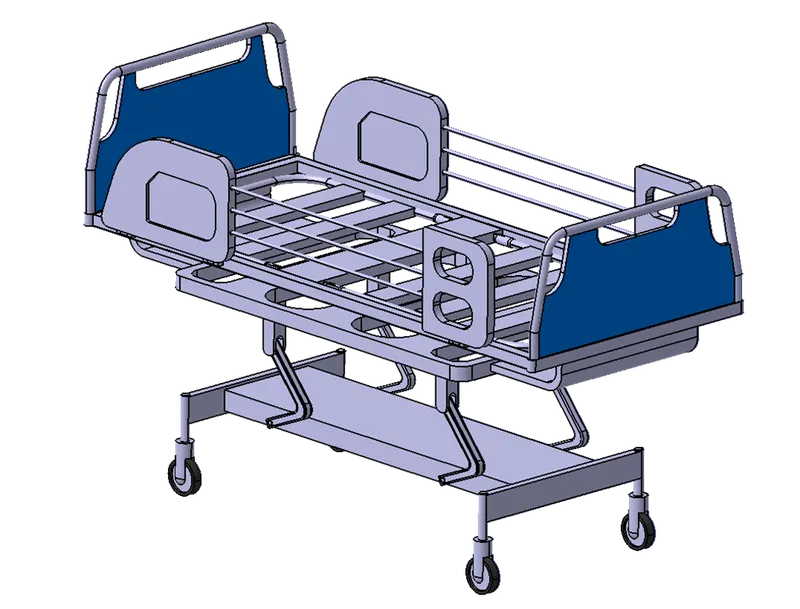
The Hospital bed shown in the picture below consists of parts such as Head board, Tail board, Side rails and the Base structure. All the components are permanently attached with the base structure. Due to this the disassembly of the product becomes very difficult.
The components also have solid parts instead of hollow parts which leads to more material consumption and weight to the entire structure. Thus, DFMA principles can be used to redesign the entire structure of the bed.
The redesigned component helps in the ease of assembly and disassembly and further reducing the material cost for the entire structure.
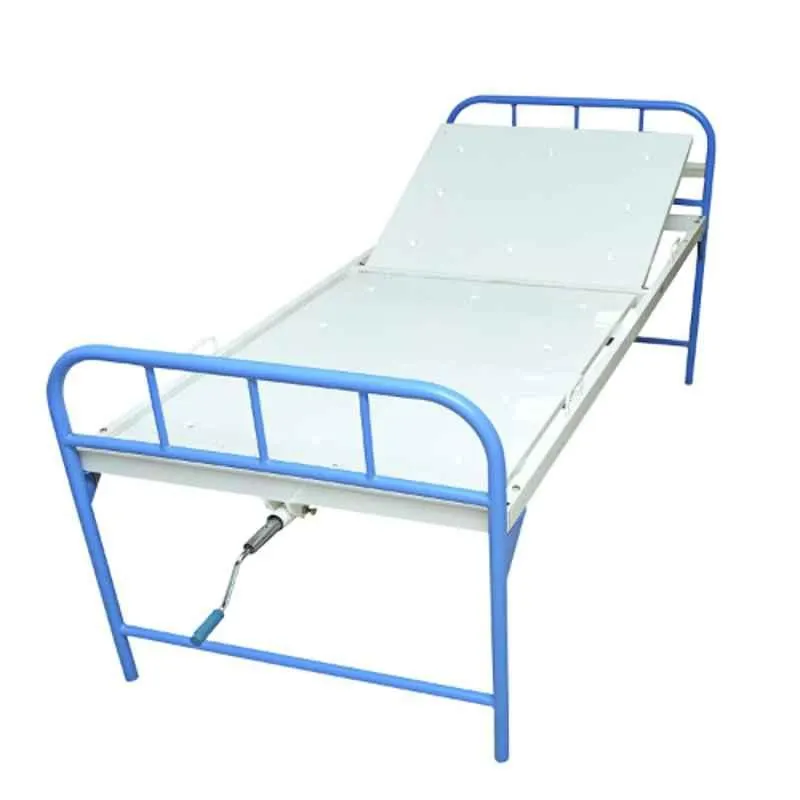
FIG 5.1.1 Existing Hospital Bed
5.2 Redesigned Hospital Bed
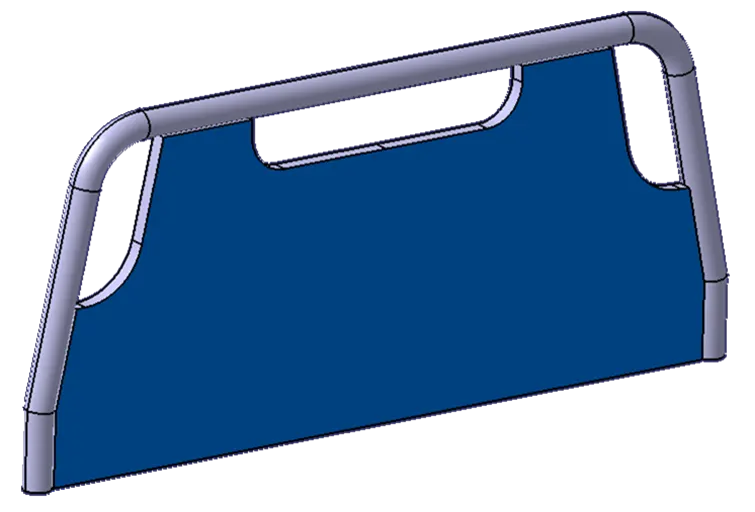
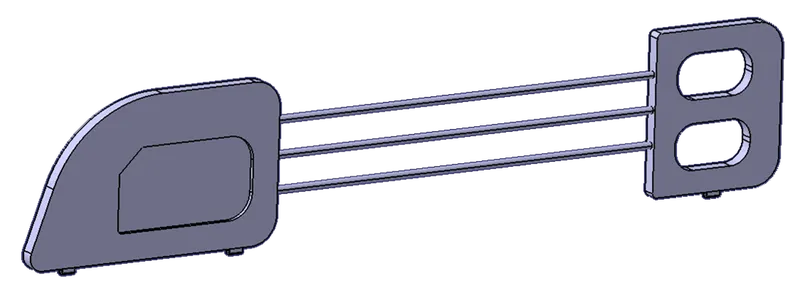
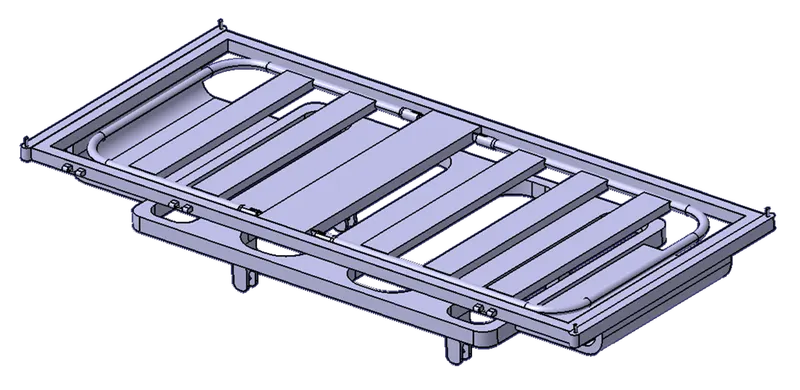
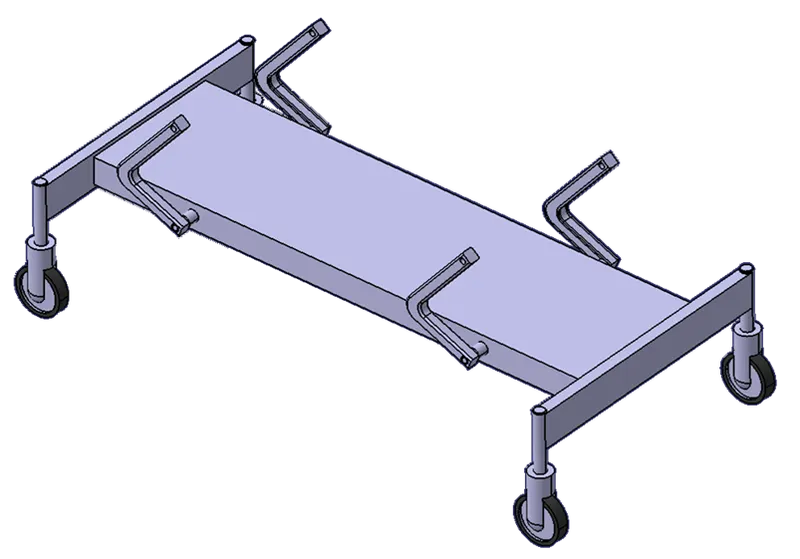
Based on the DFMA principles, the components of the hospital bed were made into sub-assemblies which are finally assembled into a single structure. The various parts are as follows,
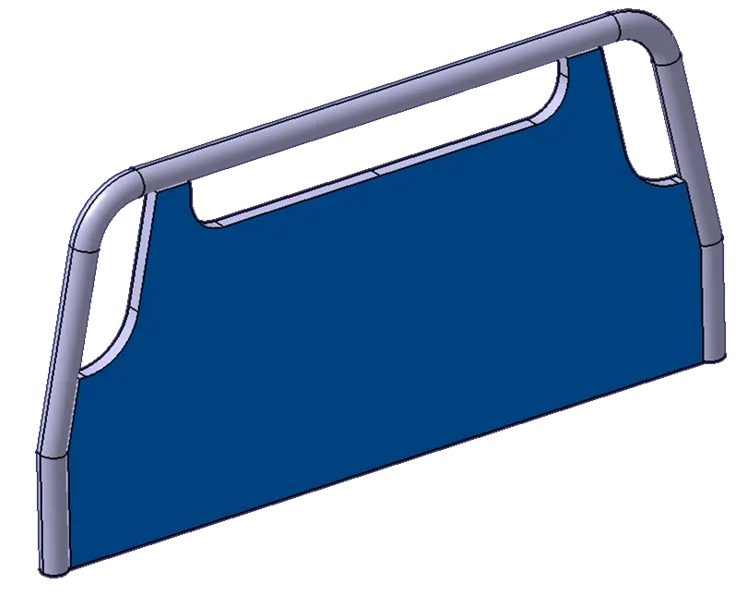
- Head rail – Injection moulding
- Tail rail – Injection moulding
- Side rail – Machining / Injection Moulding
- Base – Machining / Welding
- Wheel Base – Machining / Welding
5.2.1 Head rail
5.2.2 Tail rail
5.2.3 Side rail
5.2.4 Base
5.2.5 Wheel base
5.2.6 Assembly
6. CONCLUSION
- The necessary DFMA principles were applied to the existing model ensuring the ease of assembly and dis-assembly of the component.
- The required components were created as individual sub-assemblies using CATIA V5 which were finally assembled together.
7. REFERENCES