Design Overview in Automotive Industry - Challenge 2
- Factors to be considered while choosing a material for a component:
- Easy to manufacture
- Cost effective
- Easy to handle
- Eco-friendly
- Reliability
- Material Physical and Mechanical properties
- Availability of Raw material
- Suitability to the surrounding change of environment.
Thermoset Plastic:
Thermoset plastics, also called thermosetting resin or thermosetting polymers, are typically liquid at room temperature and then harden once heated or with a chemical addition. They are usually produced using Reaction Injection Moulding (RIM) or Resin Transfer Moulding (RTM) and form permanent chemical bonds during the curing process. These chemical bonds between the monomer chains within the material, called crosslinks, hold the molecules in place and change the nature of the material, preventing it from melting and returning to a liquid state. Once heated, thermoset plastics are set into a specific form, although overheating can cause them to degrade without entering a fluid phase.
Thermoset plastics are ideal for use in situations where heat is a factor, such as with electronic housings and appliances or chemical processing equipment, due to their greater structural integrity and resistance to both heat and chemicals. Able to resist deformation and impact, common thermosets include epoxy resins, polyimide, and phenolic, which are often used in composites.
Examples: Epoxy, Polyurethane, Phenolic and Silicone as well as materials such as Polyester
Thermoplastic:
Thermoplastics are resins that are solid at room temperature but become soft when heated and eventually become fluid as a result of crystal melting or from crossing the glass transition temperature (Tg).
Processing thermoplastics involves no chemical bonding and they can be poured into a mould to cool and solidify into the desired shape. Thermoplastics can be reheated, recycled and remoulded without affecting the material properties. As a result, these materials are used in processes including extrusion, thermoforming, and injection moulding.
However, generally thermoplastics tend to resist shrinking while offering good elasticity and strength. Used in applications including industrial machine components and plastic bags for retail, thermoplastics can soften, deform and lose some of their physical properties if exposed to high temperatures.
Example: Acrylic, Nylon, Polyester, Polypropylene, Polystyrene, and Teflon.
- Pros and Cons of Thermoset plastics:
Pros:
Thermoset plastics provide a wide range of benefits:
- Able to be moulded with different tolerances.
- Allows for flexible product designs.
- Improved structural integrity through variable wall thicknesses.
- Typically, cheaper than components fabricated from metals.
- Superb electrical insulation properties.
- Excellent heat resistance at high temperatures.
- Corrosion resistant.
- Strong dimensional stability.
- Low thermal conductivity.
- Cheaper setup and tooling costs than with thermoplastics.
- High strength-to-weight ratio.
- Water resistant.
- Wide range of colours and surface finishes.
Cons:
Despite these many benefits, there are still some drawbacks with thermoset polymers:
- Cannot be reshaped or remoulded.
- Cannot be recycled.
- Pros and Cons of Thermoplastics:
Pros:
The benefits of thermoplastics include:
- Good adherence to metals.
- High quality aesthetic finish.
- Can be recycled and reshaped with little impact on material properties.
- Resistant to chemicals and detergents.
- Good electrical insulation.
- High impact resistance.
- Enhanced anti-slip properties.
- Can create both rubbery and hardened crystalline surfaces.
- Resists chipping.
- Corrosion resistant.
Cons:
Despite these benefits, there are a few drawbacks with these materials:
- Not suited to all applications due to softening when heated.
- Typically, more expensive than thermosetting polymers.
- Manufacturing process in thermoset and thermoplastic material?
Manufacturing of Thermosets:
Generally, thermoset products are made through liquid moulding processes. The polymers and other agents are fed into tanks or barrels, where they are heated to a liquid state and mixed. Then the liquid polymers and other agents are injected into a mould cavity. As the material cools and hardens to the configuration of the cavity, it goes through a curing process where the polymers cross-link together. That process forms an irreversible chemical bond that prevents the risk of melting, softening or warping when or if the finished product is subjected to high heat or corrosive environments. This makes thermosets perfect for high-heat applications and outdoor use.
There are two primary liquid moulding processes used to produce thermoset plastics:
- Reaction Injection Moulding:
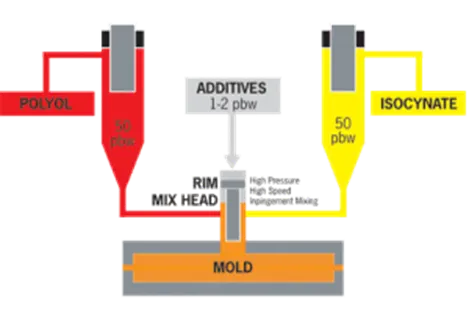
The RIM moulding process begins when two liquid agents—an A-component (polyol) and B-component (isocyanate)—are placed in separate tanks and heated to an elevated temperature. They are then fed at high pressure into a mix head. Once combined, the mixed liquid flows into a mould where the chemical reaction takes place, forming a polymer in the mould.
- Resin Transfer Moulding:
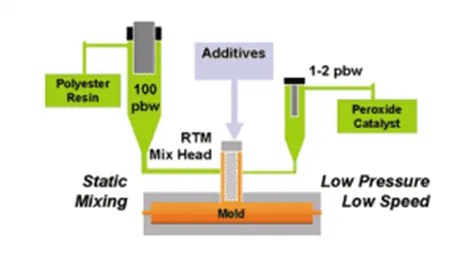
RTM is a closed-moulding process also known as liquid moulding. Resin formulations are mixed with a hardener, or catalyst, and injected into a mould that contains dry fibres, such as fiberglass, where the part is allowed to harden and form.
Manufacturing of Thermoplastics: Injection Moulding
Injection moulding is one way to manufacture and shape thermoplastics. Because thermoplastics are viscous in nature when heated, they need to be set in a mould, where they are provided a shape and allowed time to cool. Injection moulds are constructed from steel or a hardened alloy and constructed to shape thermoplastics as they cool. As the name implies, the thermoplastic liquid is injected into the moulding, where it may remain for a couple of hours as it cools. After cooling, thermoplastics are hard and ready for commercial purposes.
- Classification of Thermoplastics materials:
- Polythene:
It has a variable crystalline structure that allows for a vast range of applications. This thermoplastic can be classified as either high-density polyethene (HDPE) or low-density polyethene (LDPE).
Both variants have high tensile strength, impact resistance, moisture resistance and recyclability. Higher density versions tend to be more rigid and heat resistant, making it suitable for,
- bottles
- food containers
while the lower density alternative tends to be used more for,
- plastic bags and
- films.
- Polycarbonate:
This thermoplastic comes into its own when a strong, transparent material is required. It also has excellent impact resistance, making it suitable for,
- bullet-proof glass
- reinforced greenhouse panels
It can undergo high levels of stress without cracking or breaking. Other uses for polycarbonate include,
- DVD discs,
- eyewear lenses and
- mobile phone components
- Acrylic:
Acrylic is rigid with strong impact resistance. Acrylic sheeting can often be used as an alternative to glass in such applications as,
- windows
- aquariums
- motorcycle helmet visors
It is also frequently used as a material for arts and crafts projects, due to its transparency and aesthetic appeal. Other uses include shop signage and automotive lighting, due to its high resistance to adverse weather conditions and ease of cleaning and maintenance.
- Polyamide:
Polyamide is better known as nylon and is a common material used in fabrics and sports equipment such as nets. It is extremely tough and resistant to wear and tear. Nylon also has a high level of stability. As well as clothing, nylon is also used in a wide range of applications, including,
- Sports equipment
- Medical Products
- Polystyrene:
High Impact Polystyrene is very popular, tough nature and resistance to impacts and heavy knocks It is non-toxic and so can be produced to fit FDA grades and be used as containers for consumable goods. While polystyrene is flammable, flame- 0 retardant versions can be produced, along with high gloss grades that give a top-quality finish.
- Polypropylene (PP):
Polypropylene (PP) is very flexible, rendering it perfect for such applications as athletic clothing, rugs and car parts that need to be bent into position. Polypropylene has a high melting point and high resistance to cracking and stress. It has been compounded for a wide range of products and is extremely versatile.
- Acrylonitrile Butadiene Styrene (ABS):
This opaque thermoplastic is a terpolymer, made up of three polymers, acrylonitrile, butadiene and styrene. The combination produces a flexible, very light material that can be moulded into a plethora of everyday items and components for use in everyday life. A few of ABS plastic properties is that it can be modified to produce the exact levels of impact resistance, toughness and heat resistance that the manufacturer needs by moulding it at a high or low temperature. ABS is used commonly in drainpipe systems, automotive parts, musical instruments and sporting equipment, such as,
- Golf club heads
- Tennis rackets
- Polyester:
However, polyester is also used in electrical, medical, automotive and packaging applications. Industrial uses include,
- Ropes
- Yarns,
- Conveyor belt fabrics
- Seat belts
- Coated fabrics
Polyester offers excellent chemical resistance, dimensional stability and a high toughness-stiffness balance. Polyester fabrics are also highly stain resistant.
- Classification of Thermoset plastics:
- Polyester Resinfiberglass systems: sheet moulding compounds and bulk moulding compounds; filament winding; wet lay-up lamination; repair compounds and protective coatings.
- Polyurethanes: insulating foams, mattresses, coatings, adhesives, car parts, print rollers, shoe soles, flooring, synthetic fibres, etc. Polyurethane polymers are formed by combining two bi- or higher functional monomers/oligomers.
- Bakelite, a Phenol-Formaldehyde resin used in electrical insulators and plasticware.
- Duroplast, light but strong material, similar to Bakelite used for making car parts.
- Urea-formaldehyde foam used in plywood, particleboard and medium-density fibreboard.
- Melamine resinused on worktop surfaces.
- Diallyl-phthalate (DAP) used in high temperature and mil-spec electrical connectors and other components. Usually, glass filled.
- Epoxy Resinused as the matrix component in many fibre-reinforced plastics such as glass-reinforced plastic and graphite-reinforced plastics casting, electronics encapsulation, construction, protective coatings, adhesives, sealing and joining.
- Benzoxazines, used alone or hybridised with epoxy and phenolic resins, for structural prepregs, liquid moulding and film adhesives for composite construction, bonding and repair.
- Polyimides and Bismaleimidesused in printed circuit boards and in body parts of modern aircraft, aerospace composite structures, as a coating material and for glass reinforced pipes.
- Cyanate esters or polycyanurates for electronics applications with need for dielectric properties and high glass temperature requirements in aerospace structural composite components.
- Silicone Resinsused for thermoset polymer matrix composites and as ceramic matrix composite precursors.
- Vinyl ester resins used for wet lay-up laminating, moulding and fast setting industrial protection and repair materials.
- Poly Carbonate is used widely for transparent property in Automotive Industry.
Properties of Poly Carbonate:
- High impact strength
- Excellent strength retention at elevated temperatures
- High tensile, shear, and flexural strength
- High modulus of elasticity
- Low deformation under load
- Excellent creep and cold flow resistance
- Low coefficient of thermal expansion
- Good electrical insulation properties
- Easy to fabricate & machine
- Property and its Application of ABS (Acrylonitrile Butadiene Styrene):
- High Rigidity: Because of its high rigidity, it is used in instrument panel, Door trim.
- Good insulating property
- Good Impact Resistance: So, It is used in Bumpers.
- Good abrasion and strain resistance.
- Good weldability: Hence Instrument Panels and pillar trims are plastic welded.
- High dimensional stability.
- High surface brightness and excellent surface aspect.
- Properties of Nylon:
- Good rigidity and hardness
- Good dynamic fatigue resistance
- High Impact strength, even at low temperature
- Excellent electrical properties
- Good abrasion and wear resistance
- High heat resistance
- Good sound and vibration damping
- Easy process ability
- Virtually no stress cracking.
Applications in Automotive Industry:
There are several applications for nylon washers within the automotive industry. For example,
- Engine compartments stator, armature, and rotor components
- Gasoline motors
- Exhaust systems
- Fenders
- Airbag systems
- Brake systems
- Material Blend:
A material or polymer blend is a mixture of two or more polymers that have been mixed together to create a new material. Polymer blends can be classified according to the physical properties of their constituents as plastic, thermoplastic, elastomer, and so on.
Blends used in Automotive Industries:
- ABS/PC Blends
- High impact strength and hardness
- Improved HDT compared to ABS
- Dimensional Stability
- Electrical properties independent of moisture and temperature
- ABS/TPU Blends:
- High Impact strength
- TPU contributes toughness, lubricity, wear resistance
- ABS provides increased stiffness and improved process ability
- ABS/PVC Blends:
- Good flame resistance
- Filler:
Filler materials are particles added to resin or binders (Plastics, composites, concrete) that can improve specific properties, make the product cheaper, or a mixture of both. The two largest segments for filler material use is elastomers and plastics.
Fillers with properties:
- Calcium carbonate (CaCO3): It. brings for final plastic products brighter and glossier surface.
- Kaolin: Is mainly used in plastics for its anti-blocking characteristics as well as an infrared absorber in laser marking. It increases impact strength and heat resistance.
- Wollastonite (CaSiO3): This filler can improve moisture content, wear resistance, thermal stability, and high di-electric strength.
- Glass: Glass fibres are used to increase the mechanical properties of the thermoplastic or thermoset such as flexural modulus and tensile strength.
Additives:
A substance added to something in small quantities to improve or preserve it. The most common polymer additives are stabilizers, plasticizers, lubricants and flame retardants.
- Stabilizers are added to prolong the useful life of a polymer formulation by protecting it from thermal and light-assisted oxidation.
- Plasticizers: Plasticizers are additives used in the production of plastics to reduce the attraction between polymer chains, thereby increasing the flexibility and durability of the resulting plastic. The most common Plasticizers are phthalate esters, which are used primarily in the manufacturing of products made from PVC, including shower curtains, upholstery, flooring, and food containers.
- Lubricants are the substances, which work between surfaces in relative motion to prevent friction and wear
- Flame retardants are chemicals that are applied to materials to prevent the start or slow the growth of fire.
- Automotive interior components and the materials:
- Truck trim - Steel.
- Trunk - Steel
- Door panels - Fibre
- Instrument panel - Acrylonitrile-butadiene-styrene (ABS), ABS/polycarbonate alloys, polycarbonates, polypropylene, modified polyphenylene ether (PPE) and SMA (styrene-maleic anhydride) resins
- Glove box - Stainless steel, Carbon fibre, polycarbonates, polypropylene
- Centre console - Carbon fibre
- Headliner - tricot knit fabric
- A/C register - Polyurethane and phenolic insulation panels.
- SOS switch - Bakelite and Ebonite
- Control knob - Stainless steel
- Automotive Exterior components and the materials:
- Spoilers - Is made from ABS plastic, which is mixed with granular fillers to make the spoiler stiffer.
- Automotive lighting - Acrylonitrile-butadiene-styrene (ABS), polycarbonates, polypropylene.
- Bumper - Steel, fiberglass composite, plastic or aluminium
- Wheel arch - fibrous layer comprising of thermoplastic bicomponent filaments
- A pillar - Steel, Aluminium.
- Cover wheel bright work - High-grade sheepskin fabric.
- Silencer - Stainless Steel
- Protector - Stainless steel.
- Wheel trim - zinc coated steel with a hardness of 40 HRC
- Wiper - Blade of Aluminium and attached with rubber.
- Types of Thermoplastic moulding process:
Extrusion Moulding:
The extrusion moulding, hot melted plastic is pressed through a shaped hole to create a lengthy shaped plastic part. This customizable shape that the liquid plastic gets pressed through is called a die. This die is custom made for the particular outcome that is desired. It is almost like pressing dough through a press to make shaped cookies. The other forms of plastic moulding also use extrusion so get the raw liquid into the moulds, the difference here is that other methods use the moulds to make the desired shape and here the extrusion itself is making the shape with the use of the die’s shape.
Compression Moulding:
This method involves the raw liquid plastic being poured into a heated mould and then being compressed together to form the desired shape. The high temperature of the entire process ensures good strength in the final product. The process is finished off by cooling the liquid plastic so that it keeps its form before being trimmed and removed from the mould.
Blow Moulding:
With blow moulding, the custom plastic parts come out hollow and thin walled. This method is ideal for when the plastic part must have uniform wall thickness. This is very similar to the process of glass blowing. The machine heats up the raw plastic until it becomes liquid and then injects air into it like a balloon. The plastic is blown into a shaped mould and as it gets bigger it presses against the mould walls and it starts to take its shape. After the liquid balloon fills the mould, it is cooled to keep its shape. The process is very fast and can produce up to 1400 pieces in a 12-hour work day.
Injection Moulding:
Injection Moulding is fairly similar to extrusion moulding. The difference here is that with injection moulding the melted plastic is injected directly into a custom mould. The injection is under high pressure so that the mould is filled, and a solid part is made. As with the other methods, after the mould is filled, the plastic is cooled as to keep its new shape and then the mould is opened.
Rotational Moulding:
This method involves the resin or liquid being placed inside the mould and then being rotated at high speeds. The liquid then evenly covers the entire surface of the mould to create a hollowed part with all the walls evenly thick. After the mould is cooled and the liquid plastic has taken its new form it is then taken out of the mould.
- Santhosh Kumar Shi deepan bro