Design of backdoor
Develop a detailed report for the Back door design by explaining the design methodologies and about the components developed in the design
Report
Back Door- Also known as Tail Gate is another important and Critical part of an automobile.
It’s a swinging commodity, connecting roof, body side.
Functional Requirement-
Basic Function is to cover rear part of a vehicle. Following are the points
- Boot Volume/ luggage area
- Rear Visibility Criterion Regulations-
- Rear Crash Regulations and Requirements-
- Sealing
- Functional Requirement of Hinge Mounting and Gas Stay Mountings, Wiper Motor Mounting-
Design should be such that it will provide maximum space for luggage, housing for back light, wiper motor, striker, hinge assemblies and necessary arrangement for gas stay.
The back door is an assembly of Outer Panel, Lower Panel and Reinforcements for embosses created for various mountings.
Outer parts are basically demanding dimensional accuracy and aesthetic criterion, as per prime requirement by customers.

Material Considerations-
Appearance, functionality and safety of automobiles at the same time reducing vehicle weight and delivering superior value to customers are Main factors for selecting material.
Among steel, Al, Mg, carbon fibre , composites Steel is an ideal material as it provides better stength at low cost.
Steel is commonly used at present for good impact absorption in crash test.
Aluminum can be Ideal material to replace Steel, as it is resucing weight by about 50%, magnesium can resuce upto 70% weight. But these are not cost effective.
Design and Engineering-
Back door is sn assembly of an inner and Outer panel and some reinforcements.
These two panels are hemmesd at edges and joined using mastic joints at mid portion to provide additionla strength.
Outer panel is a welded part of Lower and Upper body parts.
Inner Pannel is deisgned from the provided input and other enginnerign features like reinforcements, embosses for vaious mountings.
Inner panel is basic strengthening component. It should be designed based on Space Criterion, Rear Strength Criterion, and Rear Visibility Criterion and Luggage area.
From input class A surface ,
1. Surface is repaired, as the surface was not a good surface.
2. two bodies are eaxtractes as lower and upper body of outer panel.
3. Assembly is created with these two parts fixed constraint.
4. Inner panel is created with ref to these two parts as reference.
For hemming purpose, 0.2 mm gap is maintined throughout.
Hence OP in offset to 0.75+ 0.75+0.2 i.e. 1.7 mm disatance.
Tooling Axis Creation- a tooling axis is one along which, the die movemnt takes palce.
Hence all the design is performed withrespect ot TA only.
From this Inner Panne Design started.
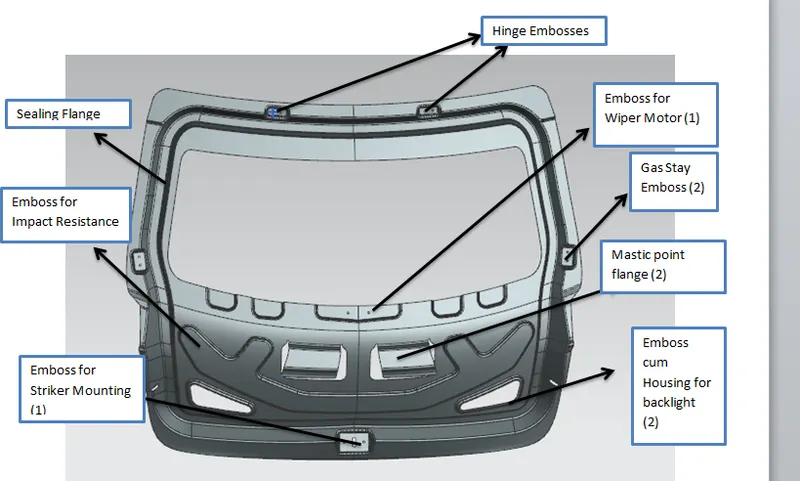
Sealing Flange is created at aout 30 mm height and consiering all curvature specilly at lower body.
Sealing –
It’s a rubber element, throughout the back door edge.
Main function to provide a fool proof closure of the door from dust, water.
It also acts as a damper of Vibration and Noise.
It is an important element as it is connecting Roof, body side and rear panel.
Sealing Flanges need to design considering Draft angle, and width of flange decided by considering hemming width.
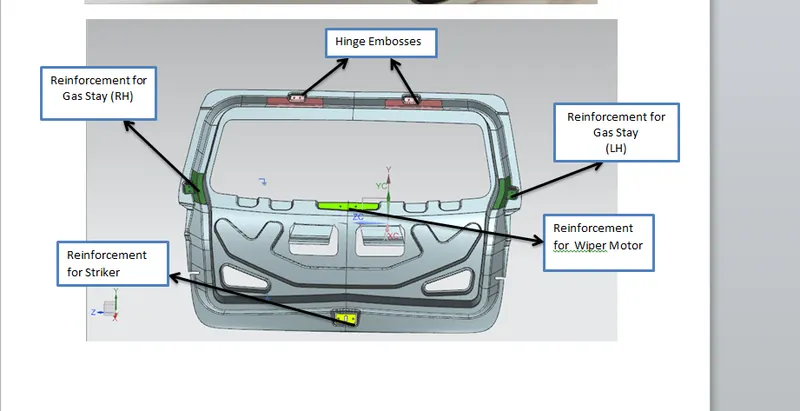
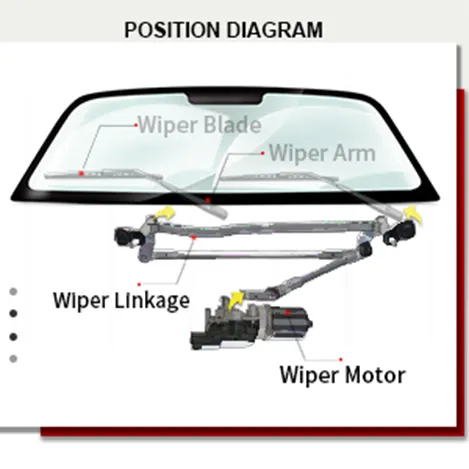
Possible loactions are decided for Hinge Assembly, Gas Saty assembly , Striker mounting and Wiper Motor mounting.

Rear Visibility and Rear Strength Criterion-
Strength of a backdoor in checked in a rear crash test.
Its design should be such way that, impact force should diverted to outside instead of passing to passenger cabin. Here we need to design Y and V shaped embosses.
In existing dsigna Combined shaped emboss is provided for trengthen purpose which directs impact force towrds c-pillar, away form passangers cabin.
Luggage area-
Design should be optimum to provide as much area as possible for luggage as well as it should be strong enough.
An emboss for back light wiring housing, it will also add strength.
Mastic point falnges are designed considering lancing Opertion, and flange width is decided by edge measurement of size of trim sheet.
Draft analysis- Draft Analysis is clear for the design for all surfaces.
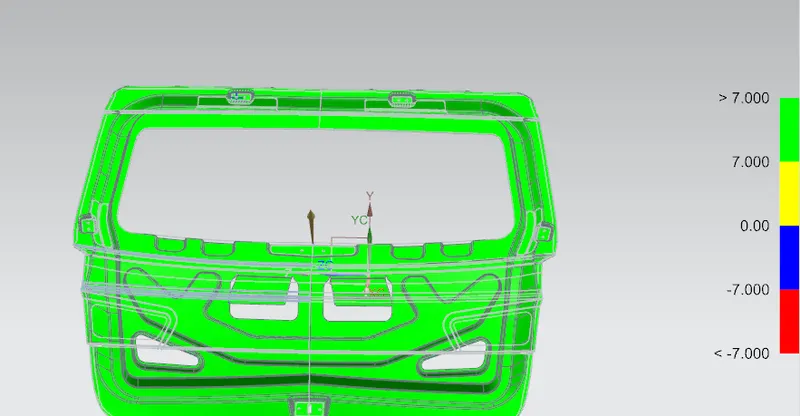
Manufacturing Process-
Stamping is used for manufacturing Inner Panels.
It is the process of shaping a piece of sheet metal into a desired shape and size with high accuracy and efficiency.
Lancing-
It is metal cutting operation.
In this metal is slit (without separting from parent material) to free up metal without separating it from the original sheet.
Lancing is done in progressive dies.
Joining Processes-
Hemming- At edges, sealant is applied between outer and Inner Panel. and hemming is performed.
Hemming joins two surfaces, and sealant prevents foreign particles entry inside.
This will also help reduce noise and vibration.
Inner center parts of outer and inner panels are joined by Mastics. It will provide addtional strength and also reduce noise.
Reinforcements-
Mountings are provided for Hinge Assembly , Gas Stay assembly, Wiper Motor and Striker.
To compensate for reduced strength at local level, reinforcements are provided.
Thickness for each reinforcemnt is taken 1.5 mm.
All sharp corners are converted to chamfer and fillet.