Design of backdoor
AIM: To develop the Backdoor of the vehicle with reference to styling surface using the method of automotive sheet metal design use appropriate design methodologies and provide the necessary reinforcements and embosses.
Components in backdoor:
1. Inner panel
2.Outer upper panel
3. outer lower panel
Design Consideration:
1. Rear visibility
2. Latch and Striker Reinforcement
3. Hinge and gas stay Reinforcement
Theory :
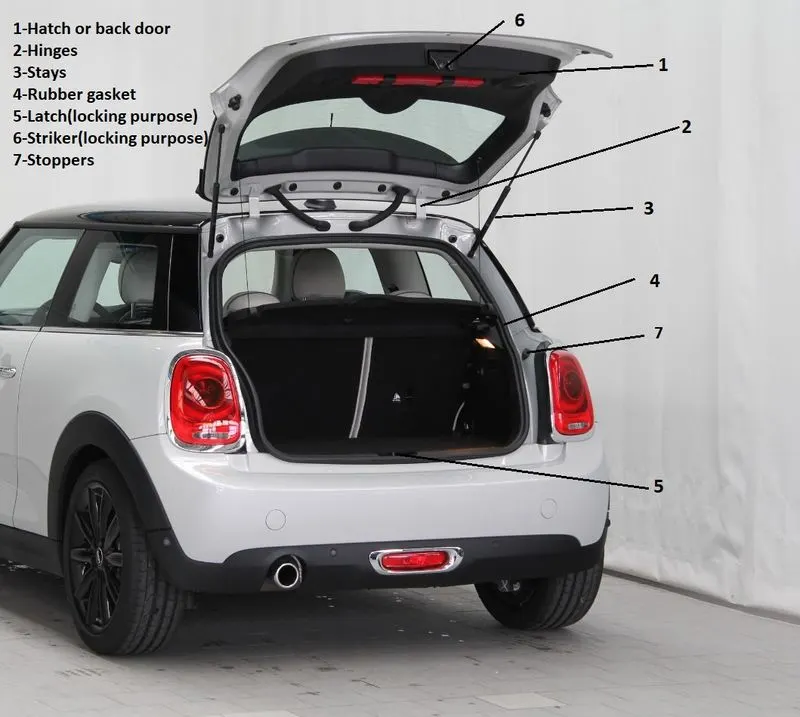
A Backdoor is a hinged board or door at the rear of the vehicle that can be moved up or down during loading and unloading condition, Also called Tailboard, it is commonly found in pickup trucks or hack back vehicles. Backdoor is also called tailgate. Which is used to make better boot space & provide access to the boot space, more thinner will be the backdoor and the more will be the boot space.
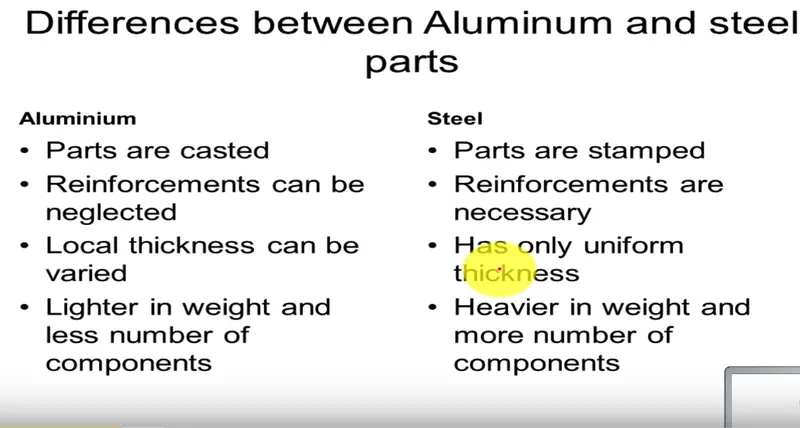
The material used for backdoors like Aluminium and steel.
As we get detail from the above chart that there is a total weight difference between steel door & aluminium door is 4.7 kg. Many of the company is going to turn toward manufacturing the aluminium door. Usually, the Aluminium backdoor is lighter in weight and has a lesser number of components. Steel backdoor is "deep drawn" with uniform thickness, added reinforcements and therefore is heavier. But the production cost of the latter is lesser.
Outer panel and inner panel :
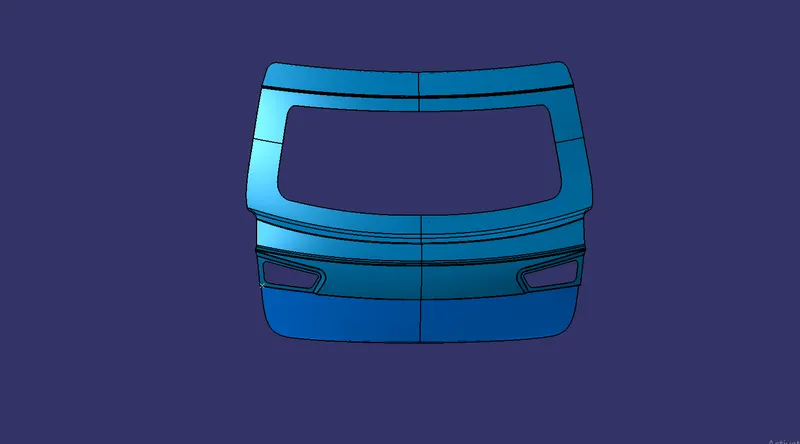
The outer panel is the styling surface of the source of the design of other parts of the back door. The outer panel should be designed with the requirement of tail light, rear glass and also the crash test requirement. The outer panel should be designed in an attractive way because it gives the rear external shape of the car. It acts as the cover outer and deals with the aesthetics of the car. Its thickness is in the range of 0.65-0.75mm.
The inner panel provides strength to the backdoor. They are of range 0.65-0.75mm thick. It is the inner panel when reinforcement and emboss are provided to justify the function.
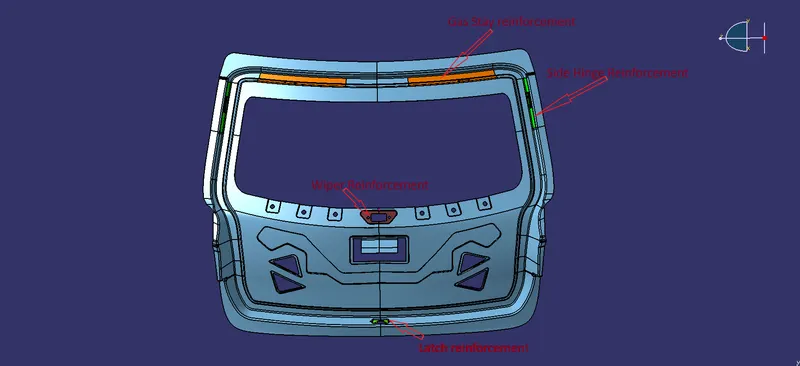
There are many cases where the inner panel is subjected to stress due to frequent opening and slamming. These stress and depression factors are compensated by a feature like embossing reinforcement.
The inner panel accommodates the latch and striker actuator. Trims mounting, Hinge and Gas stay embosses, V-Emboss, Latch etc. Various reinforcement is also spot weld in the inner panel.
Hinge reinforcement :
Hinge support the weight of the whole backdoor. Hence reinforcements are provided here too. Emboss is designed such that the hinges should operate freely.
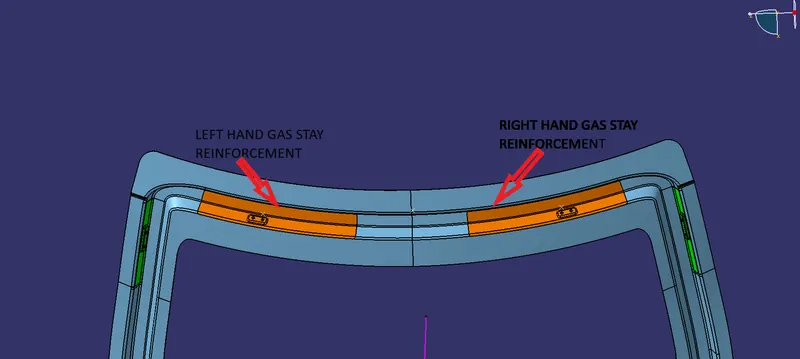
Gas Stay Reinforcement:
A gas supports the weight of the whole backdoor. It is reinforced with a thicker sheet its thickness varies from .75-1mm.
Wiper Motor Reinforcement:
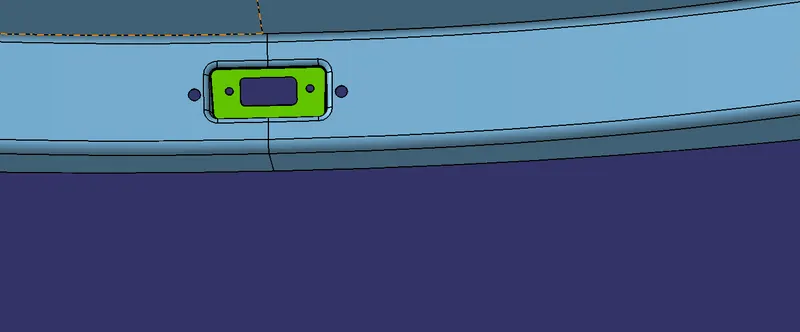
A dedicated shape near the window is left for the wiper motor assembly. A cavity is placed in the middle of the panel for the necessary components in the assembly as well as other accessories. At present, the tailgate wiper of a mid-get car generally is to be connected through-bolt and the projection welding installation nut that is located on the tailgate inner panel. In use, because of tailgate inner panel intensity ratio a little less than, the when working vibrations of tailgate rain shaving electrical machine; Drive the tailgate inner panel and move together.
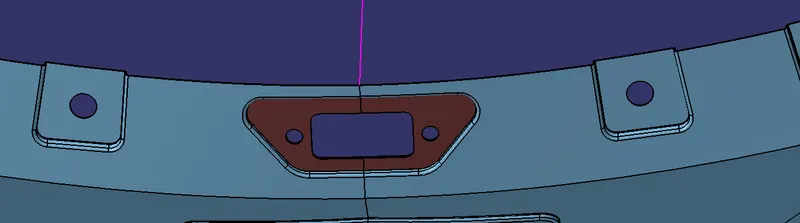
Latch and striker Reinforcement:
latch has a mounting plate, a ratchet and pawl assembly, a secondary release lever and a reinforcement plate. The mounting plate has a fishmouth. The ratchet is pivotally mounted to the mounting plate at a first pivot point. The ratchet cooperates with the fishmouth and moves between an unlatched position and a latched position. The ratchet is biased to the unlatched position.
Force Distribution:
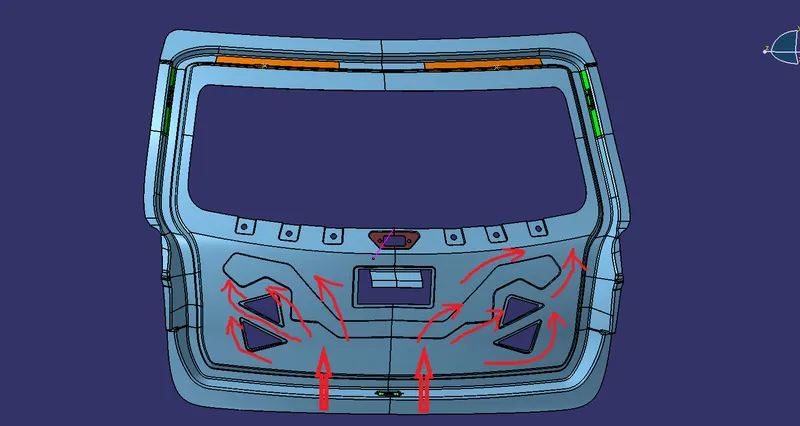
When the car hit the rear end, the force which acted should be outside. The Y or W emboss help to move the force to the outer end.
Embossing :
Embossing is the stamping process for producing raised or sunken design or relief in sheet metal. It is made in order to provide strength to the components and remove material from the panel. The shape of the emboss is decided by the load test case results. Backdoor is subjected to various load test cases such as torsion, bending, abuse case(impact test). This process can be made by means of matched male and female roller dies or bypassing a sheet or a strip of metal between rolls of the desired pattern.
Purpose of embossing :
While the accident occurs, the force will travel in a straight path towards the hinge. As a designer, the inner hood has to design such a way that force moves away from the car. So emboss should be in the inclined position towards the hinge so that force will travels towards the hinge.
Hemming :
Hemming is a technology used by the automotive industry to join inner and outer closure panels together (hoods, doors, tailgates, etc.). It is the process of bending/folding the flange of the outer panel over the inner one. The accuracy of the operation affects significantly the appearance of the car’s outer surfaces and is, therefore, a critical factor in the final quality of a finished vehicle.
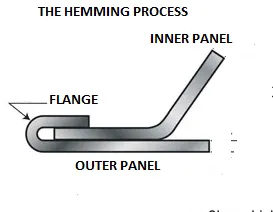
Hemming is performed in order to:
- Achieve a better final geometry in the vehicle´s part
- Add resistance and rigidity to the part
- Allow safe handling of the part
The Hemming process can be carried out in diverse vehicle components: closures (Hood, doors, tailgates), sunroof, fenders, wheelhouses and in special applications such as fuel lid, brand and special parts. Both the outer perimeter and the inner frame of the part can be hemmed.
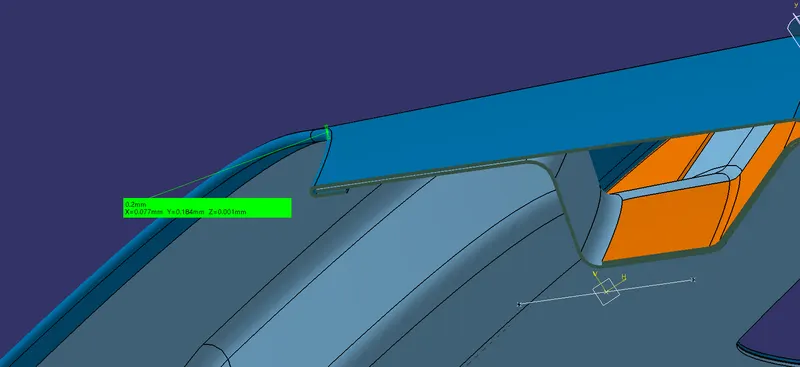
The Gap between the outer panel and the inner panel hemming portion should be 0.2mm as given below in figure:
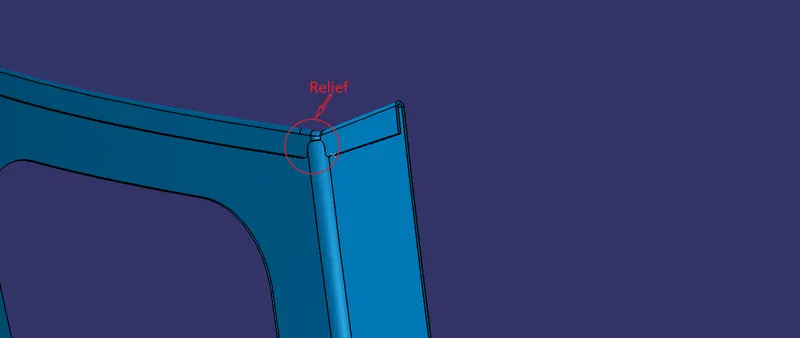
Relief in hemming:
Relief helps to control sheet metal material behaviour and to prevent unwanted deformation during unbend operations. So here I gave two corner relief for the Back door. Hemming. Hemming is the process in which the edge is rolled flush to itself, while a seam joins the edges of two materials.
Hinge axis and striker position axis study:
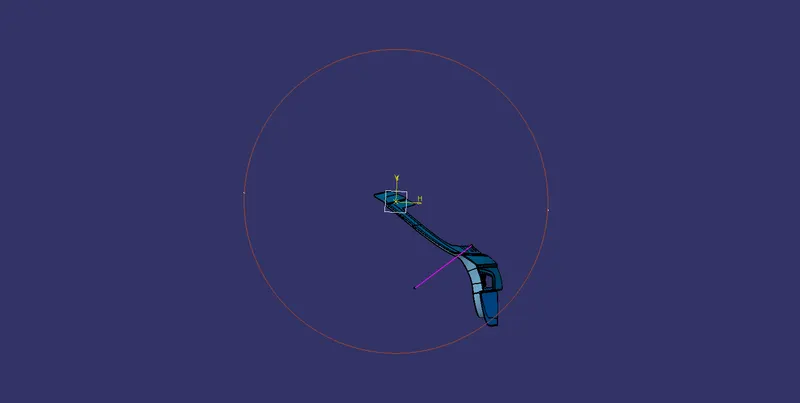
As we know that the backdoor is the swinging commodity we have to position the striker correctly. this can be done by tentatively positioning the hinge and the hinge axis, we take the centre plane with reference to the two-point we made on two hinges then from that plane we draw a circle in a sketch workbench. the circle is the striker trajectory and perpendicular to the striker. This can be adjusted bt moving the trajectory back and forth or by rotating the latch area.
Draft Analysis:
Draft analysis id to evaluate whether the parts are good to go to manufacturing according to draft angle along the tooling direction and the draft angle should be 7 degrees in the case of sheet metal. The tooling direction for analysis should be perpendicular to the wiper motor.
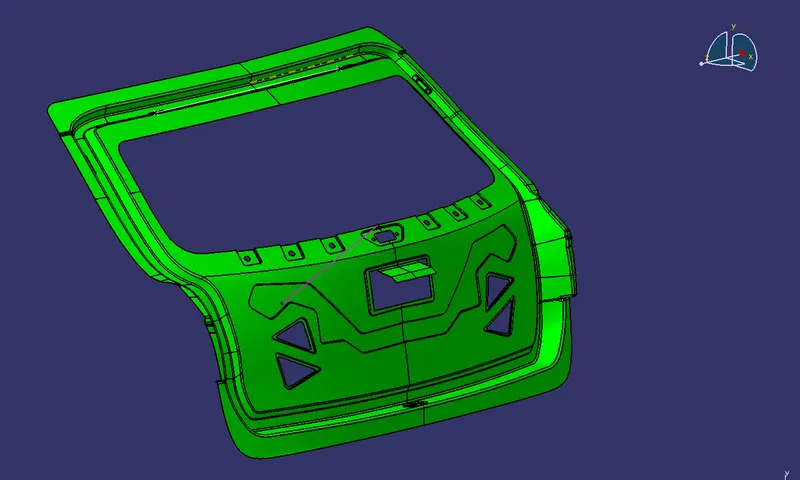
fig. Draft Analysis
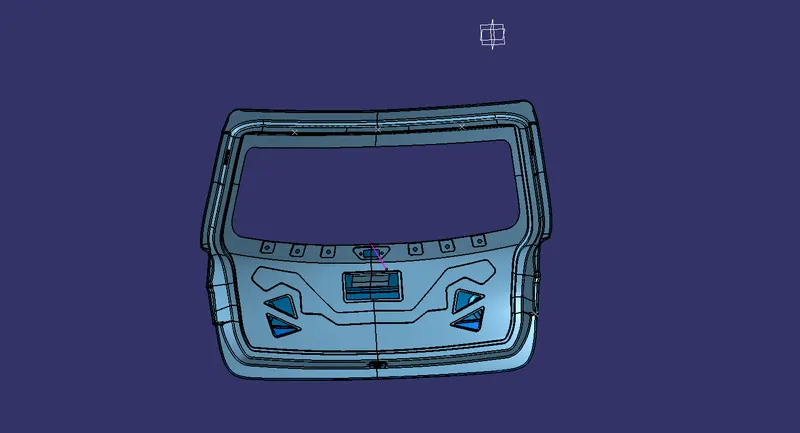
The final model of backdoor
Conclusion:
We created a BIW back door design, using appropriate design methodologies and provide the necessary reinforcements and embosses.