Design of backdoor
Backdoor Design
It is a Hinged door at the rear of the vehicle that can be moved up and down to either in most cases to a storage compartment/boot or to rear seats in some cars. Sometimes also referred to as Tailgate or Boot-door. The Backdoor is an assembly of parts such as inner panel, outer panel upper, outer panel lower and Reinforcements. Inner panel is attached to the outer panel using mastic sealant and hemming the outer panel over inner panel.
Functions of the Backdoor:
- It serves as entry and exit point for luggage/passengers.
- It houses assembly of windshield, tail lamps, wiper motor, parking sensors and cameras.
- It protects the occupants and luggage from getting damaged.
Top mounted
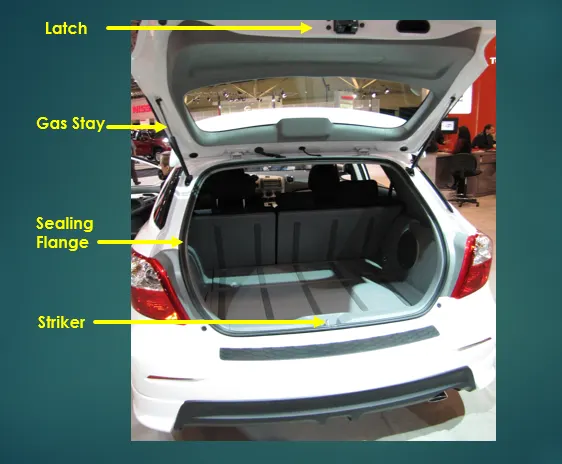
These backdoors are used in a station wagon, pickup truck, and sports utility vehicles. Today’s modern cars use top mounted tailgating systems which are gas stay supported. These tailgates provide greater rear visibility compared to other types.
Side mounted
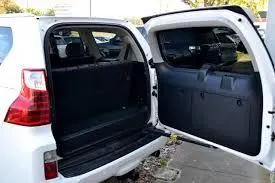
It is generally used in van type MPVs, SUVs, pickup truck vehicles. These doors are generally smaller and can be easily accessed. These doors are more convenient for the goods handling and for carrying lengthy objects lik those in pick-up trucks.
Material of Backdoor
The selection of material determines the overall weight of the back door. The common materials used are Steel & Aluminium, sometimes in combination for different region. Most low-cost vehicles use steel, since it is cheaper compared to Aluminium. Another aspect to be noted is that, if casted Aluminium parts are used instead of deep drawn steel parts there is no need of reinforcements and the overall weight of the car can be reduced by 5-10kg. Also, the draft angle for casted parts is around 3 degrees while for deep drawn parts is around 7-10 degrees.
Design considerations
- Rear visibility
- Boot space & accessibility
- Mounts for wiper motor, tail lamps, and other wiring loops
- Rear crash regulations
- Sealing Flange
- Support structures like Hinges and Gas stay.
- Bend Test, Dent Test, Torsion Test & Endurance Test
- Gap and flushness Requirements
Outer panel
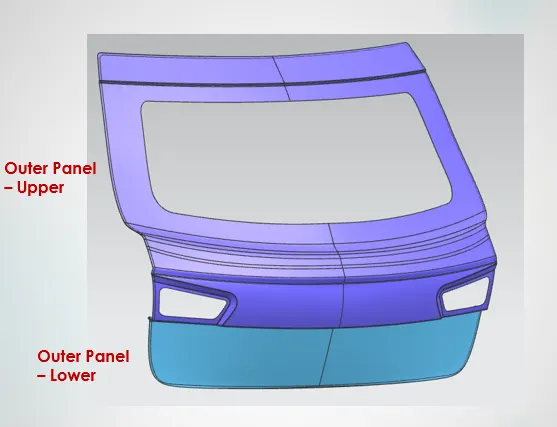
It is the outer styling surface of the back door. It houses the windshield and rear lighting units. It is provided with multistage coatings which has scratch resistance and rust prevention. It is wrapped around the inner panel through hemming process. Other components of the backdoor are designed with reference to the outer panel. Further, outer panel is divided into Outer panel upper and Outer panel lower. The thickness of both the panels is taken to be 0.75mm.
- Hemming: After designing the outer panel the Hemming was created by offsetting the surface with the help of face blend and Law extension. Hemming Relief is provided to decrease the stress concentration along the corners and also to decrease the clumping of metal along the corners, this is done by trimming the corner by a minimum radius for the rollers to pass along smoothly.
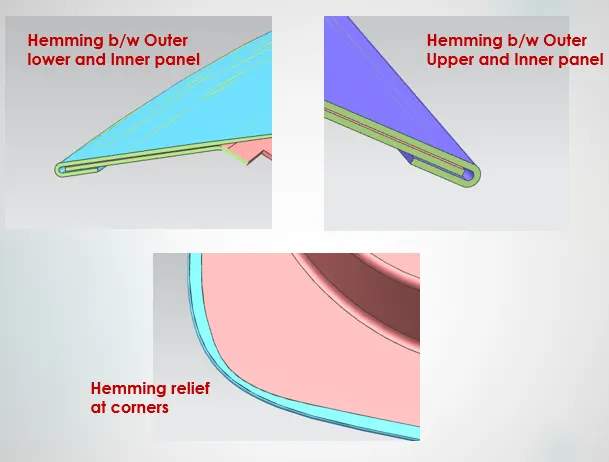
Hemming is the metal working process in which sheet metal edge is rolled onto itself. hems are used to reinforce the edge, hide burrs, and rough edges and improve appearance. Open loop hem and closed loop hem are the two types. Open loop hems have a flush while the closed loop hem is closed with no gap between sheets. The process of hem starts by bending the flange to acute angle and then a flattening die is used to flatten the hem.
Inner Panel
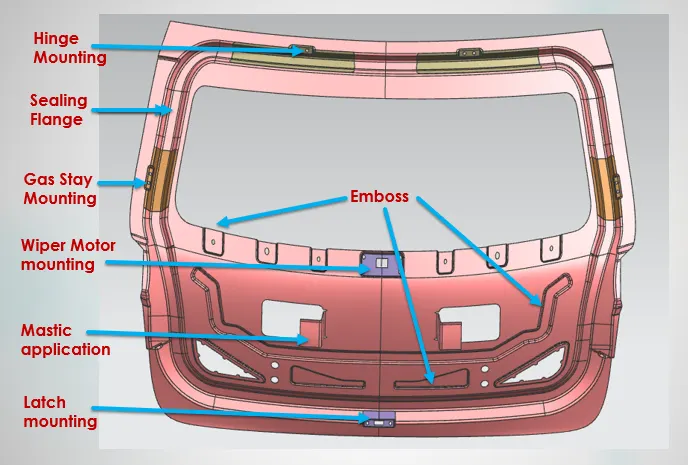
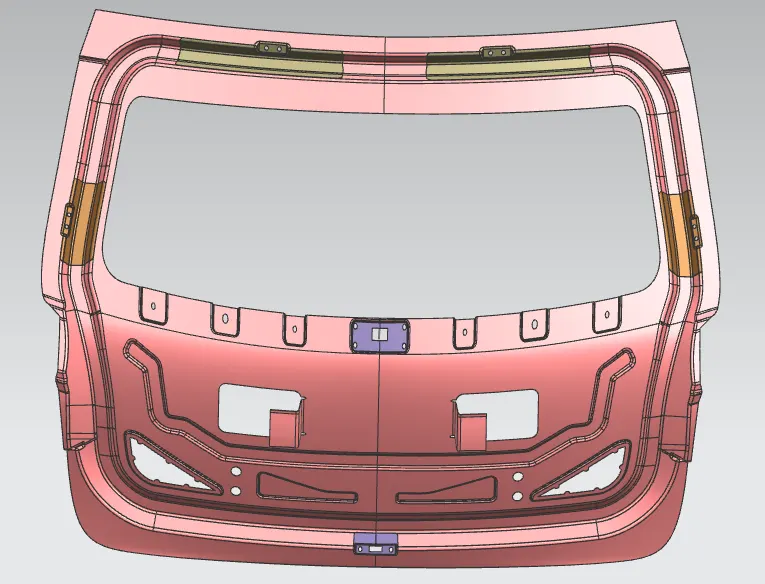
Inner panel is designed with respect to outer surface. It houses wiper motor and hinge assembly, latch and striker, Gas stay. The thickness of inner panel is also 0.75mm. Embosses are provided to provided strength and cut outs are provided to reduce the overall weight.
- Tooling Direction: Before starting to design the inner panel of the back door the tooling direction for Deep Drawing purpose should be created and all faces must be maintained a minimum of 7-degree vertical angle with the tooling direction for easy opening and closing during deep drawing process.
- Embossing: It is provided to give extra strength to sheet metal panel and to help dissipate forces/energy towards a specific direction. Here embosses (Y/V emboss) are designed in such a way to direct them towards the outer edges of the backdoor.
- Sealing Flange: It is a rubber sealing applied close to the circumference of the inner panel which enables the backdoor to sit over the rear body side of the car. It decides how a backdoor is mounted on the rear body side of the car and restricts any external debris entering inside the vehicle.
Positioning of Latch & striker/ Latch Trajectory:
It is a necessity for tight locking of backdoor that, the axis of hinges mounted on the backdoor is perpendicular to the striker opening/closing trajectory, if not, it can give rise to vibration due to improper latching of the striker. The Latch and Striker is positioned by creating a trajectory that follows the opening and closing of the back door with respect to the hinge axis.
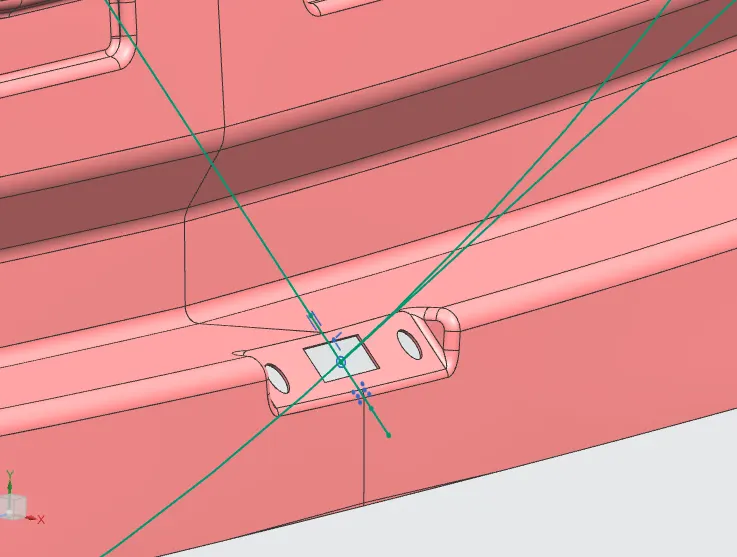
The positioning is done by first drawing an axis for the hinge rotation. Then taking the centre of the hinge axis as centre of circle and radius equal to position where we intend to place the latch. Next a tangent to circle is drawn at the intersection of radius of circle. Finally, a collinear line is drawn to the radius line to create the emboss for the striker placement. 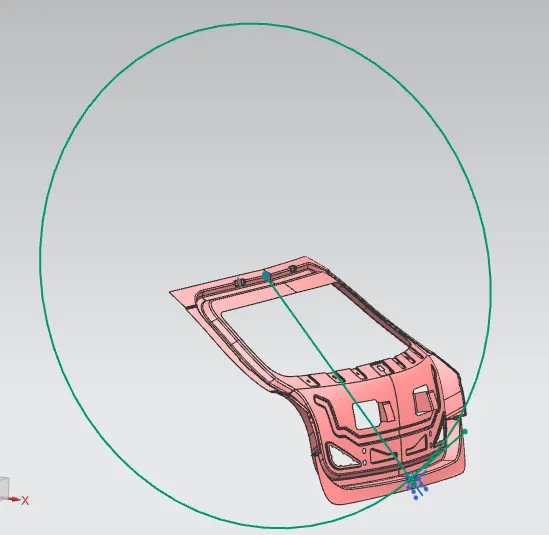
Reinforcements
Reinforcements are generally placed to increase the strength of the panel in localized areas which is relatively small compared to sheet metal parts for absorbing loads imposed and to help maintain rigidity of the panel assembly. The reinforcements are usually 1-1.5mm thick as opposed to 0.75mm thick panel used in this part. All the reinforcements are created using the same method, first, a linked face is created with reference to inner panel with the help of extract geometry and then the required portion is trimmed out and then thickened.
- Hinge reinforcements
Hinges enable the opening and closing of the back door. One end of the hinge is fixed on the backdoor and the other end on the Roof, on both sides. Hinges can be placed outside or inside the backdoor and carries the overall weight of the backdoor.
- Wiper Motor reinforcement
Wiper is used to remove water on the windshield glass which affects the rear visibility. It is actuated by a motor which is mounted on the inner panel. Due to vibration of the motor, inner panel gets deformed which results in loss of strength & rigidity of the panel thus leading to poor NVH. So, reinforcement is provided to avoid these conditions.
- Gas-stay reinforcements
Gas stay is used to lift the backdoor automatically and is used to support the backdoor in its open position. Reinforcements are provided to mitigate any damages that can be caused during opening and closing of the door. One end of the Gas Stay is fixed on the backdoor and the other end on the Body Side or on the Back door stationary area. Embossing is provided at the Gas Stay mounting area to compensate for weakness and improve strength.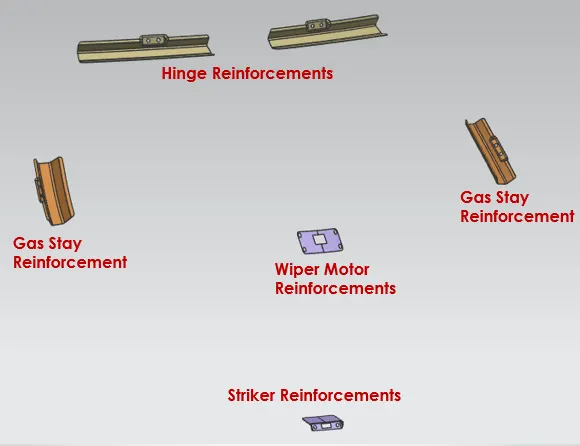
Mastic Sealants: Mastic sealant is a type of liquid sealant that cures in an elastic state, thus making it flexible while holding the bond of the surfaces that has been attached to it. Although, hemming is done to join outer and inner panels, for additional bonding, strength and also improve NVH criteria, mastic sealant is also applied between outer and inner panels.
Draft Analysis:
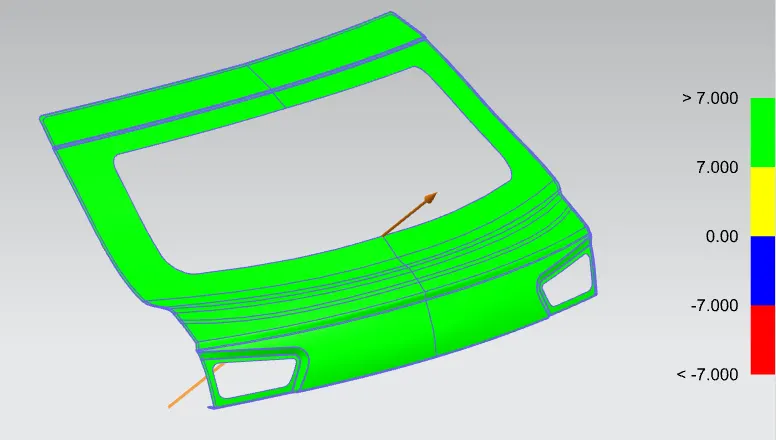
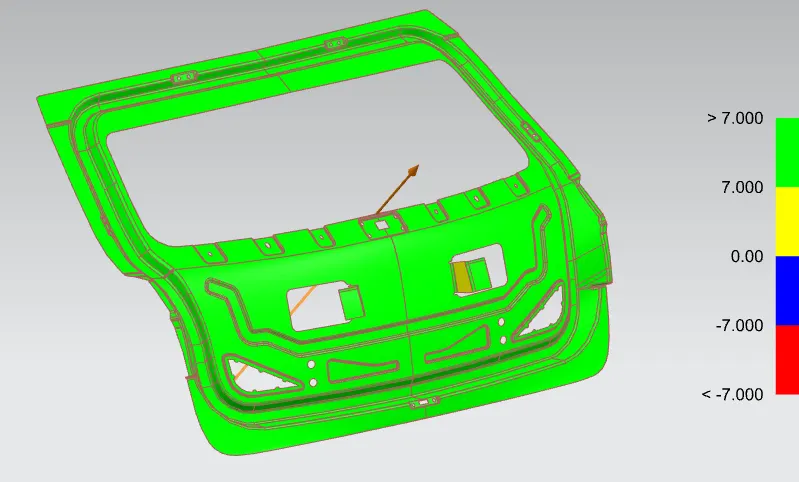
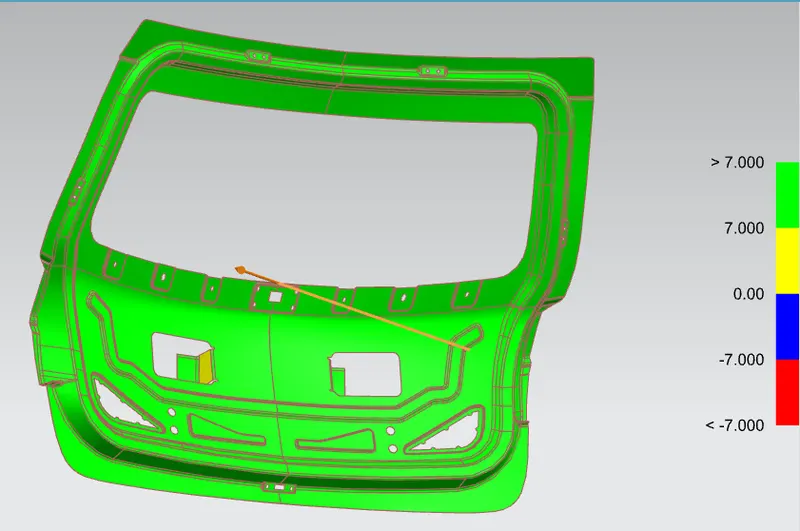
Draft analysis is done to verify the Part can be easily drawn out from the mould after deep drawing.
This type of analysis is performed based on colour ranges identifying zones on the analysed element where the deviation from the draft direction at any point, corresponds to specified values.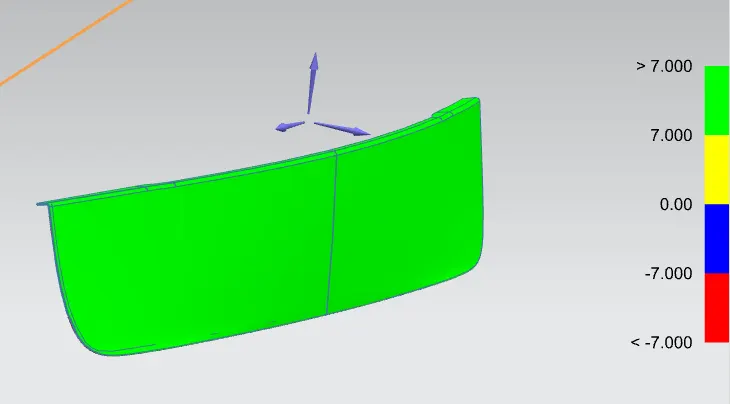
Assembly Images: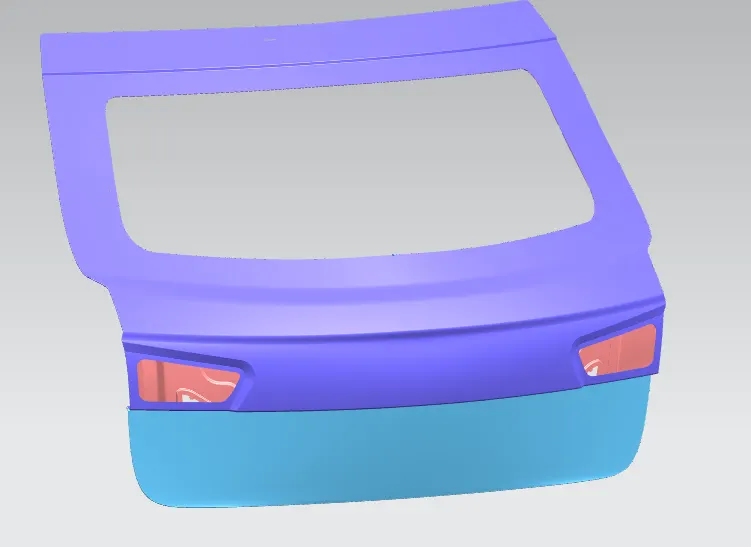
Conclusion:
Thus, the back door for a car is designed from the given styling surface of Lower and upper outer panel and Draft analysis is performed to verify the manufacturability. Additional reinforcements are provided to maintain the strength and rigidity of the panels.