Design of backdoor
DESIGN OF A BACK DOOR/TAIL GATE
AIM:
- The aim of this project is to design a car backdoor with the help of given CLASS A surface.
- Design essential flanges and reinforcements like sealing flange, hinge reinforcement, gas stay reinforcement, wiper motor reinforcement and latch & striker reinforcement.
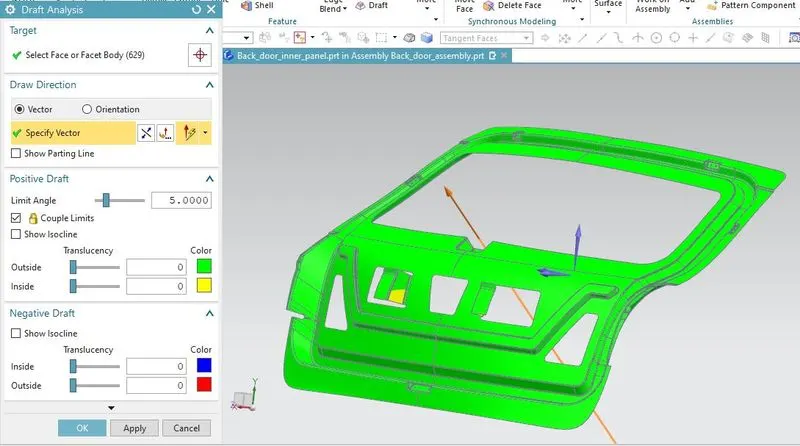
- Perform draft analysis for inner panel of the back door.
INTRODUCTION:
The backdoor or tailgate of an automobile is the product that is placed behind the rear passenger seat, which provides access to the luggage compartment. In the most of the cars, these back door are operated with the help of gas stay which in turn reduces the effort required to lift the door. It acts as a protective part that protects the occupants from rain, wind, dust etc.
The main design considerations of a backdoor are:
- rear visibility criteria regulations
- rear crash regulations
- design of sealing flange
- opening and closing the door for access to the luggage compartment
- hinge reinforcement
- gas stay reinforcement
- wiper motor reinforcement
- latch/striker reinforcement
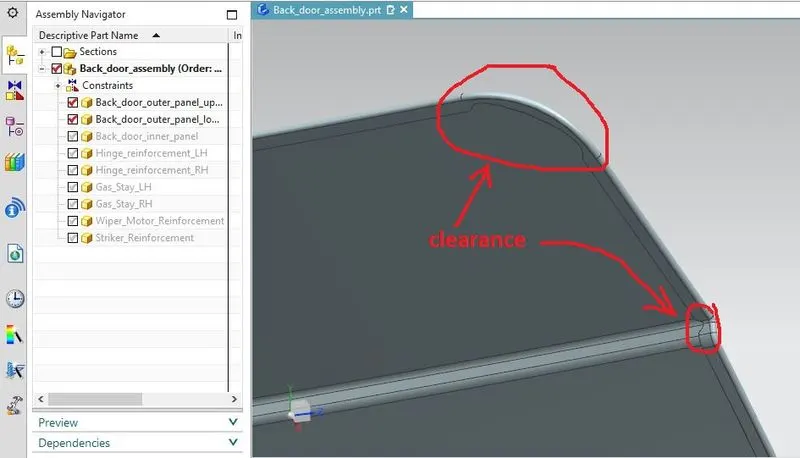
- clearance of 5 mm should be present between where mastics are used and for spot welding there should be no gap between to mating parts.
- thickness for outer panel and inner panel- 0.75 mm.
- all edges should have fillets and there should not be any sharp edges present.
- a minimum draft of 7 degrees is required for all the faces.
Since the backdoor has numerous functions so the backdoor has to be stronger enough to withstand the damage experienced by it. We make embosses and add some reinforcement to get better strength and stiffness.
Components Of Backdoor:
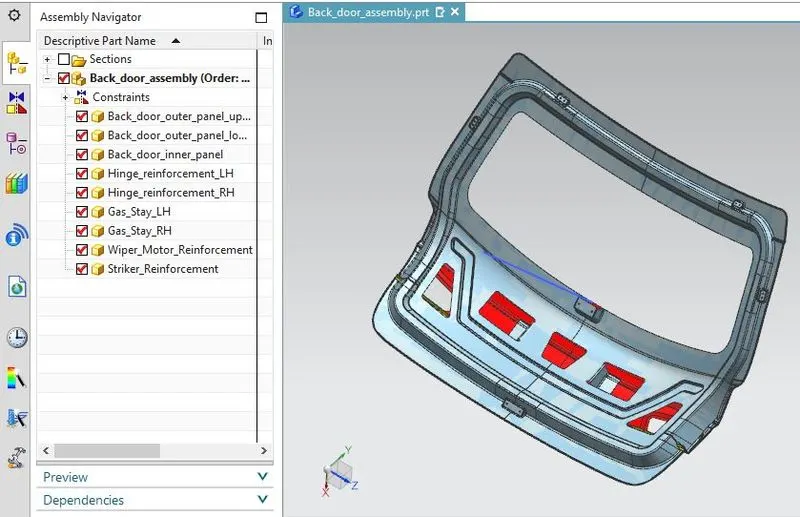
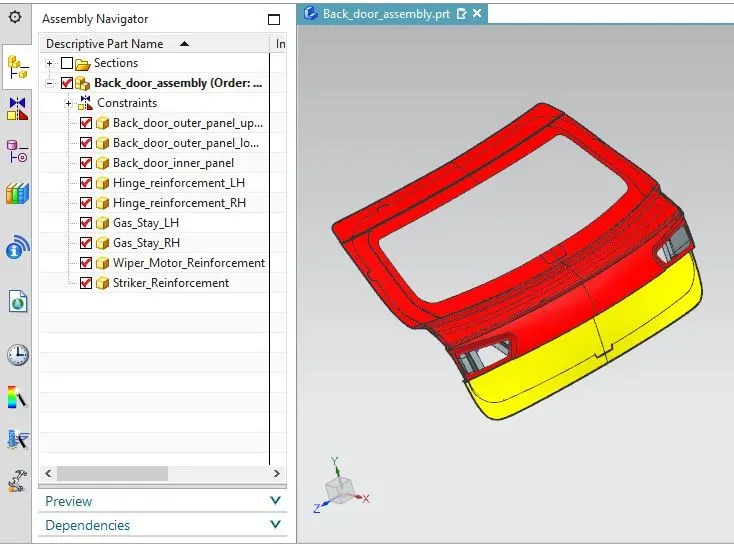
The components of a back door are inner panel, outer panel upper and lower, gas stay reinforcements, hinge reinforcements, wiper motor reinforcement, latch/striker reinforcement.
Design Methodology:
Backdoor Sealing Flange:
This section of the inner panel which enables the backdoor to sit over the rear body side of the car. Its design is important because it is the first thing that must be deigned first and it decides how a backdoor is mounted on the rear body side of the car and also restricts any external matter to enter inside the vehicle.
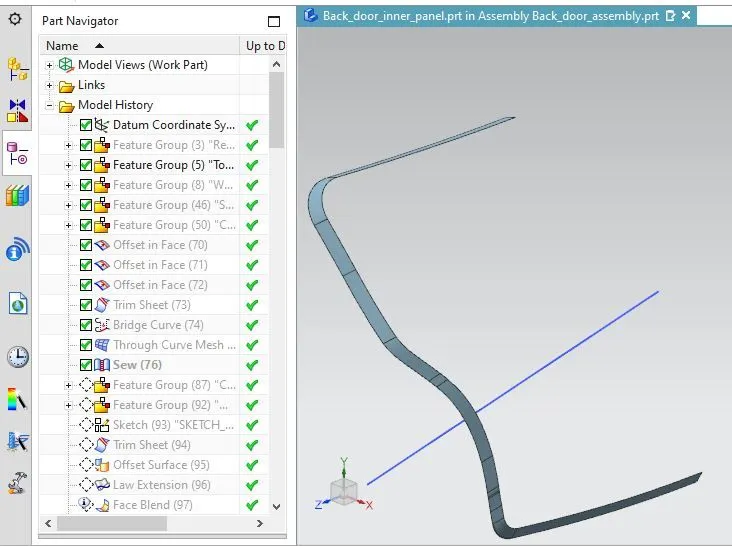
Backdoor Inner Panel:
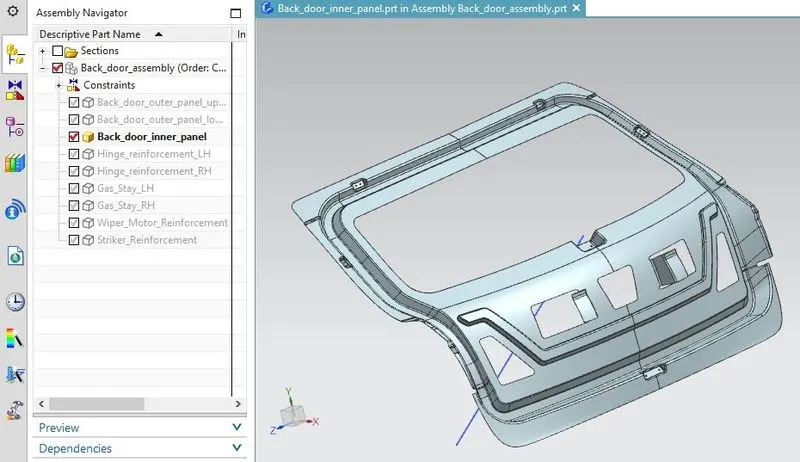
- The inner panel mainly provides strength. It is where most of the reinforcements and components are mounted. It is manufactured either by casting (aluminum) or sheet metal stamping (steel). Thickness of inner panel is 0.75 mm.
- This is the first part I designed from the given skinn data/class A surface.
- I designed the inner panel with the help of tooling direction, giving a proper tooling direction is very important. The design of the part depends on this tooling direction.
- The first thing is to design the sealing flange.
- After that I designed the entire panel with proper disign consideration & provide embosses to strengthen the sheet.
Backdoor inner panel:
Backdoor Outer Panel:
- In automotive industry there will be a dedicated team who will perform the aesthetic designing of various components including the whole vehicle. They will create various concept sketches after ideation. After that, they will also create a class a surface of the product. This class A surface is then passed over to the NPD CAD team. They will initially inspect the class A surface in order to check if the design is manufacturable or if it is following the engineering principles. If there are any issues about the design, they will contact the product design team and will ask to modify the class A surface in order to solve the problem.
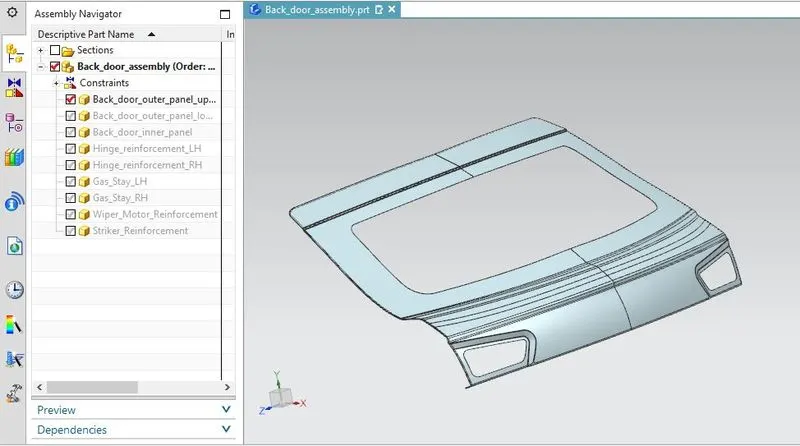
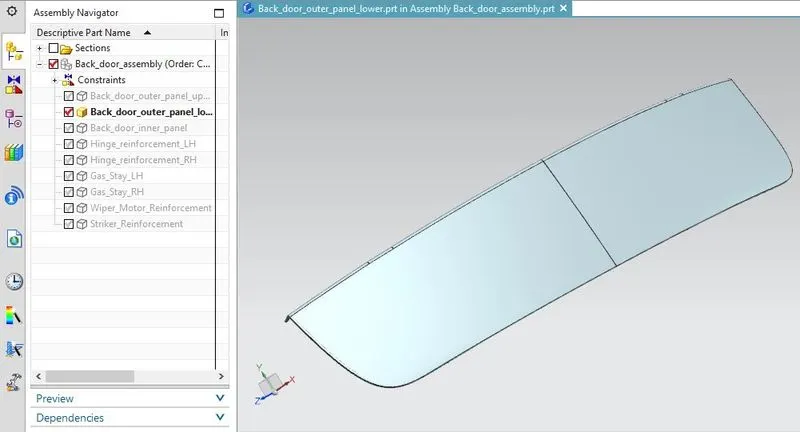
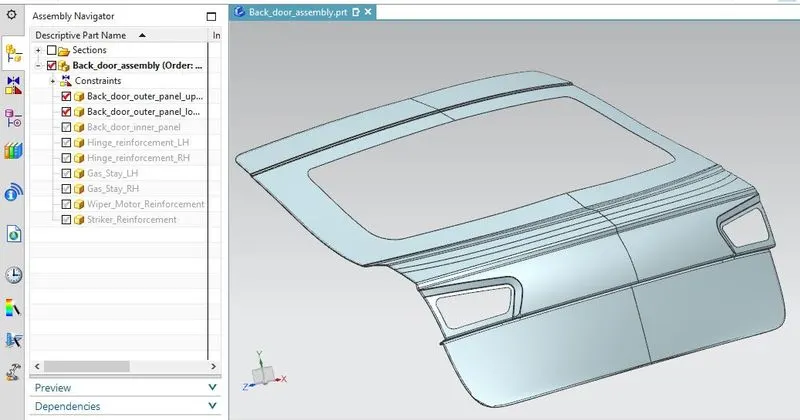
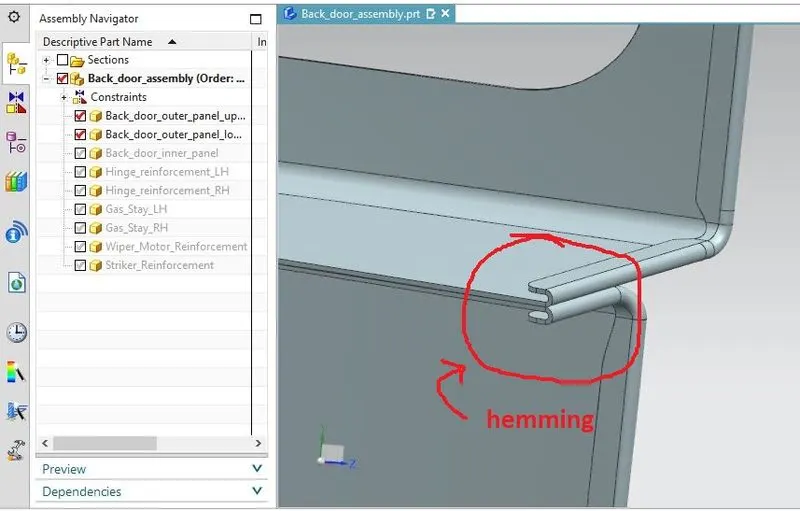
- Here I received the class A surface of back door. After designing the inner panel, I designed outer panel accordingly. The most important thing here is hemming and clearance where needed.
- Here I attached some snap shots
Backdoor outer panel upper:
Backdoor outer panel lower:
Backdoor assembled outer panel:
Hemming & clearance:
Reinforcements:
Reinforcements are made separately, thet are extra added materials. They are placed to increase the strength of the panel in localized areas which is relatively small compared to sheet metal parts for absorbing loads imposed thereon and dissipating such loads throughout the panel assembly to help maintain rigidity of the panel assembly. The reinforcements are usually 1-1.5mm thick as opposed to 0.75mm thick panel used in this part.
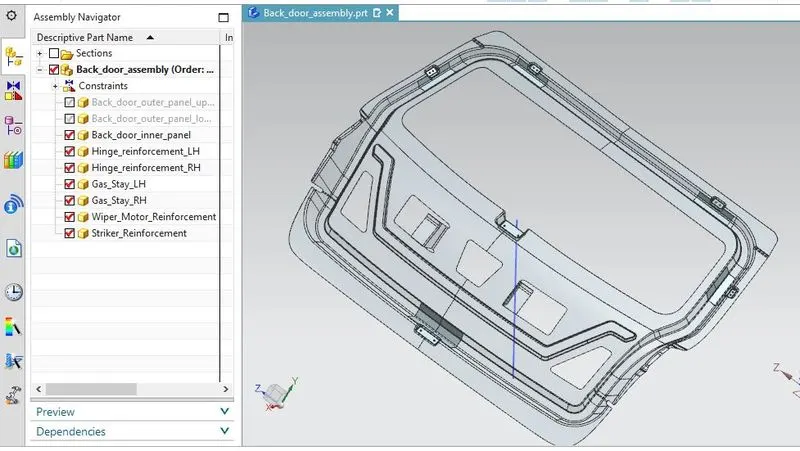
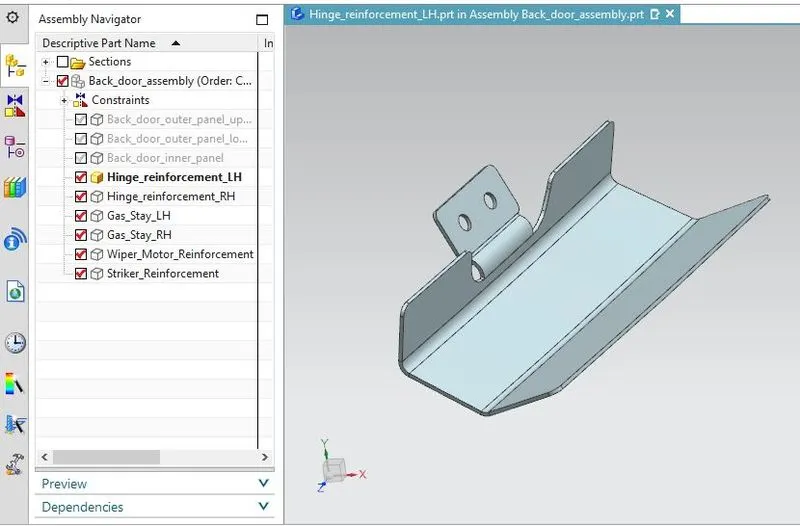
Hinge Reinforcements:
Hinge is a pivot mechanism which supports the total weight of the backdoor.Hinges enable the opening and closing of the back door. Hinges can be placed outside or inside the backdoor. The hinge reinforcements are added to compensate for the weak region due to the acting load over it.
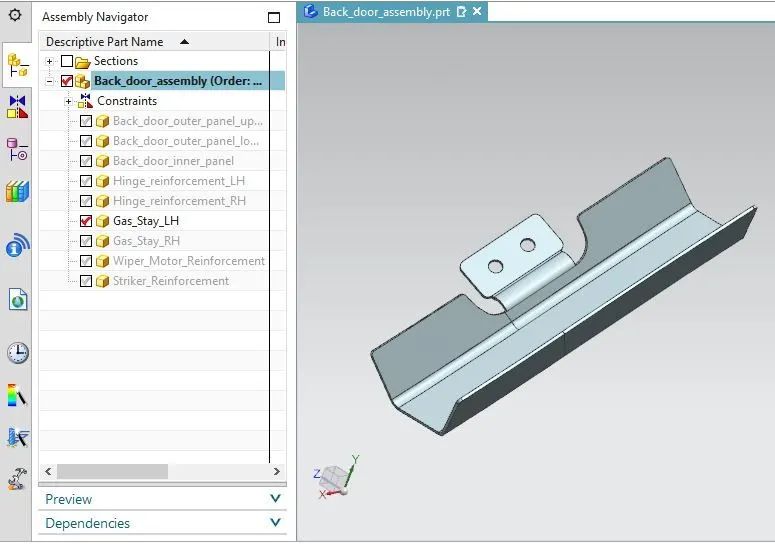
Gas Stay Reinforcements:
Gas Stay is a device used for supporting the back door in its open position. Gas stay requires no manpower and is engaged into support position automatically as the back door opens.
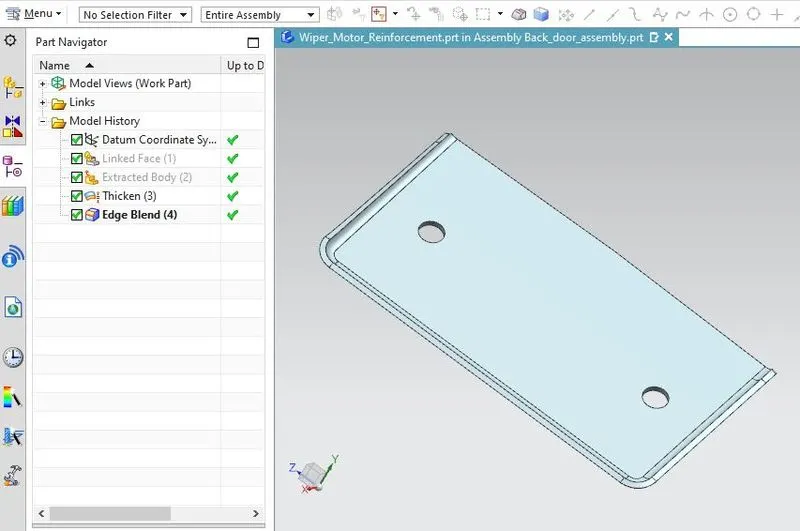
Wiper Motor Reinforcement:
Wiper is used to wipe out the dust particles on the windshield glass which affects the rear visibility. It is actuated by the motor which is mounted on the inner panel. Due to vibration and heat of the motor, inner panel gets deformed which results in loss of strength & rigidity of the panel thus leading to poor NVH. So reinforcement is provided to avoid these conditions.
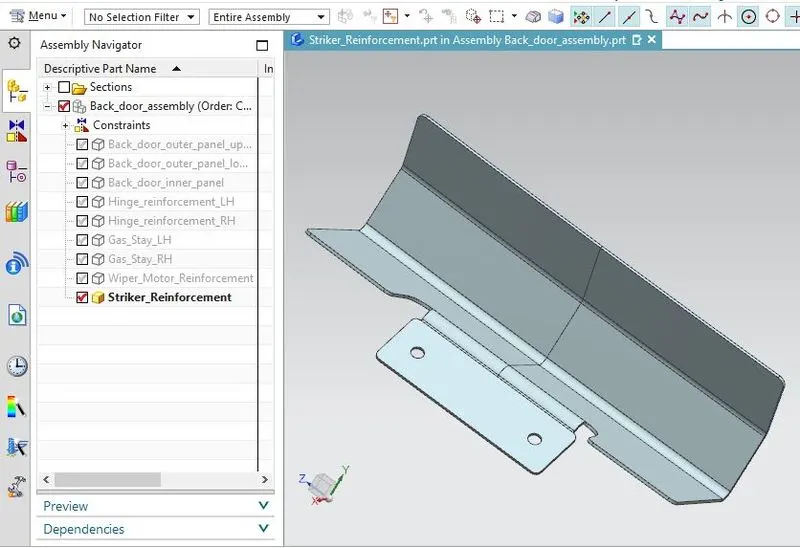
Latch/Striker Reinforcement:
The Latch & Striker forms the locking mechanism of the backdoor with the car. Due to regular opening, closing, and over slamming of the backdoor, there is stress developed in the Latch and Striker area. To compensate for the same, reinforcements are added in this area.
Draft Analysis:
The Draft Analysis allows the engineer to easily analyze a part for proper draft angle. A Draft Angle describes the amount of taper for molded or cast parts perpendicular to the parting line.
Draft Analysis for Inner Panel:
Assembly:
In this assembly Top down approach was followed, wherein from given class A surface the inner panel was created using various tools/commands in NX. After that others parts were modelled as per the requirements one by one.
Conclusion:
- The Design of back door inner panel and outer panel from the given class A surface is done.
- The draft angles are analyzed and the results are satisfactory.