Hood design-Week 2
Project: Automotive Hood design
Introduction: A car hood also referred to as a bonnet in some other countries is the hinged cover that rests over the engine of a front-engine vehicle.
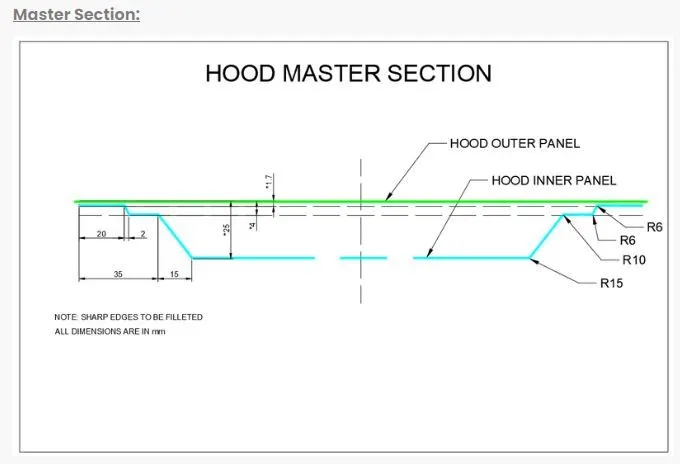
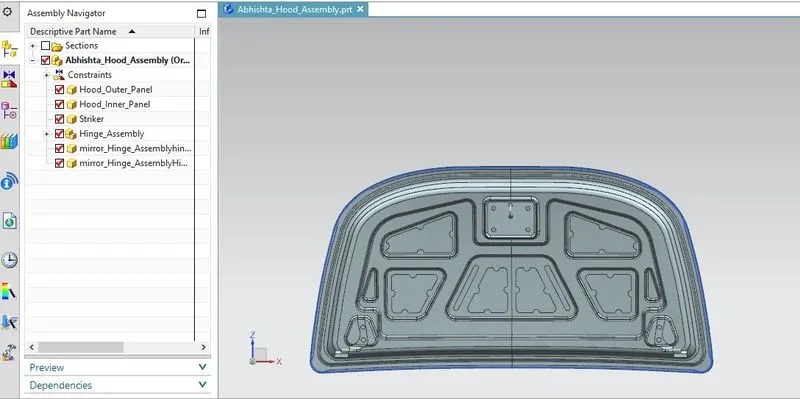
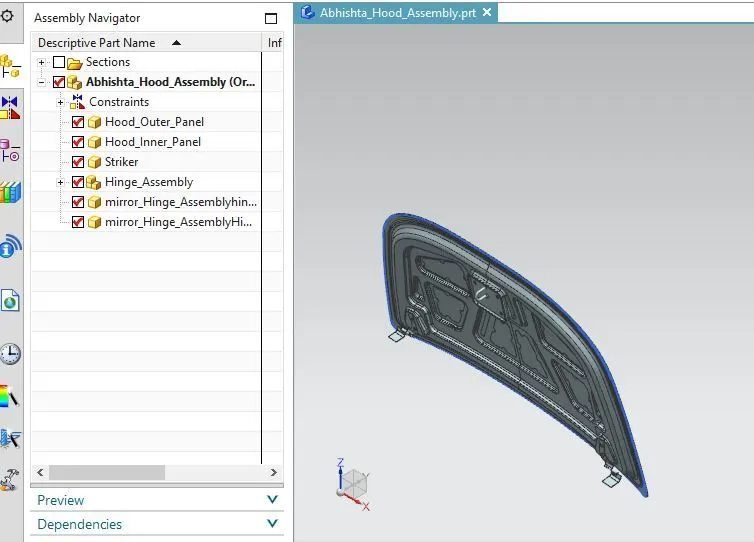
Objective: Design the hood inner panel and outer panel with the help of given hood skin data, master section and design parameters. Also assemble outer panel, inner panel, hinge and latch & striker.
Hood Inner Panel: Inner panel design is the most difficult, with the help of hood skin data and master section I am able to design this panel. This panel consist of embosses and holes. While designing this panel we should make space for latch and striker and hinge.
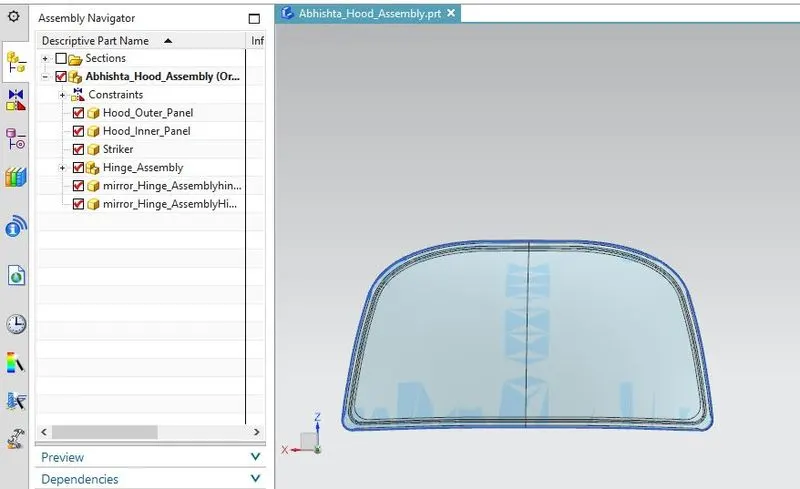
Hood Outer Panel: This is the outer section of the hood. It covers the hood inner panel and enhances the visual appeal of the car.
Reinforcement: According to the design parameter the thickness of the reinforcement is 1.5 mm. Generally this thickness is better than hood ineer and outer panel. Here we can see mainly two types of reinforcements.
- Latch and Striker: This is assembled with inner panel. Its prevents the hood from opening. Latch Trajectory design is one of the most importent design parameter for placing the striker in appropriate position.
- Hinge: Hinge helps to open the hood at a perticular angle. Placing it on the inner panel is very important design parameter, for this we need to create different embosses.
Mastic data: We cannot use welding, riveting techniques to join hood inner panel and outer panel. Because it creates a bad effect on the outer panel of the hood, we need some other option. We use mastic selant for joining inner panel and outer panel of hood. It is basically a adhesive. A mastic can cover upto 80 mm diameter, so we need some mastic points which can cover the total area of the hood.
Emboss: Embosses provides stifnees and strength. It is designed as "V" shape or "Y" shape so that it can divert the impact energy towards the corner (or away from the passenger) of its panel.
Manufacturing process:
Deep Drawing: Deep drawing is one of the most widely used processes in sheet metal forming. Apart from its use in many other sectors, it is applied in the automotive industry for the manufacturing of car body parts.
Process Defination: The deep drawing process is a forming process which occurs under a combination of tensile and compressive conditions. A flat sheet metal blank is formed into a hollow body open on one side or a hollow body is formed into a hollow body with a smaller cross-section.
In deep drawing we should provide a positive draft angle, if not, then it will affect the tool and also damage the work piece. Generally minimum 7 degree draft angle given.
Hemming: Hemming is a sheet metal forming process in which sheets are joined by bending it to 180°. Automotive body panels and automotive parts such as deck-lids, trunk-lids, doors, hoods and tailgates are formed by hemming process.
Conclusion: Hood design is one of the most difficult design. It is basically a trial and error method, and some dsign parameters are really critical, so we have to remember it while designing.