Air standard cycle
Aim:-
Plot a P-V diagram for a otto cycle and calculate thermal efficiancy
Govering equation:-
- this the equation in which we can compute how volume changes in isoentropic process
- `V/V_C=1+1/2(r_c-1)[(R+1-COStheta)-(R^2-sin^2theta)^(1/2)]`
- Here V=volume of the isoentropic state
`V_c`=clearance volume
`r_c`=compression ratio
R=connecting rod/a
a=stroke/2
`theta` =cranck angle
Objective :-
- The primary objective is to write a function which will define how volume changes in isoentropic process and write a code to make the plot of P-V diagram of otto cycle.
- The secondary objective is to calculate the thermal efficiency for given otto cycle.
Theory :-
A BRIEF INTRODUCTION OF COLD AIR -STANDRAD OTTO CYCLE :-
- Cold Air-standard otto cycle stimulate the spark ignition engine (Petrol Engine).
- Four stroke S.I engine was developed by Nikolaus A.otto in 1876.
- In spark ignition engine , combution of Air-fuel Mixture is initiated by a "spark Plug".
- In cold air-standard otto cycle ,combution process is replaced by isochoric heat addition with the help of heat exchanger.
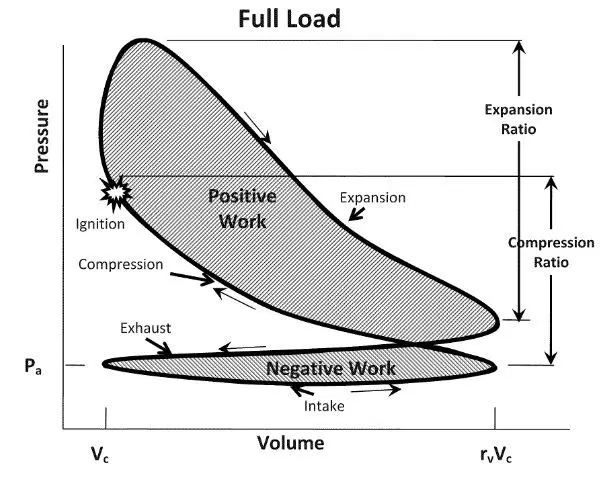
- This is the real otto cycle P-v Diagram
IMPORTANCE OF ANALYSIS OF COLD AIR-STANDARD OTTO CYCLE :-
- Performance parameter such as thermal efficiency ,Mean effective pressure obtained from cold air-standard cycle will be different from actual cycle.
- Still cold air-standard cycle analysis is important since, it enables the qualitative analysis of effect of various parameter on the performance of actual engine.
ASSUMPTION FOR COLD AIR-STANDARD OTTO CYCLE :-
- Suction and Exhaust stroke are neglected.
- A fixed amount of air is assumed as working fluid.
- Air is behaving as perfect gas and it's specific heat are taken at atmospheric pressure.
- compression and expansion process is assumed to be adiabatic.
- All the process are internally reversable process.
VARIOUS PROCESS FOR COLD AIR-STANDARD OTTO CYCLE :-
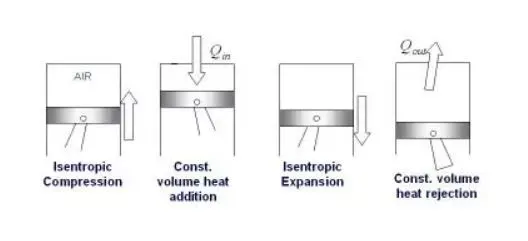
1. 1-2 internally reversible adiabatic compression process :
- In this process piston moves from BDC to TDC and air fuel mixture is compressed .
- During this process both the inlet and exhaust valve are closed.
2. 2-3 internally reversible isochoric heat addition process :
- In this process heat is added by the spark plug so that combution process is start.
- Along that a large amount of force is release and this force push the piston downward.
3. 3-4 internally reversible adiabatic expansion process :
- In this process piston moves from TDC to BDC .
- This is happend because of compressed air fuel mixture is burn and a large amount of energy is release.
4. 4-1 internally reversible isochoric heat rejection process :
- In this process air fuel mixture is fully burnt.
- At the end of this process ,burnt air fuel mixture is in little bit higher pressure than atmospheric pressure so that exhaust valve is open and exhaust process is start.
PHYSICAL REPRESENTATION OF VARIOUS PROCESS :
FORMULAS AND VARIABLES TAKEN INSIDE THE PROGRAM :
- compression ratio(cr) = v1/v2
- swept volume = pi/4*bore^2*stroke
- clearance volume = swept volume/(cr-1)
- thermal efficiency (ηth) = 1-t1/t2 0r 1-1/cr^γ-1
- γ = 1.4
- for isoentropic process pv^γ = constant
- bore dia = .2 m
- stroke = .2 m
- conecting rod length = .25 m
- v1= swept volume + clearance volume
- v2 = clearance volume
Fuction code :-
function [v]=engine_kinematics(bore,stroke,cr,con_rd,start_crank,end_crank)

a=stroke/2;
R=con_rd/a;

v_swept=(pi/4)*bore^2*stroke;
v_clr=v_swept/(cr-1);

theta=linspace(start_crank,end_crank,100);

term1=.5*(cr-1);
term2=R+1-cosd(theta);
term3=(R^2-sind(theta).^2).^.5;

v=(1+term1*(term2-term3)).*v_clr;
end- The above function code is define how volume change in isoentropic process.
The code for plot a P-v diagram of otto-cycle and calculate thermal efficiency:-
close all
clear all
clc
% plotting P-V diagram of a otto cycle

%input
gamma=1.4;

% input state variable
p1=101325;
t1=500;
t3=2300;

%engine geometry specification
bore=.2;
stroke=.2;
con_rd=.25;
cr=12;

%calculate swept volume and clearance volume

v_swept=(pi/4)*bore^2*stroke;
v_clr=v_swept/(cr-1);

% process 1-2 isoentropic compression

v1=v_swept+v_clr;
v2=v_clr;

  %we know p1v1^gamma=p2v2^gamma
  %p2=p1(v1/v2)^gamma

p2=p1*(v1/v2)^gamma

  %for isoentropic process p1v1/t1=p2v2/t2
 t2=p2*v2*t1/p1*v1;

constant_c=p1*v1^gamma;
v_compression=engine_kinematics(bore,stroke,cr,con_rd,180,0);
p_compression=constant_c./(v_compression.^gamma);

% process 2-3 heat addition
v3=v2;

%p2/t2=p3/t3 , p3=(t3/t2)*p2

p3=(t3/t2)*p2

% process 3-4 isoentropic expansion

v4=v1

%p3v3^gamma=p4v4^gamma p4=p3(v3/v4)^gamma
p4=p3*(v3/v4)^gamma;


constant_d=p3*v3^gamma;
v_expansion=engine_kinematics(bore,stroke,cr,con_rd,0,180);
p_expansion=constant_d./(v_expansion.^gamma);

hold on
grid on
plot(v1,p1,'*','r');
plot(v_compression,p_compression,'color','g');
plot(v2,p2,'*','r');
plot([v2 v3],[p2 p3],'color','b');
plot(v3,p3,'*','r');
plot(v_expansion,p_expansion,'color','g');
plot(v4,p4,'*','r');
plot([v4 v1],[p4 p1],'color','b');

xlabel('volume-(m^2)');
ylabel('Pressure-(pas)');

Thermal_efficiency=(1-(t1/t2))*100 -
- The above program is written for plot a P-V diagram of a otto cycle and calculate thermal efficiency of engine.
- First we put the essential variable such as pressure(state1),minimum temperature(state1), maximum temperature(state3) .
- Before writting the program we should know about the engine geometry value such as bore diameter, stroke length, compression ratio,conecting rod length etc
- Then calculate the swept volume and clearance volume by using given engine geometry value.
- For plotting P-V Diagram we have to know all the state volume and pressure value.
- constant_c=p1*v1^gamma;
v_compression=engine_kinematics(bore,stroke,cr,con_rd,180,0);
p_compression=constant_c./(v_compression.^gamma); - Here constant_c is a constant variable .it always constant in entire isoentopic process.
- engine_kinematics is a function ,whch is used to calculate how volume changes in isoetropic process so that we can make a curve .
- p_compression is a array of pressure variable which occur in isoentropic compession process.
- plot(v1,p1,'*','color','r');
- plot(v2,p2,'*','color','r');
- plot(v3,p3,'*','color','r');
plot(v4,p4,'*','color','r'); - These commands are used for plot all the four state of cold air- standard otto cycle ,represent by star operator.
- plot(v_compression,p_compression,'color','g','linewidth',3);
- plot(v_expansion,p_expansion,'color','g','linewidth',3);
- These commands are used for plotting of isoentropic curve cold air-standard otto cycle.
- plot([v2 v3],[p2 p3],'color','b','linewidth',3);
- plot([v4 v1],[p4 p1],'linewidth',3,'color','b');
- These commands are used for plotting isochoric process of otto cycle.
- xlabel('volume-(m^2)');
ylabel('Pressure-(pas)'); - Here 'volume' is independent variable so that we kept in x-axis and pressure in Y-axis.
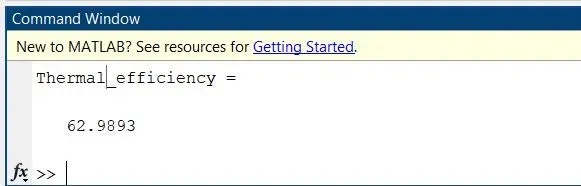
- Thermal_efficiency=(1-(t1/t2))*100
- This is the formula for calculate thermal efficiency of cold air-standard otto cycle.
- THIS IS THE OUTPUT OF THERMAL EFFICIENCY OF COLD AIR-STANDARD OTTO CYCLE :
CONCLUSION:-
- In otto cycle we can't get 100% thermal efficiency.
- otto cycle is a power produce cycle.