Telecom and 5G courses online
Every Skill-Lync course on 4G, 5G, RAN, telco cloud and telecom testing, with fees, hours, projects and which ones overlap.
- 18
- courses
- ₹40,000
- per short course
- 3 to 15
- weeks per short course
- 4
- courses that repeat a larger one
As of 21 Nov 2026 · Fees are the list price on each course page, inclusive of all charges
Skill-Lync teaches telecom in 18 online courses: 17 courses of 3 to 15 weeks on 4G LTE, the 5G core, 5G NR, Open RAN, telco cloud, wireless communication, network planning, RAN optimisation, Wireshark, telecom C programming and 4G/5G testing, plus a 48-week course on AI and ML for telecom networks. Here they all are with fees, duration and projects, which ones repeat each other, and which fits the job you want.
Every Skill-Lync course that teaches Telecom
Projects is the number of industry projects listed on the course page. Programs also include the courses' smaller assignments. EMI figures are the lowest monthly plan shown on the course page.
Which one should you pick?
- You are new to telecom and want the big picture first. Fundamentals of 5G (4 weeks, ₹40,000, 7 h) is the shortest full overview: 5G core, RAN and O-RAN splits, the NR air interface, and a hands-on week bringing up a 5G core, gNB and UE and reading the call flow in Wireshark. If you also need 4G, take 4G (LTE) - Architecture, Features and Call Flow (8 weeks, 15 h), which covers LTE from frame structure to VoLTE and ends with a 4G-vs-5G week.
- You want to write protocol stack software (L2/L3 developer). Start with C Programming for Telecom Engineers (4 weeks, 10 h, 4 projects: RLC and MAC PDU decoders, an LTE MAC scheduler simulation), then 5G NR Radio Access Network (10 weeks, 10 h), which walks through RRC and MAC code and has you integrate srsRAN with an Open5GS core. These two are the closest match to protocol developer job descriptions.
- You want core network or telco cloud work. 5G Core (9 weeks, 13 h) is the core functions, call flows, QoS and billing rules and slicing. Network Function Virtualization in 5G (12 weeks, 19 h, projects: an OpenStack NFVi and a Kubernetes PaaS) covers the cloud platform and then most of the 5G Core syllabus again, so it is the better single buy if you want both; Telco Cloud (8 weeks) is its cloud half alone.
- You want RF planning, drive test or optimisation roles. Network(RAN) Performance & Optimization (12 weeks, 23 h) is LTE KPI optimisation the way operators and vendors do it, with Actix drive-test analysis. Network Planning for Cellular and WiFi Systems (12 weeks, 26 h, the most video of the short courses) covers link budgets, cell radius, backhaul and satellite links with a TEOCO ASSET demonstration, and Fundamentals of Wireless Communication (12 weeks, 24 h) is the MATLAB physical-layer theory under both.
- You want telecom testing. Telecom Testing (4G) using Python and Robot Framework (15 weeks, 12 h) is the full path: EPC protocols and procedures, Python and pytest, manual test design, Robot Framework and TTCN-3, with a GTPv2 stack and an IE-validation test as projects. 5G Testing (3 weeks, 4 h) is a short add-on for the 5G core.
- You already work in telecom and want AI/ML. Telecom Transformation using AI and ML (48 weeks, ₹2,00,000, 114 h, 5 projects) is the only long course: half 4G/5G and O-RAN, half machine learning on RAN counters and KPIs (regression, LSTM, reinforcement learning, Bayesian optimisation), with NS-3, QXDM/MobileInsight and KPI-prediction projects. It assumes you can already code in Python.
What is Telecom?
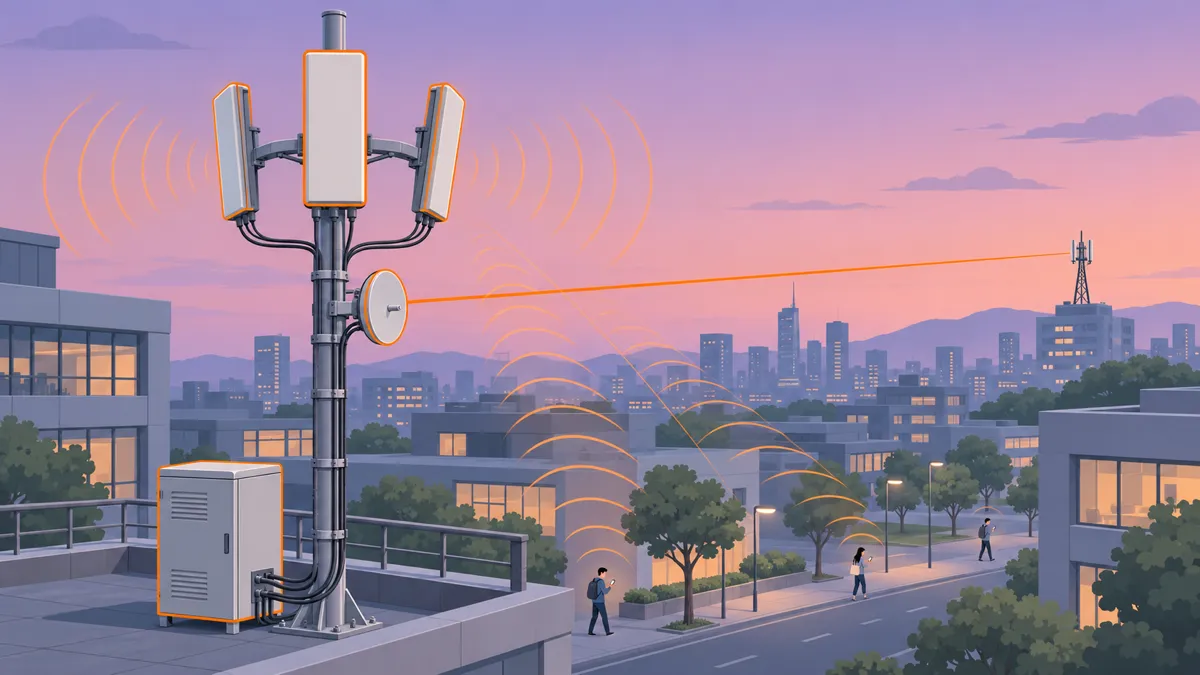
Telecom engineering, for most jobs in India today, means mobile networks: the radio access network (RAN) of towers, antennas and base stations that talks to your phone, the core network that authenticates you, sets up your data session and bills you, and the software, cloud platforms and test systems they run on. 4G LTE carries most traffic; 5G, launched in India in October 2022, adds a new radio (NR) and a cloud-native, service-based core.
The work splits into a few families, and the courses below follow them: protocol and software development (writing the C/C++ code of the LTE or 5G stack: RRC, PDCP, RLC, MAC), core network and telco cloud (5G core functions on OpenStack and Kubernetes), RF planning and optimisation (link budgets, coverage, drive tests, KPIs), and testing (writing test cases against a live or simulated network in Python, Robot Framework or TTCN-3).
Here is a calculation every 5G course gets to. NR scales its subcarrier spacing as 15 × 2μ kHz. Indian operators run 5G mostly in the 3.3 GHz band (n78) at μ = 1: 30 kHz subcarriers, so each 1 ms subframe holds 2 slots of 0.5 ms, 14 OFDM symbols each. A 100 MHz carrier at 30 kHz has 273 resource blocks of 12 subcarriers (3GPP TS 38.101-1), which occupy 273 × 12 × 30 kHz = 98.28 MHz, leaving 1.72 MHz as guard bands. That is 45,864 resource elements in every half-millisecond slot.
3GPP gives a formula for the peak rate in TS 38.306. With 4 MIMO layers, 256QAM (8 bits per symbol), the highest code rate (948/1024) and 14% overhead, those 273 blocks carry about 2.34 Gbps. Two catches. The formula ignores the TDD split: if 3 of every 5 slots are downlink, the downlink peak is about 1.4 Gbps. And a phone in the real world rarely gets 4 layers of 256QAM; with 2 layers of 64QAM the same carrier gives 876 Mbps before the TDD split. Explaining the gap between the spec sheet and a speed test is a standard interview question.
Coverage is the other half. Free-space path loss is 20 log10(d in km) + 20 log10(f in MHz) + 32.44 dB. At 1 km it is 103.3 dB at 3,500 MHz and 89.3 dB at 700 MHz, a difference of 13.98 dB (20 log10 5). In free space the 700 MHz signal would reach 5 times as far for the same loss; in a city, where loss grows closer to the 3.5th power of distance, it is about 2.5 times the range and 6.3 times the area per site. That is why operators pair a low band for coverage with mid-band 3.5 GHz for capacity, and it is the first line of every link budget in the planning and optimisation courses.
What a Telecom course covers
- 4G LTE. 3GPP releases, LTE bands and frame structure, resource blocks and bearers, the attach call flow, PDCP, RLC, MAC and the scheduler, PDCCH/PDSCH/PUCCH, handover and RACH, EPC nodes (MME, SGW, PGW, HSS), DIAMETER, GTP, S1AP, IMS and VoLTE.
- 5G core. AMF, SMF, UPF, AUSF, UDM, NRF, NSSF and PCF, the service-based architecture and REST interfaces, registration and PDU session call flows, 4G-5G interworking, QoS, policy and billing rules, network slicing, orchestration (ONAP, ETSI MANO), MEC and 5G security (SUPI, SUCI).
- 5G NR and Open RAN. NR numerology, FR1 and FR2, CORESET, search space and DCI, PRACH, reference signals, beam management and massive MIMO; the RAN protocol stack with code walkthroughs; O-RAN splits (7-2x), O-RU/O-DU/O-CU, the RAN Intelligent Controller and its interfaces.
- Telco cloud. Virtualisation, OpenStack and NFVi tuning (NUMA, CPU pinning, SR-IOV, DPDK), ETSI NFV MANO, SDN, Kubernetes, Helm, Istio, Prometheus and Grafana, and how a 5G core runs as containers.
- RF, planning and optimisation. Complex baseband, propagation and fading, MIMO and OFDM in MATLAB; link budgets, cell radius, sectorisation, Wi-Fi, microwave, fibre and satellite links; LTE coverage, capacity, accessibility, retainability and handover KPIs, drive-test analysis in Actix, VoLTE optimisation.
- Telecom software and testing. C for protocol stacks (bit fields, structures, sockets, threads, GDB) and C++; Wireshark and tcpdump for S1AP, X2AP, SIP and DNS traces; Python and pytest, Robot Framework and TTCN-3 test cases; Open5GS, UERANSIM and srsRAN labs; machine learning on RAN KPIs.
The courses in detail
C Programming for Telecom Engineers
C the way telecom protocol stacks use it: Linux and vi, bit manipulation, structures, unions and enums (with LTE examples), pointers, linked lists, threads and synchronisation, signals, makefiles, socket programming and GDB. Projects: RLC and MAC PDU decoders and an LTE cell manager and MAC scheduler simulation.
Projects include: Basic Telecom Platform Operations; RLC PDU Decoder; MAC PDU Decoder; LTE Cell Manager and Scheduler Simulation.
Tools: VirtualBox, Ubuntu 20.04, GCC, GDB
Fundamentals of Wireless Communication for Telecom Engineers using MATLAB
The physical layer in MATLAB: complex baseband models, antennas and RF front ends, propagation models and link budgets, multipath fading, channel estimation and equalisation, MIMO capacity, FDMA/TDMA/CDMA/OFDMA, OFDM system design, MIMO-OFDM, interference, beamforming and the LTE PHY frame. Projects: a multi-antenna link and a single-cell network simulation.
Projects include: Multi-Antenna Wireless Communication System Simulation using MATLAB; Simulation of a Single Cell Network using Various Propagation Models using MATLAB.
Tools: MATLAB
Telecom Testing (4G) using Python and Robot Framework
4G core (EPC) testing in 15 weeks: IP, GTP, DIAMETER and S1AP, the EPS architecture and call flows, bearers and QoS, LTE security, LTE procedures from attach to SRVCC, IMS and VoLTE, Linux tools and tcpdump, Python and pytest, manual test design, Robot Framework and TTCN-3. Projects: a GTPv2 stack in Python and a Robot Framework test that checks every IE in a Create Session Response.
Projects include: Bring-Up GTPv2 Stack with Python; Write a Testcase in ROBOT Framework to validate the IEs.
Tools: Python, WireShark, TTCN3, Bash Scripting
C Programming for Telecom Engineers and C++ Overview
The whole C for Telecom Engineers course plus about ten weeks of C++: OOP, inheritance and virtual functions, templates, exceptions, casts, smart pointers, std::thread and IPC. Same four projects (PDU decoders, LTE MAC scheduler simulation).
Projects include: Basic Telecom Platform Operations; RLC PDU Decoder; MAC PDU Decoder; LTE Cell Manager and Scheduler Simulation.
Tools: VirtualBox, Ubuntu 20.04, GCC, GDB, C++
5G Testing
Testing a 5G core: the network functions (AMF, SMF, UPF, PCF, CHF, UDM), bringing up a free 5G simulator in an Ubuntu VM with an Ansible playbook and Wireshark, then writing and running manual, white-box, black-box, corner-case and integration (IVT) test scenarios.
Tools: WireShark, Python, Docker, Ubuntu 20.04
Overview of 4G Networks and evolutions to 5G
A 3-week sampler: the first two weeks of the 4G (LTE) course (3GPP, OSI and IP basics, LTE bands, architecture, frame structure, channels) plus one week on IMT-2020 requirements, 5G core architecture and deployment options.
Projects include: Customization of LTE-Sim; Configuration of an LTE Network.
Tools: LTE-Sim, Open5GS
5G NR Protocol Stack
The first four weeks of the 5G NR RAN course: 5G basics, air interface, RAN-core interface and UE identifiers, then SDAP, MAC, PDCP and RLC with RRC and MAC code walkthroughs. No project.
Tools: WireShark, Open5GS, srsRAN, Source Insight, Oracle VirtualBox (for Windows), Ubuntu 20.04
Fundamentals of 5G
A 4-week overview of 5G: network evolution and IMT-2020 requirements, the cloud-native 5G core (SBA, NRF, NSSF, NEF), RAN deployment and O-RAN splits, the NR air interface (FR1/FR2, massive MIMO, beamforming, numerology), and a hands-on week setting up a 5G core, gNB and UE and reading the call flow in Wireshark.
Projects include: 5GC and UERANSIM Hands-on.
Tools: WireShark, VirtualBox
Open RAN
Open RAN in six weeks of lectures: why operators want open interfaces, 3GPP functional splits, the O-RAN reference architecture (O-RU, O-DU, O-CU, near-RT and non-RT RIC, O1/O2/A1/E2), fronthaul split 7-2x and eCPRI, RAN slicing, deployment options and market status. No hands-on project.
4G(LTE) - Architecture, Features and Call Flow
LTE end to end: 3GPP evolution, OSI and IP basics, LTE bands, frame structure and resource blocks, initial attach, PDCP, RLC, MAC and the scheduler (TB size and MCS), PDCCH, PDSCH and PUCCH, handover and RACH, EPC nodes (MME, SGW, PGW, HSS), VoLTE and a 4G-vs-5G week. Projects in LTE-Sim and Open5GS.
Projects include: Customization of LTE-Sim; Configuration of an LTE Network.
Tools: LTE-Sim, Open5GS
Telco Cloud
From vEPC to cloud native in 8 weeks: EPC architecture and CUPS, virtualisation, OpenStack, NFVi (NUMA, SR-IOV, DPDK), ETSI NFV MANO, SDN and data-centre networking, then Kubernetes, CNI (Calico), Helm, Istio, Prometheus and Grafana. Projects: an OpenStack NFVi and a Kubernetes PaaS.
Projects include: Building an NFVi based on OpenStack; Deploying Cloud Native PaaS using Kubernetes.
5G Core
The 5G core network: AMF, SMF, UPF, AUSF and UDM, service-based architecture and NF discovery, call flows and 4G-5G interworking, QoS, policy and billing rules (PDR, FAR, QER, URR), network slicing, orchestration (ONAP, ETSI MANO), MEC and 5G security (SUPI, SUCI). Project: a 5G core in Open5GS with UERANSIM.
Projects include: 5G Network Deployment 5GC and UERANSIM.
5G NR Radio Access Network
The 5G radio side with code walkthroughs: air interface and identifiers, SDAP, PDCP, RLC and MAC, CORESET, search space, DCI and MCS, PRACH and RRC, registration, PDU session and handover call flows, reference signals (DMRS, SRS, CSI-RS, PTRS), the MAC scheduler, beam management and massive MIMO. Projects: srsRAN with Open5GS, and PDU session modify in the RAN.
Projects include: Integration of srsRAN to Open5GS Core and UE Attach with DL/UL Data; Implementation of PDU Session Resource Modify in RAN.
Tools: WireShark
Network Analysis and Trouble Shooting Using Wireshark
Packet analysis in Wireshark, TShark, dumpcap and tcpdump: capturing and filtering traces, L1 to L4 analysis, Wi-Fi captures, DNS, DHCP, HTTP and SIP debugging, and LTE core logs (SCTP, S1AP, X2AP). Project: a Wi-Fi honeypot and an analysis of the traffic it attracts.
Projects include: Creating a Honeypot and Analysing Traffic.
Tools: WireShark, TShark, Dumpcap, TCPdump
Network Function Virtualization in 5G
Telco cloud plus the 5G core in 12 weeks: virtualisation and hypervisors, OpenStack, NFVi tuning (NUMA, CPU pinning, SR-IOV, DPDK), ETSI NFV MANO, data-centre networking and SDN, Kubernetes, Helm, Istio and Prometheus, then the 5G core functions, SBA, call flows and QoS/billing. Projects: an OpenStack NFVi and a Kubernetes PaaS.
Projects include: Build NFVi based on OpenStack; Deploy Cloud Native PaaS using Kubernetes.
Tools: VirtualBox, Lens (Kubernetes IDE), VMware Hol Lab, Openstack Training labs
Network Planning for Cellular and WiFi Systems
Planning cellular, Wi-Fi, microwave, fibre and satellite links: LTE PHY and 802.11 standards, coverage and capacity planning, link budgets and MAPL, cell radius and sectorisation, indoor Wi-Fi AP planning, backhaul design and availability, satellite link design, a business case model, and a demonstration in TEOCO ASSET. Projects: single-cell and multi-cell interference simulations in MATLAB.
Projects include: Simulation of a Single Cell Network using Various Propagation Models using MATLAB; Interference Modeling Simulations of a Multi-Cell Network using MATLAB.
Tools: MATLAB, TEOCO ASSET Suite
Network(RAN) Performance & Optimization
LTE RAN optimisation the way a drive-test or optimisation engineer does it: link budget and dimensioning, coverage problems (overshooting, holes, UL/DL imbalance) in Actix, PDCCH/PUCCH capacity and throughput, accessibility, latency and drop-call KPIs, handover optimisation, VoLTE and its features (RoHC, TTI bundling, SRVCC), RACH, carrier aggregation, PCI and tracking-area planning. Projects: drive-test actions and worst-cell KPI analysis.
Projects include: Network Design and Drive Test Principles; Network KPIs Optimization.
Telecom Transformation using AI and ML
A 48-week course in two halves: 4G and 5G NR (PHY and MAC enhancements, 5G core, O-RAN and the RIC), then 4G/5G performance counters and KPIs, channel models, NWDAF analytics and machine learning for the RAN (regression, LSTM, reinforcement learning, Bayesian optimisation) with case studies on traffic steering, slicing and root-cause analysis. Five projects incl. NS-3 5G simulation, QXDM/MobileInsight RAN analytics and KPI prediction.
Projects include: 5G Cellular Network design using NS3 Simulation; RAN Data analytics using MobileInsight or QXDM; Transport layer performance of Facebook 360 using Wireshark PCAP logs; Cloud-native microservices for real-time prediction and optimization.
Tools: NS3, MobileInsight, QXDM, PyTorch, scikit-learn, Keras, TensorFlow, Kubernetes
Jobs after a Telecom course
Typical job titles: protocol stack (L1/L2/L3) developer, 5G core or EPC engineer, RAN engineer, RF planning engineer, RF/drive test and optimisation engineer, telecom test or validation engineer, telco cloud or NFV engineer, VoLTE/IMS engineer, and network support engineer. Employers are telecom equipment makers and their R&D centres in Bengaluru, Chennai, Hyderabad and Gurugram, the operators, engineering services and testing firms, and tower and infrastructure companies.
From Skill-Lync's own placement records (as of 21 Nov 2026, 3,905 placements): only 1 has a telecom job title (a telecom engineer at a telecom equipment maker, who came from the PG Program in Electric Vehicle Design & Development, not from these courses). We cannot show a salary median or a list of hiring companies for telecom roles, so ask the counsellor for recent outcomes from the exact course before you pay.
Free Telecom tutorials
Start here before you pay for anything. These are written by Skill-Lync learners and engineers:
- What Is 5G? How 5G Technology Works, Explained With Real Numbers
- All You Need to Know about LTE Architecture
- What are the Layers of 5G Architecture?
- Network Function Virtualization (NFV): What It Is and How It Works
- Understanding the Differences Between SDN and NFV - Telecom
- Telecom Network Planning Engineer: Role, Skills, Tools and Salary
- Top 5 Skills Required for Telecom Engineers, With Worked Examples
- Frequently Asked 5G Telecom Interview Questions
Before you pay
Several courses are subsets of others. 5G NR Protocol Stack is the first four weeks of 5G NR Radio Access Network. Overview of 4G Networks and evolutions to 5G is two weeks of the 4G (LTE) course plus one week of Fundamentals of 5G. C Programming for Telecom Engineers is the first part of the C++ Overview course. Network Function Virtualization in 5G contains most of Telco Cloud and most of 5G Core. All of them cost ₹40,000, so buy the larger course, not both.
Weeks say little; hours say more. Open RAN runs 6 weeks with 4 hours of video and no project; Wireshark runs 12 weeks with 8 hours; Network Planning runs 12 weeks with 26. The fee is the same ₹40,000 for all of them.
Labs are open source, not operator equipment. The hands-on work uses Open5GS, UERANSIM, srsRAN, LTE-Sim, Wireshark and MATLAB, which is how most engineers learn, but no course gives you access to a vendor's live RAN or drive-test kit. Actix and TEOCO ASSET appear as demonstrations.
Most of these courses are not in the site menu. Only 5 of the 18 are; the rest are live and can be bought from their pages. Ask when the course content was last updated, especially for 5G, where 3GPP Releases 17 and 18 have added features since the courses were recorded.
Telecom placements are thin. We hold 1 telecom-titled placement record. None of these courses comes with a PG-style placement program.
Telecom course FAQs
What is the fee for a telecom or 5G course at Skill-Lync?
As of 21 Nov 2026: each of the 17 short telecom courses is ₹40,000, inclusive of all charges. Telecom Transformation using AI and ML, a 48-week course, is ₹2,00,000.
Which 5G course should I take first?
Fundamentals of 5G (4 weeks, 7 hours of video): it covers the 5G core, RAN and O-RAN, the NR air interface and a hands-on Open5GS/UERANSIM week. Then pick by role: 5G NR Radio Access Network for protocol developers, 5G Core or NFV in 5G for core and cloud roles.
What should I know before a telecom course?
Networking basics (OSI layers, IP addressing, TCP vs UDP), some Linux, and for developer roles C. For RF and planning roles, signals and systems and decibel arithmetic. The 4G (LTE) and Telecom Testing courses start with an OSI and IP refresher.
Is telecom a good career in India?
There is steady demand for 4G/5G protocol developers, core and cloud engineers, RF optimisation and test engineers at equipment makers, operators and engineering services firms. Our own placement data has only one telecom-titled record, so we cannot quote salaries; check current openings for the exact role.
What is the difference between 5G NR and the 5G core?
NR (New Radio) is the radio access side: the air interface between phone and base station (gNB) and its protocol stack. The 5G core is the network behind it: AMF for registration and mobility, SMF for sessions, UPF for user data, UDM and AUSF for subscribers and authentication. Skill-Lync teaches them in separate courses.
Do I need MATLAB for telecom?
Only for physical-layer and planning work: Fundamentals of Wireless Communication and Network Planning use MATLAB. Protocol, core, cloud and testing roles use C/C++, Python, Linux, Wireshark and open-source stacks such as Open5GS and srsRAN.