Differential: parts, diagram and how it works
The differential is the gearbox in the middle of a driven axle. It turns the drive through 90°, slows it down, and lets the two wheels turn at different speeds in a turn. Here an open bevel-gear differential, sized like a Dana 44 class rear axle (216 mm crown wheel, 3.73 : 1), is modelled in 3D, cut open, run straight, round a corner and onto ice, and checked with numbers from a Mahindra Thar.
By Skill-Lync · Published 24 Nov 2026 · Teaching model built and rendered in Blender from code
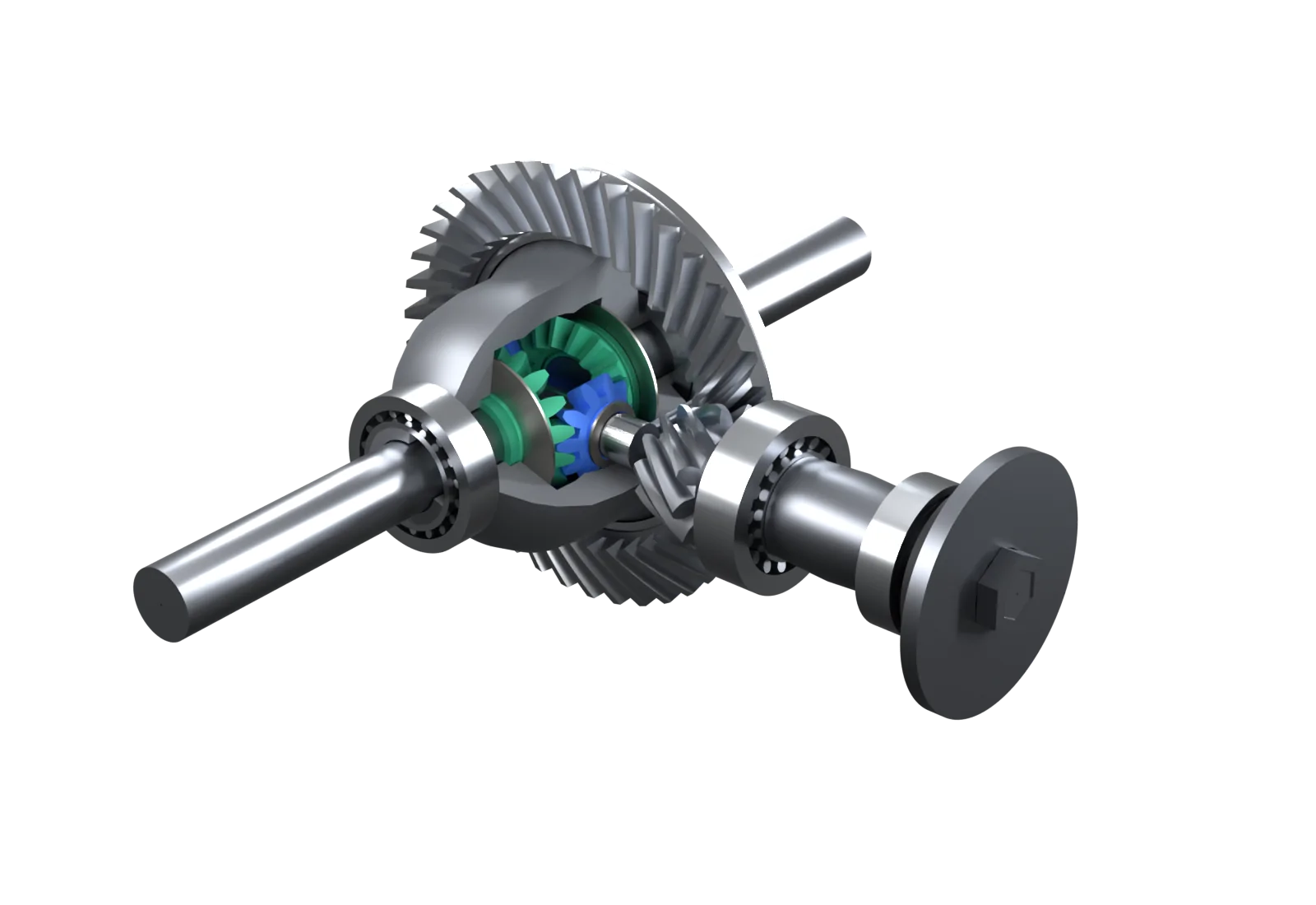
- 1Crown wheel (ring gear)
- 2Side (sun) gear
- 3Spider (planet) gear
- 4Differential case
- 5Carrier bearing
- 6Half shaft (axle)
- 7Cross pin
- 8Inner pinion bearing
- 9Drive pinion
- 10Outer pinion bearing
- 11Companion flange
What is a differential?
A differential is a gear unit in a car's driven axle that splits the engine's drive between the two wheels while letting them turn at different speeds. Its crown wheel and pinion turn the drive through 90° and reduce the speed; inside, spider gears and side gears let the outer wheel run faster than the inner one in a turn, with equal torque to both.
Think of two runners holding the ends of a bar and running round a track. The one in the outer lane has further to go, so must run faster, but they still push the bar along together. A solid axle would force both wheels to the same speed, so one tyre would have to skid on every turn. The differential lets them run at different speeds, and keeps their average equal to the speed of the crown wheel.
A teaching model: the crown wheel size, tooth counts, spline and setting numbers are sourced; other sizes are chosen. See the worked numbers and what is simplified.
Differential diagram (labelled)
Seen from above with the top half cut away, a rear-axle differential has the drive pinion coming in from the front on two tapered roller bearings, meshing with the crown wheel. The crown wheel is bolted to the differential case, which turns on two carrier bearings. Inside the case, spider gears on a cross pin mesh with two side gears splined to the half shafts.
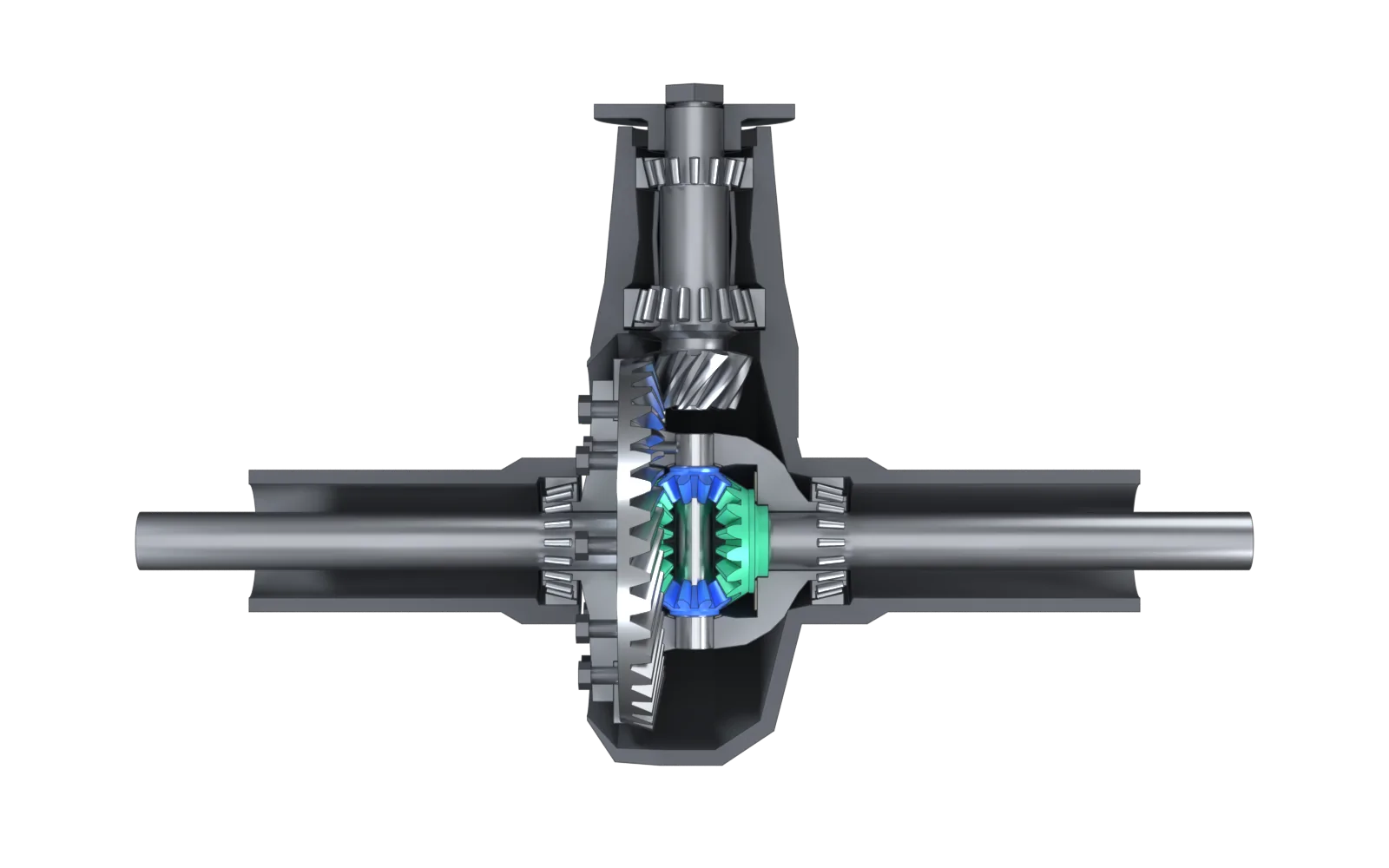
- 1Left side gear
- 2Crown wheel (ring gear)
- 3Crown wheel bolts
- 4Spider (planet) gear
- 5Carrier bearing
- 6Thrust washer
- 7Differential case
- 8Axle housing
- 9Companion flange
- 10Pinion oil seal
- 11Outer pinion bearing
- 12Collapsible spacer
- 13Inner pinion bearing
- 14Drive pinion
- 15Cross pin
- 16Right side gear
Parts of a differential and their functions
A rear-axle differential has a drive pinion and crown wheel that form the final drive, a case bolted to the crown wheel, a cross pin with two spider gears, two side gears splined to the half shafts, thrust washers, carrier and pinion bearings, a pinion seal and flange, and the axle housing that holds the oil.
| Part | What it does |
|---|---|
| Drive pinion | A small bevel gear on the end of the input shaft, driven by the propeller shaft through the companion flange. In a car's rear axle it is a hypoid gear with 11 teeth in this model. |
| Crown wheel (ring gear) | The large bevel gear the pinion drives: 41 teeth and 216 mm across on a Dana 44 class axle. Together the pinion and crown wheel are the final drive: they turn the drive through 90° and reduce speed, here 41 ÷ 11 = 3.73 : 1. |
| Crown wheel bolts | Self-locking bolts that clamp the crown wheel to the flange of the differential case (10 in this model), so the case turns with the crown wheel. |
| Differential case (carrier, cage) | A one-piece casting that carries the crown wheel and holds the differential gears inside. It turns on two carrier bearings. Real one-piece cases have openings to fit the gears through. |
| Cross pin (pinion shaft) | A steel shaft fixed across the case by a lock bolt. The spider gears turn freely on it, and it carries them round with the case. |
| Spider gears (planet gears, pinion mates) | Small bevel gears (two in a standard open axle, ten teeth here) on the cross pin. They mesh with both side gears. Straight ahead they do not spin; in a turn they spin on the pin and let the side gears run at different speeds. |
| Side gears (sun gears) | Two bevel gears (16 teeth here) facing each other inside the case, each splined to a half shaft. The ring and pinion never drive the half shafts directly; the drive always goes through the spiders to the side gears. |
| Thrust washers | Hardened washers behind each side gear and each spider gear. They take the gears' end thrust against the case; when they wear, the gears get end play and the axle knocks. |
| Half shafts (axle shafts) | Splined into the side gears at the inner end (30 splines, 33.3 mm on a Dana 44) and carried in wheel-hub bearings at the outer end. Each drives one wheel. |
| Carrier bearings | Two tapered roller bearings that support the case in the housing. Shims behind their cups set the bearing preload and the crown wheel's backlash. |
| Pinion bearings and collapsible spacer | Two tapered roller bearings, mounted facing apart, hold the pinion against the large thrust from the gear mesh. The collapsible spacer between them is crushed as the pinion nut is tightened, which sets their preload. |
| Pinion oil seal and companion flange | The seal keeps the gear oil in where the pinion shaft leaves the housing; the flange (or yoke) connects the propeller shaft. |
| Axle housing | The casting and tubes that hold all of this, carry the vehicle's weight and hold the gear oil (GL-5 hypoid oil, SAE 80W-90 for this axle family). |
Differential gear names: spider gears and side gears
Inside the case are four bevel gears in a box: two side (sun) gears facing each other on the axle line, each splined to a half shaft, and two spider (planet) gears on the cross pin between them, meshing with both. The crown wheel never touches the half shafts: all the drive goes case, cross pin, spiders, side gears.
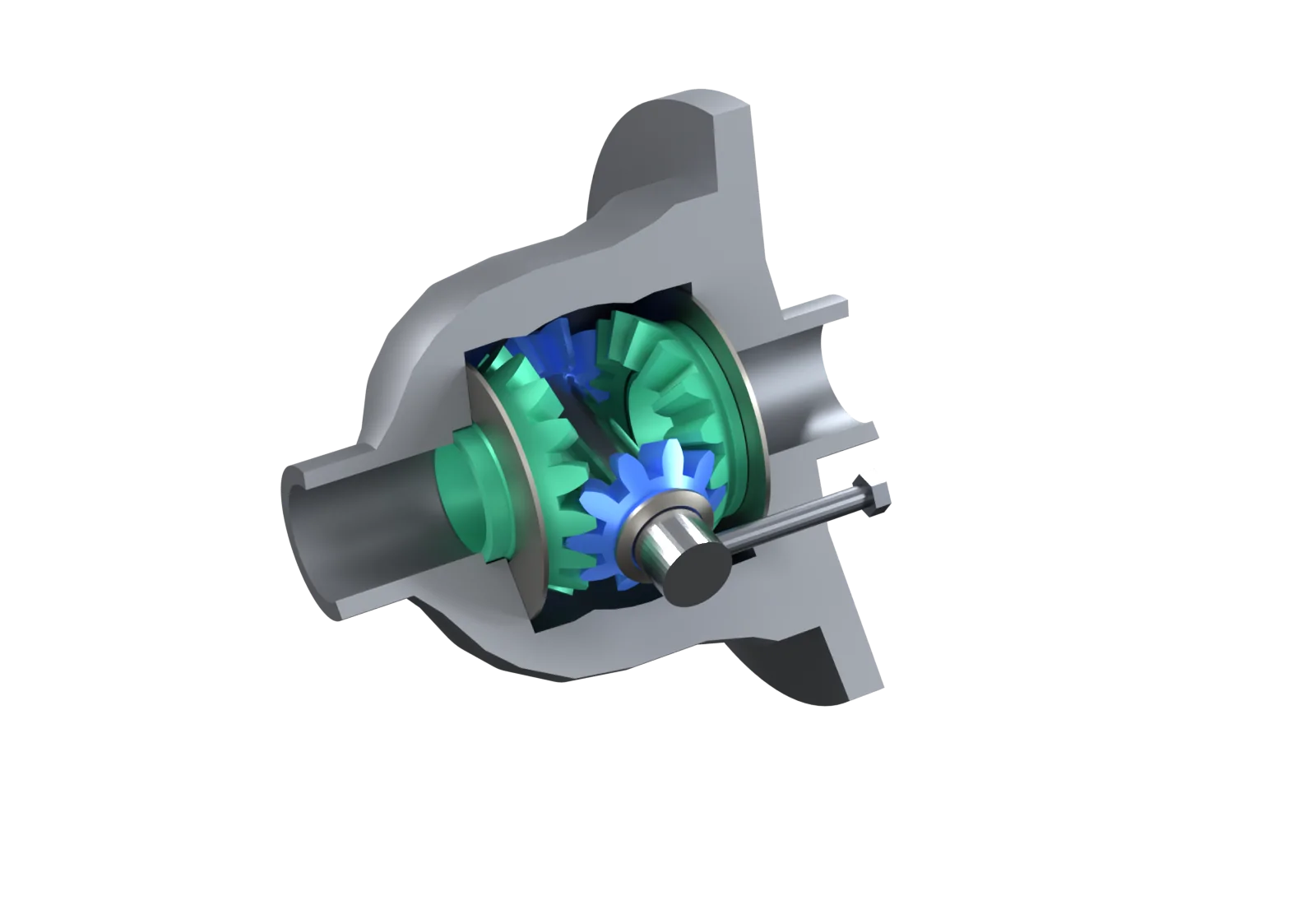
- 1Differential case
- 2Spider gear
- 3Cross pin
- 4Right side gear
- 5Spider (planet) gear
- 6Left side gear
- 7Spider thrust washer
- 8Pin lock bolt
| Gear | What it does |
|---|---|
| Two side gears | Facing each other on the axle line. Each is splined to one half shaft, so each wheel is connected to one side gear and nothing else. |
| Two spider gears | On the cross pin, between the side gears, meshing with both. They are the only link between the case and the side gears. |
| Cross pin and lock bolt | The pin goes through both walls of the case and through the spiders; a bolt across its end stops it sliding out. |
| Thrust washers | Behind every gear. The spider washers are usually dished to match the case's spherical inside. |
| Case | Turns with the crown wheel and carries the pin. Its inside is shaped round the gears; the side gears' hubs turn in its bores. |
Differential working principle
Straight ahead, the crown wheel turns the case and the spider gears go round with it without spinning, so both wheels turn at the crown wheel's speed. In a turn the inner wheel slows; the spiders roll round its side gear and spin on their pin, which speeds the outer wheel up by the same amount. Torque to the two wheels stays equal.
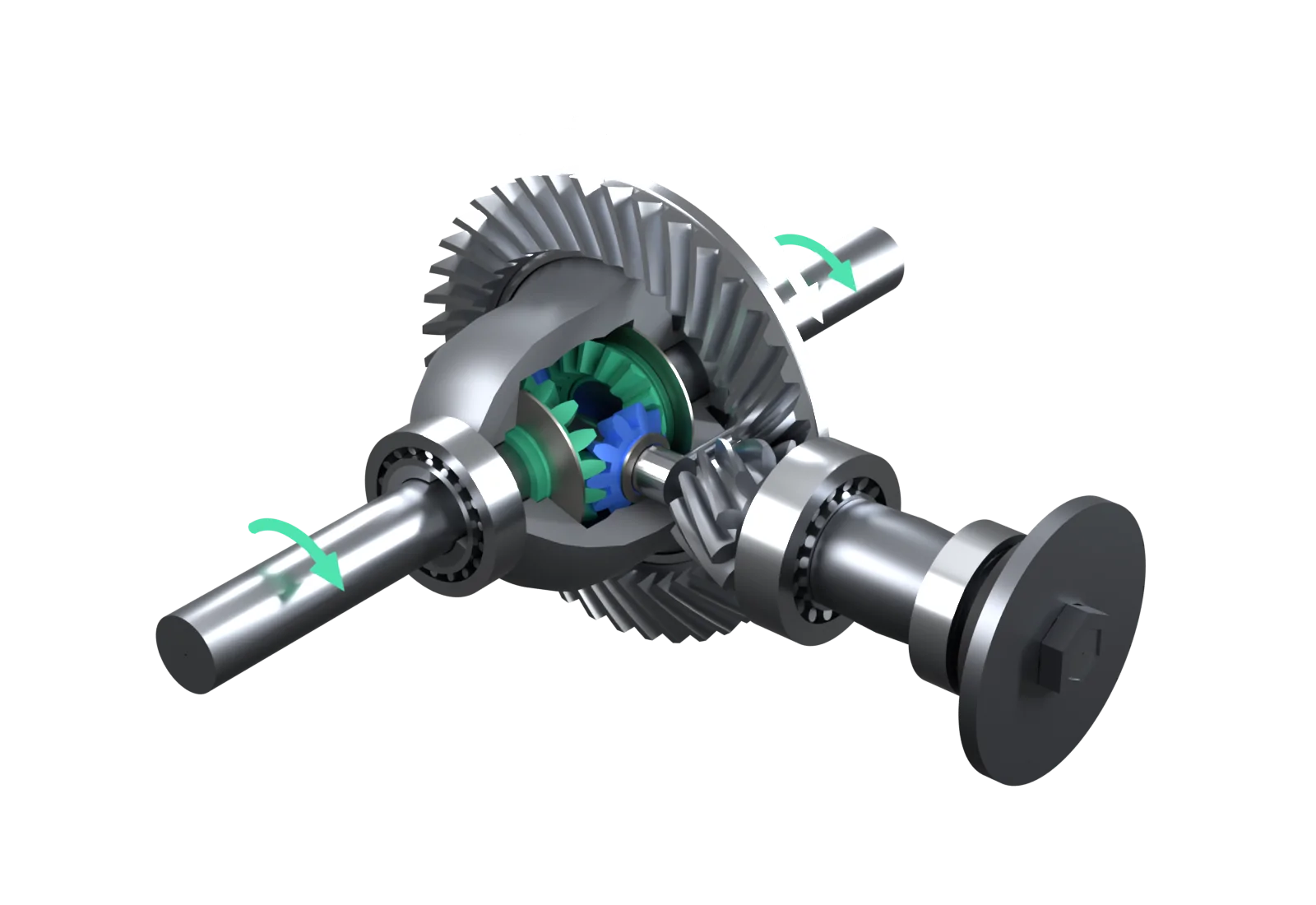
- 1Crown wheel (ring gear)
- 2Crown wheel and case: 100%
- 3Left wheel: 100%
- 4Right wheel: 100%
- 5Right side gear
- 6Spider (planet) gear
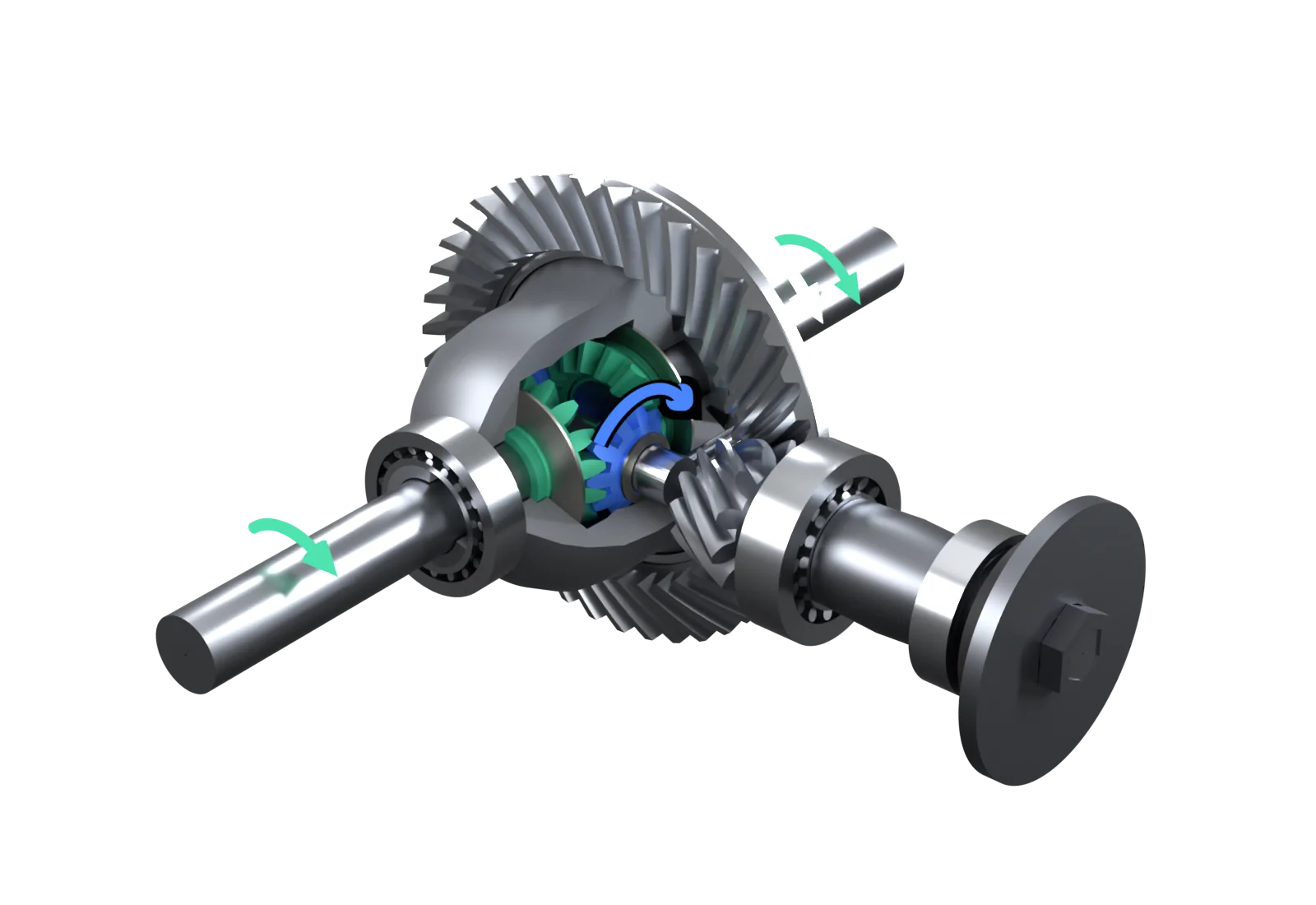
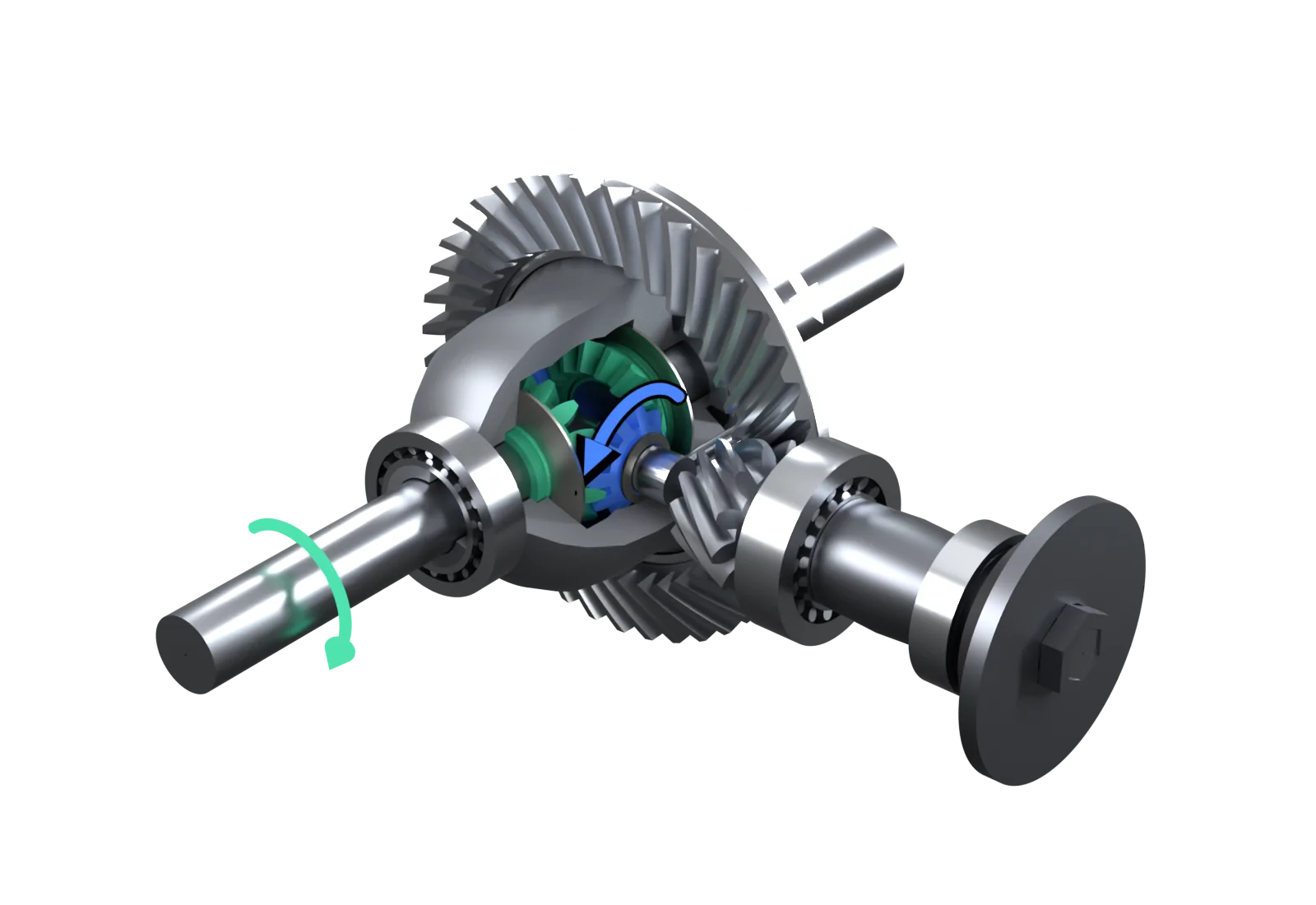
1. Straight ahead: everything turns together. The drive pinion turns the crown wheel, and the crown wheel turns the differential case. The case carries the cross pin round with it, and the spider gears on the pin push on both side gears equally. With both wheels on the road at the same speed, the spiders do not turn on their pin at all: the case, the spiders and both side gears go round as one block, so each wheel turns at the crown wheel's speed.
2. Turning right: the outer wheel speeds up. In a right-hand turn the left wheel runs on the bigger circle. The road slows the right side gear, so the spiders now roll round it and spin on the cross pin, and that spin adds speed to the left side gear exactly as much as the right one lost. In a 6 m turn at 15 km/h on a Thar-size axle, the wheels turn at 88 and 114 rpm while the crown wheel turns at 101 rpm: their average.
3. One wheel on ice: the catch. If the right wheel is on ice, it needs almost no torque to turn, and an open differential always gives both wheels the same torque. So the left wheel, on good grip, gets only the little the icy wheel can take, and stops. The case still turns, the spiders spin on the pin, and the icy wheel turns at twice the case speed. This is the open differential's weakness, and what limited-slip and locking differentials fix.
Arrows show which way each part turns for a car going forward. The angle each mint arc sweeps is in proportion to its wheel's speed as a share of the crown wheel's (the white arc is larger only because it is drawn round the crown wheel). White: the crown wheel and case. Mint: the wheels (side gears). Blue: the spiders spinning on the cross pin, which they only do when the wheel speeds differ; that arrow shows direction, not speed (in the turn they spin at about a fifth of the case speed, on ice at 1.6 times). The turn uses the Thar numbers below (113% and 87%).
Differential speeds and torque, with numbers
The crown wheel always turns at the average of the two wheel speeds: nL + nR = 2 ncase, called Willis' formula. Torque is split equally. On a Mahindra Thar-size rear axle (1,520 mm track, 255/65 R18 tyres), a 6 m turn at 15 km/h has the inner wheel at 88 rpm, the outer at 114 rpm and the crown wheel at 101 rpm.
| Step | Value | Note |
|---|---|---|
| Rear track, tyres, final drive | 1,520 mm · 255/65 R18 · 4.3 : 1 | Mahindra Thar 4WD brochure (2025) |
| Tyre diameter / rolling radius | 788.7 mm / 0.394 m | 18 × 25.4 + 2 × 0.65 × 255; unloaded, a real loaded radius is a few % smaller |
| Straight at 60 km/h | 404 rpm wheels, 1,737 rpm propeller shaft | both wheels turn at the crown wheel's speed |
| Turn: rear-axle centre on a 6 m circle at 15 km/h | crown wheel 101 rpm | 6 m is a chosen value: published Thar turning radii disagree |
| Inner wheel (5.24 m circle) | 88 rpm | 6.0 − 1.52 / 2 |
| Outer wheel (6.76 m circle) | 114 rpm | 6.0 + 1.52 / 2; 1.29 times the inner wheel |
| Check: inner + outer | 88.2 + 113.8 = 202 = 2 × 101 | Willis' formula holds |
| Each side gear relative to the case | ± 12.8 rpm | one speeds up as much as the other slows down |
| Spider speed on the cross pin | 20.5 rpm | 12.8 × 16 / 10 with this model's 16- and 10-tooth gears |
| Crown wheel torque | 1,290 N·m | 300 N·m × 4.3, assuming 1 : 1 in the gearbox (Thar gear ratios not published), no losses |
| Each half shaft | 645 N·m, 1,637 N at the tyre | equal split, in the turn as well as straight |
Equal torque at different speeds means the two wheels do not get equal power: power is torque times speed, so in the turn the outer wheel carries about 29% more power than the inner one. And the propeller shaft does not notice the turn at all: it keeps turning at 4.3 × 101 = 434 rpm.
The catch: equal torque means the weakest wheel sets the limit
The same equal split that makes a differential smooth in turns is what gets cars stuck. "If one wheel slips, the other wheel can only put out as much torque as the slipping wheel" (Spicer). Put the Thar's right rear wheel on ice with a chosen 3,500 N on that wheel and µ = 0.1: it can take only 0.1 × 3,500 × 0.394 = 138 N·m before it spins. The left wheel then gets 138 N·m too, whatever its grip.
| Differential | Ice wheel | Good wheel | Axle total | vs open |
|---|---|---|---|---|
| Open differential | 138 N·m | 138 N·m | 276 N·m | 1 × |
| Torque-sensing LSD, bias ratio 2.5 : 1 | 138 N·m | 345 N·m | 483 N·m | 1.75 × |
| Torsen-type LSD, bias ratio 4 : 1 | 138 N·m | 552 N·m | 690 N·m | 2.5 × |
| Locked (diff lock) | 138 N·m | up to all the grip allows | much more | – |
A limited-slip differential lets the good wheel take more, up to its bias ratio; Gleason gives a 4 : 1 unit about two and a half times the axle torque of an open one, which is what the table shows. A diff lock removes the limit but forces both wheels to the same speed, so it is for low speed and loose ground only. Meanwhile the open differential spins the icy wheel at twice the case speed and the spiders fast on their pin, which is how spinning a wheel for long scores the spider gears.
Assumed values: the 6 m turn radius (published Thar figures disagree), a 1 : 1 gearbox for the torque line, no losses, the unloaded tyre radius, and the 3,500 N wheel load and µ = 0.1 on ice. Every number here is recomputed by a script kept with the model files.
Crown wheel and pinion: ratio, hypoid offset and backlash
The crown wheel and pinion are the final drive. Their ratio is the crown wheel's teeth divided by the pinion's: 41 ÷ 11 = 3.73 : 1 here, the Thar uses 4.3 : 1. In cars they are hypoid gears, with the pinion below the crown wheel's centre, and they are set up to 0.12 to 0.20 mm of backlash.
Hypoid offset lowers the propeller shaft, for a lower floor, and lets the pinion be bigger and stronger with more teeth in contact. The cost is that the teeth slide along each other under high pressure, so "the correct high-pressure hypoid oil is mandatory" (Gleason): GL-5 gear oil. Setting up is done with shims: shims under the pinion set its depth, the collapsible spacer sets the pinion bearing preload, and shims behind the carrier bearing cups set the backlash, which must not vary by more than 0.05 mm around the crown wheel (Jeep JK service manual). A tooth contact pattern check then confirms the mesh.
This model draws the pair as a spiral bevel set (35° spiral angle) with the pinion on the crown wheel's centre line, because that is what the bevel geometry here can show exactly. A real Dana 44's pinion sits about 38 mm (1.5 in) lower.
Differential assembly: exploded view
Along the axle: the half shafts, carrier bearings, side gears and thrust washers come out of the case on each side; the spider gears and cross pin lift out through the case's window; the crown wheel unbolts from the case flange and slides off over the case's narrow end. Along the pinion: the pinion, inner bearing, collapsible spacer, outer bearing, seal, companion flange and nut.
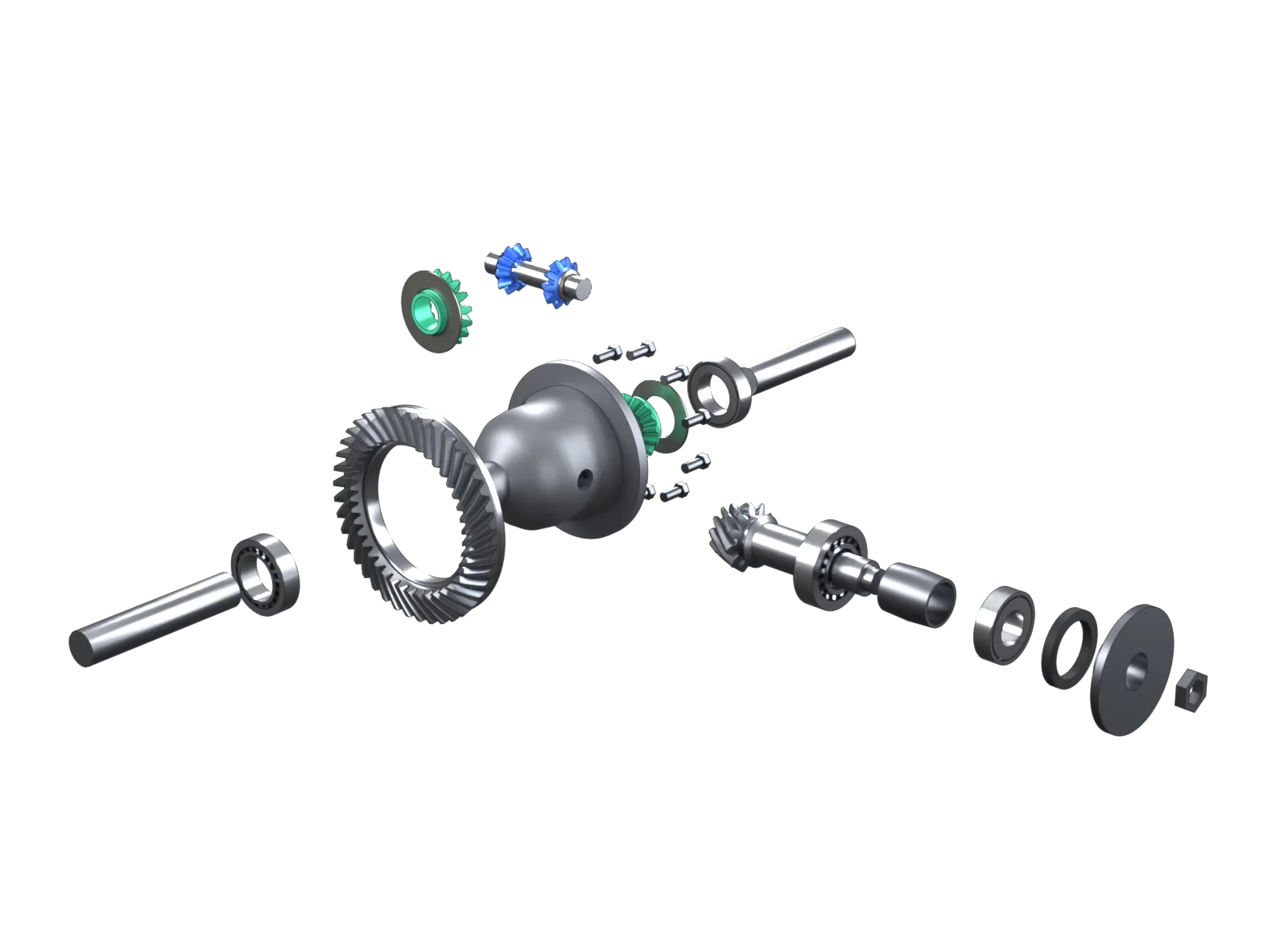
- 1Crown wheel (ring gear)
- 2Right side gear
- 3Differential case
- 4Spider gears on the cross pin
- 5Crown wheel bolts
- 6Carrier bearing
- 7Left half shaft
- 8Right half shaft
- 9Left side gear
- 10Drive pinion
- 11Pinion bearings
- 12Collapsible spacer
- 13Pinion oil seal
- 14Companion flange
Differential dimensions: front and top views
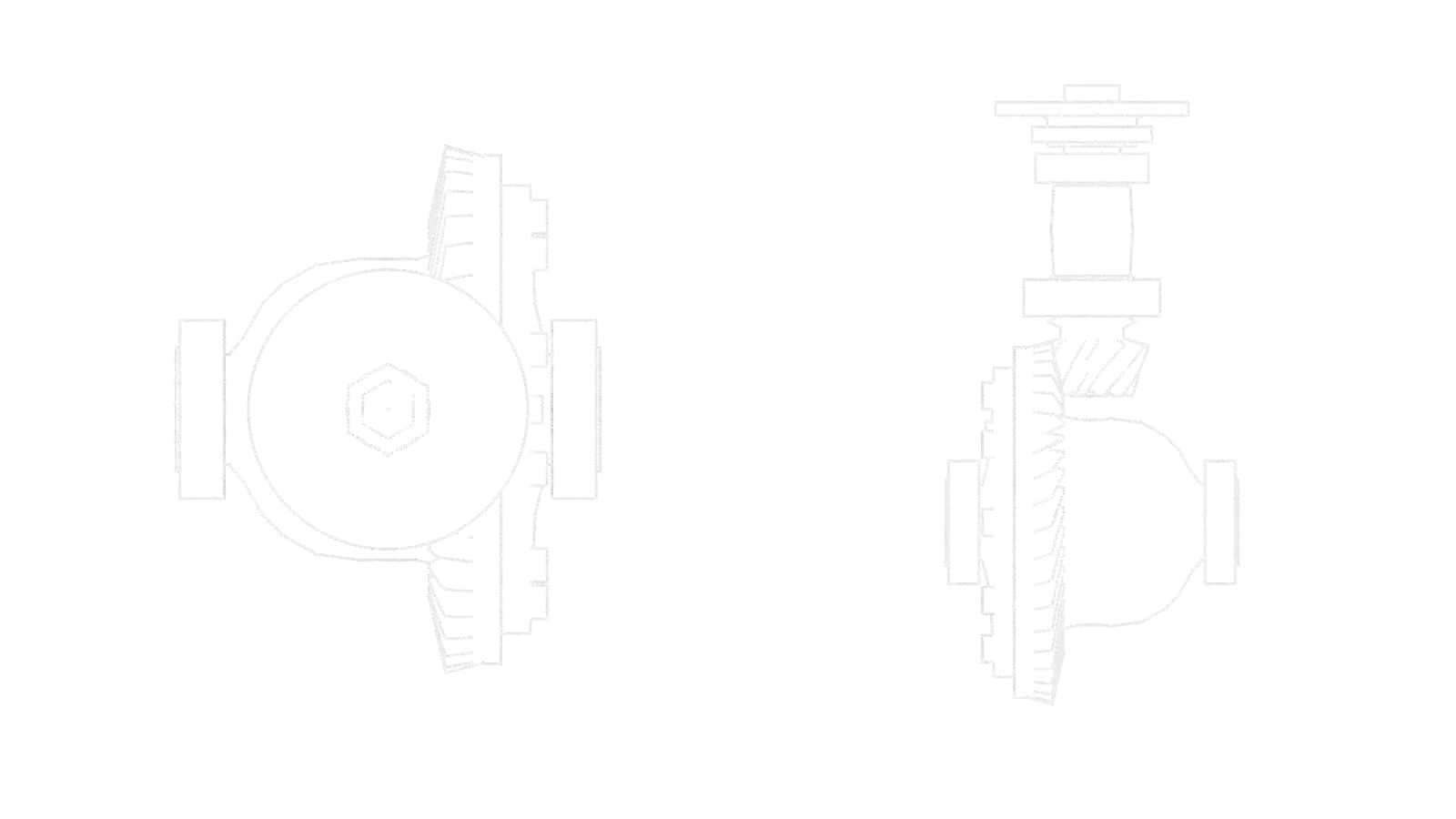
| Dimension | Value | Basis | |
|---|---|---|---|
| A | Crown wheel pitch diameter | 216 mm | Dana 44/216 (Spicer catalogue) |
| B | Across the carrier bearings | 176 mm | This model (bearings 45.6 × 74 × 20 mm; bore from a parts maker's data) |
| C | Diff centre to pinion nut | 263 mm | This model |
| – | Crown wheel / pinion teeth | 41 / 11 (3.73 : 1) | Spicer catalogue |
| – | Side / spider gear teeth | 16 / 10 | Chosen: one of the usual pairs (Dana patent: 14 × 10, 16 × 10, 13 × 9) |
| – | Half shaft spline | 30 splines, 33.3 mm (1.31 in) | Spicer catalogue |
| – | Cross pin | Ø22 mm | Chosen |
| – | Crown wheel backlash (stated, not drawn) | 0.12 to 0.20 mm | Jeep JK factory service manual |
Types of differential in automobiles
The main types are the open differential, limited-slip differentials (clutch-pack, gear-type Torsen and viscous), locking differentials (diff locks), electronic brake-based differential locks that use the ABS, and torque-vectoring differentials that actively move torque across the axle.
| Type | How it works | Where you find it |
|---|---|---|
| Open differential (this model) | Bevel gears only; torque always split equally | Most cars' driven axles, the rear axle of most light trucks |
| Clutch-pack limited-slip (Trac-Lok, Powr-Lok) | Clutch plates between the side gears and the case, preloaded by springs and squeezed harder by the gear separating forces | Performance cars, pickups, off-roaders |
| Gear-type (Torsen) limited-slip | Worm or helical gears whose friction lets one side take more torque, up to the bias ratio (2.5 : 1 to 6 : 1) | Performance cars, some AWD centre differentials |
| Viscous limited-slip | A sealed viscous coupling across the differential: speed difference shears the fluid and transfers torque | Older AWD cars, centre differentials |
| Locking differential (diff lock) | A dog clutch or locker joins a side gear to the case, so both wheels turn together | Off-roaders (the Thar's 4WD has a mechanical locking differential), tractors, trucks |
| Electronic (brake-based) differential lock | An open differential plus ABS: the brakes slow the spinning wheel, so torque goes to the other | Most modern cars with traction control; the Thar's Electronic Brake Locking Differential |
| Torque-vectoring differential | Clutches or motors that control both how much and which way torque moves across the axle | Performance AWD cars |
Limited-slip units are grouped as speed-sensing (a viscous coupling: the faster the wheels slip apart, the more it resists) or torque-sensing (ramp or Salisbury clutch types, and Torsen gears: the more torque goes in, the harder they lock). Front-wheel-drive cars put the differential inside the gearbox (a transaxle), with the same spider and side gears.
Open differential vs limited slip vs diff lock
An open differential gives both wheels equal torque and lets their speeds differ freely; a limited-slip differential lets the wheel with grip take more torque, up to its bias ratio; a diff lock forces both wheels to the same speed. Road cars need speeds to differ; getting out of mud needs torque to differ.
| Open | Limited slip | Diff lock (engaged) | |
|---|---|---|---|
| Torque to each wheel | Always equal | Unequal, up to the bias ratio | Equal speed, any torque split |
| Wheel speeds in a turn | Free to differ | Free to differ, some resistance | Forced equal (tyres scrub) |
| One wheel on ice | Car can get stuck | Good wheel gets 1.75 to 2.5 times more axle torque | Car pulls away |
| When to use | Always (road) | Always (road and light off-road) | Only at low speed, off-road, straight |
Differential problems and symptoms
Common differential problems are a whine that changes between drive and coast (gear mesh or backlash), noise only in turns (spider and side gears), a clunk when taking up drive (too much backlash), a knock at low speed (worn thrust washers or cross pin), bearing whine that rises with road speed, and oil leaks at the pinion seal.
| Problem | What you notice | Usual causes |
|---|---|---|
| Whine that changes between drive and coast | A howl or whine at a certain speed, which changes or stops when you lift off and coast | Low oil, wrong crown wheel backlash or tooth contact, worn or damaged gears (Jeep JK service manual) |
| Noise only when turning | Quiet straight ahead, noisy in turns | The side and spider gears: they only work hard in turns |
| Clunk when taking up drive | A clunk or snap when you let the clutch out or change from drive to reverse | Too much backlash, worn side gear to case clearance, also U-joints or a loose pinion nut |
| Knock at low speed | A knock every wheel turn when crawling | Worn side gear thrust washers, a worn cross pin or its bore, or a worn U-joint |
| Bearing noise | A whine or growl that rises with road speed, not engine speed; pinion bearings are higher pitched, carrier bearings lower | Worn pinion or carrier bearings (rear pinion bearing if heard under load, front if heard on the coast) |
| Oil leak | Wet patch at the front of the axle or behind a wheel | Worn pinion seal or flange, worn axle shaft seals, an unsealed cover, or too much oil |
| Scored spider gears | Noise and roughness after getting stuck | Spinning one wheel for a long time (on ice or in mud) spins the spiders fast on the pin; low or wrong oil |
Causes are from the Jeep Wrangler JK factory service manual's rear axle diagnosis, which covers the same Dana axle family.
Differential interview and viva questions
Why does a car need a differential?
In a turn the outer wheel travels a bigger circle than the inner one, so it must turn faster. If both wheels were fixed to one shaft, one tyre would have to slip on every turn, which makes the car hard to steer and wears the tyres. The differential lets the two driven wheels turn at different speeds while both still get drive.
Show that the crown wheel turns at the average of the two wheel speeds.
Relative to the case, the differential is a bevel gear train in which the two side gears turn in opposite directions at the same speed (equal side gears, ratio −1). So n_L − n_case = −(n_R − n_case), which gives n_L + n_R = 2 n_case. With the propeller shaft held still (n_case = 0), turning one wheel turns the other backwards.
Why does an open differential get stuck with one wheel on ice?
Because it always splits torque equally. The wheel on ice can only react a small torque before it spins, and the other wheel gets the same small torque, so the axle's total is about twice what the icy wheel can take. On our numbers: 138 N·m on the ice wheel, 138 N·m on the good one, 276 N·m in all.
What is torque bias ratio?
The highest ratio of the torque on the higher-torque axle shaft to the torque on the lower one that a limited-slip differential can hold before it lets the wheels slip. A 4 : 1 differential can give the axle about 2.5 times the torque an open one gives with the same low-grip wheel (Gleason).
Why are car rear axles hypoid, and what does that need?
Offsetting the pinion below the crown wheel's centre lets the propeller shaft sit lower, for a lower floor, and gives a bigger, stronger pinion with more teeth in contact. The price is sliding along the teeth, so hypoid gears must run on high-pressure (EP, GL-5) hypoid oil.
About this 3D model
A teaching model, not a copy of one manufacturer's axle. The 216 mm crown wheel, the 41/11 tooth counts (3.73 : 1), the 30-spline 33.3 mm half shafts, the two spider gears, the cross pin lock bolt and the bearing arrangement follow the Dana (Spicer) 44/216 open differential and its service data. The 16-tooth side gears and 10-tooth spiders are one of the usual pairs from a Dana patent; the bearing, pin, case and housing sizes are chosen values. Simplified: the crown wheel and pinion are drawn as spiral bevel gears with no hypoid offset; splines are plain bores; the shims, oil, rear cover, C-clips and wheel ends are left out, and the hero and gear views cut a window in the case. Skill-Lync modelled and rendered it in Blender entirely from code, with each bevel gear's teeth generated on its pitch cone, so it can be checked and re-rendered.
Related Skill-Lync courses and reading
- Vehicle Dynamics using MATLABModel the driveline from engine torque through the final drive and differential to tyre forces, in straight lines and turns.
- Hybrid Electric Vehicle Design and Analysis (Master's)Powertrain architectures, including single-speed reduction and differential layouts in electric and hybrid drivelines.
- Multibody Dynamics using SolidWorksBuild gear trains and mechanisms like this one in a motion study and check their speeds.
- Automobile Engineering interactive book: propeller shaft, universal joints, differential and rear axle
- How a car's manual gearbox works
- How powertrains and transmissions shape vehicle performance
- Planetary gear calculator (the same Willis relation, for epicyclic gears)
- Gear design calculator
- Single plate clutch in 3D (the other end of the driveline)
- More parts in 3D: all engineering components
FAQs
What is a differential in a car?
A gear unit in the driven axle that takes the drive from the propeller shaft, turns it through 90° and reduces its speed (the final drive), and splits it between the two wheels so they can turn at different speeds in a turn while both still get the same torque.
What are the parts of a differential?
The drive pinion and crown wheel (the final drive), the differential case that carries the crown wheel, the cross pin, two (or four) spider gears, two side gears splined to the half shafts, thrust washers, carrier bearings, pinion bearings with a collapsible spacer, the pinion seal and companion flange, and the axle housing.
What is the working principle of a differential?
The crown wheel turns the case, and the case carries spider gears round that mesh with both side gears. Straight ahead the spiders do not spin and both wheels turn at the crown wheel's speed. In a turn the spiders spin on their pin, so one side gear speeds up exactly as much as the other slows down: the crown wheel's speed is always the average of the two wheel speeds.
Why is a differential used in automobiles?
So the driven wheels on one axle can turn at different speeds in turns without the tyres scrubbing, which keeps steering easy and saves tyres. In a 6 m turn the outer rear wheel of a Thar-size car turns about 29% faster than the inner one.
What is the difference between an open differential and a limited slip differential?
An open differential always gives both wheels the same torque, so the wheel with the least grip limits the whole axle. A limited-slip differential resists the speed difference with clutches, gears or fluid, so it can send more torque to the wheel with grip, up to its bias ratio.
What is a differential lock?
A lock that joins the two sides of the differential so both wheels turn at the same speed whatever their grip. It gets a vehicle out of mud or snow, but must be off on dry roads and in turns, because the tyres then have to scrub. Tractors, trucks and off-roaders such as the Mahindra Thar 4WD have one.
How many spider gears are in a differential?
Usually two in a car's or light truck's standard open differential, and four in heavier-duty and many limited-slip units (Dana's Powr-Lok, for example). Four share the load between more teeth.
What oil does a differential use?
Hypoid gear oil to API GL-5, SAE 80W-90 for the Dana 44 family: the hypoid crown wheel and pinion slide along their teeth under high pressure and need the extreme-pressure additives. Limited-slip units may need a friction modifier.
Sources
- Dana Limited, Spicer light axle catalogue (2014) (Dana 44/216 ring gear diameter, ratios and tooth counts, 30-spline 1.31 in shafts, Trac-Lok and Powr-Lok, equal torque on the axle shafts) · Spicer Model 44 maintenance manual (GL-5 80W-90, clutch-pack LSD)
- Chrysler, 2010 Jeep Wrangler JK service manual, rear axle diagnosis and pinion depth, bearing preload and backlash (0.12 to 0.20 mm, 0.05 mm variation, noise and fault chart)
- CBSE, Automotive handbook (subject 804), Unit 4: differential and rear axle (parts, working, hypoid gears)
- M. Gadola, D. Chindamo, B. Lenzo, Revisiting the mechanical limited-slip differential, Engineering Letters 29(3), 2021 (Willis' formula, equal torque split, LSD types, Pecqueur 1827)
- S.E. Chocholek (Gleason), The development of a differential for the improvement of traction control, IMechE C368/88 (bias ratio, 2.5 : 1 to 6 : 1, twice the least-traction wheel) · H. Stadtfeld, Hypoid gears, Gear Technology 2011 (offset, sliding, hypoid oil)
- US 6,964,629 B2, Differential gears with optimized number of teeth (14 × 10, 16 × 10, 13 × 9) · Mahindra Thar brochure (2025) (track, tyres, final drive, torque, locking differentials) · Down To Fab tech specs (Dana 44 hypoid offset)