UDS Protocol (ISO 14229) Explained: Service IDs, NRCs and a Byte Trace
A fresher's guide to Unified Diagnostic Services under ISO 14229-1:2026: the tester-ECU model, where UDS sits on ISO-TP and DoIP, sessions and P2/P2* timing, service ID and NRC tables, a VIN read traced frame by frame, seed/key security, the DTC status byte, a worked ECU flashing sequence, how UDS differs from OBD-II, and the embedded jobs in India that use it.

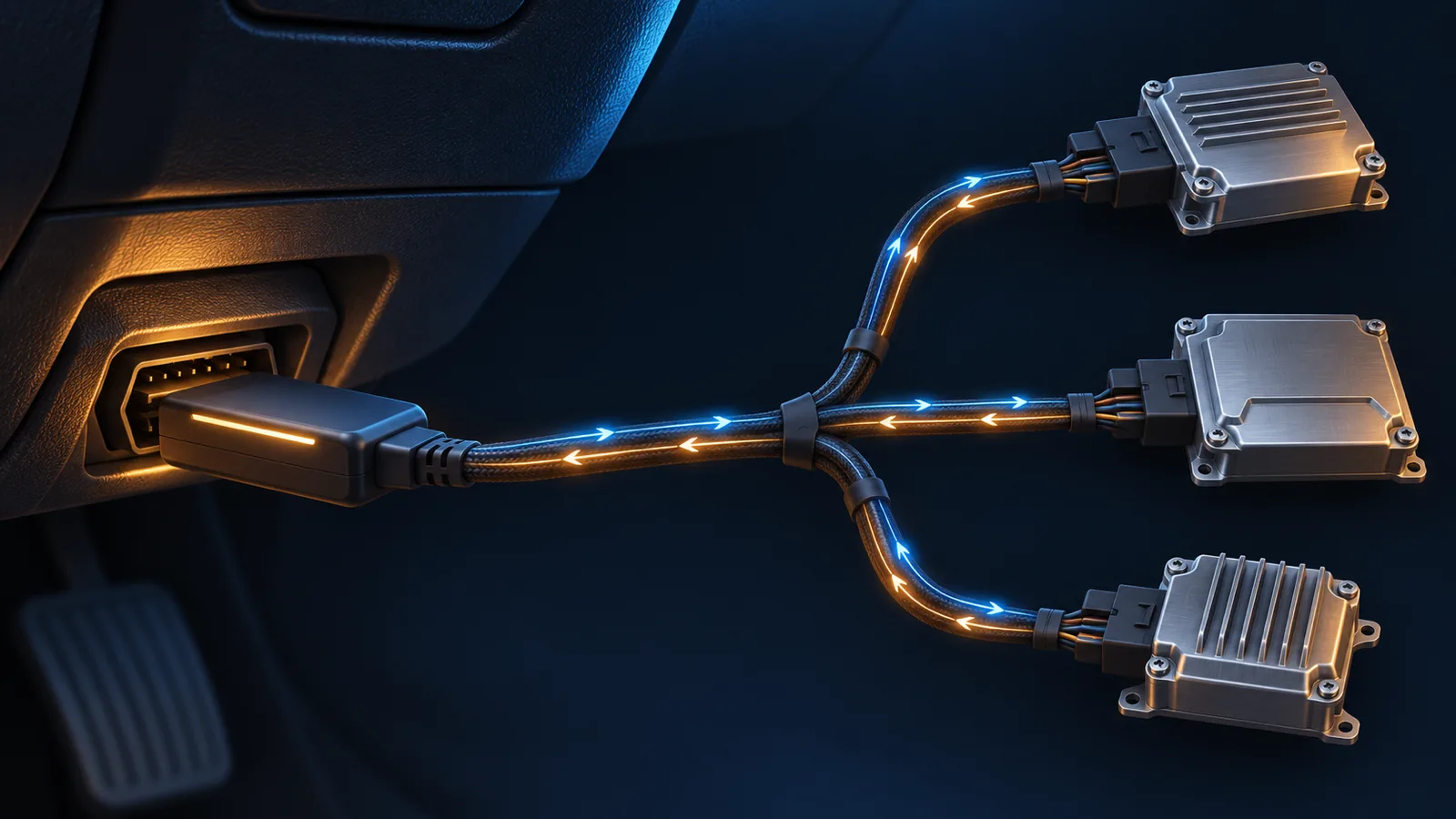
UDS (Unified Diagnostic Services) is the request-and-response protocol a diagnostic tester uses to talk to a car's electronic control units (ECUs). It is defined in ISO 14229-1, whose current edition, the fourth, was published in June 2026. The tester sends a one-byte service ID such as 0x22 (read data) plus parameters. The ECU answers with that ID plus 0x40 if it succeeds, or with 0x7F, the ID and a negative response code if it refuses. On CAN, the bytes travel over ISO-TP (ISO 15765-2); on Ethernet, they travel over DoIP (ISO 13400-2).
This guide is for students and freshers in India who meet "UDS" in automotive embedded and validation job descriptions. It gives the service IDs and negative response codes as tables, traces one VIN read frame by frame, and decodes a session response, a DTC status byte and a flash download, with every byte generated and checked by a script. ISO's text is paid, so the values were checked against the AUTOSAR diagnostic specification and open-source UDS implementations listed under Sources.
In short
- Current edition: ISO 14229-1:2026 (edition 4, valid from 5 June 2026, 434 pages). It replaces the 2020 edition and its 2022 amendment (EVS and SIS catalogues). ISO has not published a free list of what changed.
- Message rule: a positive response is the request SID + 0x40 (0x22 becomes 0x62), and a negative response is
7F <SID> <NRC>. NRC 0x78 means "busy, wait": the ECU then gets up to P2* instead of P2 to answer.- Typical timing defaults: P2 = 50 ms for the first answer, P2* = 5,000 ms after a 0x78, and a 5,000 ms session timeout (S3) unless the tester sends TesterPresent (py-uds knowledge base). Each ECU reports its own P2 and P2* when you switch session.
- Worked VIN read:
22 F1 90fits in one CAN frame. The 20-byte answer (62 F1 90 + 17 VIN characters) needs a First Frame, a Flow Control frame from the tester and 2 Consecutive Frames.- Flashing arithmetic: with 1,026-byte TransferData blocks, a 256 KiB image takes 256 blocks and the block counter ends at 0x00. At 500 kbit/s classic CAN, that is at least 8.5 s of pure bus time, and about 6 minutes if the bootloader asks for a 10 ms gap between frames.
What is UDS, and who talks to whom?
UDS is a client-server protocol. The client is the diagnostic tester: a workshop tool, an end-of-line station in the factory, a laptop with a CAN interface, or another ECU such as a gateway. The server is the ECU being diagnosed: engine, ABS, airbag, body controller, battery management system. The client always asks first, and the server only answers.
ISO 14229-1 describes itself as data-link independent: it defines the services (read identification and live data, read and clear fault memory, control actuators, run routines, stop normal messages) and leaves the transport to other standards. It also "does not specify any implementation requirements" (ISO 14229-1:2026 scope, via EVS). So it tells you what the bytes mean, not how an ECU must be coded.
A request can be addressed two ways:
- Physical addressing: one tester to one ECU. The ECU must answer unless the request says no answer is needed. Use it for anything ECU-specific: reading its VIN copy, flashing, unlocking security.
- Functional addressing: one tester to many ECUs at once, on a shared ID. Use it for broadcast-style jobs such as "everyone enter the extended session" or "everyone stop normal messages before flashing". To stop the bus filling with refusals, ECUs stay silent on functional requests they don't support (AUTOSAR suppresses NRCs 0x11, 0x12, 0x31, 0x7E and 0x7F in that case).
Where does UDS sit: ISO-TP on CAN and DoIP on Ethernet
UDS is the top of a stack. ISO 14229-1 defines the application layer and ISO 14229-2 the session layer, which covers the timing. Below that, each bus has its own transport. On CAN, ISO 15765-2 (ISO-TP, also called DoCAN) splits long messages into 8-byte classic CAN frames or 64-byte CAN FD frames. On Ethernet, ISO 13400-2 (DoIP) carries the same bytes over TCP and UDP through the vehicle gateway. The current transport editions are ISO 15765-2:2024 and ISO 13400-2:2025.
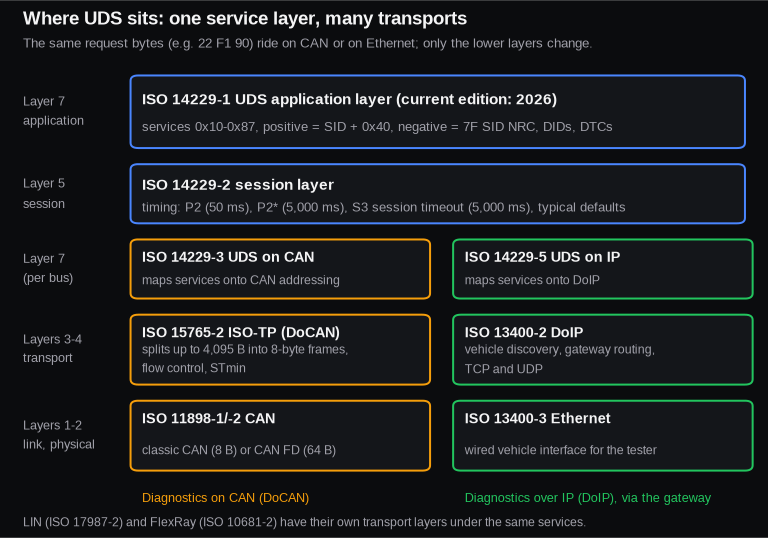
This split is why one diagnostic tool can read a VIN from a CAN ECU and from an Ethernet-connected central computer with the same 22 F1 90. If you are new to CAN itself (IDs, arbitration, the 8-byte limit), start with our post on automotive applications of the CAN protocol.
How is a UDS message built?
Every UDS request starts with a one-byte service identifier (SID). Many services follow it with a sub-function byte, then parameters such as a 2-byte data identifier (DID). The ECU answers with SID + 0x40 and echoes the sub-function or DID, or with 0x7F, the SID it is refusing and a one-byte negative response code (NRC).
10 03(DiagnosticSessionControl, extended session) is answered by50 03 ....22 F1 90(ReadDataByIdentifier, DID F190 = VIN) is answered by62 F1 90followed by the VIN.7F 22 31means "ReadDataByIdentifier refused: requestOutOfRange", for example because the ECU doesn't know that DID.
Bit 7 of the sub-function byte is the "suppress positive response" bit. 3E 00 is a TesterPresent that expects an answer; 3E 80 is the same request asking the ECU to stay quiet if all is well. Negative responses are still sent. SIDs 0x01-0x0F are left for the OBD services of ISO 15031-5 / SAE J1979, which is why UDS services start at 0x10.
What are the main UDS service IDs?
ISO 14229-1 defines more than 20 services. The 16 below cover most of what a fresher will see in diagnostics, validation and bootloader work. Values were cross-checked by script against python-udsoncan 1.26.1, the py-uds knowledge base and AUTOSAR's DCM specification.
| SID | Response | Service | What it does |
|---|---|---|---|
| 0x10 | 0x50 | DiagnosticSessionControl | Switch session: 01 default, 02 programming, 03 extended |
| 0x11 | 0x51 | ECUReset | Restart the ECU: 01 hard, 02 key off/on, 03 soft |
| 0x14 | 0x54 | ClearDiagnosticInformation | Clear stored DTCs (group FFFFFF = all) |
| 0x19 | 0x59 | ReadDTCInformation | Read fault codes with their status byte, snapshots and counts |
| 0x22 | 0x62 | ReadDataByIdentifier | Read a value by 2-byte DID, e.g. F190 = VIN |
| 0x23 | 0x63 | ReadMemoryByAddress | Read raw memory at an address |
| 0x27 | 0x67 | SecurityAccess | Seed/key unlock: odd sub-function asks for a seed, even sends the key |
| 0x28 | 0x68 | CommunicationControl | Stop or resume the ECU's normal (non-diagnostic) messages |
| 0x2E | 0x6E | WriteDataByIdentifier | Write a value by DID: VIN, variant coding, calibration flags |
| 0x2F | 0x6F | InputOutputControlByIdentifier | Take over an output for a test: fan, relay, lamp, valve |
| 0x31 | 0x71 | RoutineControl | 01 start, 02 stop, 03 get results of a routine (2-byte routine ID) |
| 0x34 | 0x74 | RequestDownload | Announce a download: memory address, size, data format |
| 0x36 | 0x76 | TransferData | Send one block, numbered by a block sequence counter |
| 0x37 | 0x77 | RequestTransferExit | Close the download |
| 0x3E | 0x7E | TesterPresent | Keep a non-default session alive |
| 0x85 | 0xC5 | ControlDTCSetting | 02 pause, 01 resume DTC recording (used around flashing) |
Others you will meet later: 0x2C (define a DID on the fly), 0x29 (Authentication, certificate-based), 0x3D (write memory), 0x35 (upload) and 0x38 (file transfer). Which services an ECU supports, in which session and at which security level, is set by the carmaker's diagnostic specification, not by ISO.
What are UDS diagnostic sessions (0x10 01, 02, 03)?
A diagnostic session is the ECU's current mode, and it decides which services are allowed. Every ECU starts in the default session (0x01) at power-up. The extended session (0x03) unlocks writing, actuator tests and communication control. The programming session (0x02) usually hands control to the bootloader so the ECU can be reflashed. Only one session is active at a time.
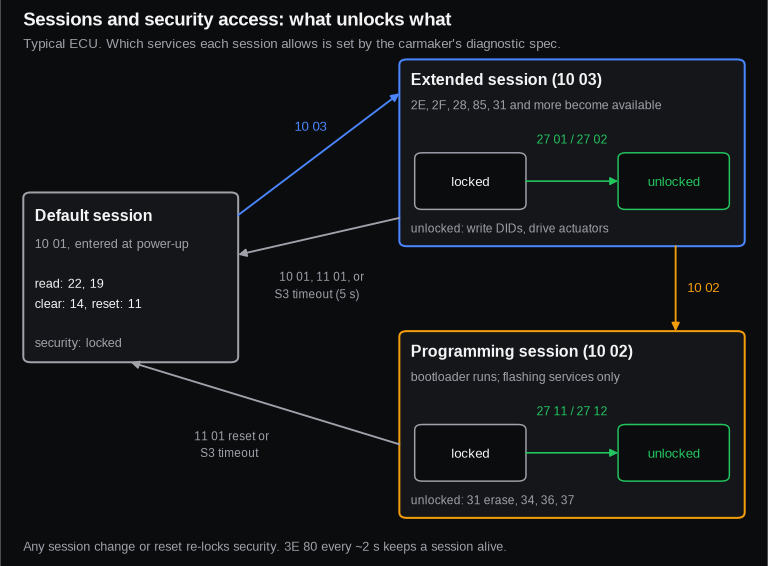
When you switch session, the ECU's positive response carries its own timing limits. Here is a decoded example:
Request:   10 03                 extended session
Response:  50 03 00 32 01 F4
           50     = 0x10 + 0x40
           03     = session echoed
           00 32  = P2 server max  = 0x0032 = 50 ms   (1 ms per bit)
           01 F4  = P2* server max = 0x01F4 = 500 x 10 ms = 5,000 ms
The 10 ms resolution of the P2* field is an easy trap: read 0x01F4 as milliseconds and you would wait 500 ms instead of 5 s (python-udsoncan decodes it as value x 10 / 1000 seconds). A non-default session also ends on its own if the tester goes quiet for S3 = 5,000 ms. That is why testers send 3E 80 every 2 s or so, the py-uds default for S3client.
What are P2 and P2* timing in UDS?
P2 is how long the ECU may take to start its answer after a request: 50 ms by default. If it needs longer, for example to erase flash, it must send 7F <SID> 78 (response pending) within P2. From then on it has P2* (5,000 ms by default) for each further answer, and it may send another 0x78 if it still needs time. The tester adds its own margin for bus delays on top of these server values.
Testers treat a timeout as a separate failure from an NRC. Python-udsoncan's client, for example, defaults to a 1 s P2 timeout and a 5 s P2* timeout.
What do UDS negative response codes (NRCs) mean?
A negative response is always three bytes: 7F, the SID being refused, and the NRC. The NRC tells you why, which is usually enough to fix the request. These ten cover most of what you will see in testing:
| NRC | Name | What it usually means |
|---|---|---|
| 0x11 | serviceNotSupported | This ECU doesn't implement the SID at all |
| 0x12 | subFunctionNotSupported | The SID exists but not that sub-function |
| 0x13 | incorrectMessageLengthOrInvalidFormat | Wrong number of bytes, or a malformed request |
| 0x22 | conditionsNotCorrect | A precondition fails: engine running, vehicle moving, voltage low |
| 0x31 | requestOutOfRange | Unknown DID or routine ID, or a parameter out of range |
| 0x33 | securityAccessDenied | You need SecurityAccess first |
| 0x35 | invalidKey | The key sent after the seed is wrong |
| 0x36 | exceedNumberOfAttempts | Too many wrong keys; the ECU locks you out |
| 0x37 | requiredTimeDelayNotExpired | The lock-out delay hasn't finished |
| 0x78 | requestCorrectlyReceived-ResponsePending | Not an error: busy, the real answer follows within P2* |
Two more are worth knowing: 0x7E and 0x7F mean "sub-function / service not supported in the active session". They usually tell you to switch to the extended session first. Codes 0x70-0x73 relate to download and transfer failures, such as a wrong block sequence counter (0x73).
Worked example: reading the VIN with 0x22 F190 over ISO-TP
A classic CAN frame carries at most 8 data bytes. ISO-TP spends the first byte (or two) on its protocol control information (PCI), so a single frame holds at most 7 bytes of UDS data. Anything longer is sent as a First Frame (with the total length), then Consecutive Frames numbered 1, 2, 3 ... (wrapping from 15 to 0). Before the Consecutive Frames, the receiver sends a Flow Control frame saying how many frames it accepts in a burst (block size) and the minimum gap between them (STmin).
We use a made-up VIN, SKLYNC2026UDS0001 (17 characters, no I, O or Q). The CAN IDs are 0x7E0 for the tester and 0x7E8 for the ECU, the first physical request/response pair in the 11-bit OBD range. Other ECUs use IDs from the carmaker's network specification. Unused bytes are padded with 0xCC, the py-uds default; carmakers specify their own filler.
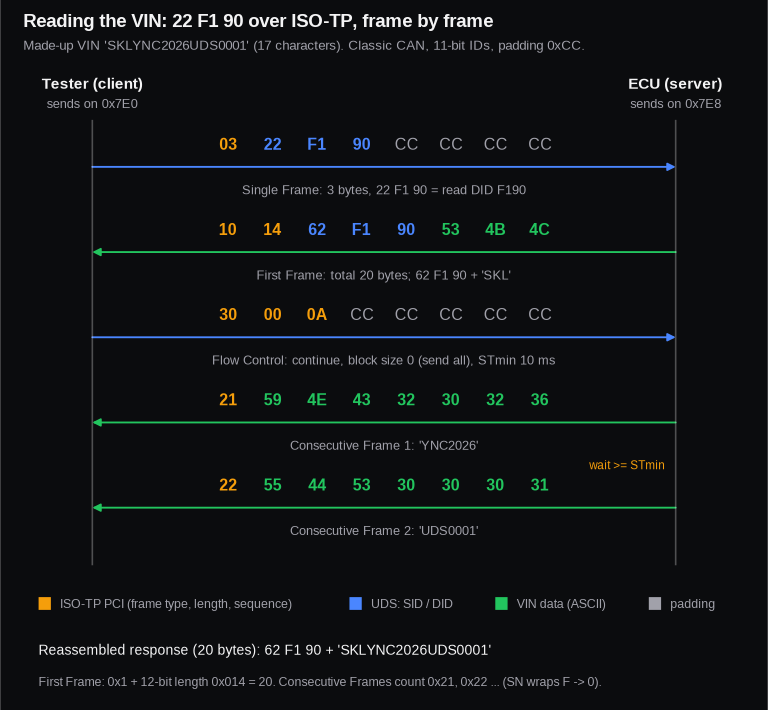
| # | CAN ID | Data bytes | Meaning |
|---|---|---|---|
| 1 | 0x7E0 | 03 22 F1 90 CC CC CC CC | Single Frame (0x0), length 3: read DID F190 |
| 2 | 0x7E8 | 10 14 62 F1 90 53 4B 4C | First Frame (0x1), length 0x014 = 20 bytes: 62 F1 90 + "SKL" |
| 3 | 0x7E0 | 30 00 0A CC CC CC CC CC | Flow Control (0x3): continue to send, block size 0 = send the rest, STmin 0x0A = 10 ms |
| 4 | 0x7E8 | 21 59 4E 43 32 30 32 36 | Consecutive Frame, sequence number 1: "YNC2026" |
| 5 | 0x7E8 | 22 55 44 53 30 30 30 31 | Consecutive Frame, sequence number 2: "UDS0001" |
The arithmetic: the response is 3 + 17 = 20 bytes. The First Frame carries 6 of them, and each Consecutive Frame carries 7, so 6 + 7 + 7 = 20 and the last frame needs no padding. The 12-bit length field allows up to 4,095 bytes per message; ISO 15765-2 has an escape to a 32-bit length for anything longer. With CAN FD, a single frame can carry much more, which is one reason flashing over CAN FD is faster. Inside an AUTOSAR ECU, the CanTp module does this segmentation for the DCM; our AUTOSAR interview questions trace that path.
How does UDS security access (seed and key) work?
SecurityAccess (0x27) is a challenge-response unlock. The tester asks for a seed with an odd sub-function (01). The ECU replies with a random seed, and both sides compute a key from it with a secret algorithm. The tester sends its key with the next even sub-function (02). If the keys match, that security level unlocks until the session changes or the ECU resets.
27 01                 tester: requestSeed, level 1
67 01 3A 9C 51 E7     ECU: seed
27 02 73 54 0D D8     tester: sendKey, level 1
67 02                 ECU: unlocked
The key here comes from a toy algorithm in our script (XOR with a made-up constant, multiply, add, rotate). Real algorithms and secrets are confidential to each carmaker and supplier, and different levels use different pairs (for example 27 11 / 27 12 for programming). Three details trip up beginners:
- A wrong key gives
7F 27 35. Too many wrong keys give7F 27 36, and then the ECU refuses new seeds with7F 27 37until a delay timer expires. In AUTOSAR the attempt count and delay are configuration parameters. - If the level is already unlocked, a seed request returns a seed of all zeros (AUTOSAR SWS_Dcm_00323).
- Any session change re-locks the ECU, so unlock after entering the session you need.
Seed/key is only as strong as the secrecy of its algorithm. ISO 14229-1 therefore also defines Authentication (0x29), which proves the tester's identity with cryptographic certificates. For the wider security picture, see our post on automotive cybersecurity.
How do you read DTCs with 0x19, and what does the status byte mean?
A DTC (diagnostic trouble code) in UDS is 3 bytes, followed by a 1-byte status whose 8 bits record the fault's history. The most common request is 19 02 <mask>, "report DTCs by status mask". The ECU returns every DTC whose status matches any bit in the mask.
Request:   19 02 08               all DTCs with bit 3 (confirmed) set
Response:  59 02 FF 03 01 00 2F
           FF        = status bits this ECU supports (availability mask)
           03 01 00  = DTC 0x030100  ->  P0301-00 in SAE J2012 format
           2F        = status byte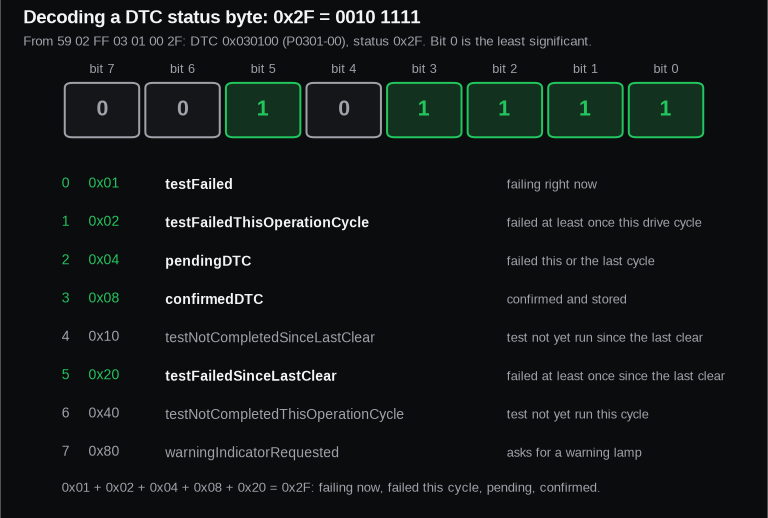
To turn the 3 bytes into the familiar code, take the top two bits of the first byte as the system letter (00 P, 01 C, 10 B, 11 U). The next two bits give the first digit and the low four bits the second. The second byte gives two more hex digits, and the third byte is the failure type after the dash. 0x03 = 00 00 0011, so the code is P, 0, 3, then 01 and -00: P0301-00. In an AUTOSAR ECU, the DEM module maintains this status byte and the DCM module answers the 0x19 request.
Two practical notes. 14 FF FF FF clears all DTCs, but a fault that is still present will set testFailed again on the next test. And the 0x2F above is the classic signature of a fault that is active right now and confirmed, which a technician would fix first.
What is the typical UDS sequence for ECU flashing?
Reprogramming an ECU ("flashing") uses the same services in a fixed order. Each carmaker publishes its own sequence, routine IDs and security levels, but most follow this shape:
| Step | Request | Addressing | Purpose |
|---|---|---|---|
| 1 | 10 03 | functional | All ECUs enter the extended session |
| 2 | 31 01 02 03 | physical | Check programming preconditions (example routine 0x0203; the 0x0200-0xDFFF range is carmaker-specific) |
| 3 | 85 02 | functional | Stop DTC recording, so other ECUs don't log faults while the bus is quiet |
| 4 | 28 03 01 | functional | Stop normal messages; diagnostics keep working |
| 5 | 10 02 | physical | Target ECU enters the programming session (bootloader) |
| 6 | 27 11 / 27 12 | physical | Unlock the programming security level |
| 7 | 31 01 FF 00 ... | physical | eraseMemory routine; expect 7F 31 78 while the flash erases |
| 8 | 34 00 44 ... | physical | RequestDownload: start address and size |
| 9 | 36 01 ... to 36 00 ... | physical | TransferData blocks, counter 01, 02 ... FF, 00 |
| 10 | 37 | physical | RequestTransferExit |
| 11 | 31 01 FF 01 | physical | checkProgrammingDependencies: signature, CRC, compatibility |
| 12 | 11 01 | physical | Hard reset into the new software |
| 13 | 28 00 01, 85 01, 10 01 | functional | Everyone back to normal (or let the S3 timer expire) |
Now the numbers for a 256 KiB (262,144-byte) application. The download request is 34 00 44 00 00 80 00 00 04 00 00. The format byte 00 means no compression or encryption, and 44 means a 4-byte address (0x00008000) and a 4-byte size (0x00040000). The ECU replies 74 20 04 02: a 2-byte field saying each TransferData request may be up to 0x0402 = 1,026 bytes, including the 0x36 SID and the counter byte.
The block counter starts at 0x01 and rolls from 0xFF to 0x00, so the 256th block carries 0x00. Each 1,026-byte block travels as 1 First Frame + 146 Consecutive Frames. With the tester's Flow Control (block size 0) and the ECU's 76 xx reply, that makes 149 frames per block. An 8-byte classic CAN frame is 111 bits including the interframe space, ignoring stuff bits, as worked in our EV book's CAN chapter. That takes 0.222 ms at 500 kbit/s:
That is the floor, before flash erase and write times. If the bootloader's Flow Control asks for STmin = 10 ms, the forced gaps alone add about 256 × 146 × 10 ms ≈ 374 s, over six minutes. This is why bootloaders ask for STmin 0 when they can, and why bigger frames help: CAN FD carries up to 64 bytes per frame, and DoIP runs over Ethernet. As more software moves to central computers in the software-defined vehicle, Ethernet diagnostics become more common.
What is the difference between UDS and OBD-II?
OBD-II (SAE J1979, a near-equivalent of ISO 15031-5) is a small, legally mandated subset of diagnostics for emissions. It has 10 services (modes 0x01-0x0A), the same on every car, so any generic scan tool can read them. UDS is the full manufacturer diagnostic toolkit, and much of its content is carmaker-specific. Both can run over the same ISO-TP transport, and UDS deliberately leaves SIDs 0x01-0x0F free for OBD.
| OBD-II (SAE J1979 / ISO 15031-5) | UDS (ISO 14229-1) | |
|---|---|---|
| Purpose | Emissions-related diagnostics, required by law | All diagnostics, configuration and flashing |
| Services | 10 modes (0x01-0x0A) | More than 20 services (0x10 and up) |
| Read the VIN | Mode 09, PID 02 (response has an extra item-count byte) | 22 F1 90 |
| Typical 11-bit IDs | 0x7DF functional, 0x7E0-0x7E7 physical, replies 0x7E8-0x7EF | Defined in each carmaker's network specification |
| Security | No seed/key: any generic scan tool can use it | Sessions, seed/key, authentication |
The line is blurring. OBDonUDS (SAE J1979-2 / ISO 27145-3) and WWH-OBD carry the legislated OBD data using UDS services (CSS Electronics, updated January 2025).
How can you practise UDS without a car?
You can learn most of UDS on a laptop. The open-source Python stack used to check this post is enough:
- python-can has a virtual bus interface: two bus objects in the same Python process exchange CAN frames with no hardware.
- can-isotp handles segmentation, Flow Control, STmin and padding. Set it up and watch it produce the five frames above.
- udsoncan is a UDS client. Its documentation has examples for reading a DID, running a routine and plugging in your own security algorithm.
A good first project: write a toy ECU server in Python that answers 0x10, 0x22, 0x27 and 0x19 with the right NRCs and test it with udsoncan as the client, then port the server to a microcontroller with a CAN peripheral. That exercises the embedded C and CAN skills in our guide to automotive embedded systems. At work the tools are commercial, but the bytes are the same.
Which jobs in India use UDS?
UDS is a daily tool in automotive embedded and validation roles at carmakers, Tier-1 suppliers and engineering service companies. The job titles vary, but the work falls into four groups:
- Diagnostics engineer (ECU software): configures or codes the DCM and DEM (in AUTOSAR ECUs) so the ECU answers the carmaker's diagnostic specification: DIDs, DTCs, sessions, security.
- Bootloader / flashing engineer: owns the programming session, erase/download/verify routines, and secure boot and signature checks.
- Validation and HIL test engineer: writes test scripts that send UDS requests, check responses and NRCs, and inject faults to see the right DTCs set. Our post on testing ECU software covers the basics.
- Service and end-of-line tools engineer: builds the tester side, such as workshop tools and factory flashing stations.
Skill-Lync's own placement records give a sense of where embedded learners land. They are based on 3,711 records up to 7 November 2026 (data snapshot of 15 November 2026). The Embedded track has n = 278 placements, with a median starting offer of 4.0 LPA (middle half 3.5-5.0 LPA). The most frequent employers were Cyient (n = 18), Nexteer Automotive (n = 17), Expleo Engineering (n = 9), Tata Technologies (n = 8) and L&T Technology Services (n = 7). These records don't tag UDS work separately. They are a self-selected sample of learners who reported a placement, mostly 2021-23 starting offers, so read them as a pointer to where to apply, not a market survey. Our embedded engineer salary page has the full breakdown.
To build the base, Skill-Lync's Automotive Embedded Systems and AUTOSAR course covers the basic software that hosts diagnostics. Automotive Cybersecurity and Vehicle Networks goes deeper into CAN. Diagnostic roles also tend to sit close to ISO 26262 functional safety work, because DTCs and safe states are part of the safety case.
What is the catch?
UDS looks simple in a table. Four things make real projects harder:
- The standard is paid and has just changed. ISO 14229-1:2026 was published in June 2026, and its changes from the 2020 edition are not public. The open references used here model the 2020 edition. The common SIDs, the +0x40 rule and the NRCs in this post are shared by every reference we checked, but confirm the edition named in your project before relying on any detail.
- Most of the content is carmaker-specific. Apart from standard identification DIDs such as F190, the DIDs, routine IDs, security algorithms, CAN IDs and session rules come from the carmaker's diagnostic specification. You will spend more time in that document than in ISO 14229.
- The timing values are defaults, not guarantees. Each ECU reports its own P2 and P2*, and gateways add delay. Tools that hard-code 50 ms will fail on slow ECUs.
- Seed/key is not real security on its own. If the algorithm leaks, anyone with a CAN interface can unlock the ECU. Newer ECUs add certificate-based Authentication (0x29) and secure boot.
Frequently asked questions
Is UDS the same as OBD-II?
No. OBD-II (SAE J1979 / ISO 15031-5) is a small, standardised set of emissions services that every car must support. UDS (ISO 14229-1) is the full manufacturer diagnostic protocol for every ECU, including configuration and flashing. Both can run over ISO-TP on CAN, and newer OBD variants such as OBDonUDS carry the OBD data using UDS services.
What is the difference between ISO 14229 and ISO 15765?
ISO 14229-1 defines what the diagnostic bytes mean: services, sub-functions, NRCs. ISO 15765-2 (ISO-TP) defines how those bytes are cut into CAN frames and put back together, using Single, First, Consecutive and Flow Control frames. Over Ethernet, ISO 13400-2 (DoIP) does the transport job instead.
Is the ISO 14229 standard free to download?
No. ISO 14229-1:2026 is a paid standard, sold by ISO and by national standards bodies. For learning, the AUTOSAR DCM specification is free, and the python-udsoncan and py-uds documentation lists the service IDs, NRCs and DTC status bits.
Which UDS services are used to flash an ECU?
The core is RequestDownload (0x34), TransferData (0x36) and RequestTransferExit (0x37). Around them sit session control (0x10 02), SecurityAccess (0x27), RoutineControl (0x31) for erase and checks, and ECUReset (0x11). Before flashing, ControlDTCSetting (0x85) and CommunicationControl (0x28) quieten the rest of the vehicle.
What does NRC 0x78 mean in UDS?
0x78 (requestCorrectlyReceived-ResponsePending) means the ECU has the request but needs more time, for example to erase flash. It is not an error. The tester should keep waiting, up to P2* (5,000 ms by default) per pending message, until the final positive or negative answer arrives.
Sources and further reading
- ISO, ISO 14229-1:2026, Unified diagnostic services, Part 1: Application layer, edition 4, June 2026 (catalogue page).
- EVS (Estonian Centre for Standardisation and Accreditation), ISO 14229-1:2026 catalogue entry and scope, valid from 5 June 2026 (accessed 23 Nov 2026).
- SIS (Swedish Institute for Standards), SS-ISO 14229-1:2026: edition 4, 434 pages, replaces the 2020 edition and Amd 1:2022 (accessed 23 Nov 2026).
- EVS, ISO 15765-2:2024, DoCAN transport protocol and network layer, and ISO 13400-2:2025, DoIP transport protocol and network layer (accessed 23 Nov 2026).
- AUTOSAR, Specification of Diagnostic Communication Manager, Classic Platform R24-11: NRC table, session values, seed and suppression rules.
- python-udsoncan 1.26.1, services documentation and source: SIDs, response codes, session timing decode, DTC status bits (June 2026 release).
- python-can-isotp 2.0.7, implementation documentation: frame types, Flow Control, STmin, padding.
- py-uds 5.0.0, UDS knowledge base: service list, addressing, timing defaults, CAN segmentation, DTC formats, routine IDs (September 2026 release).
- python-can 4.6.1, virtual interface documentation.
- CSS Electronics, OBD2 Explained and UDS Explained, updated January 2025.
- Skill-Lync placement records, data snapshot of 15 November 2026 (3,711 records up to 7 November 2026), Embedded track.