ISO 26262 Functional Safety Explained: ASIL, HARA, Metrics and Jobs
A fresher's guide to ISO 26262:2018: the 12 parts, the V-model, a complete HARA for electric power steering with the ASIL table checked by script, ASIL decomposition, a worked SPFM/LFM/PMHF calculation, how it fits with SOTIF, ISO/SAE 21434 and India's AIS-189/190, and what functional safety engineers in India do.

ISO 26262 is the international standard for the functional safety of electrical and electronic (E/E) systems in series-production road vehicles. It covers every vehicle type except mopeds. The current edition, ISO 26262:2018, has 12 parts. It asks you to rate each hazard by severity, exposure and controllability, which gives an Automotive Safety Integrity Level (ASIL) from A to D. That ASIL then sets how rigorous the development process must be and which hardware failure targets apply.
This guide is for students and freshers in India who meet "ISO 26262" in embedded, ADAS, EV and AUTOSAR job descriptions. It follows one electric power steering (EPS) system from hazard analysis to hardware metrics, with every table and number checked by a script. The standard is a paid document, so we paraphrase it and cite where each number comes from.
In short
- ISO 26262:2018 (second edition, published December 2018) has 12 parts. It replaced the 2011 edition, which only covered passenger cars up to 3,500 kg. ISO lists the 2018 parts as "to be revised", and the third edition is expected no earlier than 2027 (UL Solutions, January 2024).
- ASIL comes from three ratings: severity S1-S3, exposure E1-E4 and controllability C1-C3. Of the 36 combinations, only one (S3, E4, C3) gives ASIL D. 18 give QM, meaning normal quality management is enough.
- Hardware targets (ISO 26262-5:2018): single-point fault metric of at least 90%, 97% and 99% for ASIL B, C and D. Latent fault metric of at least 60%, 80% and 90%. Random-failure rate (PMHF) below 100, 100 and 10 FIT.
- Our worked EPS example: an ECU with SPFM 98.45% and LFM 88.50% passes ASIL C but fails ASIL D, even though its PMHF (4.15 FIT) is under the 10 FIT limit. Two design changes raise it to 99.47%, 98.86% and 1.41 FIT.
- In India, the Bureau of Indian Standards has adopted ISO 26262 as identical IS/ISO 26262 standards. Separately, MoRTH's draft rules of 22 June 2026 (G.S.R. 503(E)) would make cybersecurity (AIS-189) and software-update (AIS-190) management mandatory in phases from October 2026.
What is functional safety, and what is it not?
Functional safety means there is no unreasonable risk from hazards caused by electronic systems malfunctioning. Examples include a steering ECU that adds torque nobody asked for, or a brake controller that stops braking. ISO 26262 covers that one cause of harm: E/E systems that fail or misbehave. It does not cover crash structures, how well a feature performs when nothing is broken, or hackers.
The scope is explicit: electric shock, fire, heat and toxicity are outside it unless a malfunctioning E/E system directly causes them, and so is nominal performance (ISO 26262-1:2018 abstract).
| Question | Which standard answers it |
|---|---|
| The EPS motor driver fails and the wheel jerks. Is that controlled? | ISO 26262 (functional safety) |
| The camera misreads a faded lane line with nothing broken. Is the lane-keep feature still safe? | ISO 21448 (SOTIF, safety of the intended functionality) |
| Someone sends forged CAN messages through the infotainment unit. Is that prevented? | ISO/SAE 21434 (cybersecurity engineering) |
| Does the body crumple correctly in a 64 km/h offset crash? | Crash regulations and NCAP, not ISO 26262 |
ISO 26262 is the automotive adaptation of the generic functional safety standard IEC 61508 (ISO 26262-2:2018, Introduction), so the vocabulary carries over to industrial and rail work.
What are the 12 parts of ISO 26262:2018?
ISO 26262:2018 has 12 parts. Ten are normative requirements (Parts 1-9 and 12), and two are guidelines (Part 10, general guidance, and Part 11, semiconductors). The 2018 edition added trucks, buses, trailers and motorcycles to the scope. It also added semiconductor guidance, references to cybersecurity and updated target values for the hardware metrics (ISO 26262-2:2018, Foreword).
| Part | Title | What you use it for |
|---|---|---|
| 1 | Vocabulary | Definitions: item, hazard, safety goal, ASIL, FTTI, safe state |
| 2 | Management of functional safety | Safety culture, safety plan, safety case, confirmation measures |
| 3 | Concept phase | Item definition, HARA, safety goals, functional safety concept |
| 4 | Product development at the system level | Technical safety concept, system architecture, integration, safety validation |
| 5 | Product development at the hardware level | Hardware safety requirements, FMEDA, SPFM, LFM, PMHF |
| 6 | Product development at the software level | Software safety requirements, architecture, unit design, coding and testing |
| 7 | Production, operation, service and decommissioning | Keeping the product safe after release |
| 8 | Supporting processes | Requirements management, configuration, change control, tool qualification, interfaces with suppliers |
| 9 | ASIL-oriented and safety-oriented analyses | ASIL decomposition, dependent failure analysis, FMEA/FTA expectations |
| 10 | Guidelines on ISO 26262 | Worked explanations of the concepts (informative) |
| 11 | Guidelines on application of ISO 26262 to semiconductors | Chips and IP blocks: failure modes, transient faults, safety manuals (informative) |
| 12 | Adaptation of ISO 26262 for motorcycles | Motorcycle-specific HARA and validation |
Learn the 2018 edition. ISO marks its parts "to be revised", and UL Solutions wrote in January 2024 that third-edition work began in autumn 2023 with release not expected before 2027. Until then, projects are assessed against 2018.
How does the ISO 26262 safety lifecycle map onto the V-model?
ISO 26262 uses the V-model as its reference process. On the left arm you go down from the vehicle-level hazard analysis to detailed hardware and software design. On the right arm you integrate and test back up to the vehicle. Each test level checks the design level opposite it. Management (Part 2), supporting processes (Part 8) and safety analyses (Part 9) run alongside the whole V.
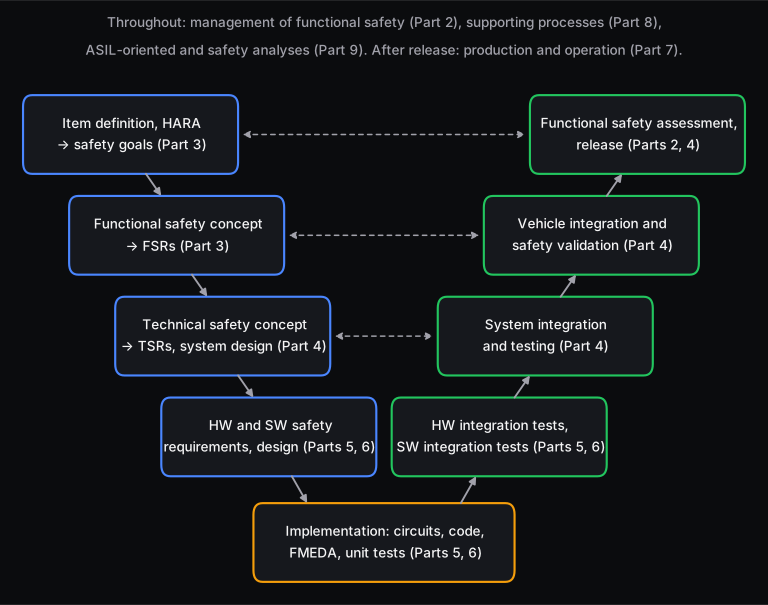
If you know model-based development, this is the same V as MIL, SIL and HIL testing in our MBD for ADAS guide. ISO 26262 adds safety work products to it: the HARA, safety concepts, FMEDA and safety case.
What is an item definition?
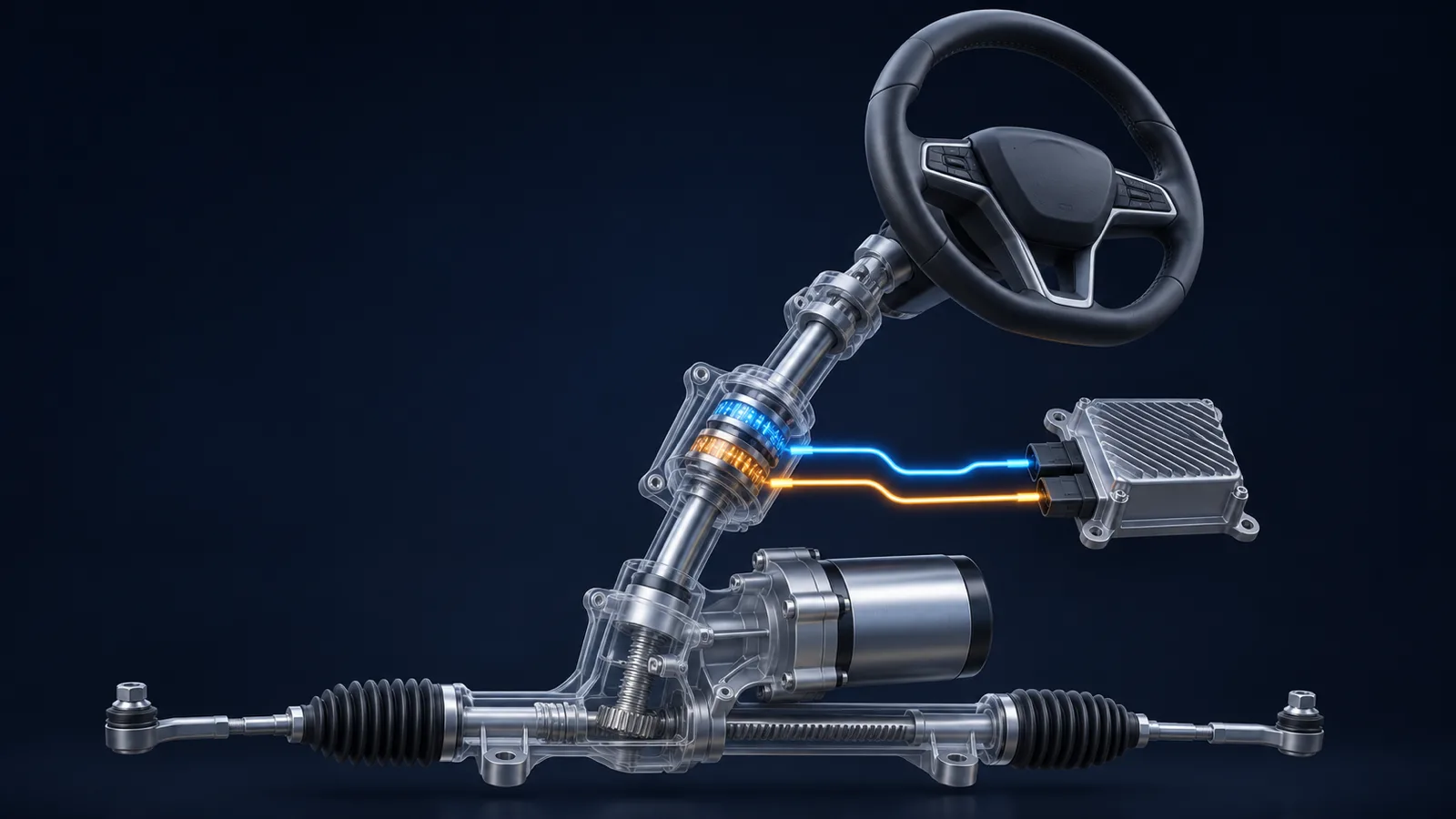
The item definition is the first work product. It describes the system that implements a vehicle-level function: what it does, its boundaries, interfaces, operating modes and assumptions about the rest of the vehicle. Our item is an EPS system: column torque sensor, ECU, motor and MOSFET bridge, plus the vehicle-speed and 12 V interfaces. It adds motor torque in proportion to the driver's torque, with less assist as speed rises.
How do you do a HARA in ISO 26262?
A HARA (hazard analysis and risk assessment) lists how the item can malfunction and places each malfunction in realistic driving situations. Each combination of malfunction and situation is a hazardous event. You rate each one for severity (S), exposure (E) and controllability (C), and look up its ASIL. Every hazardous event rated ASIL A or above gets a safety goal.
| Class | Severity (S) | Exposure (E) | Controllability (C) |
|---|---|---|---|
| 0 | No injuries | Incredible | Controllable in general |
| 1 | Light and moderate injuries | Very low probability (by frequency: less than once a year for most drivers) | Simply controllable: 99% or more of drivers avoid harm |
| 2 | Severe and life-threatening, survival probable | Low probability (by duration: under 1% of operating time) | Normally controllable: 90% or more avoid harm |
| 3 | Life-threatening (survival uncertain) or fatal | Medium probability (1% to 10% of operating time) | Difficult or uncontrollable: fewer than 90% avoid harm |
| 4 | - | High probability (over 10% of operating time) | - |
The percentage bands come from the standard's informative annex and are guidance. Because ratings are judgement, SAE published J2980 on ASIL hazard classification, and exposure values are often taken from catalogues such as the German VDA's tables (Schildbach, 2018).
Worked example: HARA for electric power steering
Here are four hazardous events for our EPS item. The S, E and C ratings are our illustrative judgements with the reasoning shown. A real project argues each one from accident data, driving statistics and, for controllability, driver studies.
| ID | Malfunction in a situation | S | E | C | ASIL |
|---|---|---|---|---|---|
| HE1 | Unintended steering torque (self-steer) at 80-120 km/h on a two-lane highway with oncoming traffic | S3: head-on crash at speed | E4: highway driving is well over 10% of driving time | C3: a sudden pull at speed leaves too little time to correct | D |
| HE2 | Too much assist (steering suddenly very light) at highway speed | S3 | E4 | C2: the car becomes twitchy, but most drivers hold it | C |
| HE3 | Loss of assist in a tight bend on a ghat road at about 40 km/h | S2: running wide into a barrier or drop | E3: tight bends are a small share of driving | C2: the wheel gets heavy but still turns | A |
| HE4 | Loss of assist while parking below 10 km/h | S1: a low-speed bump at worst | E4: parking happens on almost every trip | C1: almost everyone can steer a little harder | QM |
The same failure (the motor stops helping) is ASIL A on a ghat road and QM in a parking lot: the ASIL belongs to the hazardous event, not the part. A safety goal covering several events takes the highest of their ASILs.
How is the ASIL determined from S, E and C?
You look up the ASIL in a 3 by 4 by 3 table (ISO 26262-3:2018, Table 4). Only S3, E4 and C3 together give ASIL D. Lowering any one rating by one class lowers the ASIL by one level, from D to C, B, A and finally QM. Any class of 0 (S0, E0 or C0) means QM. The table can be written as a simple sum rule.
Add the three class numbers. A total of 10 gives ASIL D, 9 gives C, 8 gives B and 7 gives A. A total of 6 or less, or any zero, gives QM. This sum rule is described by Schildbach (2018), and it matches the published table exactly. Our calc.py checks this. It transcribes all 36 cells from the table printed by Abbaspour et al. (2024) and asserts that the sum rule and the one-step rule give the same answer for every cell. It also counts the cells: 18 QM, 8 A, 6 B, 3 C and 1 D. For HE1 the sum is , so ASIL D. For HE4 it is , so QM.
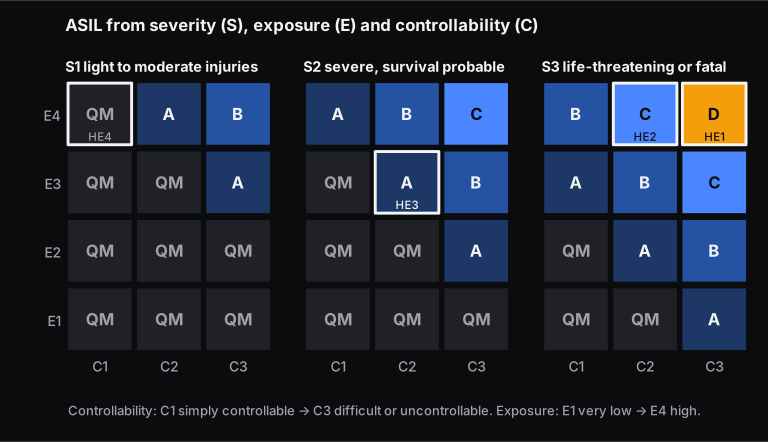
A practical warning: copies of this table found online are not always right. One university thesis we checked prints QM for S1/E4/C2 and S2/E4/C1, where the table has A. Before you trust a copy, check it against the one-step rule.
How do safety goals become FSRs and TSRs?
A safety goal is the top-level safety requirement that comes out of the HARA. The functional safety concept refines it into functional safety requirements (FSRs). These say what must happen, without fixing the hardware. The technical safety concept then turns FSRs into technical safety requirements (TSRs), allocated to specific hardware and software. Each child requirement inherits the highest ASIL of its parents.
For the EPS, the chain looks like this:
- Safety goal (ASIL D): avoid unintended steering torque that could make the vehicle leave its lane.
- FSR (ASIL D): detect a mismatch between the driver's torque request and the motor torque, and bring the motor to zero torque (the safe state) within the fault-tolerant time interval. The FTTI is the time between a fault occurring and the hazard becoming real.
- TSRs: compare the two torque-sensor channels and flag a fault if they disagree; run the MCU cores in lockstep; give an independent path the power to switch off the gate driver.
Hardware (Part 5) and software (Part 6) safety requirements then come from the TSRs, and every test must trace back to a safety goal.
What is ASIL decomposition, and when can you use it?
ASIL decomposition splits one safety requirement into redundant requirements on independent elements. Each element can then be developed to a lower ASIL. For example, an ASIL D requirement can be met by two ASIL B elements, written B(D) + B(D). The letter in brackets records the original ASIL. Decomposition is only allowed when the two elements are sufficiently independent, which you show with a dependent failure analysis.
| Original ASIL | Allowed decompositions (ISO 26262-9:2018) |
|---|---|
| D | D(D) + QM(D), or C(D) + A(D), or B(D) + B(D) |
| C | C(C) + QM(C), or B(C) + A(C) |
| B | B(B) + QM(B), or A(B) + A(B) |
| A | A(A) + QM(A) |
A useful way to remember it: with QM = 0, A = 1, B = 2, C = 3 and D = 4, every allowed pair adds up to the original level. Our script checks this for all eight schemes.
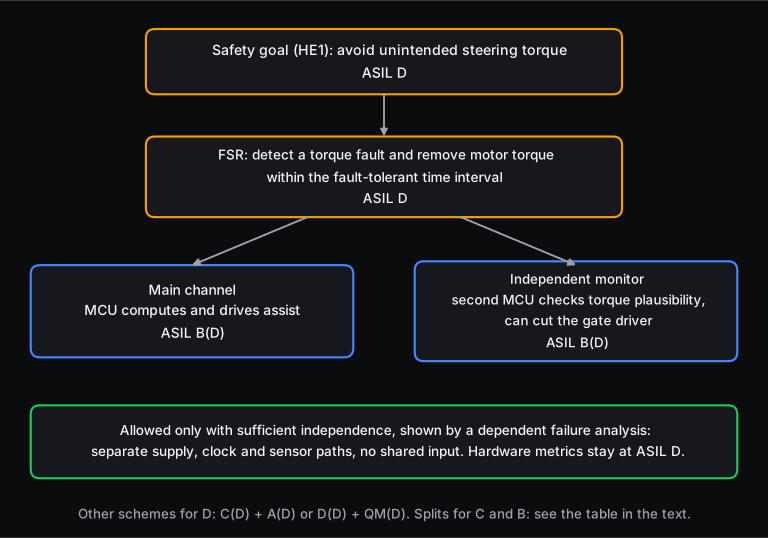
Two rules catch freshers out. First, the independence must be real. A Texas Instruments white paper (April 2019) shows a steering lock split across two MCUs that failed this test: the second MCU got vehicle speed through the first, so one fault could defeat both. Separate CAN buses fixed it. Second, decomposition lowers the ASIL of each branch's development work, not the random hardware targets, which are still judged at the safety goal's ASIL (ISO 26262-9:2018, clause 5).
What are SPFM, LFM and PMHF, and what targets apply per ASIL?
They are the three numbers ISO 26262-5 uses to judge how well hardware handles random failures. SPFM (single-point fault metric) is the share of failures that cannot directly violate the safety goal. LFM (latent fault metric) is the share of the remaining multiple-point faults that are detected rather than lying hidden. PMHF (probabilistic metric for random hardware failures) is the residual rate of violating the goal, in FIT.
One FIT is one failure in device-hours, so a 100 FIT part fails on average once in 10 million hours. The definitions (ISO 26262-5 Annex C) are:
is each safety-related element's failure rate. is single-point faults with no safety mechanism, residual faults that slip past one, and latent faults, such as a dead watchdog nobody has noticed, that cause harm only when a second fault arrives. A common PMHF estimate adds a dual-point term over the operating lifetime :
| ASIL | SPFM | LFM | PMHF |
|---|---|---|---|
| A | No target | No target | No target |
| B | ≥ 90% | ≥ 60% | < 100 FIT ( per hour) |
| C | ≥ 97% | ≥ 80% | < 100 FIT ( per hour) |
| D | ≥ 99% | ≥ 90% | < 10 FIT ( per hour) |
Each value was checked against at least two of: a TI white paper, a Politecnico di Torino thesis and a TSMC patent (see sources).
Worked example: an FMEDA for one EPS controller channel
An FMEDA (failure modes, effects and diagnostic analysis) splits each element's failure rate into the categories above. Here is a deliberately small one for the ASIL D safety goal HE1. The failure rates, safe fractions and coverages are teaching values we chose, not datasheet numbers. Design A has 90% diagnostic coverage on the bridge and no start-up test of the safety mechanisms. Design B adds an independent phase-current check (99%) and a start-up test that catches 90% of watchdog and monitor faults.
| Element | λ (FIT) | Safe share | Coverage A / B | Residual A / B (FIT) |
|---|---|---|---|---|
| Microcontroller (lockstep cores, ECC) | 120 | 40% | 99% / 99% | 0.72 / 0.72 |
| Torque sensor (two channels, cross-checked) | 30 | 20% | 99% / 99% | 0.24 / 0.24 |
| Gate driver and MOSFET bridge | 60 | 50% | 90% / 99% | 3.00 / 0.30 |
| Power supply with voltage monitor | 25 | 40% | 99% / 99% | 0.15 / 0.15 |
| Safety-mechanism hardware (watchdog, monitors) | 30 | - | start-up test 0% / 90% | latent 30 / 3 |
| Total | 265 | 4.11 / 1.41 |
The residual of an element is its non-safe failure rate times the share its safety mechanism misses. For the bridge in design A that is FIT. Then:
For the PMHF of design A, the faults the safety mechanisms would catch total 136.89 FIT. They become dangerous only if the unchecked 30 FIT of safety-mechanism hardware has already failed silently. With an assumed operating lifetime of 10,000 hours:
So PMHF for A is about 4.11 + 0.04 = 4.15 FIT, and for B it is 1.41 FIT. Even with ten times the lifetime, the dual-point term for A would only be 0.41 FIT. Residual faults dominate here.
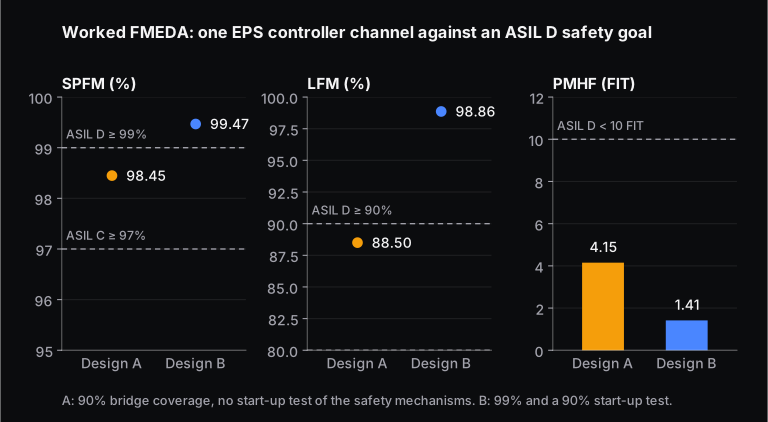
This is the key lesson: design A's PMHF is well under 10 FIT, yet it is not ASIL D, because SPFM and LFM fall short. An ASIL D design must pass all three. The fixes were better coverage on the weakest element and a start-up test, not a better microcontroller.
What are confirmation measures in ISO 26262?
Confirmation measures are the checks that the safety work was done properly. There are three kinds. Confirmation reviews check key work products such as the HARA, safety plan, safety analyses and safety case. A functional safety audit checks that the planned processes were actually followed. A functional safety assessment judges whether the item achieves functional safety. The required independence of the reviewer increases with the ASIL.
Depending on the ASIL, the reviewer must not be the author and may need to sit outside the author's reporting line or department (Synopsys, January 2023). The vehicle manufacturer appoints the people who assess the whole item; a supplier's assessment covers only its element. Independent assessment is a career path of its own, at certification bodies and inside large suppliers.
How does ISO 26262 relate to SOTIF, ISO/SAE 21434 and AIS standards in India?
ISO 26262 handles hazards from faults. ISO 21448 (SOTIF) handles hazards from a system that works as designed but is not good enough, such as a sensor that misses an object. ISO/SAE 21434 handles cybersecurity. India has adopted ISO 26262 itself as IS/ISO 26262. Separately, MoRTH has drafted rules that would make cybersecurity (AIS-189) and software-update (AIS-190) management systems mandatory.
| Standard | Edition | Hazard source | Typical work product |
|---|---|---|---|
| ISO 26262 | 2018 (2nd), 12 parts | Random hardware faults and systematic faults in E/E systems | HARA, safety concepts, FMEDA, safety case |
| ISO 21448 (SOTIF) | 2022 (1st), published 30 June 2022 | Functional insufficiencies and foreseeable misuse in sensing-heavy functions (ADAS, automated driving levels 1-5) | Triggering-condition analysis, scenario-based validation |
| ISO/SAE 21434 | 2021 (1st), published 31 August 2021 | Cyberattacks on vehicle E/E systems | Threat analysis and risk assessment (TARA), cybersecurity case |
A lane-keeping ECU needs all three: ISO 26262 for processor faults, SOTIF for the camera's blind spots, 21434 against spoofed steering commands. ISO lists both newer standards as "to be revised".
India (checked 22 November 2026). BIS lists the ISO 26262 parts as Indian Standards "identical under single numbering", for example IS/ISO 26262-12:2018 under its TED 11 committee. We found no AIS or Central Motor Vehicles Rules provision making ISO 26262 itself a type-approval requirement; it is applied through carmaker-supplier development work, which the standard itself regulates. Draft notification G.S.R. 503(E) of 22 June 2026 proposes Rules 125-T and 125-U, which would make AIS-189 cybersecurity and AIS-190 software-update management systems mandatory in phases, from October 2026 for Level 3+ automated vehicles to all update-capable vehicles by October 2029 (Autocar Professional, 27 June 2026). They are still drafts as far as we could find, but ARAI already certifies to them: Kia India received both certificates in October 2026. Our software-defined vehicle guide covers the architecture these rules target.
What does a functional safety engineer do in India, and who hires them?
A functional safety engineer plans and carries out the ISO 26262 work for an ECU or vehicle function. That means HARA, safety concepts, FMEA, FTA, FMEDA and dependent failure analysis, plus the safety plan and safety case. They also review the requirements and test evidence. In India they work at Tier-1 engineering centres, engineering service outsourcing (ESO) firms, semiconductor design centres and certification bodies.
- System safety engineer (Tier-1 or OEM): HARA, safety concepts, DFA. Bosch Engineering lists HARA, safety concepts, FMEA/FTA/FMEDA/DFA and SOTIF among its functional safety services.
- Hardware safety engineer: FMEDA, metric budgets, safety mechanisms, at ECU and chip companies.
- Software safety engineer: software safety requirements and freedom from interference between ASIL and QM code, close to AUTOSAR teams.
- Consultant at an ESO: the same work for many clients. Tata Elxsi cites ASIL D production projects and TÜV NORD/UL-certified engineers.
- Assessor or auditor at a certification body, after years of project work.
Skill-Lync's own placement records (3,711 records up to 7 November 2026, data snapshot of 15 November 2026) don't tag functional safety roles separately, so we can't give a FuSa-specific count. In the closest domains, Tata Elxsi was the most frequent employer of EV-track learners (n = 60) and Electrical-track learners (n = 25). Expleo Engineering followed (n = 47 EV, n = 17 Electrical), and Cyient (n = 18) and Nexteer Automotive (n = 17) led the Embedded track. These numbers are a self-selected sample of learners who reported a placement, mostly starting offers from 2021-23, so treat them as a pointer to where to apply, not a market share.
Freshers rarely start with a pure "functional safety engineer" title. More often you join as an embedded, MBD or validation engineer on a safety-relevant ECU and pick up safety work there. The skills that help most: writing traceable requirements; FMEA and FTA (practise on our FMEA RPN calculator); FIT and diagnostic-coverage maths; embedded C, MISRA and AUTOSAR (see our AUTOSAR interview questions); MATLAB/Simulink with MIL/SIL/HIL testing, as in the adaptive cruise control example; and a safety-analysis tool such as Ansys medini analyze.
For a structured start, Skill-Lync's short Functional Safety Overview introduces the ISO 26262 process, and Automotive Embedded Systems and AUTOSAR and Software V&V for Model-Based Development build the base the job sits on. Personnel certificates from TÜV SÜD or TÜV NORD suit engineers with project experience; check a programme's prerequisites before paying for one as a fresher.
What is the catch?
ISO 26262 is a framework for argument and evidence, not a formula that makes a car safe. Four limits:
- The HARA is judgement. Two competent teams can disagree by one class, and one class moves the ASIL a full level.
- The FMEDA is only as good as its inputs. Failure rates and diagnostic coverage are often estimates; a 2026 paper by Bosch safety engineers argues their uncertainty in SPFM and LFM should be quantified (Armato et al.).
- It assumes a safe state. The 2018 edition mainly targets systems that can switch off safely; automated vehicles must keep operating after a fault, which the next edition is expected to address (Schildbach, 2018; UL Solutions, 2024).
- The text is paid and changing. For project work, use a licensed copy and watch for the third edition.
Frequently asked questions
Is ISO 26262 mandatory in India?
We found no AIS or Central Motor Vehicles Rules provision that makes ISO 26262 compliance a legal type-approval requirement in India, as of 22 November 2026. BIS has adopted it as IS/ISO 26262, and it is applied through carmaker-supplier development of safety-relevant ECUs, the relationship the standard's Part 2 and Part 8 regulate.
What is the difference between ASIL and SIL?
SIL (safety integrity level, 1 to 4) comes from IEC 61508, the generic industrial standard. ASIL (A to D) is the automotive scheme in ISO 26262, set from severity, exposure and controllability. The scales are built differently, so don't treat ASIL D and a SIL as interchangeable labels.
Which part of ISO 26262 should a fresher read first?
Start with Part 1 (vocabulary) and Part 3 (concept phase: item definition, HARA, functional safety concept). Then Part 5 for hardware or Part 6 for software. Part 10 explains the concepts with examples.
Can a mechanical engineer become a functional safety engineer?
Yes, especially on the system and HARA side, where vehicle dynamics, failure analysis and FMEA experience help. You will need to add basic electronics, requirements engineering and reliability maths. Hardware metric roles lean more towards electronics graduates.
Sources and further reading
- ISO, ISO 26262-1:2018 Road vehicles - Functional safety - Part 1: Vocabulary (published 17 Dec 2018; status "to be revised"; read 22 Nov 2026)
- ISO, ISO 26262-12:2018 Adaptation of ISO 26262 for motorcycles (read 22 Nov 2026)
- ISO, ISO 26262-2:2018 preview: Foreword, Introduction and Scope (via iTeh Standards; read 22 Nov 2026)
- ISO, ISO 21448:2022 Safety of the intended functionality and ISO/SAE 21434:2021 Cybersecurity engineering (read 22 Nov 2026)
- Wikipedia, ISO 26262 (part titles, edition dates and S/E/C class names; read 22 Nov 2026)
- UL Solutions, What to expect with version 3 of ISO 26262 (2 Jan 2024)
- A. Abbaspour, A. Arab, Y. Mousavi, Enhancing Autonomous Driving Safety Analysis with Generative AI, arXiv 2410.23207v2, Table I (ASIL determination table) (Oct 2024)
- G. Schildbach, On the Application of ISO 26262 in Control Design for Automated Vehicles, arXiv 1804.04349 (2018)
- C. Hobbs and P. Lee, Understanding ISO 26262 ASILs, Electronic Design (9 Jul 2013)
- Texas Instruments, SLOA294A white paper, hardware metric targets (Jun 2020, rev. Apr 2024)
- Texas Instruments (J. George), An introduction to ASIL decomposition and SIL synthesis, SWAY028 (Apr 2019)
- M. Gravagnone, Functional Safety Analysis and Embedded Safety Mechanisms Implementation for ASIL C Automotive Actuator, Politecnico di Torino thesis (Oct 2025): SPFM, LFM and PMHF formulas and targets
- TSMC, US11651134B2 (SPFM/LFM minimums per ASIL) and Continental, US9566966B2 (metric definitions per ISO 26262-5 Annex C)
- A. Armato, C. Kehl, S. Fischer (Robert Bosch GmbH), Quantifying Uncertainty in FMEDA Safety Metrics, arXiv 2603.21770 (Mar 2026)
- Ansys, medini analyze: ISO 26262 definitions (safety goal, FSR, TSR, decomposition, independence; read 22 Nov 2026)
- Synopsys (S. Chonnad, V. Litovtchenko), The Role of Confirmation Measures in ISO 26262 (Jan 2023)
- Bureau of Indian Standards, IS/ISO 26262-12:2018 record (read 22 Nov 2026)
- Autocar Professional, India drafts mandatory cybersecurity, software-update rules (27 Jun 2026); TeamLease RegTech, Draft CMV (Amendment) Rules, 2026, G.S.R. 503(E) (26 Jun 2026)
- Autocar Professional, Kia India receives AIS 189 and AIS 190 certifications from ARAI (14 Oct 2026)
- Bosch Engineering, Functional safety services; Tata Elxsi, Functional safety services (read 22 Nov 2026)
- Skill-Lync placement records, research/placement-stats.json, snapshot 15 Nov 2026 (3,711 records up to 7 Nov 2026)