What Is a Software Defined Vehicle? Zonal Architecture, OTA and Skills
A software-defined vehicle runs its features on a few central computers and zone controllers that can be updated over the air. Here is how zonal architecture, automotive Ethernet, SOME/IP and AUTOSAR Adaptive fit together, a worked CAN vs Ethernet update calculation, UN R155/R156 and India's draft AIS-189/190, the honest downsides, and the skills employers hire for.

In short
- A software-defined vehicle (SDV) is a car whose features live mainly in software running on a few powerful computers, so the maker can fix, change and add features over the air after you buy it.
- The hardware change behind it is zonal architecture: a handful of zone controllers wired to one or more central computers over Ethernet, instead of one control unit per feature. Rivian says its second-generation R1 went from 17 ECUs to 7 and lost about 2.6 km of wiring (6 Jun 2024). BMW says the Neue Klasse harness has 600 m less cable and is 30% lighter (11 Mar 2025).
- Ethernet replaces CAN as the backbone because of bandwidth. In our worked example, a 100 MB software image takes at least 52.9 minutes over 500 kbit/s Classical CAN and about 8.4 seconds over 100 Mbit/s automotive Ethernet.
- Over-the-air updates are regulated. UN R155 (cybersecurity) and R156 (software updates) have been in force since 22 Jan 2021. India's versions, AIS-189 and AIS-190, were proposed in MoRTH's draft G.S.R. 503(E) of 22 Jun 2026. We found no final notification as of 16 Nov 2026.
- In India, Volvo launched the EX90 as its first SDV here on 12 Oct 2026, and Mahindra will push new features to existing BE 6, XEV 9e and XEV 9S owners over the air from January 2027.
A software defined vehicle is a car designed so that what it does is set mainly by software, not by fixed hardware. The software runs on a small number of central computers and zone controllers, and the maker can update it over the air (OTA) for the car's whole life. Doing that means redesigning the car's electronics. Instead of a separate electronic control unit (ECU) for every feature, an SDV uses zonal architecture, an Ethernet backbone, service-oriented middleware such as SOME/IP and AUTOSAR Adaptive, and an update process that meets UN R155 and R156.
This guide explains each of those pieces in plain language, with code-drawn diagrams and one worked calculation. It covers where India stands as of 16 November 2026 and the honest downsides. It ends with what all this means for embedded and automotive engineers looking for work in India.
What is a software defined vehicle, in simple terms?
A software defined vehicle is a car whose behaviour (how it drives, charges, assists the driver and talks to you) comes mostly from software running on general-purpose car computers. Because the hardware is designed with spare capacity, the maker can fix bugs and add or change features with an over-the-air update instead of a workshop visit or a new part.
Think of the difference between an old feature phone and a smartphone. The feature phone did exactly what it shipped with. The smartphone is a general computer whose apps and operating system keep changing. A conventional car is closer to the feature phone. Each function, from the airbag to the window lifter, has its own small computer with its own frozen software, usually written by the supplier who sold the box.
"Software-defined" does not mean the car has no hardware or that everything becomes an app. Brakes, steering and motors are still physical. What changes is where the decisions are made, who writes that code, and whether it can be changed safely after sale.
What is happening with software-defined vehicles in India right now?
As of 16 November 2026, we found no verified SDV announcement by an Indian carmaker or supplier dated this month. The most recent confirmed developments are these. Each comes from a company release or a named report.
- Volvo EX90 (12 Oct 2026): Volvo Car India launched the EX90 as its first software-defined vehicle offering in India, at ₹1.26 crore ex-showroom. The launch release describes one core computer, the NVIDIA DRIVE platform with a Qualcomm Snapdragon 8155 cockpit, and continuous OTA updates. Test drives start in November 2026 and deliveries in January 2027.
- Bharat Samanvaya for SDV (October 2026): a special interest group set up in October 2026 under the Eclipse SDV open-source working group. It focuses on India-specific requirements, regulation (functional safety, cybersecurity, software lifecycle) and contributions to Eclipse SDV projects. Its page does not list member companies.
- Mahindra (release dated 15 Aug 2026): Mahindra calls MAIA, its "Artificial Intelligence Architecture", the foundation of its SDV vision. It says features introduced on the BE 6 SPORTEQ will reach existing BE 6, XEV 9e and XEV 9S owners through OTA updates, in phases starting January 2027. The exact features depend on model and variant.
- Tata Motors: Autocar Pro (7 Jun 2025) describes the Harrier EV's software core as t.idal, the "Tata Intelligent Digital Architecture Layer", built around a cockpit domain controller. It quotes Tata Motors' chief product officer Anand Kulkarni: "We've moved from hardware-dominated to software-first."
- Tata Elxsi and JSW Motors (24 Apr 2026): Tata Elxsi will lead the connected vehicle platform for JSW Motors' upcoming vehicles. The work extends to SDV architectures, OTA frameworks, functional safety and cybersecurity, with an engineering hub in Pune.
- Regulation (draft, 22 Jun 2026): the road transport ministry (MoRTH) proposed mandatory cybersecurity and software-update rules under AIS-189 and AIS-190. These are explained in the OTA section below.
Note what this list shows and what it doesn't. Indian OEMs are shipping OTA-updatable cars with central cockpit or domain controllers. None of the Indian releases we read publishes a full zonal architecture with ECU counts, so this post doesn't guess one.
How is SDV architecture different from a traditional car?
A traditional car uses a distributed architecture: one ECU per function, each with its own wiring and bus connection. SDV architecture moves through two steps. The domain step groups functions under a few domain controllers. The zonal step connects everything to a few zone controllers by location and runs most software on one or more central computers over an Ethernet backbone.
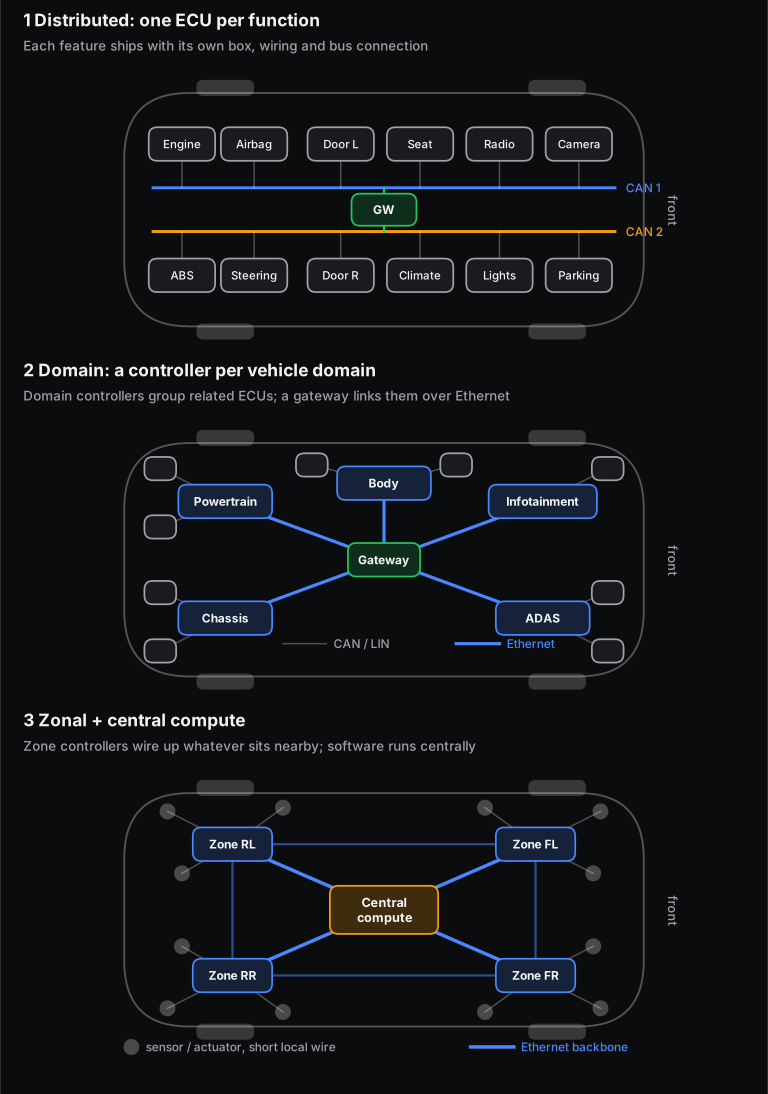
- Distributed. Every feature arrives as a box from a supplier: an engine ECU, an ABS ECU, a door module, a seat module. The boxes share data over several CAN and LIN buses joined by a gateway. It is easy to source but hard to change. A new feature usually means a new box, new wires, and software from yet another supplier.
- Domain. Functions are grouped by what they do (powertrain, chassis, body, infotainment, ADAS), and each group gets a more powerful domain controller. A central gateway links the domains, often over Ethernet. Small ECUs still hang off each domain.
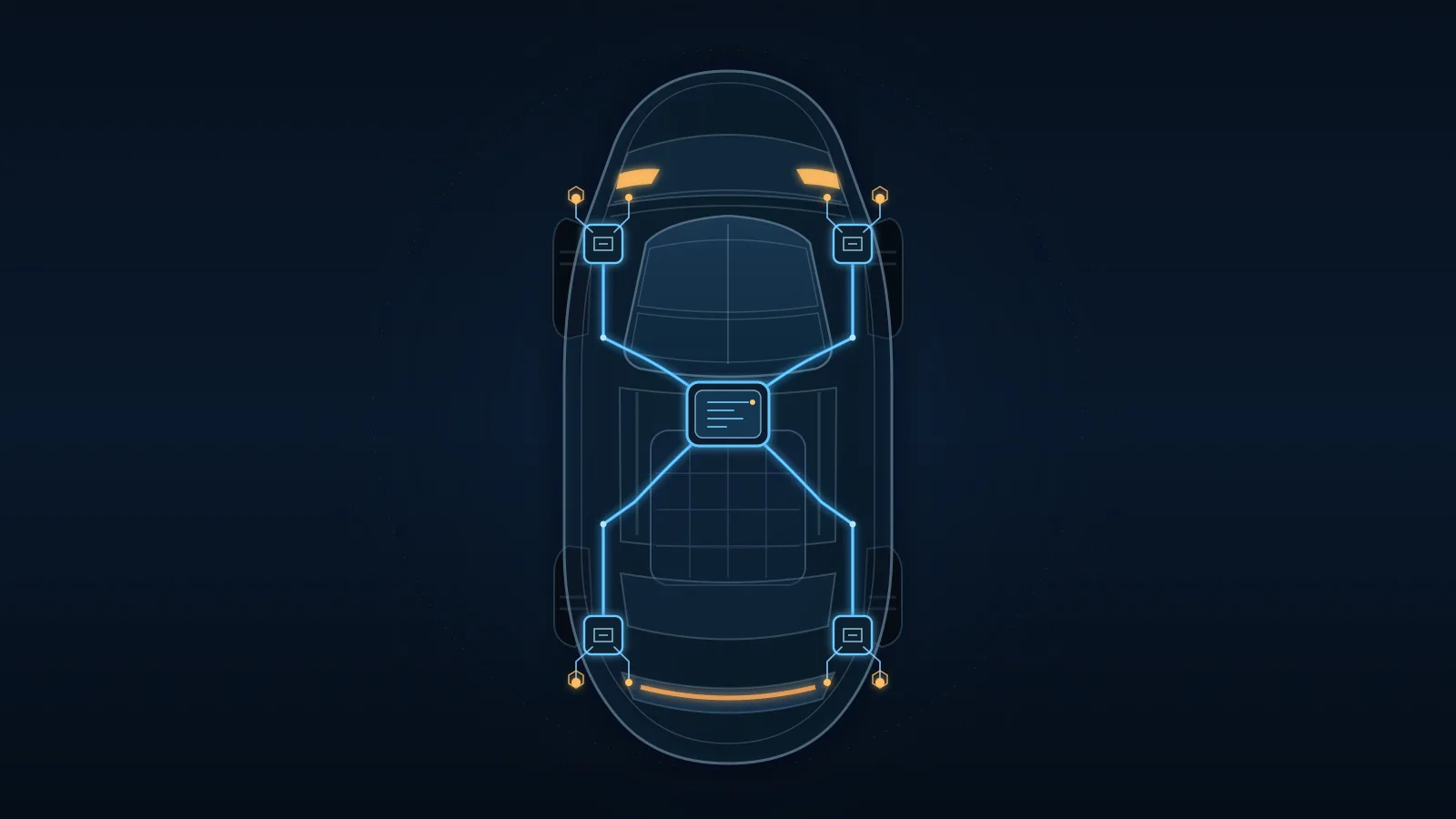
- Zonal plus central compute. The car is split by location, not function. A zone controller in each corner (or area) of the car powers and wires up whatever sits near it, such as lights, door motors, switches and sensors, whichever domain they belong to. The zones pass data over Ethernet to central computers, where most of the feature software runs.
What is zonal architecture?
Zonal architecture is an electrical layout in which a few zone controllers, each serving one physical area of the car, connect nearby sensors and actuators with short local wires and link to central computers over a high-speed Ethernet backbone. It replaces long point-to-point wiring runs from each part to its own distant ECU.
A useful analogy is a city's electricity network. You don't run a cable from the power station to every house. You run trunk lines to local substations, and each substation feeds its neighbourhood. Zone controllers are the substations. Many of them also distribute power, using electronic fuses in place of blade fuses. BMW says its digital fuses replace up to 150 classic fuses.
How much wiring and how many ECUs does zonal architecture save?
Only a few manufacturers have published numbers, and they are the makers' own claims, not independent measurements:
| Vehicle | What changed | Claimed result | Source |
|---|---|---|---|
| Rivian R1 (second generation, 2024) | Zonal system with three zonal ECUs (West, East, South) | 17 ECUs down to 7 (59% fewer); about 1.6 miles (2.57 km) of wiring and 44 lb (20.0 kg) removed per vehicle | Rivian via InsideEVs, 6 Jun 2024; Popular Science, 6 Aug 2024 |
| BMW Neue Klasse | Four high-performance computers ("superbrains") plus zonal harness | 600 m less cable, harness 30% lighter, more than 20 times the computing power of the previous generation | BMW Group, 11 Mar 2025 |
BMW does not say how many ECUs disappear, so "four computers replace 100 ECUs" headlines go beyond what BMW published. Wiring savings also depend on how many zones you choose. More zones means shorter local wires but more controllers and more network hops.
What does the central computer in an SDV do?
The central computer, also called a high-performance computer (HPC) or vehicle computer, runs the software that used to be spread across dozens of ECUs. It handles functions such as driver assistance, the infotainment cockpit, energy management and vehicle behaviour. It uses a microprocessor system-on-chip with far more computing power than a typical ECU microcontroller.
Concentrating software brings three practical benefits:
- One place to update. An OTA campaign has to reach a few computers, not dozens of ECUs from different suppliers.
- Shared resources. Camera, radar and map data can be fused in one place, and spare computing capacity can host features added later.
- Software separate from hardware. Applications are written against platform services, not one supplier's box, so they can move between car lines.
Real designs differ. BMW splits the work across four computers (infotainment, automated driving, driving dynamics and basic body functions). Volvo describes the EX90 as running on a single core computer. "Central" means few and powerful, not necessarily one.
Why do SDVs use automotive Ethernet instead of CAN?
SDVs use automotive Ethernet as the backbone because a zonal car moves far more data between zones and central computers than CAN can carry. Classical CAN runs at up to 1 Mbit/s with 8-byte messages. Single-pair automotive Ethernet runs at 10, 100 or 1,000 Mbit/s and carries IP traffic, including large software updates. CAN remains for local, low-rate links.
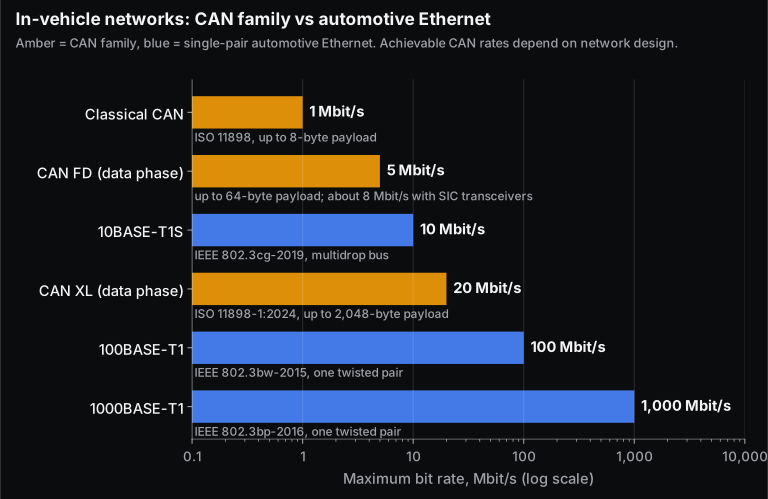
- Classical CAN (ISO 11898) carries up to 8 bytes of data per frame. CiA notes that most high-speed CAN runs at up to 1 Mbit/s.
- CAN FD raises the payload to 64 bytes and speeds up the data phase. ISO 11898-2:2024 transceivers are specified up to 5 Mbit/s, and signal-improvement (SIC) transceivers reach about 8 Mbit/s, depending on network design.
- CAN XL (ISO 11898-1:2024) carries 1 to 2,048 bytes and reaches 20 Mbit/s and more with SIC XL transceivers.
- Automotive Ethernet runs over a single twisted pair: 100BASE-T1 (IEEE 802.3bw, approved October 2015), 1000BASE-T1 (802.3bp, June 2016) and 10BASE-T1S (802.3cg, November 2019). 10BASE-T1S is a multidrop bus, so it can do some of CAN's job with Ethernet's protocols.
Worked example: how long does a 100 MB update take over CAN vs Ethernet?
Take an illustrative 100 MB software image (8 × 108 bits) and assume the link carries nothing else. Real reprogramming adds flow control, security checks and flash-write time, so treat these as best cases. What matters here is the ratio.
Classical CAN at 500 kbit/s. A frame with an 11-bit identifier and data bytes is bits long, including the 3-bit gap between frames. Bit stuffing can add up to more bits (Davis et al., 2007). With :
Large payloads travel over CAN with the ISO-TP transport protocol (ISO 15765-2). Each consecutive frame spends one byte on protocol control and carries 7 bytes (56 bits) of the image. So the image moves at:
100BASE-T1 Ethernet. A full Ethernet frame takes 1,538 bytes on the wire: 8 bytes of preamble and start delimiter, a 14-byte header, 1,500 bytes of payload, a 4-byte checksum and a 12-byte gap. Take away 20 bytes each for the IPv4 and TCP headers, and 1,460 bytes of the image remain:
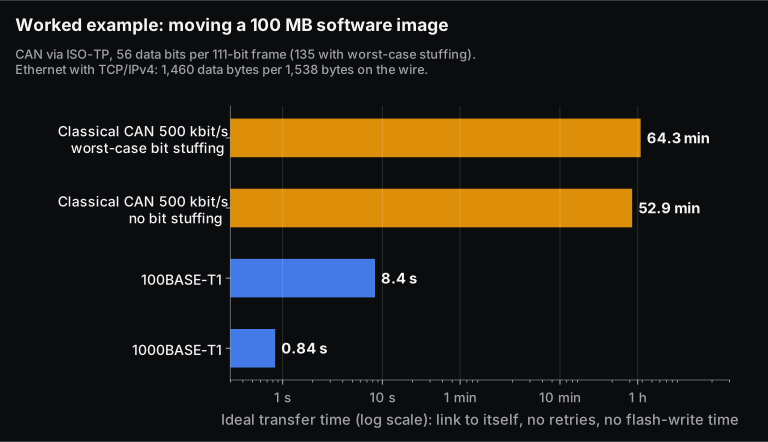
That is a factor of about 376 between 500 kbit/s CAN and 100 Mbit/s Ethernet, and about ten times more again at 1000BASE-T1 (0.84 s). This is why OTA-capable cars bring updates in over Ethernet to the central computer and only use CAN for the last short hop to small ECUs, if at all. CAN FD and CAN XL narrow the gap but don't close it. CAN isn't going away, though. It stays cheap, robust and well understood for local links inside a zone. For the CAN basics, see our guide to the CAN protocol in automotive electronics.
What is service-oriented architecture in a car? SOME/IP and DDS explained
Service-oriented architecture (SOA) means software components offer and use named services, such as "vehicle speed" or "set seat position", over the network. They find each other at run time instead of exchanging fixed signals defined years earlier in a communication matrix. In cars, the two main SOA protocols are SOME/IP and DDS.
In a classic CAN car, engineers fix in advance, for example, that message ID 0x1A0 carries wheel speed in bytes 2-3 and is sent every 10 ms. Every ECU that needs it is built around that matrix, so adding a new consumer or producer means changing the matrix. In a service-oriented car, a component announces "I provide WheelSpeed", and any authorised component can subscribe to it. That is what lets an OTA update add a feature that uses data nobody planned for in 2023.
- SOME/IP ("Scalable service-Oriented MiddlewarE over IP") is AUTOSAR's protocol for remote procedure calls, event notifications and data serialization over IP. Its companion, SOME/IP-SD, handles service discovery.
- DDS (Data Distribution Service), an Object Management Group standard, is a data-centric publish-subscribe model with configurable quality of service. The AUTOSAR Adaptive Platform includes DDS integration alongside SOME/IP.
AUTOSAR Classic vs Adaptive: which one runs where in an SDV?
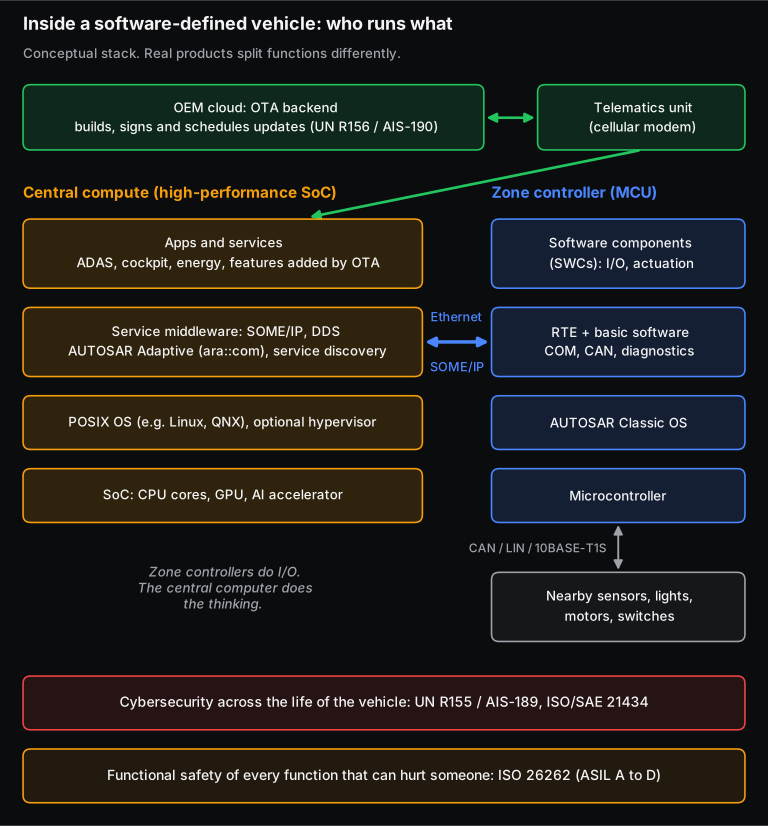
In an SDV, both AUTOSAR platforms usually run side by side. AUTOSAR Classic runs on microcontrollers in zone controllers and small ECUs that need hard real-time, safety-rated behaviour. AUTOSAR Adaptive runs on the microprocessor central computers, where software is service-oriented, written for a POSIX operating system and updated more often.
| AUTOSAR Classic Platform | AUTOSAR Adaptive Platform | |
|---|---|---|
| Hardware | Microcontroller ECUs | Microprocessor systems (high-performance computers) |
| Software layers | Application, RTE, basic software (BSW) | Applications on the AUTOSAR Runtime for Adaptive Applications (ARA) |
| Operating system | AUTOSAR OS | POSIX-based; AUTOSAR recommends the PSE51 profile for safety-relevant real-time systems |
| Communication | Mostly signal-based (CAN, LIN, FlexRay, Ethernet) | Service-oriented, with services discovered at run time (SOME/IP, DDS) |
| Configuration | Generated at build time from ARXML descriptions | Communication paths can be set at design time, at start-up or at run time |
| Typical SDV role | Zone controllers, actuators, safety ECUs | Central compute, gateways, ADAS and cockpit platforms |
For the interview-level detail (RTE, BSW, the COM stack, ara::com), see our AUTOSAR interview questions guide.
How do OTA updates work, and what do UN R155 and R156 require?
An OTA update is built and signed on the carmaker's servers, sent over the cellular network to the car's telematics unit, checked, and then installed on the target computers, usually with a fallback if installation fails. UN R156 requires the maker to run an approved software update management system (SUMS). UN R155 requires a certified cybersecurity management system (CSMS) covering the vehicle's whole life.
- UN R155 (cybersecurity) and UN R156 (software updates) were adopted by the UNECE World Forum (WP.29) in June 2020. They entered into force on 22 January 2021 in the countries that apply them under the 1958 Agreement. UNECE described R156 as the first international regulation covering over-the-air updates.
- In the EU, they became mandatory for new vehicle types from July 2022 and for all new vehicles from July 2024.
- The engineering standard behind R155 compliance is usually ISO/SAE 21434:2021, which covers cybersecurity risk management from concept to decommissioning.
What are AIS-189 and AIS-190 in India?
AIS-189 and AIS-190 are India's proposed equivalents of UN R155 and R156. MoRTH's draft notification G.S.R. 503(E), dated 22 June 2026, would add Rule 125-T (cybersecurity management system per AIS-189) and Rule 125-U (software update management system per AIS-190) to the Central Motor Vehicles Rules, 1989. We found no final notification as of 16 November 2026.
As reported by Autocar Pro (27 Jun 2026) and summarised by TeamLease RegTech:
- Scope: Rule 125-T covers M, N and T category vehicles fitted with at least one ECU, plus L7 vehicles with Level 3 or higher automation. Rule 125-U covers categories M, N, T, A and C.
- Phases: the draft proposes Level 3+ automated vehicles first (new models from 1 October 2026, existing models from April 2027), then OTA-capable vehicles in 2028, then all vehicles with any software-update capability by October 2029. Reports differ slightly on the intermediate dates, so check the final Gazette text.
- Process: comments were invited for 30 days from 26 June 2026. The AIS standards apply until the Bureau of Indian Standards notifies its own.
What we can confirm is the draft and its proposed schedule. Whether the October 2026 date took effect as proposed, we could not verify. For engineers, the direction is clear either way. Cybersecurity and update management are becoming type-approval requirements in India, as they already are in the EU. Our automotive cybersecurity explainer covers the attack side.
What are the downsides and risks of software-defined vehicles?
SDVs are harder to build than the marketing suggests. The main risks are software cost and delays, a bigger cyber attack surface, the difficulty of proving functional safety when many functions share one computer, and a supply chain built around buying finished boxes. Each one is manageable, but none goes away.
- Cost and schedule. Software platforms are expensive and late more often than hardware. Porsche's own IPO prospectus (reported 14 Oct 2022) said the electric Macan's production start had been pushed back "in part due to delays at CARIAD and the Group in developing the E3 1.2 platform", Volkswagen Group's in-house software platform. A central computer is also a far more expensive part than any single small ECU it replaces. The business case rests on savings in wiring, assembly and software reuse across car lines, and those only arrive at volume.
- Cybersecurity. A car that accepts code from the internet is a target. That is why R155 and R156 exist: updates must be authenticated, the update path protected from tampering, and risks monitored for the vehicle's life, not just at launch.
- Functional safety (ISO 26262). ISO 26262 grades hazards from ASIL A (lowest) to ASIL D (highest). When a braking-related function and a music app share one chip, engineers must show the app can't interfere with the safety function, through partitioning, hypervisors or separate safety cores. Every OTA change to safety-relevant code also needs the safety case updated, which slows the "update anything, anytime" promise.
- Legacy supply chain. The industry was built on Tier-1 suppliers delivering a finished ECU with its own software. In an SDV the carmaker owns the integration and much of the code. That changes contracts, liability and who employs the engineers. Tata Elxsi's JSW Motors deal, under which it owns the connected vehicle platform end to end from concept to aftersales, is one Indian example of that shift.
- Updates can fail. An interrupted or faulty update can leave a function, or the car, unusable until it is recovered. So update systems need verification before install, a safe state during installation and a way to roll back. Testing all of that across every model, variant and software version on the road is real, ongoing work.
What changes for engineers, and which skills do Indian employers ask for?
SDVs shift automotive electronics work from configuring one supplier box toward building platform software: Linux or QNX on high-performance chips, service-oriented middleware, Ethernet networking, OTA and cybersecurity processes, and safety analysis for mixed-criticality systems. Classic embedded C, CAN and AUTOSAR Classic skills stay in demand for zone controllers.
The skills follow directly from the stack above:
| Layer | What you work on | Skills to learn |
|---|---|---|
| Zone controllers and ECUs | I/O, actuation, diagnostics | Embedded C, microcontrollers, CAN/CAN FD, LIN, AUTOSAR Classic (RTE, BSW, COM), UDS diagnostics |
| Central compute | Platform and application software | Modern C++, POSIX/Linux or QNX, AUTOSAR Adaptive, SOME/IP, DDS, multithreading |
| Networking | Backbone and gateways | Automotive Ethernet (100BASE-T1, 10BASE-T1S), TCP/IP, network analysis tools such as Wireshark |
| OTA and security | Update pipeline, keys, threat analysis | UN R155/R156, AIS-189/190 (draft), ISO/SAE 21434 TARA, secure boot, cryptography basics |
| Safety and validation | Proving it works | ISO 26262, MIL/SIL/HIL testing, requirements traceability, ADAS validation |
On employers, Skill-Lync's own data is a starting point. Based on 3,711 Skill-Lync placement records up to 7 Nov 2026 (data snapshot of 15 Nov 2026), learners placed in the embedded domain (n = 278) had a median starting offer of ₹4.0 lakh per year (middle half ₹3.5-5.0 LPA). The companies that hired the most of them were Cyient (18), Nexteer Automotive (17), Expleo Engineering (9), Tata Technologies (8), L&T Technology Services (7) and Ielektron (7). This is a self-selected sample of Skill-Lync learners, mostly early-career offers from 2021-23, so it says nothing about senior SDV roles. We also tried to verify live SDV job ads for this post, but the listings had expired or would not load. We have therefore not quoted any employer's job requirements.
If you are starting out, build the base first: embedded C, CAN and AUTOSAR Classic. Then add C++ on Linux, Ethernet and one service protocol. Skill-Lync's Introduction to Automotive Embedded Systems and AUTOSAR covers the first part. Introduction to Automotive Cybersecurity and Vehicle Networks covers in-vehicle networks and security. For a longer path, see the PG Program in Embedded Systems for EV Applications, and for the validation side, Introduction to the Future of Vehicle Validation-ADAS. Our post on testing ECU software covers the validation skills.
Frequently asked questions
Is every electric car a software defined vehicle?
No. Electric and software-defined are separate ideas. An EV can have a conventional distributed architecture with one ECU per function and few OTA updates. A petrol or diesel car can be built on a central-compute, OTA-capable architecture. EV platforms are often designed from scratch, which makes them a natural place to start.
Is an OTA infotainment update enough to call a car software-defined?
Not really. Updating maps or the touchscreen app is the easy part. A true SDV can update functions across the vehicle, such as driving modes, driver assistance and energy management, because those functions run on updatable central computers rather than fixed ECUs. Many cars sit somewhere in between.
Will zonal architecture make CAN obsolete?
No. Ethernet takes over the backbone between zones and central computers, but CAN, CAN FD and LIN remain the cheap, proven choice for short links from a zone controller to sensors, switches and actuators. CAN XL and 10BASE-T1S compete for some of those local links.
What is the difference between UN R155 and ISO/SAE 21434?
UN R155 is a regulation: to get type approval in countries that apply it, a carmaker must show a certified cybersecurity management system. ISO/SAE 21434 is an engineering standard that describes how to do cybersecurity risk management. Most makers use it to meet R155's requirements.
Do I need to learn AUTOSAR Adaptive to work on SDVs?
Not for every role. Zone-controller and ECU jobs still run on AUTOSAR Classic and embedded C. Central-compute and middleware roles use AUTOSAR Adaptive or similar POSIX-based platforms with C++ and SOME/IP or DDS. Learning Classic first, then Adaptive, covers both.
Sources and further reading
- Volvo Car India EX90 launch release, reproduced by MediaInfoline, 12 Oct 2026
- Mahindra, Mahindra introduces the BE 6 SPORTEQ, press release, 15 Aug 2026
- Autocar Pro, Tata's Harrier EV: A Premium Electric Pivot with Software-First Thinking, 7 Jun 2025
- Tata Elxsi, JSW Motors and Tata Elxsi partnership, press release, 24 Apr 2026
- Eclipse SDV, Bharat Samanvaya for SDV SIG (accessed 16 Nov 2026)
- Autocar Pro, India Drafts Mandatory Cybersecurity, Software-Update Rules for Connected and Autonomous Vehicles, 27 Jun 2026
- TeamLease RegTech, Draft Central Motor Vehicles (Amendment) Rules, 2026, G.S.R. 503(E), 26 Jun 2026
- UNECE, UN Regulations on Cybersecurity and Software Updates to pave the way for mass roll out of connected vehicles, June 2020
- UNECE via CLEPA, Three landmark UN vehicle regulations enter into force, January 2021
- ISO, ISO/SAE 21434:2021 Road vehicles: Cybersecurity engineering and ISO 26262-1:2018 Road vehicles: Functional safety
- AUTOSAR, Adaptive Platform and Classic Platform pages (accessed 16 Nov 2026); SOME/IP Protocol Specification, R24-11
- Object Management Group, Data Distribution Service specification, v1.4
- IEEE 802.3 task forces: 802.3bw (100BASE-T1), 802.3bp (1000BASE-T1), 802.3cg (10BASE-T1S); IEEE 802.3-2022
- CAN in Automation: CAN knowledge, CAN FD: the basic idea, CAN XL (accessed 16 Nov 2026)
- Davis, Burns, Bril and Lukkien, Controller Area Network (CAN) schedulability analysis: Refuted, revisited and revised, Real-Time Systems 35 (2007)
- ISO 15765-2 (ISO-TP) overview; IETF RFC 791 (IPv4) and RFC 9293 (TCP)
- InsideEVs, Rivian's zonal architecture cuts wiring and ECUs, 6 Jun 2024; Popular Science, How Rivian reduced electrical wiring by 1.6 miles and 44 pounds, 6 Aug 2024
- BMW Group, Four "superbrains" for the Neue Klasse, 11 Mar 2025
- InsideEVs, Porsche Confirms Macan EV Delay To 2024 Over Slow Software Development, 14 Oct 2022
- Skill-Lync placement records, snapshot of 15 Nov 2026 (3,711 records up to 7 Nov 2026; embedded domain n = 278)