RAPP-8: AERB Clears First Approach to Criticality of 700 MWe Reactor
On 19 November 2026 AERB permitted the first approach to criticality of RAPP-8 at Rawatbhata, India's fourth 700 MWe PHWR. Here is what was approved and what is only expected, what criticality and the power-raising steps after it mean, how the reactor works (with NPCIL's design numbers and a worked heat and fuel balance), where the 700 MWe fleet stands, and the NPCIL and BARC routes for engineers.

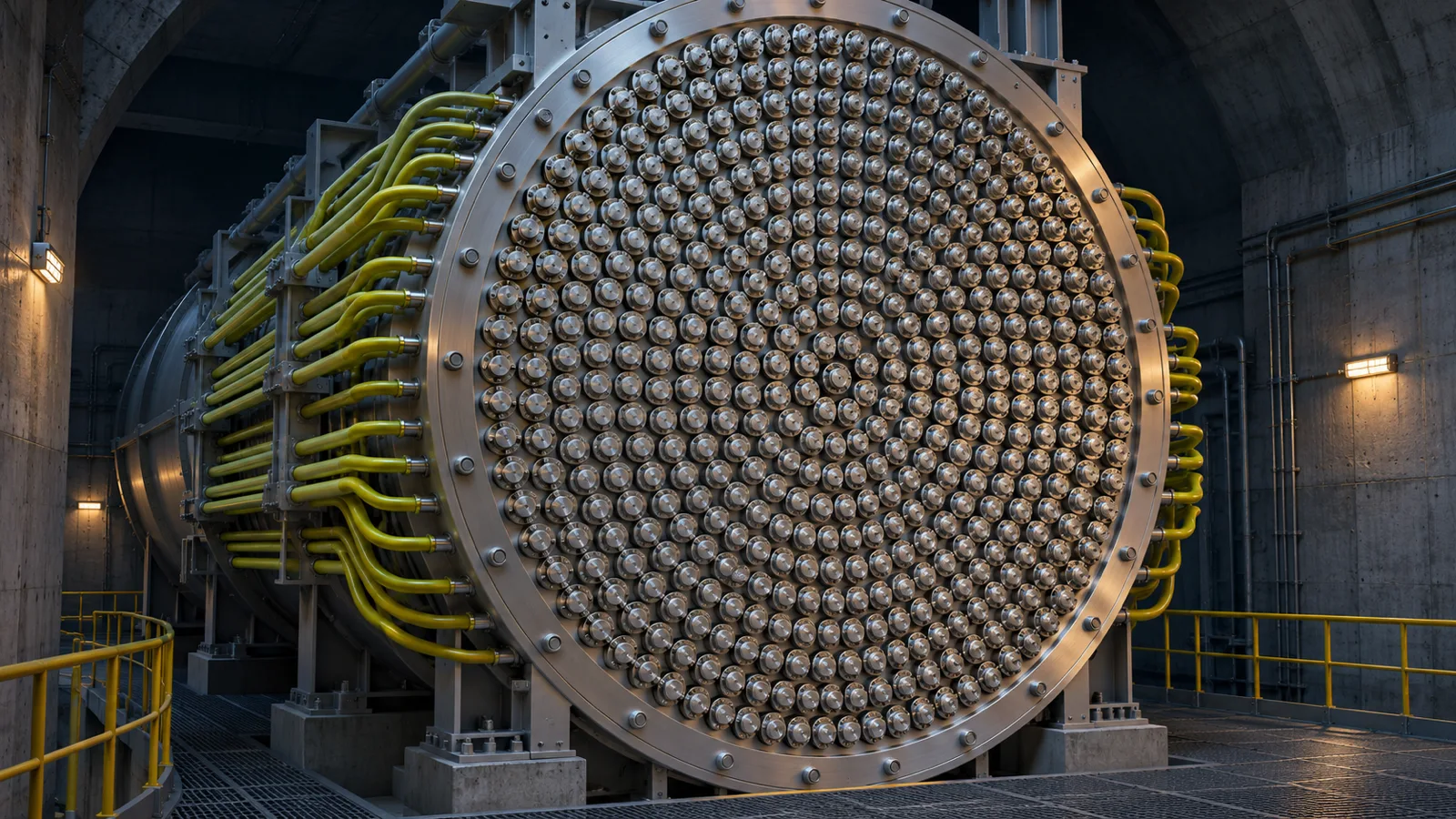
On 19 November 2026 the Atomic Energy Regulatory Board (AERB) gave permission for the First Approach to Criticality (FAC) of Unit 8 of the Rajasthan Atomic Power Project (RAPP-8) at Rawatbhata, in Chittorgarh district, Rajasthan. RAPP-8 is the fourth of India's indigenously designed 700 MWe Pressurised Heavy Water Reactors (PHWRs). The permission lets NPCIL start a controlled, self-sustaining fission chain reaction in the core for the first time. As of 22 November 2026, neither NPCIL nor AERB has announced that the reactor has actually gone critical.
Below: what is confirmed, what criticality and the later AERB power steps mean, how the reactor works (with NPCIL's design numbers and a worked calculation), where the 700 MWe fleet stands, and the NPCIL and BARC routes for engineers.
Key numbers at a glance
- 19 Nov 2026: AERB grants RAPP-8 permission for the First Approach to Criticality (AERB press release AERB/OSE&RD/PR/2026/142, dated 19 Nov 2026).
- 19 Sep 2026, 15:18: NPCIL began initial fuel loading in RAPP-8 (NPCIL press release, 20 Sep 2026).
- 2,166 MWth, 700 MWe gross, 630 MWe net: the 700 MWe PHWR design rating in NPCIL's KAPP-3&4 / RAPP-7&8 design table. That works out to 32.3% gross efficiency (our calculation).
- 392 channels, 4,704 bundles: natural uranium oxide fuel, 12 bundles in each pressure tube, average discharge burn-up 7,000 MWd per tonne (NPCIL design table).
- 4 of 16: RAPP-8 is the fourth of the sixteen 700 MWe PHWRs being set up in India. Three are already in commercial operation: KAPS-3, KAPS-4 and RAPS-7 (NPCIL, 20 Sep 2026).
What did AERB approve for RAPP-8, and when?
AERB's press release of 19 November 2026 says it granted permission for the First Approach to Criticality of RAPP-8 that day. The permission came after AERB's safety review of the reactor's design, construction, commissioning test results and operational readiness. That review covered assessments by AERB and its safety committees, regulatory inspections and a decision by the Board of AERB.
The release calls FAC "an important stage" on the way to commercial electricity generation, subject to the prescribed tests and further AERB permissions. AERB's resident site observer team will keep watching the commissioning work. The Rawatbhata site now has eight nuclear power units.
The steps before this one are on record. AERB permitted hot conditioning and light-water commissioning of RAPP-8 on 19 December 2025; AERB's 30 January 2026 permission for RAPP-7 records this. NPCIL began loading fuel at 15:18 on 19 September 2026, after its own AERB permission. When AERB's Chairman visited Rawatbhata (AERB note of 1 October 2026), RAPS-7 was operating and RAPS-8 was "under commissioning".
Confirmed vs reported (as of 22 Nov 2026)
| Item | Status | Source |
|---|---|---|
| FAC permission for RAPP-8 granted on 19 Nov 2026 | Confirmed | AERB press release 142, 19 Nov 2026 |
| Initial fuel loading began on 19 Sep 2026 at 15:18 | Confirmed | NPCIL press release, 20 Sep 2026 |
| RAPP-8 has reached first criticality | Not announced | The last RAPP-8 item on NPCIL's press list is from September. AERB's last is the FAC permission. |
| Commercial operation "during the current financial year" (by 31 Mar 2027) | NPCIL's expectation, not a fact | NPCIL press release, 20 Sep 2026 |
What does "first approach to criticality" mean?
A reactor is critical when its fission chain reaction sustains itself at a steady level. Each generation of neutrons produces exactly as many neutrons in the next generation as it loses to absorption and leakage. Engineers write this as k-effective = 1. The "first approach" is the controlled process of taking a newly built core from subcritical (k below 1) to critical for the very first time.
The Department of Atomic Energy defined it in those terms when RAPP-7 went critical. Criticality is the point where the neutrons produced by fission equal the neutrons lost, so the power stays stable (DAE/PIB, 28 Sep 2024). The multiplication factor k is the ratio of neutrons in one generation to neutrons in the one before:
- k < 1: subcritical. The chain dies away unless a neutron source keeps feeding it.
- k = 1: critical. The chain sustains itself at a constant level.
- k > 1: supercritical. The population grows, which is how power is raised once the reactor is under control.
Two things make this controllable in practice. First, a small share of neutrons is released a few seconds after fission by decaying fission products, rather than within a fraction of a millisecond. Those "delayed" neutrons slow the chain's response enough for control systems to keep up (BARC Newsletter, Jan-Feb 2021). Second, the approach starts from a poisoned core. AERB's FAC permission for KAPP-4 shows heavy water going into the moderator with a minimum boron level, "to prevent reactor criticality". The 700 MWe design lists natural boron (in the initial phase) and gadolinium nitrate as its soluble neutron absorbers.
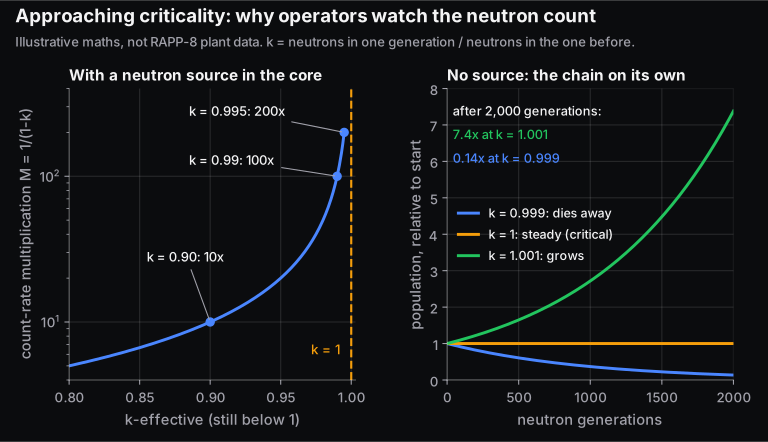
The left panel shows the textbook idea behind a first approach. With a neutron source in a subcritical core, the steady count rate is multiplied by . At k = 0.90 that is 10 times; at 0.99 it is 100 times; at 0.995 it is 200 times. As the poison is reduced step by step, the count rate climbs faster and faster. Operators use that trend to predict where k reaches 1 and approach it gently, not overshoot it. This is the general method, not RAPP-8's actual procedure, which NPCIL has not published.
What happens after a reactor goes critical?
Criticality is not the finish line. For the 700 MWe PHWRs, AERB has used a set ladder of stages, and each rung needs its own permission. First comes FAC together with the Phase-B low-power physics experiments (LPPE). Phase C then raises the reactor power in three sub-stages: C-1 up to 50% of full power (FP), C-2 up to 90% FP and C-3 up to 100% FP. After a review of performance close to rated power comes a licence for operation.
The stage names and caps come from AERB's own permissions. The KAPP-4 Phase-C permission of 9 February 2024 allowed power "up to 50% FP (Phase C-1)". It said C-2 (up to 90% FP) and C-3 (100% FP) "shall be taken up only after necessary Permission from AERB". Before granting the next step, AERB reviews data from the step before. For RAPP-7's final step, AERB reviewed "commissioning data at 90%FP" before allowing 100%.
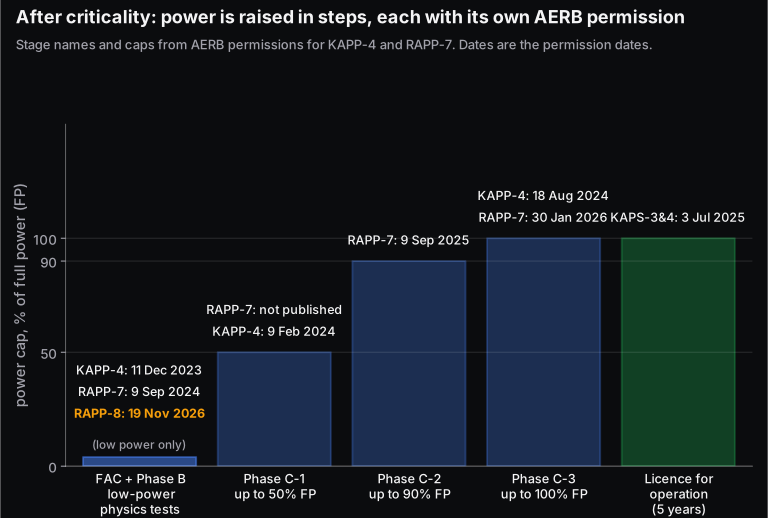
RAPP-7, the twin unit next door, shows how long the ladder takes:
- 9 Sep 2024: AERB permits heavy-water addition to the moderator, FAC and low-power physics experiments. AERB's press release, dated 10 September, says the permission was issued on 9 September; DAE and AERB's newsletter give 10 September.
- 19 Sep 2024, 21:42: RAPP-7 reaches criticality (DAE/PIB).
- 15 Apr 2025: commercial operation (NPCIL plant list).
- 9 Sep 2025: permission to raise power up to 90% FP.
- 30 Jan 2026: permission to raise power up to 100% FP (Phase C-3), valid until 31 January 2027.
Criticality came about ten days after the permission. Commercial operation came before the final power-raise permissions, at RAPP-7 and at KAPS-4, which entered commercial operation on 31 March 2024 but got its 100% FP permission on 18 August 2024. So "commercial operation" does not mean a unit is cleared for full rated power.
How does a 700 MWe PHWR work?
A 700 MWe PHWR is a natural-uranium reactor that uses heavy water twice. Heavy water is the moderator, which slows neutrons down so they cause fission efficiently. It is also the coolant, which carries heat to the steam generators. Natural uranium has only 0.7% U-235. Pressurised and boiling light-water reactors, such as the VVERs at Kudankulam, need fuel enriched to about 4%, but a PHWR can run on natural uranium. India chose PHWRs for the first stage of its three-stage nuclear programme (BARC Newsletter, Jan-Feb 2021).
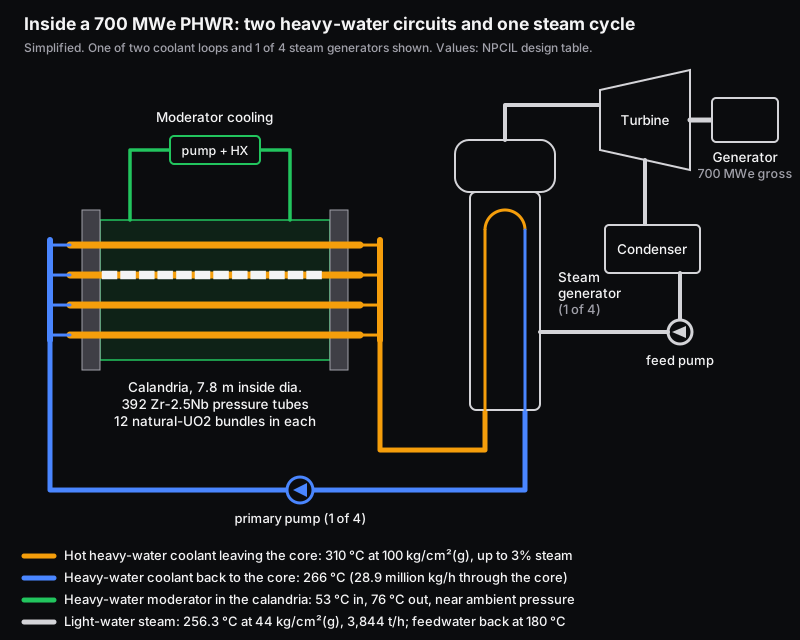
Here are the main parts, with the figures from NPCIL's design table:
- Calandria: a horizontal cylindrical tank, 7.8 m in inside diameter, with a 32 mm wall of stainless steel SS-304L. It holds 282 m³ of heavy-water moderator at near-ambient pressure, kept at 53 °C in and 76 °C out by its own pump and heat-exchanger loop. A light-water-filled concrete vault surrounds it (IAEA ARIS).
- Pressure tubes (coolant channels): 392 tubes of cold-worked Zr-2.5% Nb alloy run horizontally through the calandria, each 103.4 mm in inside diameter over a 5.94 m core length. Each sits inside a calandria tube, held concentric by four garter springs. The gap holds circulating carbon dioxide, which is monitored for moisture to detect leaks (IAEA ARIS). This design keeps the hot, high-pressure coolant apart from the cool, low-pressure moderator.
- Fuel: 37-element bundles of natural UO2 clad in Zircaloy-4, about 0.5 m long, 12 per channel, 4,704 in the core. A natural-uranium core needs fresh fuel continuously, so fuel is changed while the reactor runs. Fuelling machines lock onto a channel, push in new bundles and take out spent ones (BARC). This is called on-power refuelling.
- Primary heat transport system: heavy-water coolant at 100 kg/cm²(g) enters the core at 266 °C and leaves at 310 °C, with up to 3% steam at the channel exit. Flow is 28.9 million kg/h, driven by four vertical centrifugal pumps. There are two identical figure-of-eight loops, each with two steam generators and two pumps (IAEA ARIS).
- Steam generators: four mushroom-type units with integral steam drums. The design table lists 2,489 Incoloy-800 tubes of 19 mm outside diameter. Together they make 3,844 t/h of steam at 44 kg/cm²(g) and 256.3 °C for the turbine.
- Safety systems: two independent, fast-acting shutdown systems. The first uses spring-assisted cadmium shut-off rods that drop by gravity. The second injects gadolinium nitrate into the moderator (IAEA ARIS). Other features: a passive decay heat removal system, an emergency core cooling system, and a double containment of 49.5 m inner diameter with a steel-lined primary containment. The plant connects to the grid through separate 400 kV and 220 kV systems.
The design grew out of India's 540 MWe PHWR at Tarapur 3&4, raising output by using the available thermal margins (IAEA ARIS).
How much electricity and fuel does one 700 MWe PHWR use? (worked numbers)
The numbers below are computed by a script from NPCIL's design table, with steam properties from the NIST Chemistry WebBook. We take a 90% capacity factor, which is NPCIL's fleet capacity factor for April to October 2026 and also the design availability target.
1. Efficiency
The difference of 70 MW is used inside the station by auxiliaries such as pumps and cooling systems. That is 10% of gross output. About 1,466 MW of the reactor's heat is not turned into electricity, and most of it leaves through the condenser cooling water. NPCIL's table rounds the net efficiency to 29%.
2. Energy per year
At the same capacity factor, net output to the grid is about 4.97 TWh (4.97 billion units) a year from one unit.
3. Fuel burn-up arithmetic
Burn-up is the heat taken out of each tonne of uranium before it is discharged. NPCIL's table gives an average of 7,000 MWd per tonne. A year at 90% capacity factor produces of reactor heat, which needs a uranium mass :
That is about 309 kg of natural uranium for each full-power day, or 278 kg a day averaged over the year. Each kilogram yields about 54 MWh of gross electricity. This is the equilibrium-core average implied by the design figures. Real refuelling rates vary with the core's history, and the first core behaves differently.
4. Check the steam side yourself
The design table lets you check the heat balance. Steam at 44 kg/cm²(g) is 44.16 bar absolute. NIST's water data give a saturation temperature of 256.3 °C at that pressure, which matches NPCIL's figure. Saturated steam there has an enthalpy of 2,798.5 kJ/kg, and feedwater at 180 °C has 764.8 kJ/kg:
That is within 0.3% of the 2,166 MWth rating. The calculation ignores steam-generator blowdown, moisture in the steam and the heat added by the primary pumps, so a gap of this size is what you would expect. Skill-Lync's Rankine cycle calculator lets you take the same steam conditions through a turbine and condenser.
Where does India's 700 MWe PHWR fleet stand?
NPCIL counts sixteen 700 MWe PHWRs being set up. Three are in commercial operation, RAPP-8 is in commissioning, and the rest are under construction or in pre-project work. In its 20 September 2026 release, NPCIL said it operates 24 reactors with a total capacity of 8.78 GWe. It also has 17 reactors of about 13 GWe at various stages of implementation.
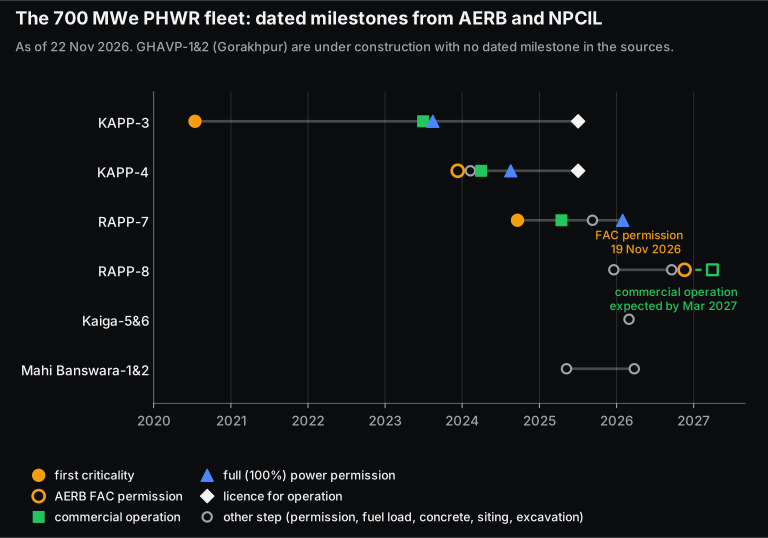
| Unit(s) | Status | Latest dated milestone | Source (date) |
|---|---|---|---|
| KAPS-3 (Kakrapar, Gujarat) | Commercial operation since 30 Jun 2023 | Five-year licence for operation, handed over 3 Jul 2025 | NPCIL plant list; AERB (Jul 2025) |
| KAPS-4 | Commercial operation since 31 Mar 2024 | Same licence, 3 Jul 2025 | NPCIL; AERB (Jul 2025) |
| RAPS-7 (Rawatbhata, Rajasthan) | Commercial operation since 15 Apr 2025 | Permission up to 100% FP, 30 Jan 2026 | NPCIL; AERB (30 Jan 2026) |
| RAPP-8 | Commissioning | FAC permission, 19 Nov 2026 | AERB (19 Nov 2026) |
| Kaiga-5&6 (Karnataka) | Under construction | First pour of concrete, 1 Mar 2026 (AERB permission 24 Feb 2026) | NPCIL project page (Mar 2026); AERB (28 Feb 2026) |
| Mahi Banswara-1&2 (Rajasthan) | Excavation stage, built by ASHVINI (NPCIL 51%, NTPC 49%) | Excavation consent, announced 26 Mar 2026 | AERB (26 Mar 2026) |
| GHAVP-1&2 (Gorakhpur, Haryana) | Under construction | Civil structures in progress | NPCIL project page (PDF dated Sep 2025) |
| GHAVP-3&4, Mahi Banswara-3&4, Chutka-1&2 | Pre-project | Siting and environmental clearances in place (GHAVP-3&4); land and clearances (Chutka) | NPCIL fleet-mode page (PDF dated Sep 2025) |
Ten of these units form the government's "fleet mode" order, approved in May 2017 (AERB Bulletin 2019): Kaiga-5&6, Mahi Banswara-1 to 4, GHAVP-3&4 and Chutka-1&2. The fleet approach means bulk orders for long-lead equipment and repeated, standard designs. AERB's notes on the Kaiga concrete pour and the Mahi Banswara excavation both describe those units as similar in design to KAPS-3&4.
What does RAPP-8 mean for engineering students and jobs?
Each new unit needs commissioning, operations and maintenance engineers, and the fleet behind it needs designers and project engineers for years. The two main entry routes for fresh graduates are NPCIL's Executive Trainee scheme through GATE and BARC's training schools.
NPCIL Executive Trainee through GATE
- ET-2027 notice (Advt. NPCIL/HQ/HRM/ET/2026/03): the disciplines are Mechanical, Electrical, Electronics, Instrumentation, Chemical, Civil and Computer Science. Candidates need a valid GATE 2025, 2026 or 2027 score, and the interview shortlist is made on GATE score. The detailed advertisement is due "tentatively within 10 days" of the GATE 2027 results.
- What ET-2026 looked like (Advt. NPCIL/HQ/HRM/ET/2026/02): 330 posts, of which 125 were Mechanical, 65 Electrical, 50 Electronics, 40 Chemical, 35 Civil and 15 Instrumentation. The interview shortlist ran at 1:12 per vacancy. Trainees got a stipend of ₹74,000 a month plus a one-time book allowance of ₹30,000. Training lasts one year at an NPCIL Nuclear Training Centre, in either the PHWR or the light-water reactor stream. After that, trainees join as Scientific Officer/C at Level 10 (₹56,100 basic).
- Our NPCIL Executive Trainee guide tracks the ET-2027 advert, eligibility and dates. The GATE 2027 Mechanical guide covers the exam itself.
BARC OCES/DGFS
The Department of Atomic Energy also hires fresh engineers as Scientific Officers through BARC's training schools (OCES and DGFS). You get in through GATE or BARC's own online exam, then an interview. The training stipend is ₹74,000 a month. The details, dates and 2027 status are on our BARC OCES/DGFS page.
Which skills does a reactor like RAPP-8 use?
- Mechanical: thermodynamics and steam tables (the heat balance above is the kind of check plant engineers do), heat transfer and two-phase flow in the channels, pumps and rotating equipment, and pressure-boundary design and in-service inspection. Skill-Lync's Foundations of Thermodynamics for Industrial Applications covers the cycle maths. Thermal-hydraulics analysis also draws on CFD (see the CFD course hub).
- Instrumentation and electronics: neutron flux monitoring and reactivity control. AERB's commissioning permissions require "continuous & reliable core neutron monitoring". Plants also use liquid zone control and the two shutdown systems.
- Electrical: station and emergency power supplies, and the 400 kV and 220 kV grid connections.
- Chemical: heavy-water and coolant chemistry, and the boron and gadolinium poisons used to control reactivity.
- Civil: prestressed and reinforced double containments, and seismic design (the design safe-shutdown earthquake is 0.214 g).
- Computer Science: computer-based control and protection systems, which AERB reviews through independent verification and validation. Computer Science is new to NPCIL's ET list for 2027.
Frequently asked questions
Has RAPP-8 achieved criticality?
Not as far as any official source shows on 22 November 2026. AERB granted permission for the First Approach to Criticality on 19 November 2026. The next announcement to watch for is NPCIL's own release saying the reactor has gone critical. For RAPP-7, criticality came about ten days after AERB's permission.
Is RAPP-8 the same as RAPS-8?
Yes. NPCIL's project pages use RAPP (Rajasthan Atomic Power Project) for Units 7 and 8. Its list of operating plants uses RAPS (Rajasthan Atomic Power Station) for units in operation. AERB documents use both names for Unit 8. The units sit at Rawatbhata, in Chittorgarh district near Kota.
When will RAPP-8 start producing commercial power?
NPCIL said in September 2026 that the unit is expected to start commercial operation during the current financial year, which ends on 31 March 2027. That is NPCIL's expectation, not a confirmed date. Before then the unit must complete low-power physics tests and the power-raising stages, each with AERB's permission.
Why does a PHWR use heavy water instead of ordinary water?
Heavy water slows neutrons down while absorbing very few of them. That lets a reactor sustain a chain reaction with natural uranium, which has only 0.7% U-235, so India does not need enrichment for its PHWR fleet. The cost is the heavy water inventory and the need to refuel continuously while the reactor runs.
Can a Mechanical graduate get into NPCIL without GATE?
Not through the Executive Trainee route: NPCIL shortlists ETs on GATE score alone. Mechanical had the most ET posts in 2026, 125 of 330. The other DAE route, BARC OCES/DGFS, also runs its own online exam alongside GATE scores.
Sources and further reading
- Atomic Energy Regulatory Board, Press release AERB/OSE&RD/PR/2026/142: AERB approves First Approach to Criticality of RAPP Unit-8 (19 Nov 2026; read 22 Nov 2026).
- Nuclear Power Corporation of India Ltd, Press release: RAPP-8 reaches a major milestone with commencement of initial fuel loading (20 Sep 2026).
- AERB, Permission for raising reactor power of RAPP-7 up to 100% FP (Phase C-3) (30 Jan 2026), which also records RAPP-7's 90% FP permission and RAPP-8's hot-conditioning permission.
- AERB, Press release: AERB approves the First Approach to Criticality of RAPP Unit 7 (10 Sep 2024).
- AERB, Permission for FAC and LPPE of KAPP-4 (11 Dec 2023), Phase-C commissioning of KAPP-4 (9 Feb 2024) and KAPP-4 up to 100% FP (18 Aug 2024).
- AERB, AERB grants licence for operation of India's first 700 MWe PHWR (Jul 2025).
- AERB, Visit of Chairman, AERB to Rawatbhata Rajasthan Site of NPCIL (1 Oct 2026); FPC permission for Kaiga-5&6 (28 Feb 2026); Excavation consent for Mahi Banswara-1&2 (26 Mar 2026).
- AERB, AERB Newsletter, July-September 2024 (RAPP-7 and KAPP-3/4 milestones).
- Department of Atomic Energy via PIB, Rajasthan Atomic Power Project Unit-7 reaches criticality (28 Sep 2024).
- NPCIL, A6 Interim report on safety evaluation of 700 MWe Indian PHWRs at KAPP-3,4 and RAPP-7,8, design parameter table (2011).
- NPCIL, EIA executive summary, 4 x 700 MW PHWR Mahi Banswara (rated thermal output 2,166 MWt).
- IAEA ARIS, Advanced Large Water Cooled Reactors booklet, IPHWR-700 pages (2020).
- BARC, Evolution of PHWR technology: a historical review, BARC Newsletter (Jan-Feb 2021).
- NPCIL, Nuclear power plants, installed capacity and capacity factor, and project pages for RAPP-7&8, Kaiga-5&6, GHAVP-1&2 and fleet-mode reactors (read 22 Nov 2026).
- NPCIL, ET-2027 notice, Advt. NPCIL/HQ/HRM/ET/2026/03 and ET-2026 advertisement, Advt. NPCIL/HQ/HRM/ET/2026/02.
- NIST Chemistry WebBook, Thermophysical properties of fluid systems (water), used for the steam-side check (read 22 Nov 2026).
- Worked numbers and figures: computed by Skill-Lync's scripts from the sources above. The approach-to-criticality panels are illustrative maths, not plant data.