Quick Select (QSELECT) and Advanced Selection in AutoCAD, With Examples
How Quick Select, Select Similar, FILTER and the WP, CP, Fence and lasso modes work in AutoCAD 2027 and LT, with a worked civil site plan: 12 columns picked in one pass, and why a window takes 13 objects where a crossing takes 15.
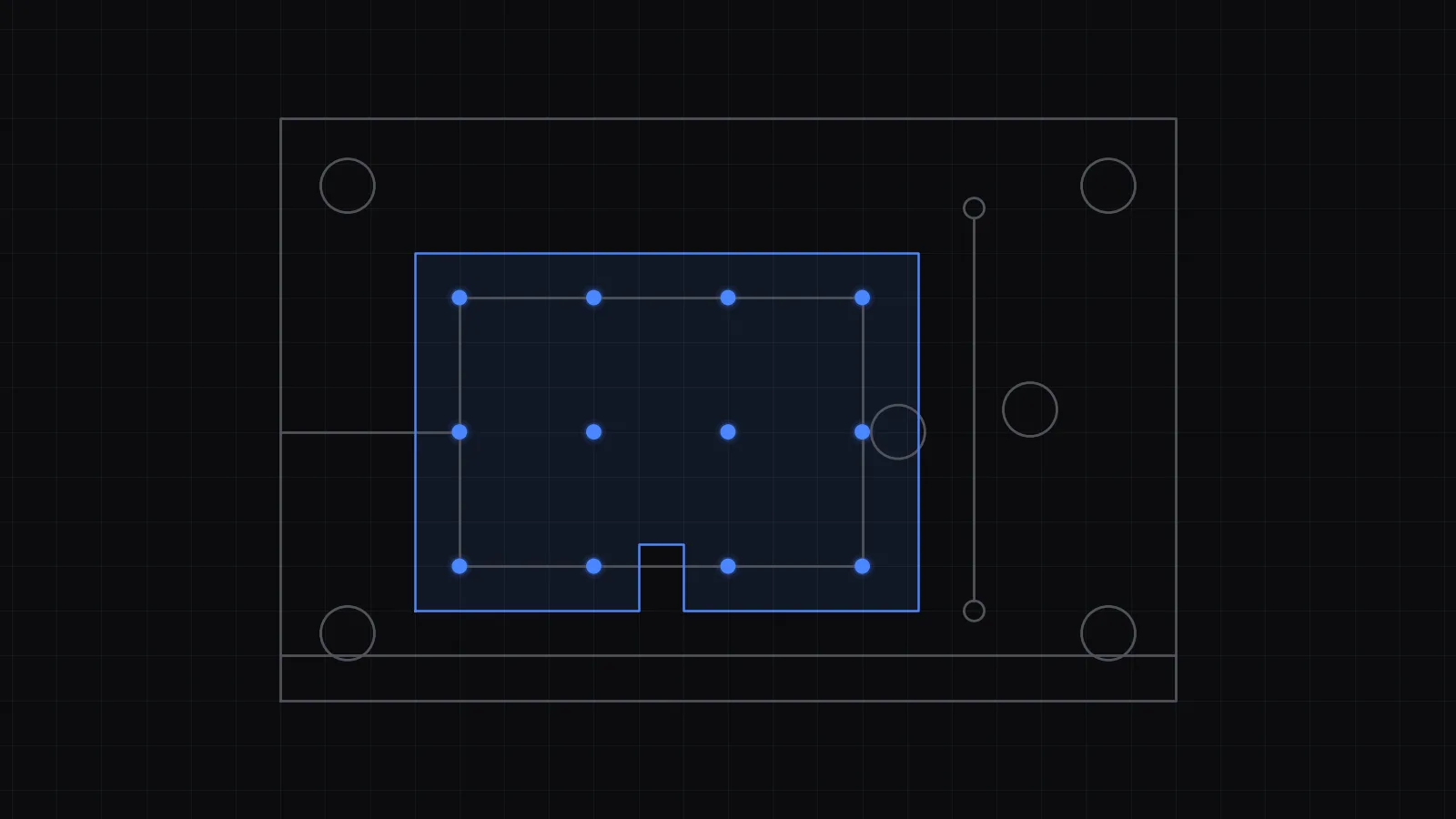
Quick Select (QSELECT) picks every object in an AutoCAD drawing that matches a type and a property, such as all circles with a radius under 0.3 m or every object on the sewer layer, without clicking them one by one. The advanced selection modes do the same job by area: Window Polygon (WP) takes objects fully inside a polygon you draw, Crossing Polygon (CP) also takes anything the polygon touches, and Fence takes whatever a line crosses.
In short (AutoCAD 2027 documentation)
- QSELECT filters by object type, property, an operator (Equals, Not Equal To, Greater Than, Less Than, Wildcard Match) and a value, on the whole drawing or the current selection. It does not select or count nested blocks.
- SELECTSIMILAR starts from an object you pick. Its default, SELECTSIMILARMODE = 130, matches object type, layer and (for blocks, xrefs and images) name.
- FILTER builds rules with AND, OR, XOR and NOT and saves them by name (up to 18 characters) in filter.nfl.
- Window vs Crossing: in Skill-Lync's 40 m × 26 m site-plan example, the same two corners select 13 objects as a window and 15 as a crossing.
- Previous (P) brings back the last selection set, not the last edited object. Ctrl+Shift+L does the same.
This guide is for civil engineering students and junior drafters who can already draw in AutoCAD or AutoCAD LT and now waste time picking objects. Command names, defaults and system variables are quoted from Autodesk's AutoCAD 2027 help (AutoCAD 2027's release notes are dated 25 March 2026). Selection has worked this way for many releases, so the steps apply to 2024-2026 as well. Every count in the worked examples was checked by a short script Skill-Lync keeps with this article.
What is Quick Select (QSELECT) in AutoCAD?
Quick Select is a dialog box that builds a selection set from rules instead of mouse clicks. You choose where to look (the whole drawing or the current selection), an object type, one of its properties, an operator and a value. AutoCAD selects everything that matches, and the set is ready for Move, Erase, Properties or any other command.
Open it in any of three ways: type QSELECT, click Home tab › Utilities panel › Quick Select, or right-click in the drawing area and choose Quick Select. The result also becomes the Previous selection set, so you can call it back at a later "Select objects" prompt by typing P.
QSELECT is strongest when the objects share a measurable property but sit all over the drawing: every 460 mm column circle, every piece of text in one style, every block whose name starts with "TREE". Picking those with windows on a 200-sheet project is slow and you will miss some.
How do I use Quick Select step by step?
Type QSELECT, set Apply To, pick an Object Type, choose a Property, set the Operator and Value, choose Include or Exclude under How to Apply, and click OK. AutoCAD highlights the matching objects. The worked example below selects the 12 columns on a site plan in one pass.
- Apply To: Entire drawing, or Current selection if you selected objects first. Click the Select Objects button to make a selection without closing your settings.
- Object Type: Circle. When Apply To is the whole drawing the list shows every type in the file; otherwise only the types in your selection.
- Properties: Radius. Each type has its own list (a line has Length and Angle, text has Height and Style).
- Operator: Less than. Wildcard Match appears only for editable text fields such as a block name or a text value; Select All ignores the property.
- Value: 0.3.
- How to Apply: Include in new selection set. Tick Append to current selection set if you want to add to what is already selected rather than replace it.
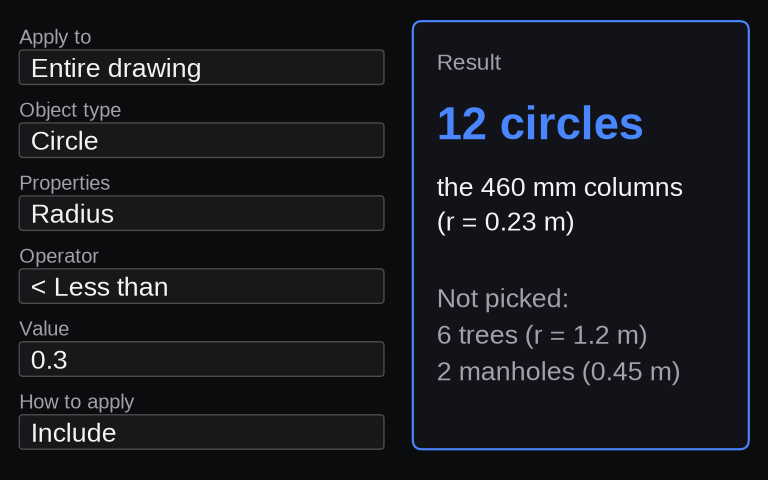
Worked example. The example site plan has 25 objects: a plot boundary, a building footprint, 12 columns drawn as circles of radius 0.23 m (460 mm diameter), 6 tree symbols of radius 1.2 m, 2 manholes of radius 0.45 m, a sewer, a water main and a kerb line. With the settings above, QSELECT returns exactly the 12 columns. The value 0.3 works because it sits between the column radius (0.23 m) and the next smallest circle, the manholes (0.45 m). Change the operator to Greater than and the value to 0.5, and you get the 6 trees instead.
Two habits make QSELECT reliable. First, pick a threshold with a clear gap on both sides, as above, because real drawings have circles of 0.2299 m that look like 0.23 m. Second, check the count AutoCAD reports at the command line against what you expect before you erase or move anything.
How do I select all objects on one layer in AutoCAD?
Use QSELECT with Object Type set to Multiple, Property set to Layer, Operator Equals and the layer name as the value. It selects every object on that layer, whatever its type. In the example drawing, Layer = C-SSWR selects 3 objects: the two manholes and the sewer between them.
The reverse is often more useful. Layer, Not Equal To, S-COLS selects the other 13 objects, which is how you would grab everything except the structure before sending a drawing to the services consultant. If you only need to see a layer rather than select it, the Layer Isolate tools are faster; selection is for when you are about to change the objects.
A second way: click one object on the layer, right-click and choose Select Similar. With the default settings that selects objects of the same type on the same layer, so it would pick the 6 trees if you clicked a tree, but not lines on the same layer.
What is the difference between Quick Select and Select Similar?
Select Similar (SELECTSIMILAR) starts from an object you click and adds every object in the drawing that matches it. Quick Select starts from rules you type. Select Similar is faster for "more like this one"; Quick Select can do things Select Similar cannot: work inside a preselected area, use Not Equal To or Greater Than, and include or exclude matches.
Which properties count as "similar" is set by the SELECTSIMILARMODE system variable, or by typing SE (Settings) at the SELECTSIMILAR prompt. It is a bitcode: add the values of the properties that must match. Object type always has to match (value 0).
| Property | Value |
|---|---|
| Object type (always) | 0 |
| Color | 1 |
| Layer | 2 |
| Linetype | 4 |
| Linetype scale | 8 |
| Lineweight | 16 |
| Plot style | 32 |
| Object style (text, dimension, table styles) | 64 |
| Name (blocks, xrefs, images) | 128 |
The initial value is 130, which is Layer plus Name:
So to make Select Similar also insist on the same colour, set 131. Name matters more than it looks: for unnamed objects such as lines and circles, Autodesk's help says the Name setting treats objects of the same type as similar. In the example drawing, Select Similar on one tree with the default 130 selects all 6 trees (circle, layer L-TREE). Set the mode to 128 and the same click selects all 20 circles, columns and manholes included, because layer no longer has to match.
When should I use FILTER instead of Quick Select?
Use FILTER when one rule is not enough or you need the same rule every week. FILTER combines conditions with AND, OR, XOR and NOT, can test coordinates (for example circles whose centre X is greater than 100), and saves named filters in a file called filter.nfl for reuse. Quick Select handles one property at a time.
Autodesk's own example selects every circle except those with a radius of 1.0 or more: Object = Circle, then Begin NOT, Circle Radius >= 1.00, End NOT. Logical operators must be paired and balanced (XOR takes exactly two operands, NOT takes one). Saved filter names can be up to 18 characters.
The handy trick is to run it transparently. Start a command such as ERASE, and at "Select objects" type 'FILTER (with the apostrophe). Click Apply, and then draw any window or crossing you like: only objects that pass the filter are taken. That is how you erase the text inside one building without touching the text in the next one.
What is the difference between window and crossing selection?
A window selection, made by picking corners from left to right, selects only objects completely inside the rectangle. A crossing selection, picked from right to left, selects objects inside the rectangle and any that cross its edges. AutoCAD shows the crossing outline dashed (or otherwise highlighted) so you can tell which one you are drawing.
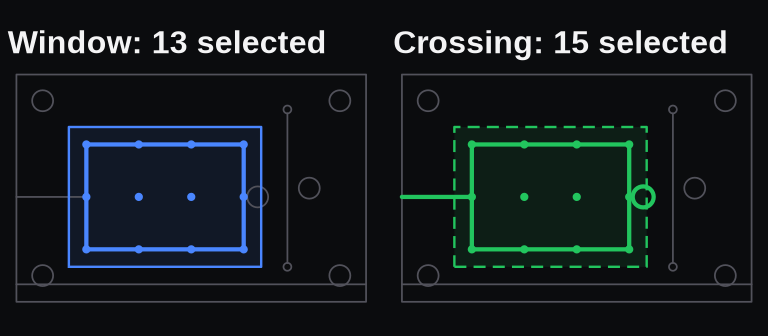
In the example, both selections use the corners (6, 4) and (28, 20). The window takes 13 objects: the footprint polyline and the 12 columns, all fully inside. The crossing takes 15, because it adds the water main (it runs in from the plot boundary at x = 0 and crosses the left edge at x = 6 m) and the tree at (27.6, 12), whose 2.4 m canopy pokes 0.8 m past the right edge. Nothing else touches the rectangle.
The rule of thumb for civil drawings: use a window when you want only what you can see is inside (one room's furniture, one bay's columns), and a crossing when you need everything that reaches into an area (all pipes entering a manhole chamber, all grid lines through a bay). The Box option makes the direction decide for you: right to left behaves as Crossing, left to right as Window, which is the normal click-and-pick behaviour.
How do Window Polygon, Crossing Polygon and Fence work?
They are the irregular versions of window and crossing. At any "Select objects" prompt, type WP or CP and click the corners of a polygon; AutoCAD closes it for you when you press Enter. WP takes objects completely inside, CP takes objects inside or crossing. Type F for Fence and click a line: everything the line crosses is selected.
The polygon can have any shape, but it cannot cross or touch itself; a fence is not closed and may cross itself. None of the three is affected by the PICKADD setting, so they always add to the current set.
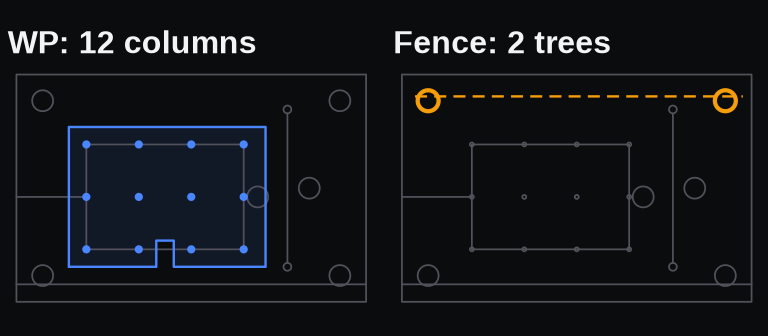
Worked example, WP. Suppose you want all 12 columns but not the footprint polyline, which runs through the column centres. A rectangle cannot do it: any window that holds the corner columns also holds the whole footprint. A WP with a small notch can. The polygon (6, 4) → (16, 4) → (16, 7) → (18, 7) → (18, 4) → (28.5, 4) → (28.5, 20) → (6, 20) dips across the south wall at x = 16 m, between the columns at 14 m and 20 m. The wall is no longer completely inside, so it drops out; the 12 columns stay. The same polygon as a CP selects 15 objects, the same as the crossing rectangle.
Worked example, Fence. A fence from (1.5, 23.5) to (39, 23.5) crosses only the two north tree symbols (centres at y = 23 m, radius 1.2 m). It passes 1.5 m above the north manhole's centre, more than its 0.45 m radius, so the manhole is left alone. Fences are the quickest way to grab a row of street lights, a line of piles or all the dimension lines along one grid.
In real work, QSELECT would also pick the 12 columns (Circle, Radius < 0.3). Area selection wins when the objects you want share no clean property, for example one zone of a mixed layer.
How does lasso selection work in AutoCAD?
Click in an empty part of the drawing and hold the mouse button while you drag: AutoCAD draws a free-form lasso instead of a rectangle. Dragging left starts a crossing lasso, dragging right a window lasso, and pressing the Spacebar while dragging cycles crossing, window and fence. Release the button to finish.
Lasso is controlled by the PICKAUTO system variable. Its initial value is 5, which is 1 (start a window or crossing when you click away from an object) plus 4 (start a lasso when you click and drag). If you prefer click-and-drag to make an ordinary rectangle, clear "Allow press and drag for Lasso" on the Selection tab of Options.
Which selection options can I type at the Select objects prompt?
AutoCAD 2027 lists these modes: Window, Last, Crossing, BOX, ALL, Fence, WPolygon, CPolygon, Group, Add, Remove, Multiple, Previous, Undo, AUto, SIngle, SUbobject and Object. Type the capital letters (W, L, C, BOX, ALL, F, WP, CP, G, A, R, M, P, U, AU, SI, SU, O). A mode lasts only for the current prompt; type ? to list them.
| Type | Mode | What it selects |
|---|---|---|
| W / C | Window / Crossing | Fully inside / inside or crossing a rectangle |
| WP / CP | WPolygon / CPolygon | The same, for a polygon you click |
| F | Fence | Anything an open line crosses |
| ALL | All | Everything in model space or the current layout, except objects on frozen or locked layers |
| L | Last | The most recently created visible object (its layer must be on and thawed) |
| P | Previous | The most recent selection set (Ctrl+Shift+L also works) |
| G | Group | All objects in a named group (unnamed groups need the *, e.g. *A3) |
| R / A | Remove / Add | Switch between taking objects out and putting them back in |
| U | Undo | Drops the object most recently added |
| M | Multiple | Picks without highlighting, faster on very heavy objects |
| SI | Single | Ends the prompt after the first pick |
One correction to a common mix-up (and to an older version of this article): Previous does not select the last modified object. It reselects the last selection set, which is why it is so useful after QSELECT. Autodesk notes that operations which delete objects clear the Previous set, and it is ignored if you switch between model space and a layout.
How do I add or remove objects from a selection?
Hold Shift and click (or Shift and drag a window) to remove objects from the current selection; release Shift and keep picking to add more. This is the default behaviour, PICKADD = 2. At a "Select objects" prompt you can also type R to switch to Remove mode and A to switch back to Add.
If clicking a new object replaces your selection instead of adding to it, PICKADD has been set to 0 (or "Use Shift to add to selection" is ticked in Options › Selection). Set PICKADD back to 2. For objects stacked on top of each other, such as a column circle drawn over a grid bubble, turn on selection cycling (Ctrl+W toggles it). SELECTIONCYCLING is 0 (off) initially in AutoCAD 2027; at 2 AutoCAD also opens a Selection list of the overlapping objects (Windows only).
Why is my selection not working in AutoCAD?
Most selection problems come from a setting or a layer state, not a bug. Locked and frozen layers are skipped by ALL, frozen or off layers hide objects from Last, and QSELECT does not count nested blocks. Check these first:
- Can't select before a command (noun-verb): PICKFIRST must be 1, its default.
- No hover highlight: PICKBOX is 0. Its initial value is 3 pixels; at 0 selection preview is off.
- Click-drag makes a lasso you didn't want: PICKAUTO, or clear the lasso option in Options › Selection.
- QSELECT count looks low: objects inside blocks (and blocks nested in associative arrays) are not selected or counted. Explode a copy or count the blocks instead.
- Selecting one object grabs several: Object Grouping is on. Ctrl+Shift+A toggles it.
- Huge drawings feel slow while you drag a window: preview highlighting stops after SELECTIONPREVIEWLIMIT objects (20,000 by default), which is expected.
Do these selection tools work in AutoCAD LT?
Yes. QSELECT, SELECTSIMILAR, FILTER, the WP, CP and Fence modes, lasso, PICKADD and selection cycling are all documented in the AutoCAD LT 2027 help. The one exception in this article is subobject selection (Ctrl+click on faces, edges and vertices of 3D solids), which is not available in LT because LT has no 3D solid modelling.
Where do Skill-Lync courses fit?
Selection is one of the first habits Skill-Lync's AutoCAD Essentials for Civil Engineers course builds, before layers, blocks, layouts and plotting. The recorded course runs about 30 hours over 60 lessons, and the first three are free on Grow; you can also compare every Skill-Lync AutoCAD course. As of 17 Nov 2026, Skill-Lync's placement records (n = 3,905) include 339 placements from the Master's in Civil Engineering program, mostly detailer and BIM modeller roles, with a median disclosed starting salary of ₹2.45 LPA (n = 328). These are self-reported entry-level offers, a starting point rather than a promise. Related guides: undo, redo and basic selection methods, grips and Match Properties and the Intersection, Perpendicular and Tangent snaps. To pick the right course for your background, talk to a Skill-Lync counsellor.
Frequently asked questions
Is there a shortcut for Quick Select in AutoCAD?
The dependable way is to type QSELECT and press Enter, click Home tab › Utilities panel › Quick Select, or right-click in the drawing area and choose Quick Select. If you use it all day, add your own command alias such as QS to acad.pgp (acadlt.pgp in LT), then run REINIT so AutoCAD reloads the file without restarting.
How do I select all text in an AutoCAD drawing?
Run QSELECT with Apply To set to Entire drawing and Object Type set to Text (single-line) or MText (multiline), Operator Select All, then click OK. Run it twice with Append to current selection set ticked to get both types. To limit it to one text style or height, choose that property and an Equals value instead.
What is the difference between WP and CP in AutoCAD?
Both use a polygon you click. WP (Window Polygon) selects only objects completely inside it; CP (Crossing Polygon) also selects objects that cross its edges. In Skill-Lync's site-plan example, a notched WP selected the 12 columns but not the wall polyline, while the same polygon as CP selected 15 objects, including the wall, a tree and a pipe.
Why does Select Similar pick objects on other layers?
Because SELECTSIMILARMODE no longer includes Layer (value 2). The default, 130, matches layer and name, so objects on other layers are left out. If someone set it to 128 or 0, any object of the same type qualifies. Type SELECTSIMILAR, then SE for Settings, and tick Layer again, or set SELECTSIMILARMODE back to 130.
Can Quick Select count blocks in AutoCAD?
Yes, for blocks inserted directly in the drawing: set Object Type to Block Reference, Property to Name and Operator to Wildcard Match with a value such as TREE*, and the command line reports how many were selected. It does not select or count nested blocks, or blocks inside associative arrays, so a block placed inside another block is missed.
Sources and further reading
- QSELECT (Command) and Quick Select Dialog Box, AutoCAD 2027 Help, Autodesk (accessed 21 Nov 2026).
- SELECT (Command) and Selection Modes (Command Modifier), AutoCAD 2027 Help (accessed 21 Nov 2026).
- SELECTSIMILAR (Command), SELECTSIMILARMODE (System Variable) and Select Similar Settings Dialog Box, AutoCAD 2027 Help (accessed 21 Nov 2026).
- Object Selection Filters Dialog Box and To Create and Save a Selection Filter, AutoCAD 2027 Help (accessed 21 Nov 2026).
- Have You Tried: Window, Fence, Lasso, and More, AutoCAD LT 2027 Help: lasso, Shift to deselect, Ctrl+Shift+L, selection settings and system variable defaults (accessed 21 Nov 2026).
- PICKADD, PICKAUTO, PICKBOX and SELECTIONCYCLING system variables, AutoCAD 2027 Help (accessed 21 Nov 2026).
- To Manage Command Aliases, AutoCAD 2027 Help: acad.pgp / acadlt.pgp and REINIT (accessed 21 Nov 2026).
- AutoCAD 2027 Release Notes, Autodesk, 25 March 2026 (accessed 21 Nov 2026).
- Worked examples: calc.py and the figure script, kept in this article's run folder (Skill-Lync blog engine, 21 Nov 2026).