WOT Condition
Aim:-
- To Calculate a Wide Open Throttle (WOT) Condition.
OBJECTIVES:-
- To calculate the ratio of Hill-Climbing Power required by a fully loaded tata ultra truck to a Half-Loaded one.
- To calculate the minimum length of the flyover considering the minimum height at the summit should be 5.5 meters.
- To prepare a new drive cycle to excel file for the driver glider model and include a hill-climbing angle to it.
- To model the WOT (Wide Open Throttle) response of the GM EV1 car and compare it with official figures of the performance of a real vehicle.
- To show variation in acceleration time with a 5% change in vehicle parameters.
INTRODUCTION
Wide-open throttle
WOT is also known as the highest acceleration peak when the motor operates at its full RPM to propel the vehicle. At this condition, the vehicle is at rest position and we apply full throttle within no time.
For HEV’s Wide-open throttle depend upon traction, generator motor, and engine to satisfy the driver demand for achieving its acceleration performance.
Different types of load
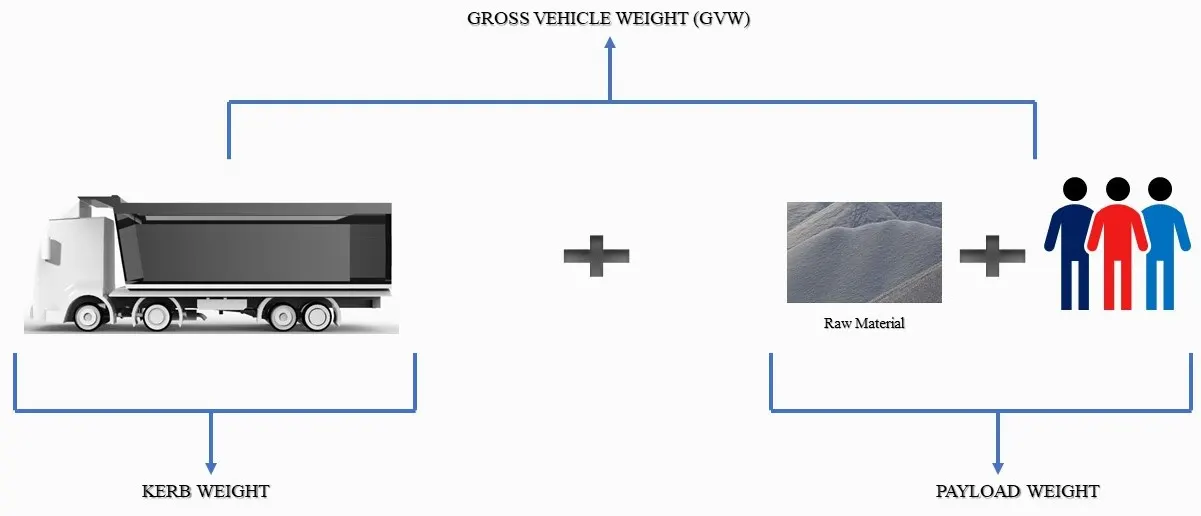
- Kerb Weight (Curb Weight):- Kerb word is derived from British English whereas Curb if American English.
Kerb weight is one of the most important specifications of any vehicle. Kerb weight is the total mass of a vehicle with standard equipment and all required operating equipment such as motor oil, transmission oil, coolant, air conditioning refrigerant, and from time to time a full tank of fuel.
- Payload:- Payload weight is defined as the number of goods or stuff can vehicles safely carry.
Payload weight = Gross vehicle weight - Kerb weight
- Gross Vehicle Weight: - It is the maximum operating weight/mass of a vehicle as specified by the manufacturer including the vehicle's chassis, body, engine, engine fluids, fuel, accessories, driver, passengers, and cargo but excluding that of any trailers.
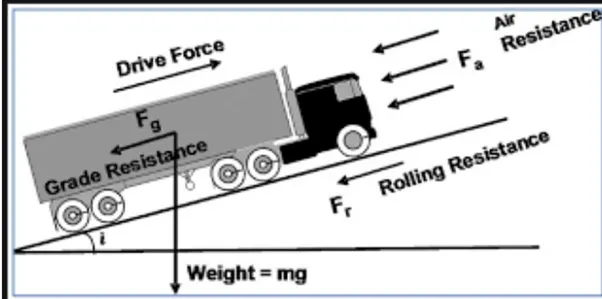
Gradeability of Vehicle: - Gradeability is defined as the steepness of grade that a motor vehicle is capable of climbing at efficient speed or we can say that it is the highest grade a vehicle can ascend maintaining a particular speed.
Gradeability is measured in different ways,
- An angle of inclination to the horizontal.
- Percentage of rise over run.
- The ratio of one part run to some particular number of parts.
Governing Equation:-
- Hill-Climbing Power (Phc):-
Phc = Fhc . Vhv
where, Fhc = Hill-Climbing Force in (N),
Vhc = HIll-Climbing Velocity / Speed (m/s). - Hill-Climbing Force:-
Fhc = W . g . sin(θ)
where, W = Weight (kg)
θ = Angle of Inclination - Gradeability (G):-
G = ((Fte/W)-μrr)
where, Fte = Traction Force (N)
μrr = Coefficient of Rolling Force - Inclination Angle (θ):-
θ = 1 / tan(G)
Solution:-
1. Calculating the ratio of 'Hill-Climbing' power required by fully loaded Tata ultra truck to the 'Half-Loaded'.
For the calculation, I have selected "TATA ULTRA EX 1918.T BS6".
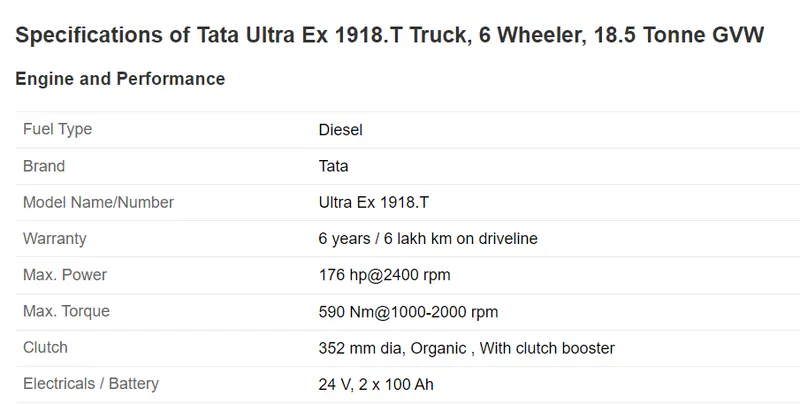
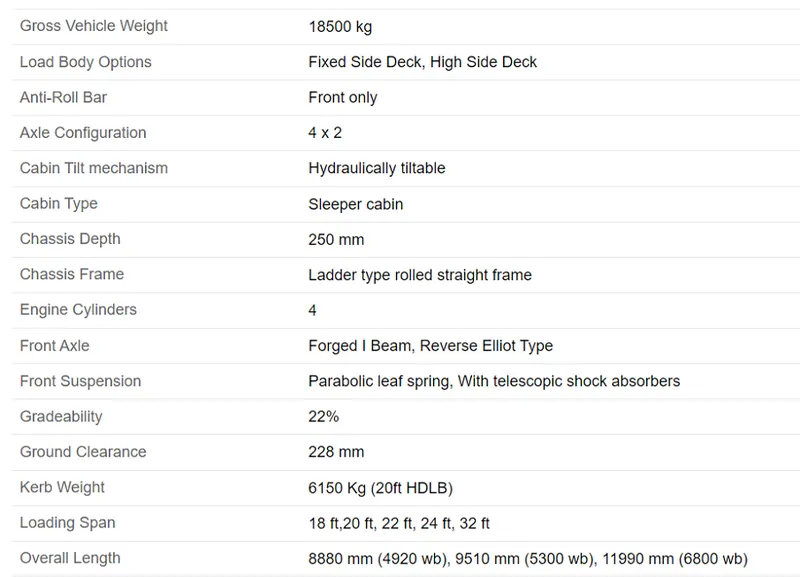
- CASE 1:- Hill-Climbing Power for Fully-Loaded TATA ULTRA 1918.T truck,
Kerb Weight = 6150 kg
Payload = 12350 kg
Total Weight (W) = Kerb weight + Payload = 18500 kg
Hill Climbling Speed (Vhc) = 30 kmph 30/3.6 = 8.33 m/s
Gradeability (G) = 22%
Angle of Inclination(θ) = 1/tan(G) = 12°
Hill-Climbing Force (Fhc1):-
Fhc1 = W . g . sin(θ)
=18500 * 9.81 * sin(12)
= 37732.85 (N)
Hill-Climbing Power (Phc1):-
Phc1 = Fhc . Vhc
= 37732.85 * 8.33
= 314314.64 (W)
= 314 (KW) - CASE 2:- Hill-Climbing Power for half-loaded Truck,
kerb Weight = 6150 kg
Payload = 12350/2 = 6175 kg
Total Weight (W) = 12325 kg
Hill-climbing Force (Fhc2):-
Fhc2 = W * g * sin(θ)
= 12325 * 9.81 * sin(12)
= 25138.23 (N)
Hill-climbing Power (Phc2)
Phc2 = Fhc2 * Vhc
= 25138.23 * 8.33
= 209401.44 (W)
= 209 (KW) - Ratio of Hill-climbing power required by "Fully loaded TATA ULTRA EX 1918.T BS6" to the "Half loaded"
= Phc1/Phc2
= 314/209
= 1.5
'The ratio is 1.5'
2. To calculate the minimum length of the flyover considering the minimum height at the summit should be 5.5 meters.
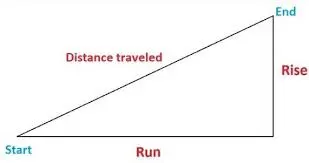
Here,
Rise or minimum summit Height (H) = 5.5 m
Gradeability = 22%
Angle of inclination = 12°
To calculate the minimum length or Run of the flyover,
sin(θ) = Rise/Run
sin(12) = 5.5 / (minimum length)
minimum length = 5.5 / sin(12°) = 26.45 m
Minimum Length of the flyover is 26.45 m.
3. To Prepare a new drive cycle excel file for the drive glider model and also include a hill-climbing angle to it.
The link to Excel sheet data for the velocity of vehicle at a particular time is given below;
The velocity of the vehicle in the spreadsheet is converted to m/s from km/hr. The vehicle data is assumed to b 2minutes with a 1sec gap interval.
Steps to prepare a new drive cycle:-
- At first, open MATLAB and then open the "Drive_Cycle" Excel sheet.
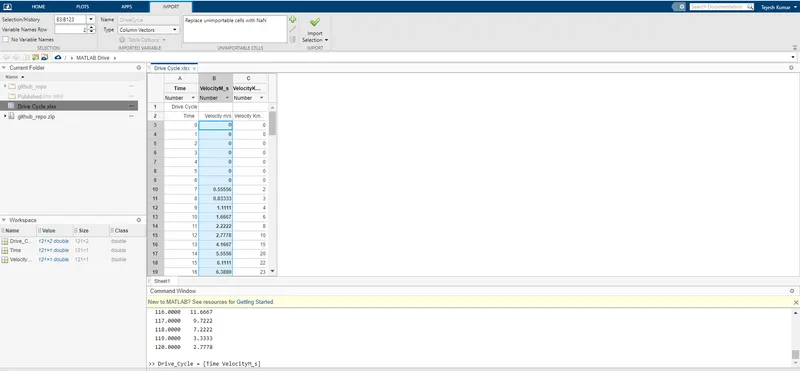
- Change the output type as ''Column vectors'. This will select the two columns 'Time' & 'VelocityM_s' Separately.
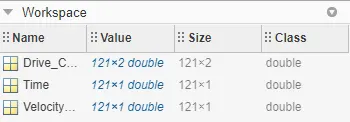
- After selecting the output click on Import data to load the data in the Workspace.
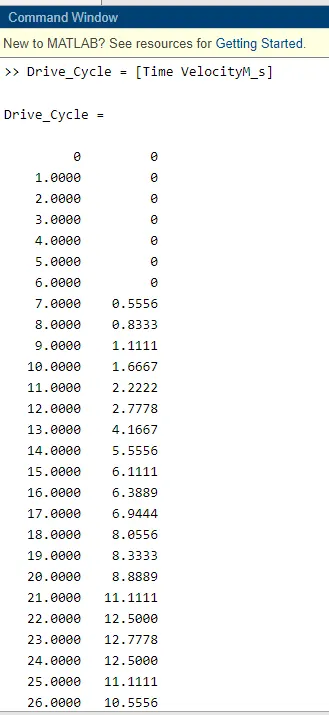
- Defind "Drive_Cycle" as an Array of 'Time' & 'VelocityM_s' in command window.
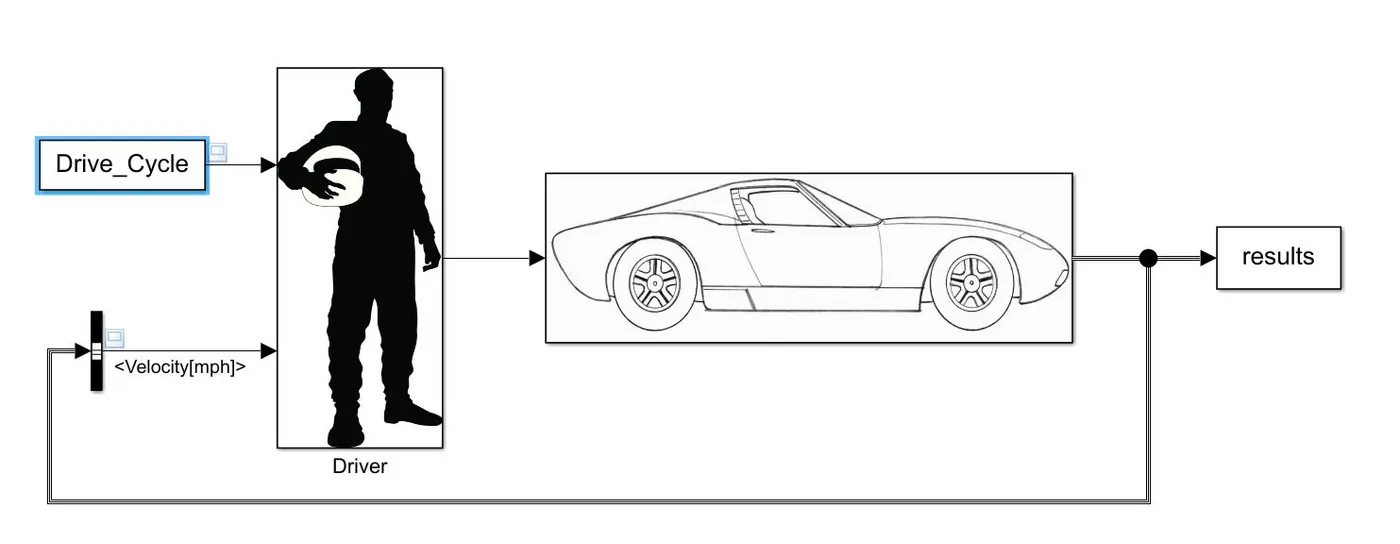
- Open the Driver Glider.slx in Simulink
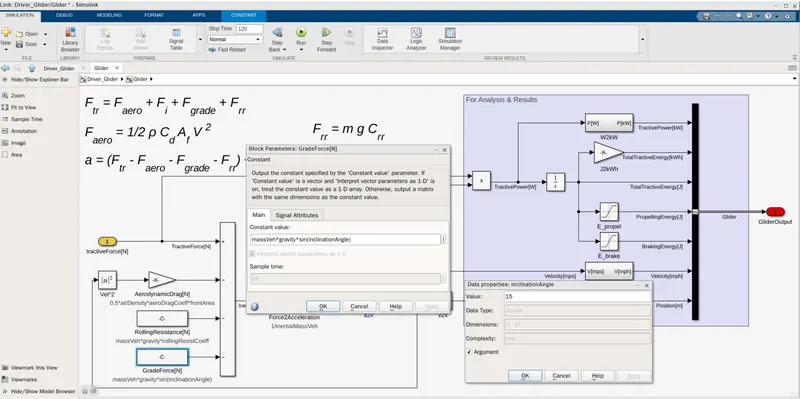
- Include the Hill Climbing Angle, double click on 'Glider' Block', then click on 'Grad Force' block.
- Change the Value of Inclination Angle, here we assumed the value as 15°
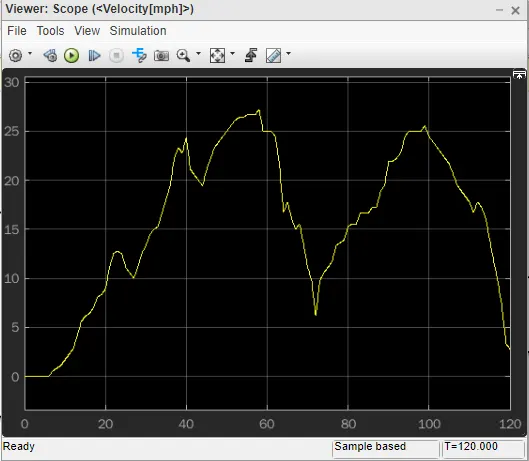
- Without Including the Inclination Angle
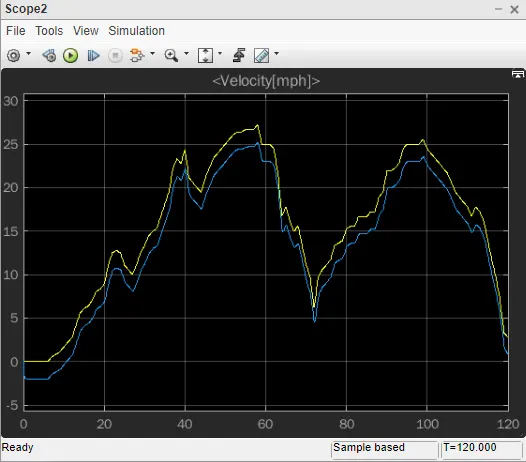
- The model is Run and we get a graph of 'Time' & 'Velocity' along with the effect of inclination.
4. To model the WOT(Wide Open Throttle) response of GM EV1 car and compare it with the official figures of the performance of a real vehicle and to shoe variation in acceleration time with a 5% change in vehicle parameters.
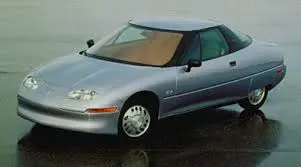
The GM EV1 was arguable the first modern electric car from the General Motors company it incorporated technologies that were quite novel for its time.
Govering equation for acceleration time is as follows:-

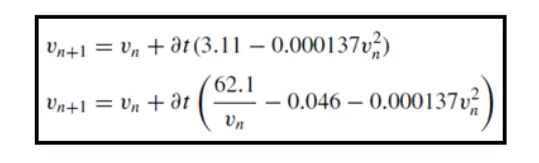
Vehicle Parameters:-
Mass of the Vehicle (M) = 1540 kg,
Tire Radius (r) = 0.30 m,
Gear Ratio (G) = 11,
Velocity of the vehicle (V) = 19.8 m/s,
Drag coefficient (Cd) = 0.19,
Rolling Rwsistance (μrr) = 0.0048,
Maximum Torque (Tmax) = 140 Nm,
Frontal area (A) = 1.8 m^2,
Gear efficiency (ηg) = 0.95,
Acceleration of the vehicle (dv/dt).
CASE - 1 : Considering original parameters.
%WOT Simulation
close all
clear all
clc

%WOT response for GM EV 1
%Input Data
t = linspace(0,30,301);   %0 to 30s, in 0.1s steps or 301
vel = zeros(1,301);       % 301 reading of velocity, Intial Velocity
dt = 0.1;

for n = 1:300
    if vel(n)<19.8
        vel(n+1) = vel(n)+dt*(3.11-(0.000137*(vel(n)^2)));
    else if vel(n)>19.8
            vel(n+1) = vel(n)+dt*((62.1/vel(n))-0.046-(0.000137*(vel(n)^2)));
    end
    if vel(n)>36
        vel(n+1) = vel(n);
    end
    end
end

%ploting WOT of GM EV1 with Original parameters .
vel = vel.*3.6
figure(1)
plot(t,vel)
axis ([0 30 0 140]);
xlabel('Time in sec');
ylabel('Velocity in Kmph');
title('WOT of GM EV1 car')
grid on
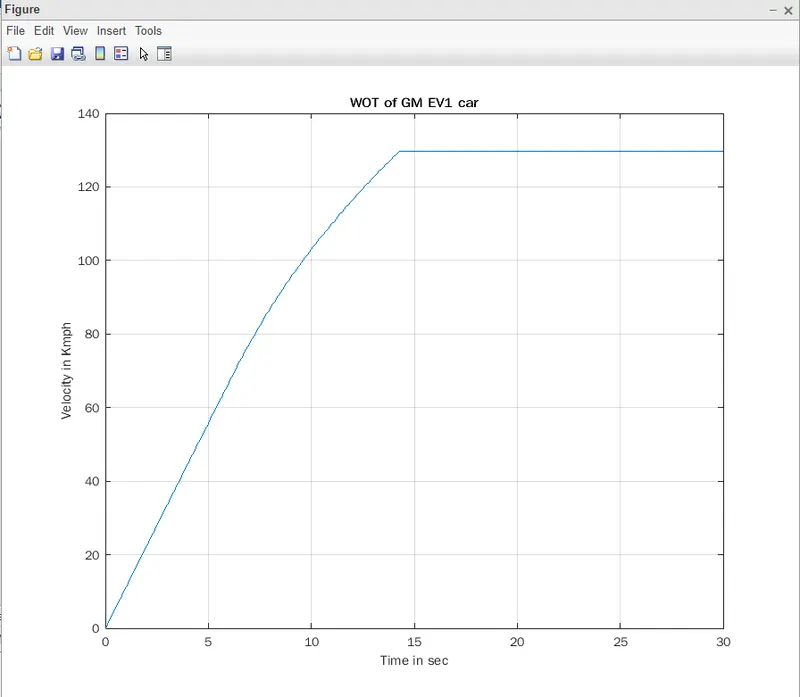
Plot considering original parameters
CASE - 2 : 5% Change in parametres.
were,
Mass of the vehicle (M) = 1617 kg,
Frontal area (A) = 1.9 m^2,
%WOT response for GM EV1 car various by 5%
vel1 = (vel*0.05)+vel;
for n = 1:300
    if vel1<19.8
        vel1(n+1) = vel1(n)+dt*(2.95-(0.00013*(vel1(n)^2)));
    else if vel1>=19.8
            vel1(n) = vel1(n)+dt*((59.14/vel1(n))-0.046-(0.00013*(vel1(n)^2)));
    end
    if vel1(n)>36
        Vel1(n+1) = vel1(n);
    end
    end
end

% Plotting WOT og GM EV1 with 5% varied parameters.
figure(2)
plot(t,vel1);
axis ([0 30 0 140]);
xlabel('Time in sec');
ylabel ('Velocity in Kmph');
title('WOT of GM EV1 car varied by 5%');
grid on
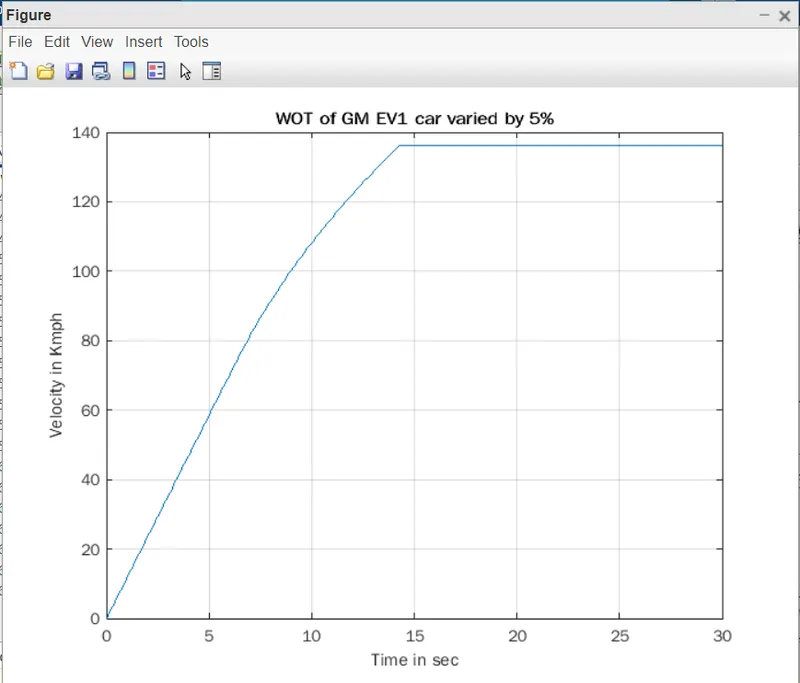
Plot considering 5% of varied parameters.
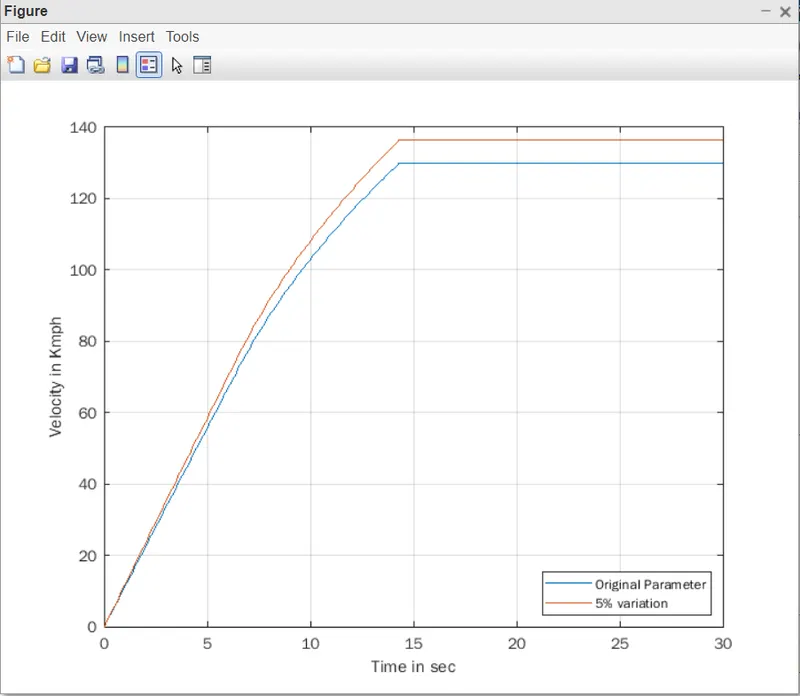
Comparing original parameters with 5% varied parameters,
%Comparing Original Parametrs with %5 varied Parameters.
figure(3)
plot(t,vel);
hold on
plot(t,vel1);
axis([0 30 0 140]);
xlabel('Time in sec')
ylabel('Velocity in Kmph')
legend('Original Parameter','5% variation','location','southeast')
grid on
Plot Comparing Original Parametrs with 5% varied parameters.
CONCLUSION :
- The ratio of power required for a fully loaded Tata Ultra truck to half loaded one is approximately equal to 1.5.
- The minimum length of the flyover with assumed values of gradeability for truck is found to be 20 meters.
- A new drive cycle is prepared and the driver glider model is simulated including hill climbing angle.
- The 5% change in vehicle parameters leads to increase of acceleration time.
References: