Wide Open Throttle (WOT) condition for GM EV1
Aim:
To obtain the hill-climbing power ratio of the TATA-ULTRA truck also to find the minimum length of the flyover keeping gradeability of trucks in mind, to prepare a new drive cycle to excel file for the model “Driver_Glider.slx” and to Model the WOT (Wide Open Throttle) response of GM EV1 car.
Objectives:
i) To calculate the ratio of hill-climbing power required by a fully loaded tata ultra truck to the half-loaded one.
ii) Construction of the minimum length of the flyover, considering the minimum height at the summit should be 5.5 meters.
iii) To prepare a new drive cycle to excel file for the model and also include a hill-climbing angle to it. Revise the model file “Driver_Glider.slx” and comment on the result.
iv) To compare the WOT response of GM EV1 vehicle with the official figures of the performance by preparing a table showing variation in acceleration time with a 5% change in vehicle parameters.
i) Solution#
Vehicle specifications:


Vehicle weight:
Gross vehicle weight(GVW)= 11990 Kg ---------------- fully loaded
Half loaded vehicle weight= 7862.5 Kg

Gradeability of 33% = 18.26°
θ = 18.26°
We know,
Hill Climbing force (Fhc)= m*g*sinθ
where,
sinθ= slope angle
mass(m)= 11990 kg
gravity(g)= 9.81 m/s^2
Fhc= 11990*9.81*0.3133
= 36854.41 N ------------------------- fully loaded
For half loaded,
mass(m)= 7862.5 kg
Fhc= 7862.5*9.81*0.3133
= 24165.18 N -------------------------- half loaded
Consider,
Truck Velocity(v) = 25 km/hr
= 6.94 m/s
Power(Phc) = Fhc*v
=36854.41*6.94
=255769.60 W ----------------------- Fully loaded
Power(Phc) = Fhc*v
= 24165.18*6.94
= 167706.34 W ----------------------- half loaded
Ratio(Phc) = 255769.60/167706.34
= 1.52
The ratio of hill-climbing power required by a fully loaded tata ultra truck to the half-loaded one is 1.52
ii) Solution#
Gradeability:
Gradeability is defined as the steepest gradient a machine (truck) can climb.
We have considered the gradeability of the truck as 33% and the minimum height of the summit is 5.5 meters.
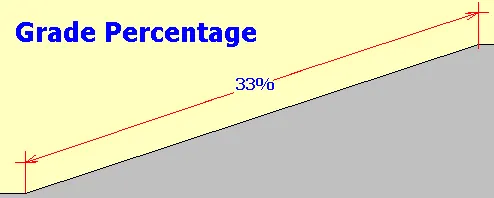
Gradeability = 33%
In angle α = 18.26°
h = 5.5 meters
l = minimum length of flyover
We know,
Sin α = h/l
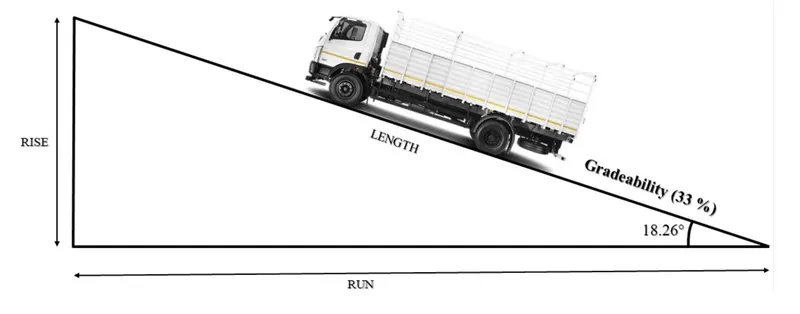
Gradeability(%) = Rise/Run
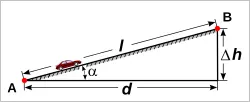
l = h/Sin α
l = 5.5/0.3133
l = 17.55 meters
Minimum length of the flyover is 17.55 m
Assumptions:
- We have taken the gradeability of the truck (TATA ULTRA) as 33% here and the minimum length of the flyover which has to be constructed on the highway is 17.55 meters.
iii)Solution#
- Model file “Driver_Glider.slx”
- The file can be found on the following link: https://in.mathworks.com/matlabcentral/fileexchange/63823-matlab-and-simulink-racing-lounge-vehicle-modeling
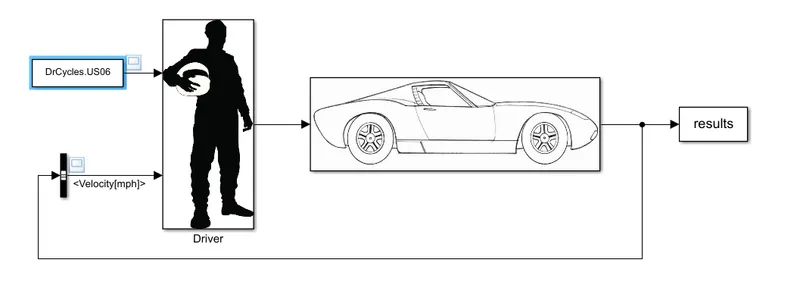
- Drive cycle is created in the excel file for velocity(mph) and Hill Climbing angle in Radians.
- We have considered the angle in radians to calculate the Hill Climbing force required by the vehicle.
- The time considered here for the simulation is (1 to 60) seconds.
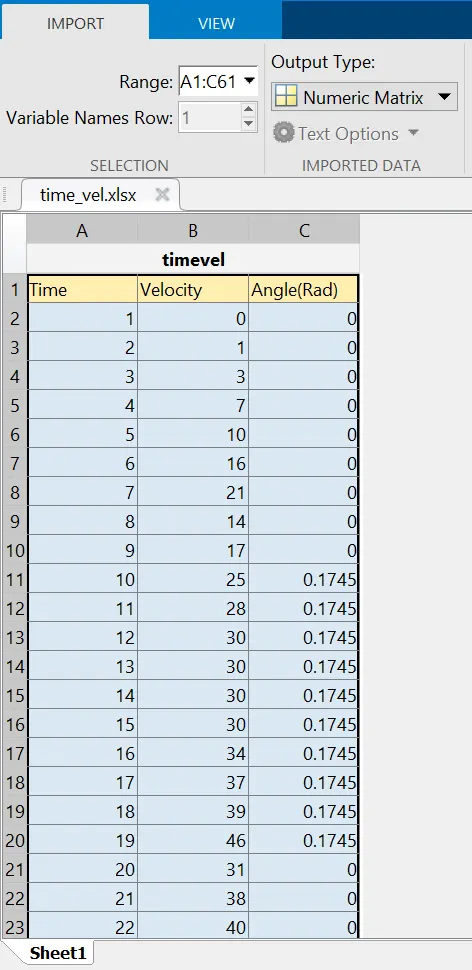
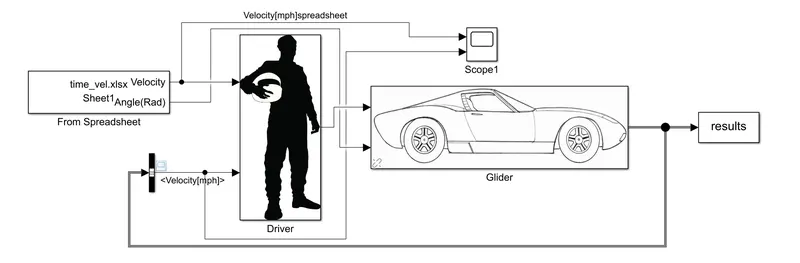
- Modified “Driver_Glider.slx” model file:
We have added the excel file 'time_vel.xlsx' using the import data option. Connected the file to the 'Driver' and the 'Glider' block.
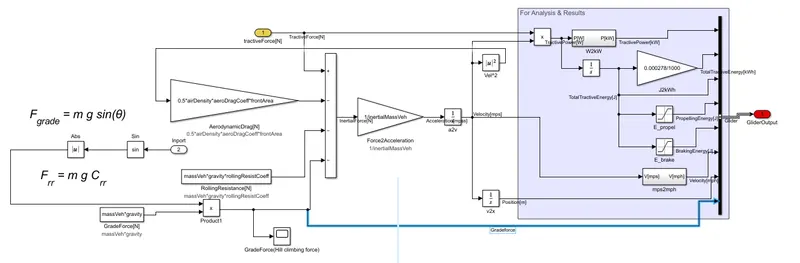
- Modified "Glider" block:
In order to justify the objective of including the hill-climbing angle, the data has to be taken from the excel sheet and angle values are stored in radians.
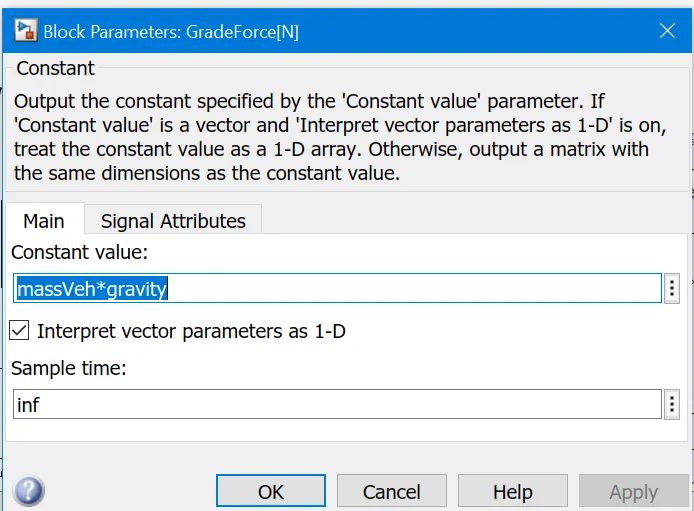
We know that:
Fgrade=m*g*sin(θ)
Sine(inclination) is removed from the GradeForce(Hill climbing block) as the angle values have to be taken from the drive cycle created in the excel file. 'Inport' block is used to take the angle values from the excel sheet and it is connected to 'Sin' block after that 'GradeForce' block connected to 'product' with 'Sin' block completing the Gradeforce equation which is equal to mass*gravity*sin(rad)
Result obtained:
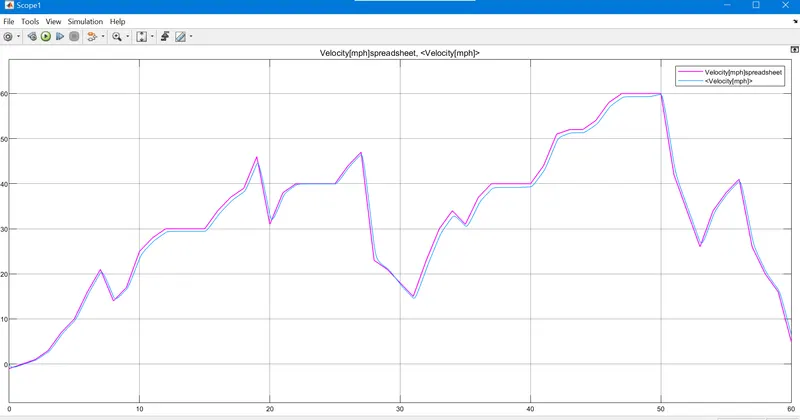
- From the velocity-time graph, it is clear that the required force (tractive effort) for the vehicle increases as the hill angle increases.
- The comparison is done with velocity data included hill angle from the excel sheet and from the model defined velocity(mph) parameters.
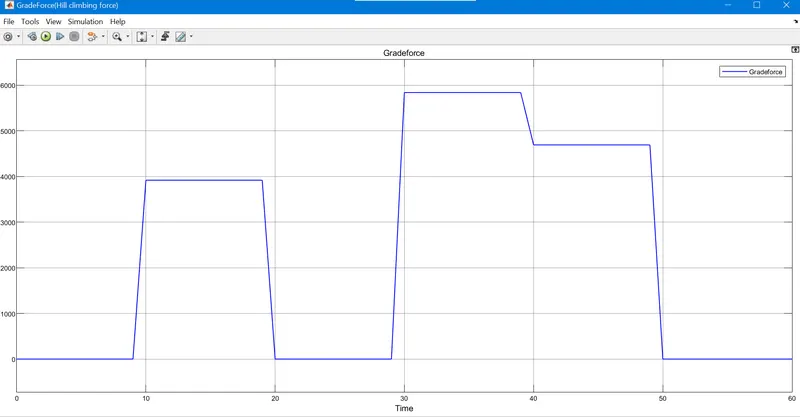
- The results of Gradeforce can also be seen from the below figure.
iv)Solution#
GM EV1 car:
The GM EV1 is a rechargeable battery-powered two-seater car, which at the time of its introduction represented probably the most advanced electric vehicle using rechargeable batteries. It was purposely designed through and through as an electric vehicle and is not a modified IC engine vehicle. It was introduced in 1997 initially using lead-acid batteries, but more recent versions have used NiMH batteries to give an extended range.
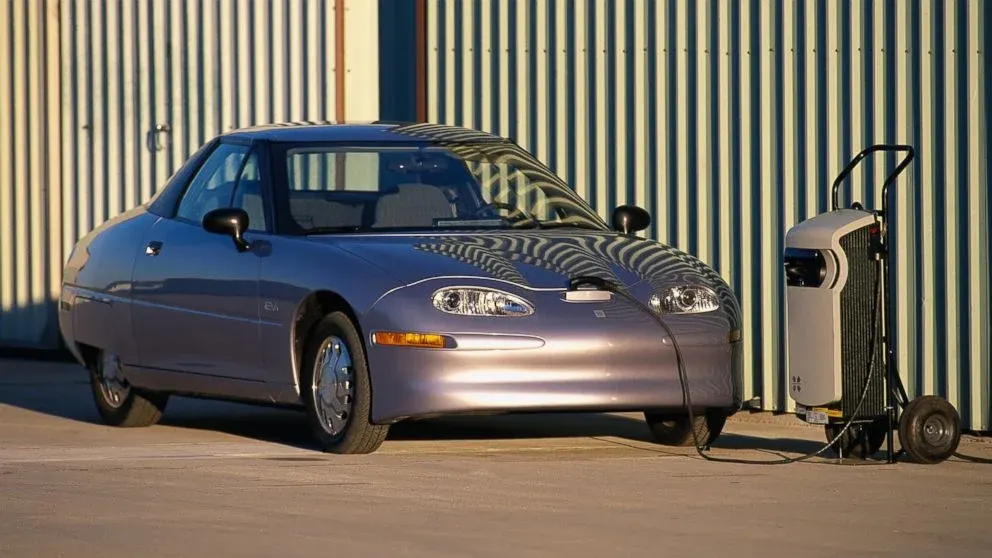
Details of the car are given below:
Drag coefficient (Cd) = 0.19
Coefficient of rolling resistance, μrr= 0.0048
Maximum speed of induction motor = 12000 rpm
Vehicle mass = 1400 kg
Mass of driver & passenger each= 70 kg
Total mass including driver and passenger = 1540 kg
Gear ratio(G)= 11:1
frontal area (A) = 1.8 m^2
Tyre radius (r)= 0.30 m
Motor torque(T) = T max, T max = 140 N m
Angular velocity(ωc) = 733 rad s−1
Critical Velocity(v) = 19.8 m s−1 (71.3 kph)
Gear efficiency (ηg) = 0.95
Power (P) = 102 KW
We have the equations we need, we can combine them in order to find the acceleration of a vehicle.
Fte =μrr*m*g + 0.625*A*Cd*ν^2 + m*a + I*(G^2/ηg*r^2)*a ---------------(i)
Fte = tractive force
Fte = T*G/r
The motor’s moment of inertia (I) is not known. However, compared with the mass of such a heavy vehicle this will be very low. The wheels are also very light. We will approximate this term by increasing the mass very modestly to 1560 kg in the final term of Equation (ii).
Acceleration nothing but a = dν/dt, then we have
T*G/r = μrr*m*g + 0.625*A*Cd*ν^2 + (m + I*(G^2/ηg*r^2)*dv/dt ----------------- (ii)
A value of ηg of 0.95 is estimated. An effect of this will be to reduce the torque, and so this factor will be applied to the torque. When the torque is constant, from eqn (ii), and
putting the values in the equation(ii), we have
0.95 × 37 × 140 = 72.4 + 0.214v2 + 1560 dv/dt
dv/dt = 3.11 − 0.000137*v^2 -------------- (iii)
Above 19.8 m/s the motor operates at a constant 102 kW, as this is a WOT test. So,
T = 102000/37*v = 2756/v
Once the speed has reached 19.8 m s−1 the velocity is given by the differential equation
0.95 × 37 × 2756/ν = 72.4 + 0.214v^2 + 1560 dv/dt
dv/dt = 62.1/v - 0.046 − 0.000137v^2 ------------ (iv)
The procedure for finding the acceleration can be done, the only extra complication is that when the velocity reaches 35.8 m s−1 it stops rising, because at this point the motor controller limits any further acceleration.
Before any program such as MATLAB can be used the key equations, Equations (iii) and (iv), must be put into ‘finite difference’ form. The two equations become,
vn+1 = vn + δt (3.11 − 0.000137vn^2) ------------------ (v)
vn+1 = vn + δt(62.1/vn - 0.046 - 0.000137 vn^2) ----------- (vi)
#WOT test of the GM EV1 electric car original data in Matlab:
% WOT test of the GM EV1 electric car.
t=linspace(0,30,301); % --- 0 to 30 seconds, in 0.1 second steps
v=zeros(1,301); % 300 readings of velocity
dT=0.1; % 0.1 second time step
% In this case there are three phases to the acceleration, as explained in the text.
for n=1:300
if v(n)< 19.8  % --- velocity in (m/s)
% Equation (v)
v(n+1) = v(n) + dT*(3.11 + (0.000137*(v(n)^2)));
elseif v(n) > 35.8 % ---- velocity in (m/s)
% Controller stops any more speed increase
v(n+1) = v(n);
else
    % Equation (vi)
v(n+1) = v(n) + dT * ((62.1/v(n)) - 0.046 - (0.000137*(v(n)^2)));
end;
end;
v=v.*3.6; %-----Multiply all v values by 3.6 to
% convert to kph
plot(t,v,'linewidth',1,'color','g');
xlabel('Time/seconds');
ylabel('Velocity/kph');
grid on
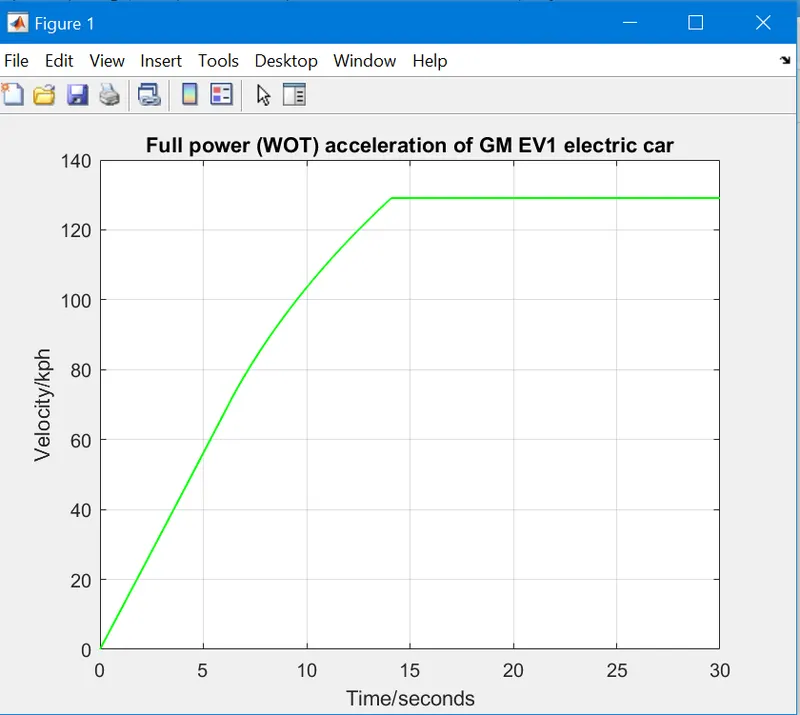
title('Full power (WOT) acceleration of GM EV1 electric car');- Original results:
5% change in vehicle parameters:
Total mass including driver and passenger = 1617 kg
Power (P) = 107.1 KW
Motor torque(T) = T max, T max = 147 N m
We have the equation,
T*G/r = μrr*m*g + 0.625*A*Cd*ν^2 + (m + I*(G^2/ηg*r^2)*dv/dt --------- (ii)
Putting the values in equation (ii),
0.95 × 37 × 147 = 76.14 + 0.214v^2 + 1617 dv/dt
dv/dt = 3.148 - 0.000132 v^2 ----------- (vii)
Above 19.8 m/s the motor operates at a constant 102 kW, as this is a WOT test. So,
T = 107100/37*v = 2895/v
Once the speed has reached 19.8 m s−1 the velocity is given by the differential equation
0.95 × 37 × 2895/ν = 76.14 + 0.214v^2 + 1617 dv/dt
dv/dt = 62.93/v - 0.047 − 0.000132v^2 ------------ (viii)
Equations (vii) and (viii), must be put into ‘finite difference’ form. The two equations become,
vn+1 = vn + δt (3.148− 0.000132vn^2) ------------------ (ix)
vn+1 = vn + δt(62.93/vn - 0.047 - 0.000132 vn^2) ----------- (x)
Program for 5% change in the WOT parameters:
clear all
close all
clc


% WOT test of the GM EV1 electric car with 5% change in the parameters.

t=linspace(0,30,301); % 0 to 30 seconds, in 0.1 second steps
v1=zeros(1,301); % 300 readings of velocity
dT=0.1; % 0.1 second time step

% In this case there are three phases to the acceleration, as
% explained in the text.

for n=1:300
if v1(n)< 19.8
% Equation (ix)
v1(n+1) = v1(n) + dT*(3.148 + (0.000132*(v1(n)^2)));

elseif v1(n) > 35.8
% Controller stops any more speed increase
v1(n+1) = v1(n);
else
    % Equation (x)
v1(n+1) = v1(n) + dT * ((62.93/v1(n)) - 0.047 - (0.000132*(v1(n)^2)));
end;
end;
v1=v1.*3.6; %Multiply all v values by 3.6 to
%convert to kph

plot(t,v1,'linewidth',1,'color','b');
xlabel('Time/seconds');
ylabel('Velocity/kph');
legend('5% change in Veh. parameters')
grid on
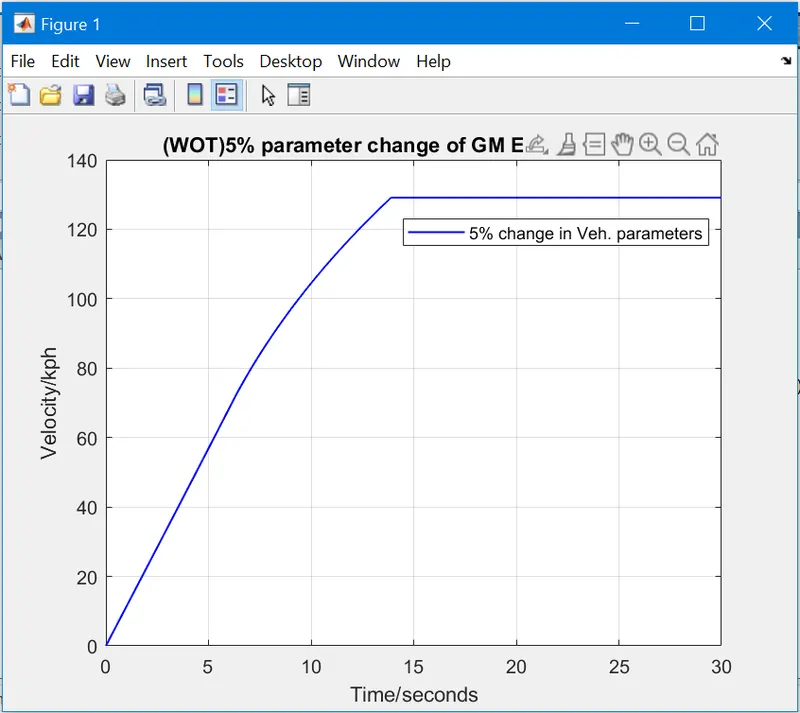
title('(WOT)5% parameter change of GM EV1 electric car');- Result in the form of a graph for 5% change in the veh. parameters:
Program for the WOT comparison with original & 5% change in the parameters:
clear all
close all
clc

% WOT  comparison test of the GM EV1 electric car with original parameters.

t=linspace(0,30,301); % 0 to 30 seconds, in 0.1 second steps
v=zeros(1,301); % 300 readings of velocity
v1=zeros(1,301); % 300 readings of velocity


dT=0.1; % 0.1 second time step

% In this case there are three phases to the acceleration, as
% explained in the text.

for n=1:300
if v(n)< 19.8

% Equation------(v)

v(n+1) = v(n) + dT*(3.11 + (0.000137*(v(n)^2)));

elseif v(n) > 35.8

% Controller stops any more speed increase
v(n+1) = v(n);
else
    % Equation-------(vi)
v(n+1) = v(n) + dT * ((62.1/v(n)) - 0.046 - (0.000137*(v(n)^2)));
end;
end;
% GM EV1 car with 5% change in the parameters

for n=1:300
if v1(n)< 19.8
% Equation------(ix)
v1(n+1) = v1(n) + dT*(3.148 + (0.000132*(v1(n)^2)));
elseif v1(n) > 35.8
% Controller stops any more speed increase
v1(n+1) = v1(n);
else
    % Equation-----(x)
v1(n+1) = v1(n) + dT * ((62.93/v1(n)) - 0.047 - (0.000132*(v1(n)^2)));
end;
end;

v=v.*3.6;
v1=v1.*3.6; %Multiply all v values by 3.6 to convert to kph


plot(t,v,'linewidth',1.5,'color','g');

hold on

plot(t,v1,'linewidth',1.5,'color','b');
grid on
xlabel('Time/seconds');
ylabel('Velocity/kph');
legend('Original','5% change in Veh. parameters')

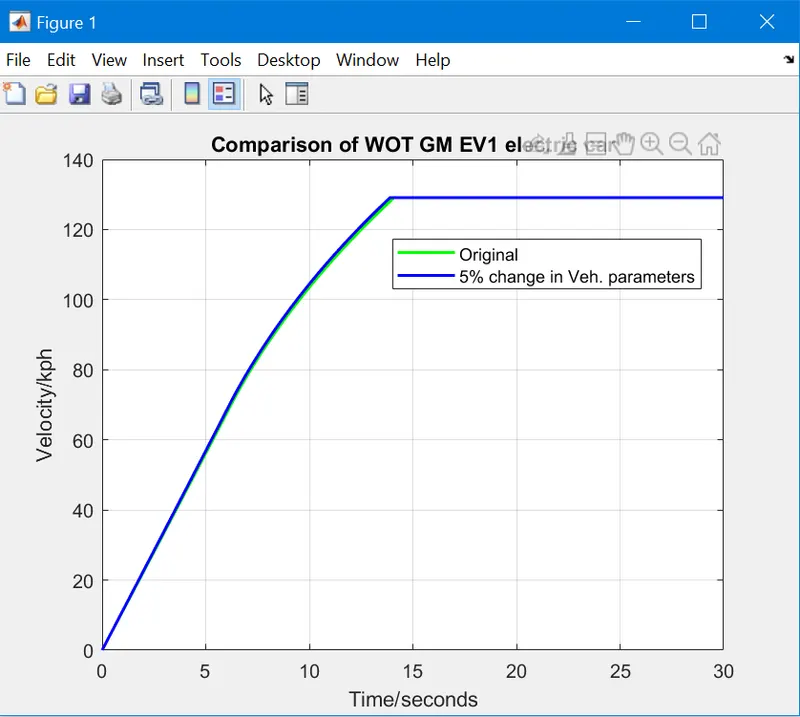
title('Comparison of WOT GM EV1 electric car');- Comparison results:
GM EV1 vehicle specifications:
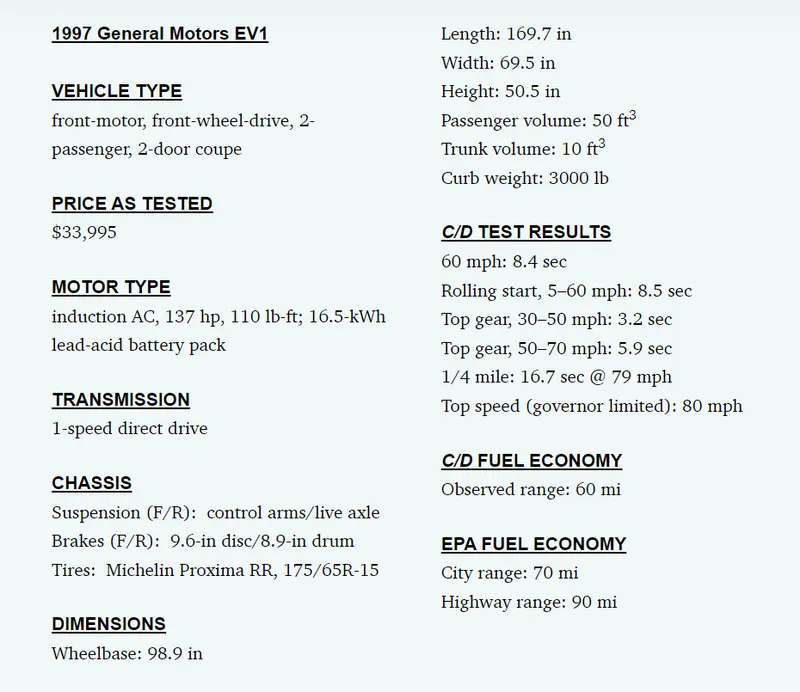
- We want to check the acceleration time from 0 to 96.56 kmph(60 mph) and from the specifications, it is 8.4 sec. So, we have the Matlab program for original data and 5% changed parameters data and it can be seen from the excel created after the data extracted from the Matlab workspace.
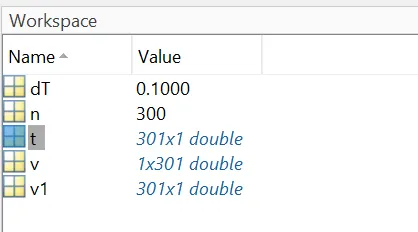
- We have the variables 'v' & 'v1' for the velocity also 't' as the time taken for 0 to 30 sec with a time step of 0.1 sec.
Acceleration time from the Matlab vehicle data simulation for 96.56 kmph(60 mph) is 9.1 sec for original data and 9 sec for 5% changed parameters data as indicated below.
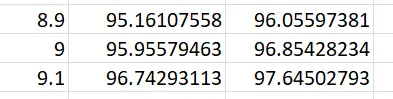
- We can say that the vehicle performance tested in the physical environment and the simulated condition is near about the same with a minor difference in the 0 to 96.56 kmph acceleration time of 0.6 to 0.7 sec
- We have also tested for the top speed for both original data & 5% changed parameters data and their respective time to attain maximum(WOT) as shown below.
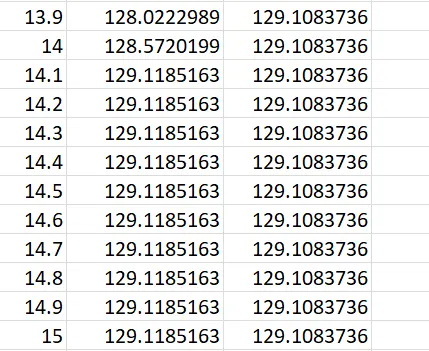
- It is also observed that after a change of 5% in vehicle parameters data, GM EV1 reaches top speed(129.10 kmph) in less time than the original data. An excel file is also prepared to show the acceleration test results of GM EV1.
- https://docs.google.com/spreadsheets/d/1_KqZE9ZcaEcXfE5ETkm-OQE_U8hnFZl9HYT4eTH8wwM/edit?usp=sharing
Conclusion:
Done detailed analysis to meet the objectives of this challenge and the results are also concluded with explanations.
References: