Week 9 - Project 1 - Door Trim Lower with Engineering Features
AIM :-
Door Trim Lower Plastic component through the given Class-A surface. To begin with, the tooling axis for the given Class-A Surface should be created meeting the requirements of the draft angle and at the end perform the Draft analysis on the model.
CONSIDERATION :-
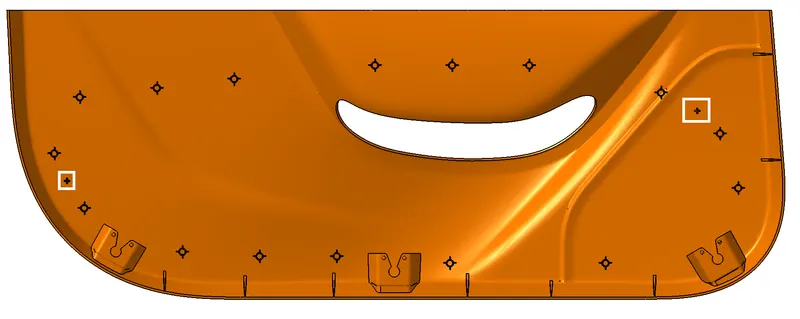
Heat Stakes and the locators considering the design rules mentioned in the video for the door applique.
DESCRIPTION:
Class A surface: Class-A surfaces is a term used in most in automotive design to describe a set of freedom surfaces of high efficiency and quality.
Class B surface: Class B surfaces are the secondary surfaces that you can we see sometimes but are less important.
Class C surface: Class C surface are the surfaces which connects the class A and Class B surfaces.
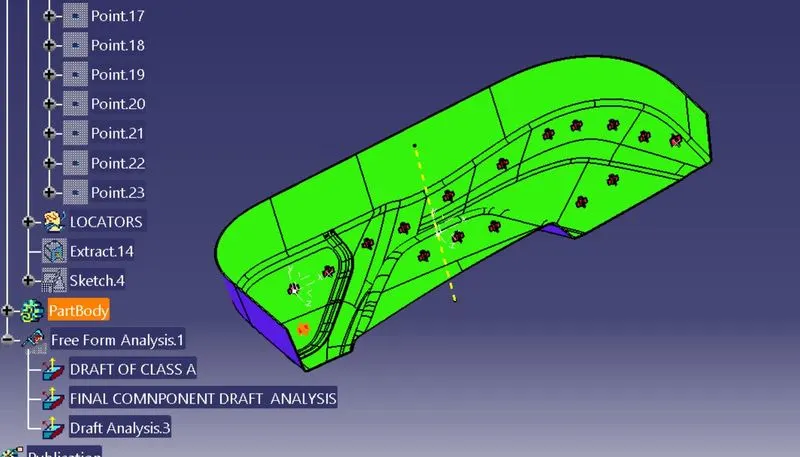
Draft analysis: Draft analysis is performed on components where the ejection of materials happen after the material is made inside the tools.
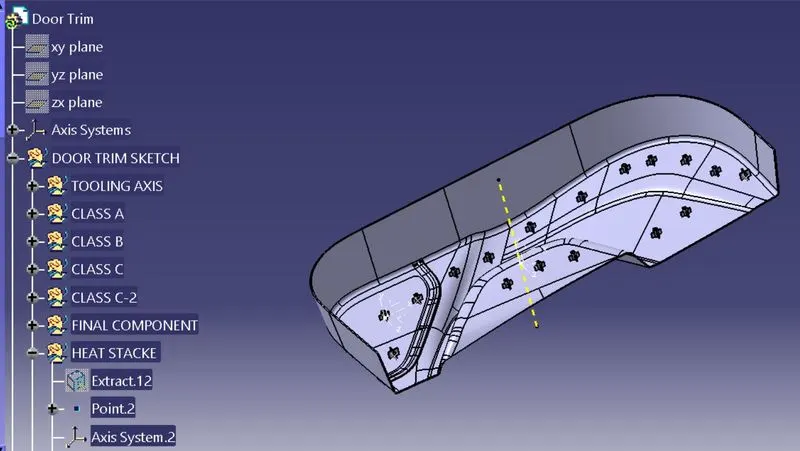
TOOLING AXIS CREATION: Generally tooling axis is created using bisecting line method. But in the components where it has a bin, then the tooling axis is considered as a line normal to the base surface of bin. Same is done with this component. A line normal to base surface is created and considered as tooling axis.
Draft analysis of Class A: Draft analysis is performed on Class A to check the validity of the tooling axis. During draft analysis, it was observed that bin walls are having 90 degree angle with base. There is no minimum draft given to the walls. Since we are not authorised to make changes in Class A surface, we can inform Class A designer to give minimum draft to walls.
SOLID MODEL WITH SUPPORTS AND TOOLING AXIS
DRAFT ANALYSIS