Week 9 - Project 1 - Door Trim Lower with Engineering Features
PROJECT
DOOR TRIM - HEAT STAKES & LOCATORS
Aim:
To create a Door Trim-Heat Stacks & Locators through a given input Class A Surface and Tooling axis to Draft Analysis on the A surface and final plastic component.
REPORT:
Door Trim Dog House:
Class A Surface:
- To start the design process we need to find out the tooling axis for the surface and check the drafts using the Draft Analysis tool in CATIA.
- And Publicize the A surface.
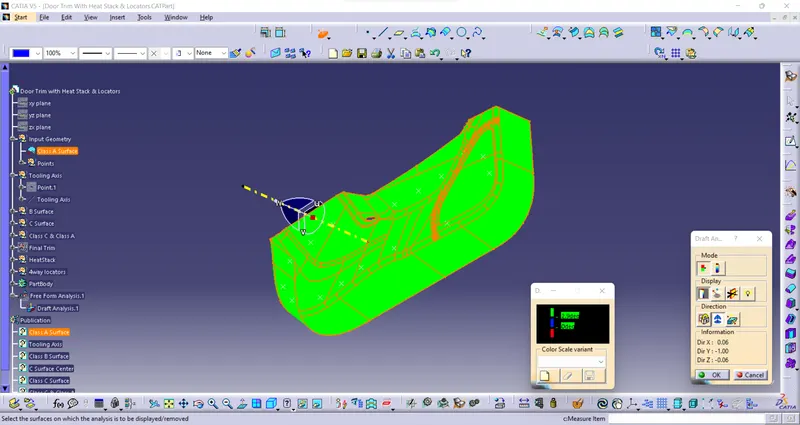
Tooling Axis:
- Create an Extract on a flat surface and point on surface 0mm and Create a Line - Normal To Surface click on the point and take a Class A Surface, give some color and make it a dashed line.
- Take a draft analysis with A surface in positive green and blue, little deviation is there.
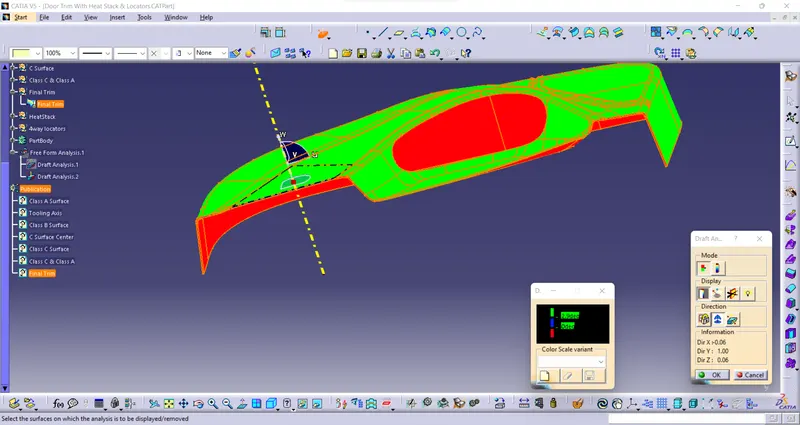
- And same thing to do in final draft analysis with final solid component, it seems a deviation green and blue that’s fine acceptable.
- And Publicate the Tooling Axis.
Class B Surface:
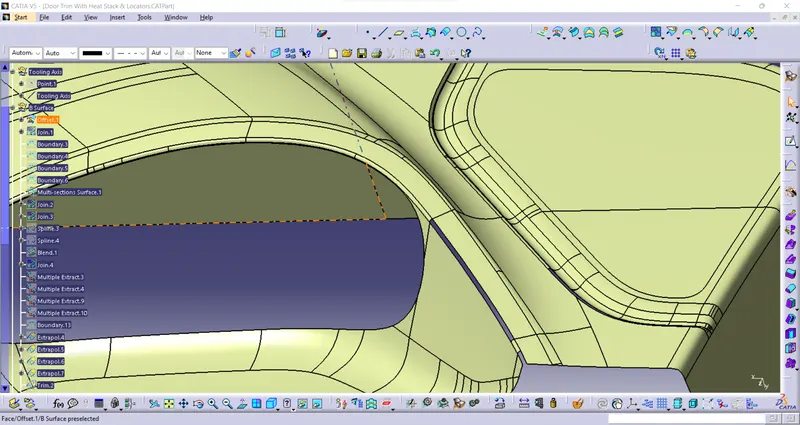
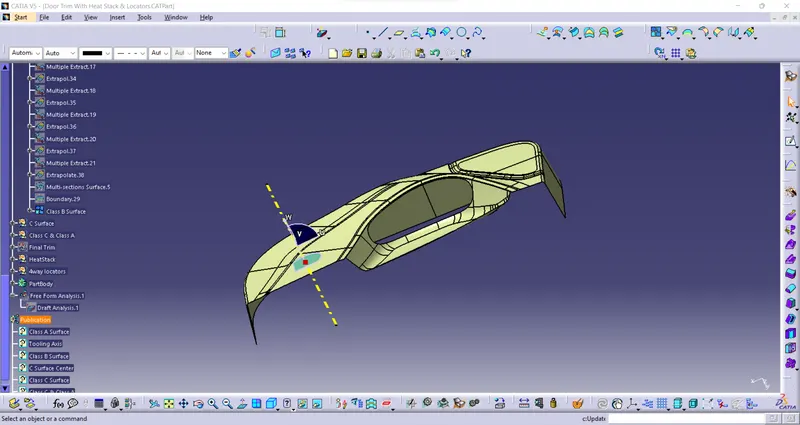
- Take a 2.5mm Offset from Class A Surface Downward the unfinished surface we get .
- Take a boundary to make a multi section surface and Extrapolate to trim it after applying the filet and join those to make a Class B Surface.
- Then Publicize the B-Surface.
Class C Surface:
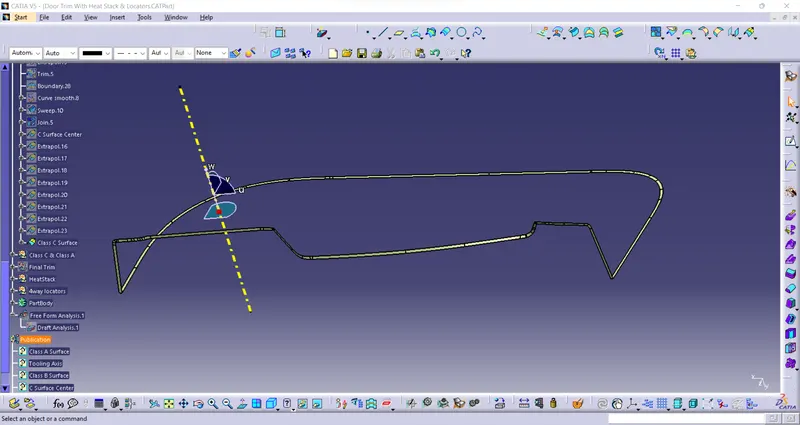
- Unhide the A Surface to Take a boundary as a reference to make C surface.
- Go to sweep line-> with Reference surface 90 degree draft angle for all sweep.
- And join all the sweep parts to make a Class C surface.
- Then Publicize it.
Class C & Class A Surfaces:
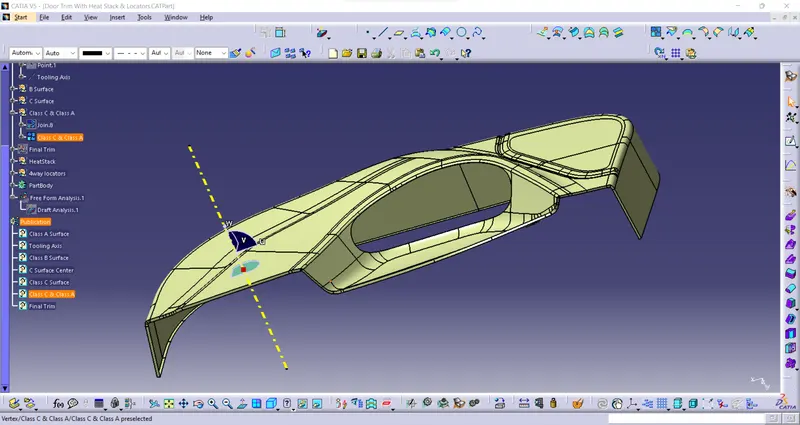
- Join the both finished Class C and Class A surfaces.
- Then Publicize it.
Final trim:
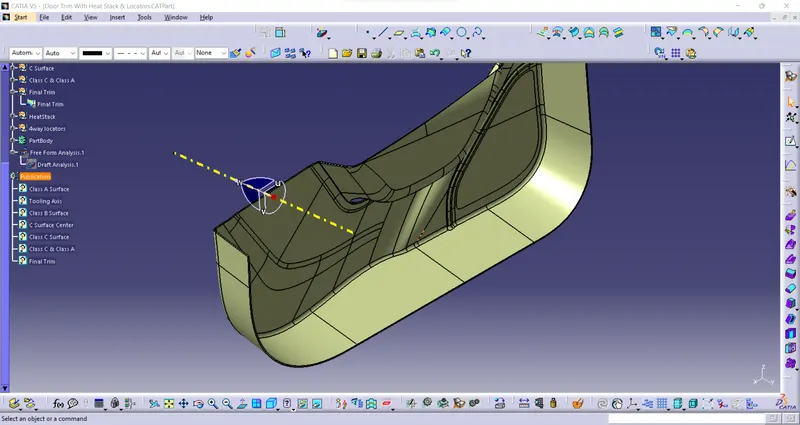
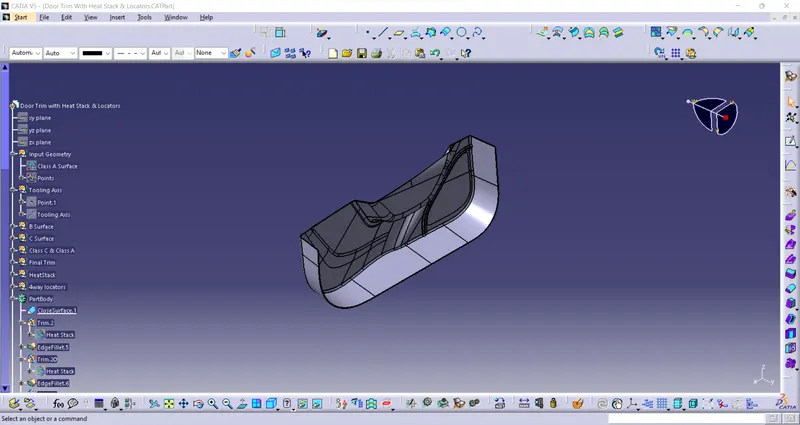
- Take a Joined part C Surface And A Surface to Trim with Class B Surface, we get the output closed surface body.
- Then Analyze the Draft with the final part.
- Publicize it.
- Then publicize it.
Part Body:
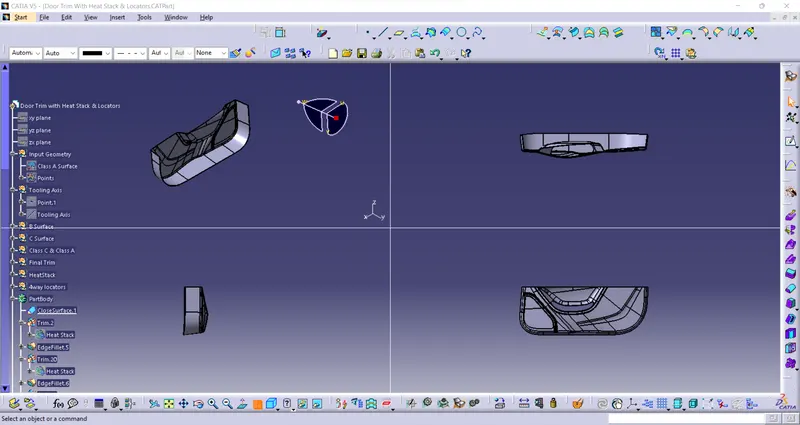
- Take a Final Trim Of closed surface body, go to the part workbench and give closed body to make a solid part.
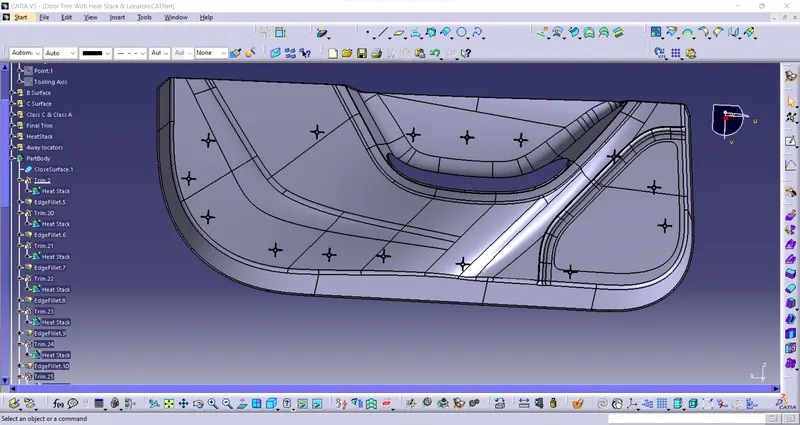
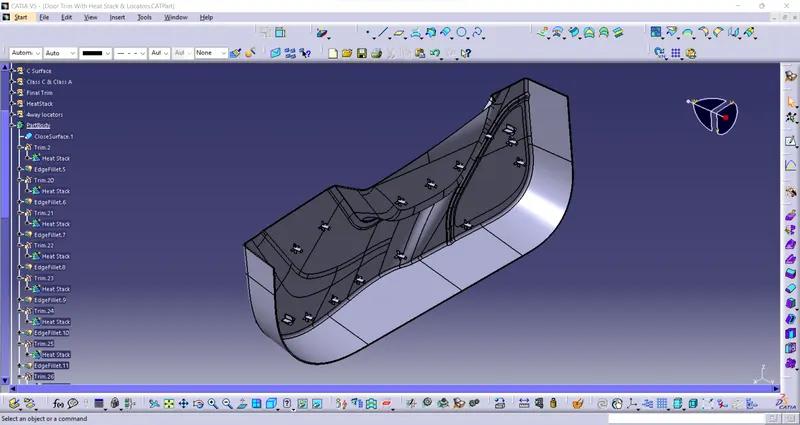
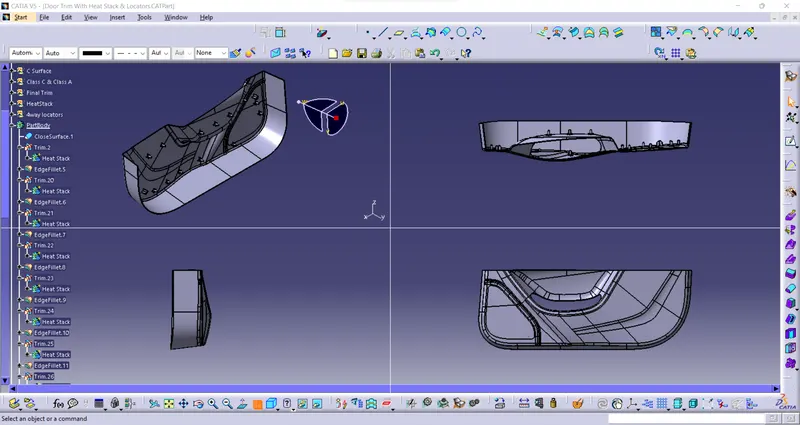
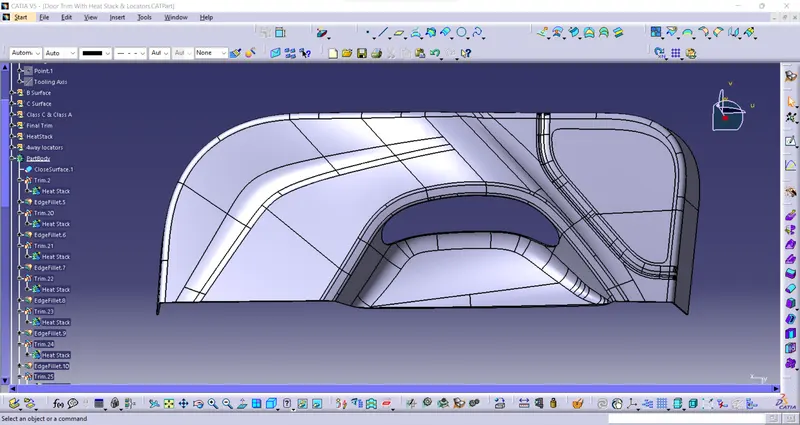
- Heat Stacks & 4-way Locators create after union trim with part body.
Heat Stacks Creation:
- Heat staking also known as thermoplastic staking is the process of joining two dissimilar materials together. In heat staking we use local heating and cooling to raise the temperature of plastic components and allow plastic reforming to be carried out.
- Inner Diameter of Heat Stake (d) - 5 mm.
- Outer Diameter of Heat Stake (d) - 7 mm.
- Height of the Heatstake - Depends on the rib height and counter part thickness.
- Length of the Rib - 22 mm.
- Height of the Ribs - 3 mm to 6 mm.
- Minimum filet of Heat Stakes - 0.25 mm.
- Minimum Draft Angle of Heat Stakes - 0.5 degrees.
- Create as per the rules given, union trim it with part body after creating duplicate for each part of heat stacks to translate with point to point creation to make it.
4-way Locators:
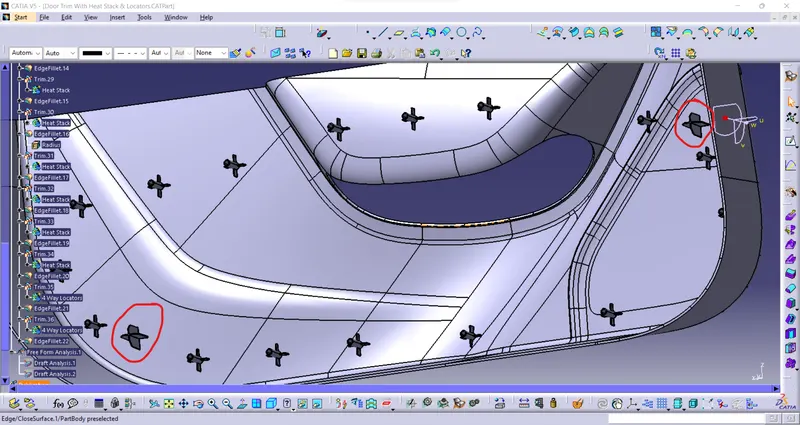
- A round locating pin located concentrically in a hole is a common application of a 4-way pin, and helps to further secure the piece. 4-WAY LOCATORS: 4-way means you prevent movement at 2 axes (+X, -X, +Y and -Y) on the plane. Generally, you have a cylindrical pin on the fixture and circular hole at the workpiece part.
- Height of the locators should be 1 mm (or) 2 mm greater than the heat stakes
- Thickness, filet and draft angle are the same as rib design rules.
- Ideal Chamfer value - 5 mm x 45 degrees
- Ideal length of the locators - 15 mm
- Create as per the rules given, union trim it with part body after creating duplicate 4-way locator to translate with point to point creation to make it.
Below Mentioned the 2 part is Called 4-Way Locators.
Conclusion:
The report of “Door trim - Heat Stacks & Locators” Has been successfully Done By Myself and thank you!.