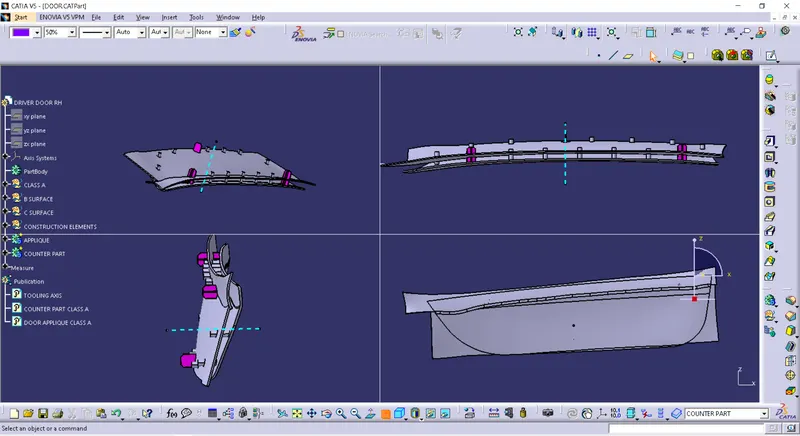
Door Applique Design with Engineering Features
Aim
To create the locators and heat stakes on the door applique body made from the given class A, following all the design standards and performing draft analysis on the body.
Theory
Design Principle.
The design of this part will be carried put by following the 3-2-1 principle.
3-2-1 Principle.
As per this principle , for fixing a part on to a body, the movement of the part along the three axes (XX,YY,ZZ . See figure) should be arrested.
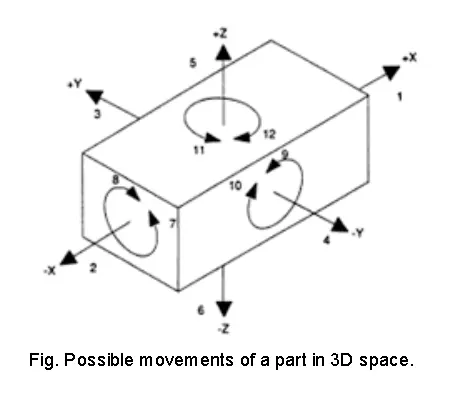
For achieving this design principle, we use locators and Heat stakes.
LOCATORS
By using locators , we can arrest the movements of a part in 3D space. Locators are of two types.
- 4 way locator.
This helps to arrest 4 degrees of freedom along 2 axes
- 2 way locator.
This helps to arrest 2 degrees of freedom along an axis.
HEAT STAKES
The process used for the joining of thermoplastic materials with dissimilar materials such as metal , plastic or other materials is called heat staking.
Heat/Thermal staking is an assembly process achieved by controlled melting and reforming of plastic studs or boss to lock another plastic or metal component onto a part. The protruding studs get locked in place and as they get in contact with the heated thermal tips , the stud melts and fills the volume of the tip cavity to lock itself in place.
PROCEDURE
STEP 1
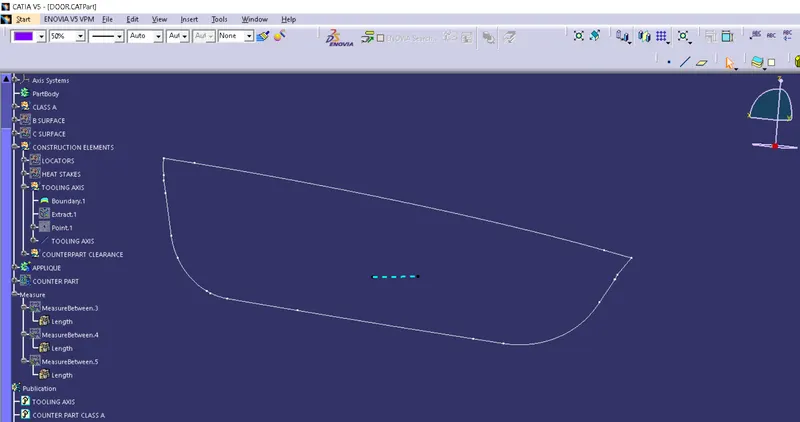
Open the given class a in the catia workbench. Then create a tooling axis from the given class A surface.
STEP 2
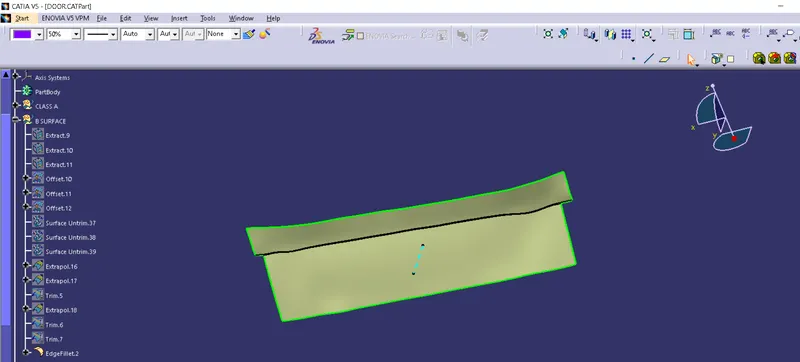
Then create class A and B surfaces using untrimming , extrapolating and sweep commands . After that join A and B surfaces to form a body for the door applique and the counterpart which it is going to be connected to.
STEP 3
Locators
We place 3 locators in a triangular manner on three positions of the part with maximum possible distance from each other.
4-way locators and a 2-way locator are created for arresting the degree of freedoms with proper fillets , entry chamfer and drafts. After making one locator , use the translate command to duplicate the 4-way locator on the other end also. Then make another 2-way locator on the middle bottom portion also .
Thickness of the locator should not exceed the thickness of the material.
All the locators should maintain almost similar height from the surface.
After making the locators union-trim it with the door applique part body.
Heat Stakes
Make heat stakes at possible extremes of the part. Make as many heat stakes as per the dimension of the part but all heat stakes should maintain a minimum of 50mm gap between them, can be more than 50mm.
If one heat stake comes near one of the locators , simply remove it or make adjustments accordingly.
After making the locators and heat stakes, make clearance for them on the counter part . For locators give holes with minimum of 0.1 mm of clearance and for heat stakes give minimum of 0.05 mm of clearance
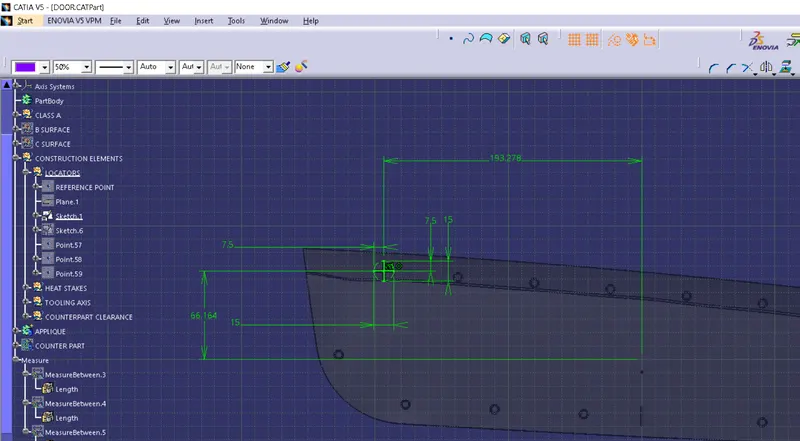
4 way locator sketch
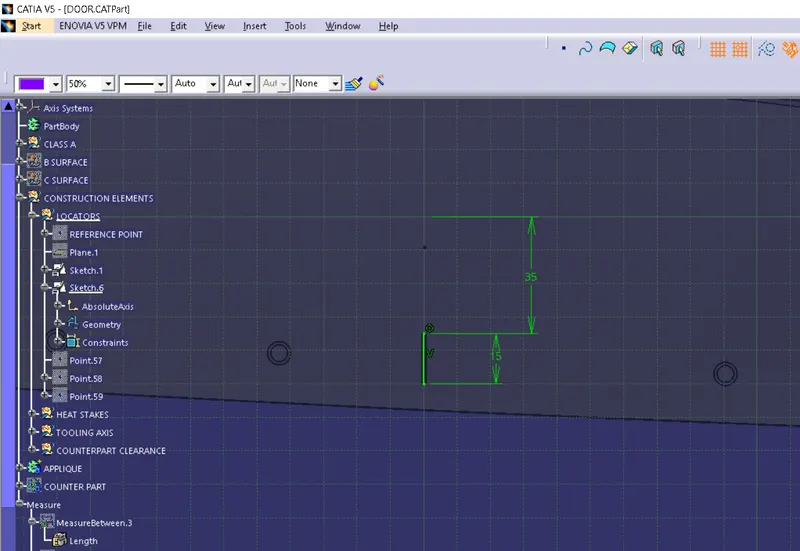
2 way locator sketch
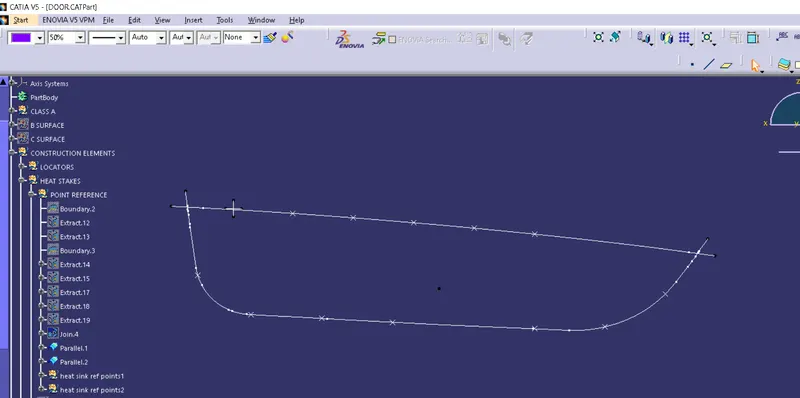
reference points for heat stakes
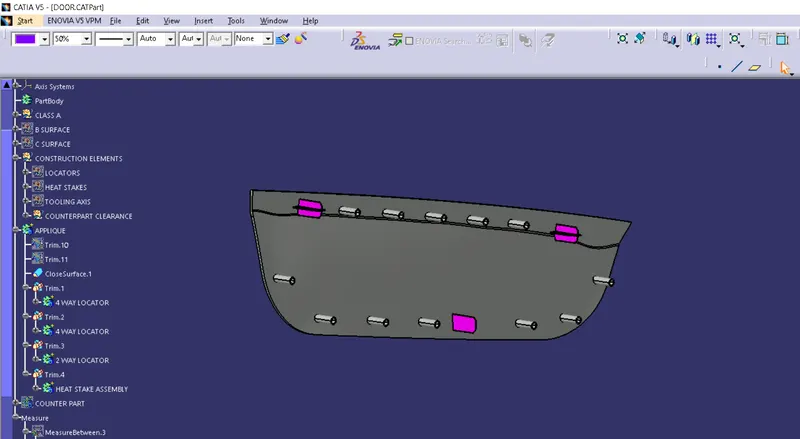
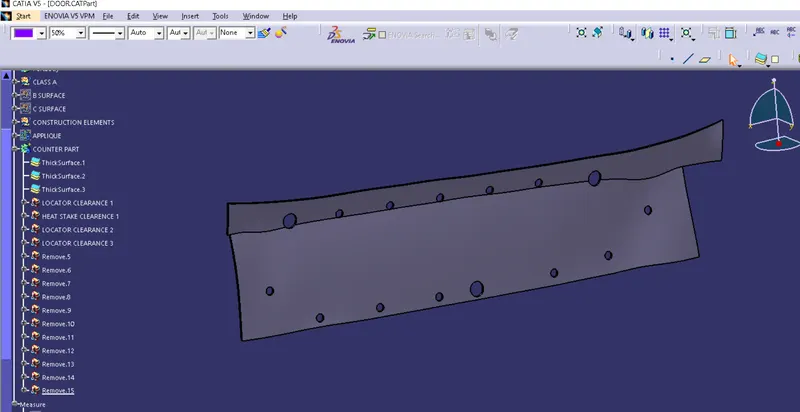
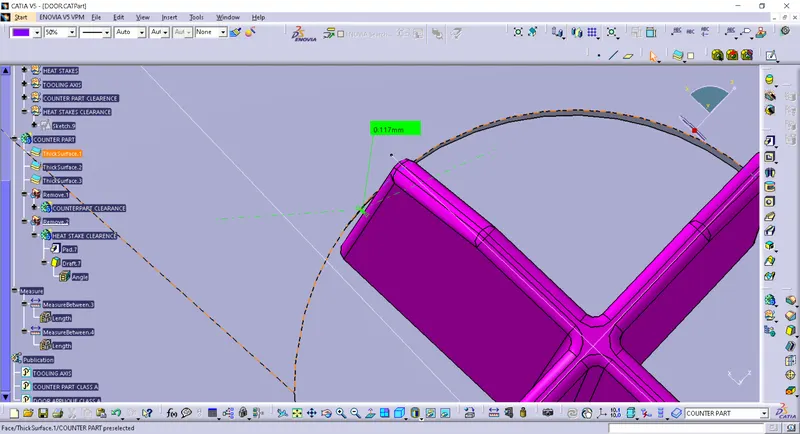
4 way pin clearance 0.1mm maintained
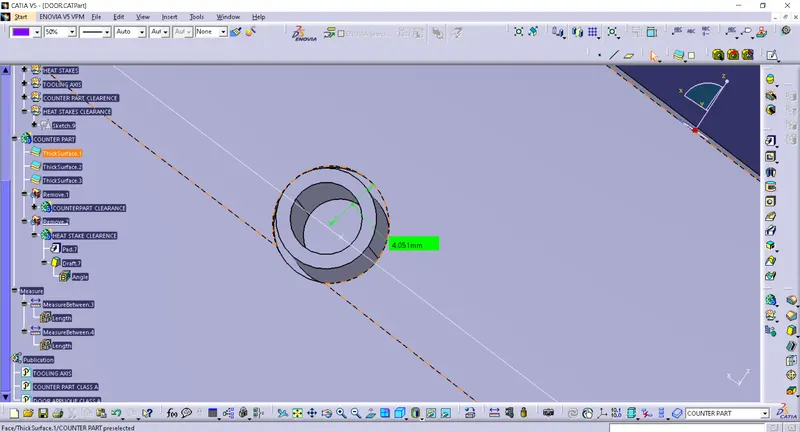
heat stakes clearance 4.05(radius of hole with clearance) ie., clearance after draft , 0.05 is maintained
STEP 4
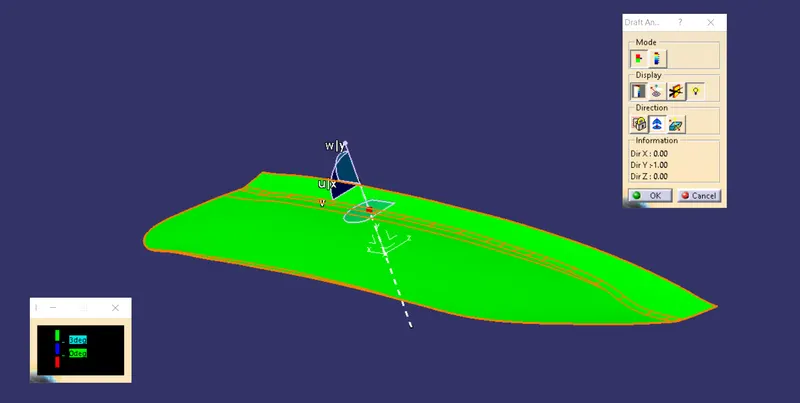
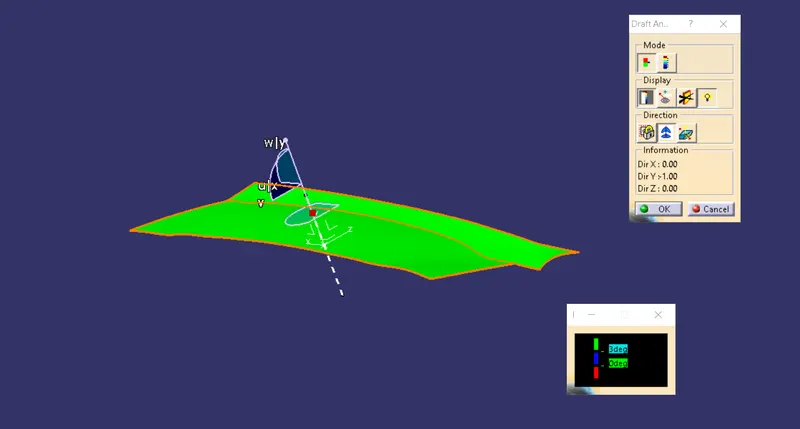
Finally perform draft analysis on the door applique and the counterpart.
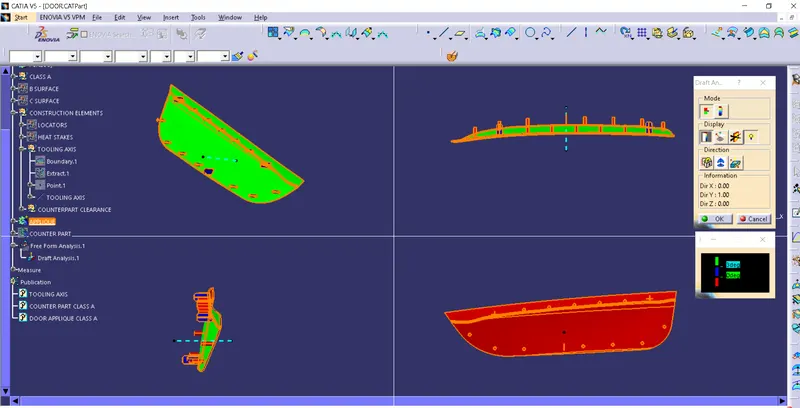
draft analysis on the door applique
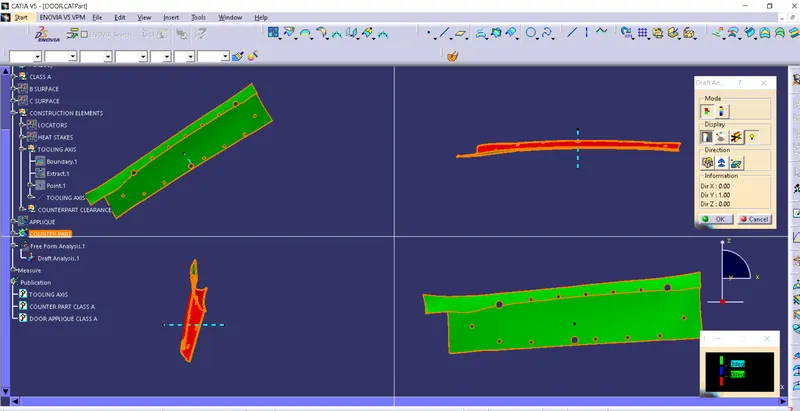
draft analysis on the counterpart.