Week 9 - Project 1 - Door Applique Design with Engineering Features
Door Applique Design
Aim:-
- To create a solid body of a given Door Applique and to create the Locators and Heat Stakes on it as per design standards.
Introduction:-
- Heat staking:
Heat Staking is a pulsed-heat process to join two or more parts out of which one at least is made of plastic. The process is to deform plastic material using heat and force at a set process time. The bond is made by partially de-forming the plastic part in order to fix the other Heat Staking makes it easy to bond metal to plastic and is commonly used in high volume/low cost applications such as automotive, IT and consumer appliances.
In Manufacturing Of thermoplastic components. it is often necessary to join the thermoplastic part of a dissimilar material weather it can be a metal,dissimilar material or the other material. Thermal staking is an assembly method that uses the controlled melting and reforming of a plastic stud or boss to capture or lock another plastic or a metal component of an assembly in place The plastic studs protrude through the holes in a component to be locked in a place.the heated thermal tip contacts the top of the stud which melts and fills the volume af the tip cavity to produce the head,locking the component in a place. The progressive melting of the plastic under continous pressure forms the head When staking,the right combination of heat and pressure for the applications is critical.
Advantages of Heat Stakes:
- Similar and dissimilar materials may be joined: metal to metal, plastic to plastic, metal to plastic.
- Accurate control operating within a small process window.
- Local heating resulting in no damage to surrounding materials. Processing of glass-filled materials.
- No mechanical vibration. Many heat-stake shapes possible through custom designed tools.
2 and 4 way locators:
In any kind of assembly before fixing the part to the mating part we need to fix the position of the part with respect to the mating part In these cases we need to follow some engineering principles in this project we are going to follow the 3-2-1 Principle. Any Part which has to be fixed during welding or machining process has to be fixed is having 12 degrees of freedom.
- Translation Movement along X Axis.
- Translation Movement along Y Axis.
- Translation Movement along Z Axis.
- Rotational Movernent along XAxis.
- Rotational Movement alorig Y Axis.
- Rotational Movement along Z Axis.
Procedure:-
1)Input given:
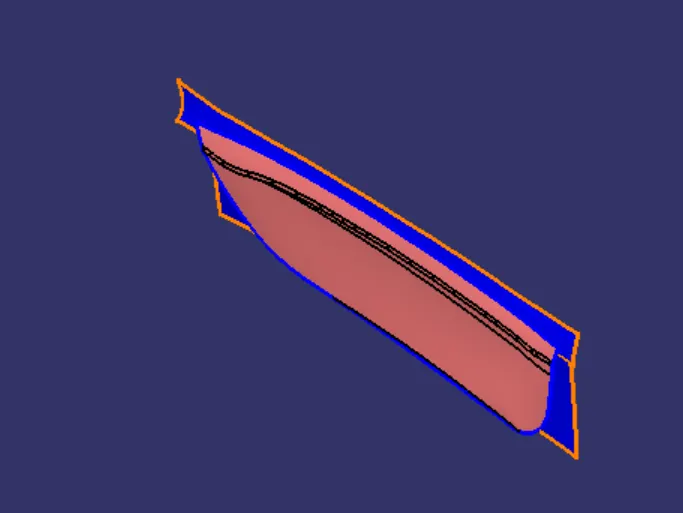
2)Tooling axis:
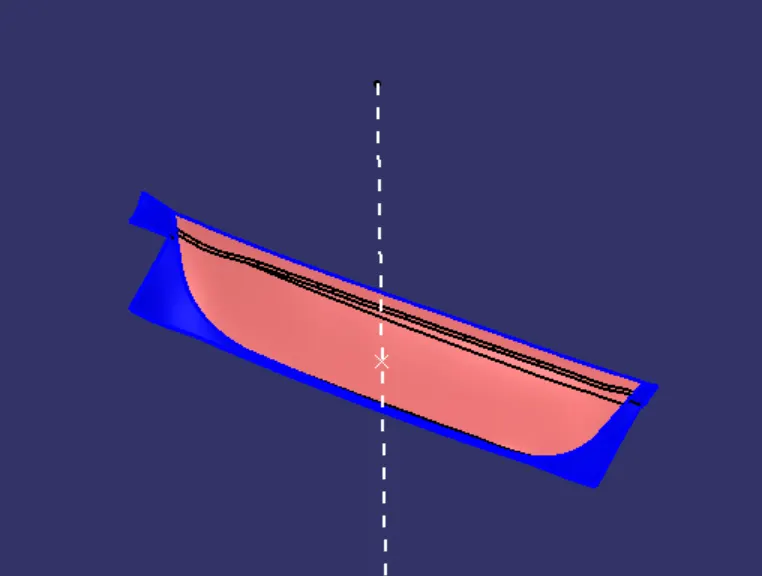
Tooling axis is nothing but the direction in which the core and cavity opens and close.Design engineer works is to analyse the Class A surface and find out the best possible tooling direction keeping in mind all the draft angle is with respect to be easily ejected from the moulds.
3)A class surface:
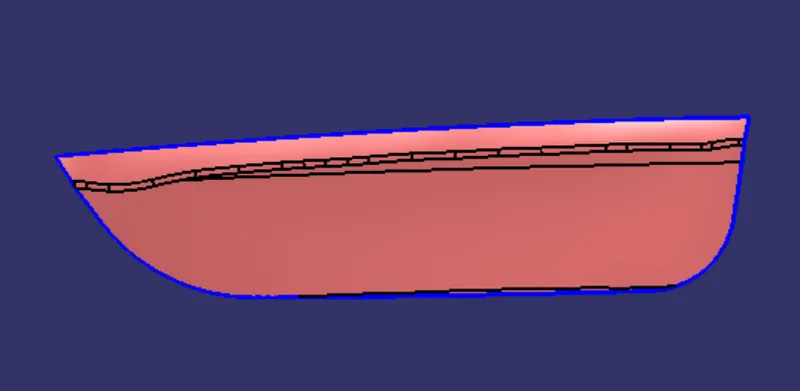
In automotive design, a class A surface is any of a set of free form surfaces high efficiency/and equality Although strictly, it is nothing more than saying the surfaces have curvature and tangency allgriment-to ideal aesthetical reflection quality ,many people interpret class A surfaces to have G2 (or even G3) curvature continuity to one another Class A surfacing is done using computer-aided industrial design applications. Class A surface modellers are also called 'digital sculptors' in the industry. Industrial designes develop there design styling through the A-Surface, the physical surface the end user can feel, touch, see etc.
4) B class surface:
Represent internal and/or functional surfaces. This cluster exemplary includes derived surfaces created by offset operations from class A surfaces to define the thickness of material. In this file it is important to link class B surfaces geometrically to enable an adaptation to class A surfaces automatically in case of styling change, After creating the tooling axis, B surface is to be created which is nothing but the surface parallel to the A surface. B surface contains all the fillets and the edges which the A surface contains.
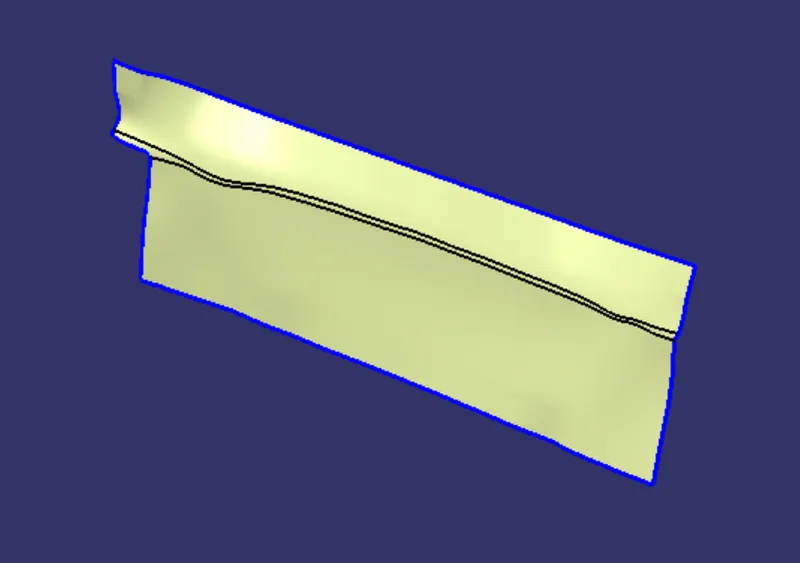
5)C class surface:
Class C surface is swept along the boundry of the class A at an angle perpendicular to the class A surface with respect to the tooling axis direction with a draft angle of 3 degree.
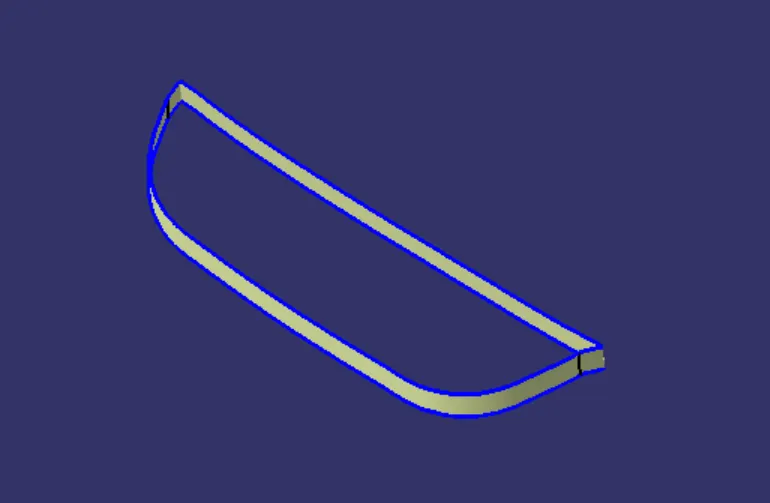
6)Joining class A,B &C surface:
After finishing all the three surfaces, join class A and C surface together using the join command. now the joined surface are then trimmed with B surface to form closed surface.
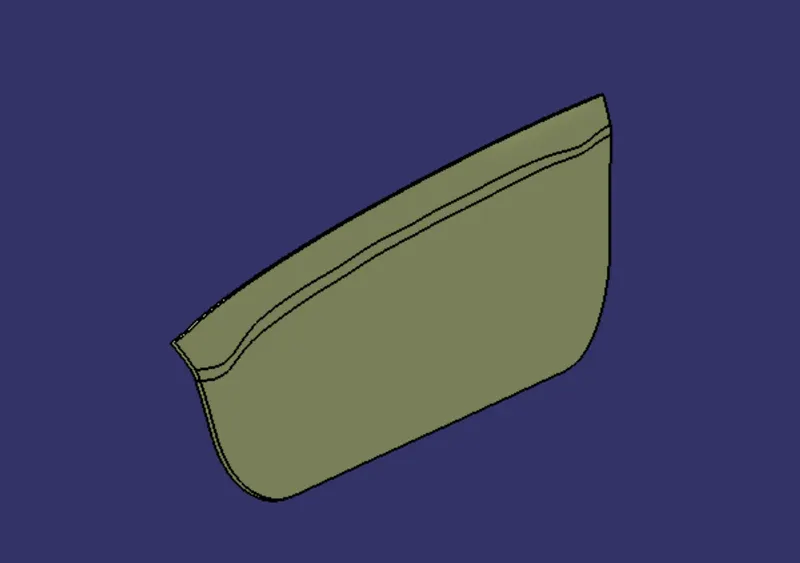
7) Draft analysis:
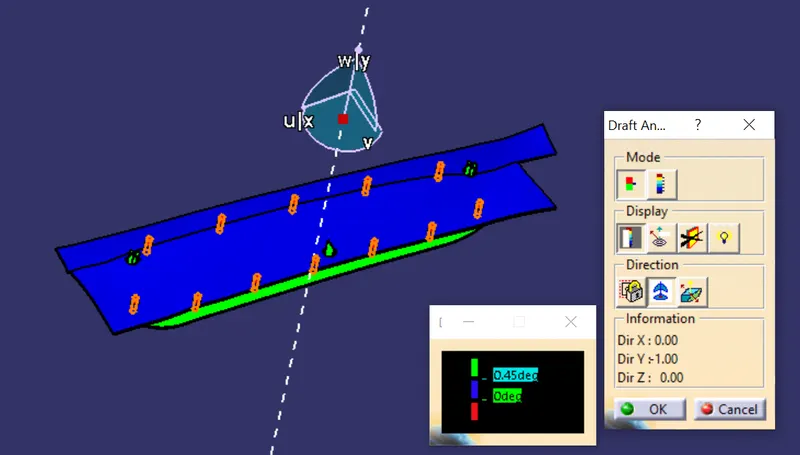
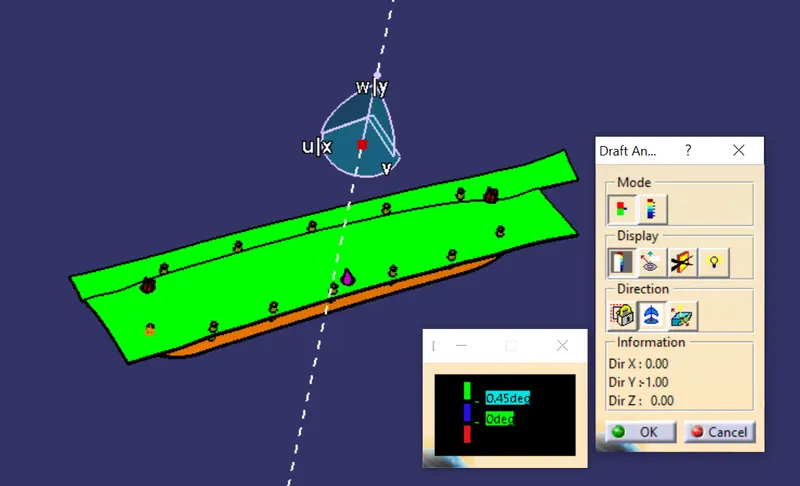
The Draft Analysis command enables you to detect ,if the part you drafted will be easily removed. This type of analysis is performed based on color ranges identifying zones on the analyzed element where the deviation from the draft direction at any point, corresponds to specified values. Draft angles are very important in thermoforming product design. If the product is formed onto a fermale or negative mold, it shrinks away from the mold sidewalls. As a result, true female or negative products can be thermoformed with vertical walls having zero draft angles.
8) Creating 2 and 4 way locators and Heat stakes:
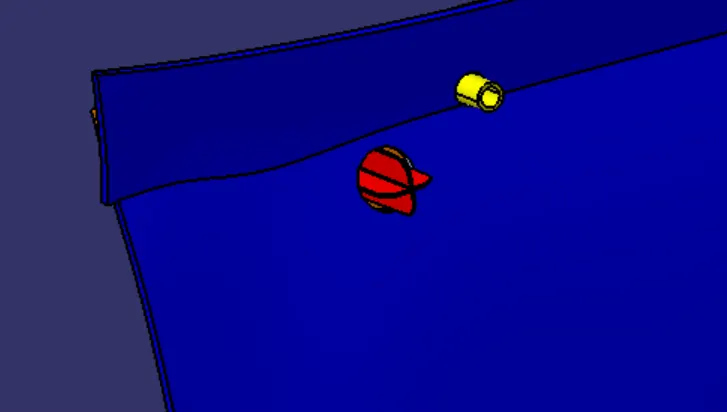
4-way locators mean you prevent movement at 2 axis (+X, -X, Y and -Y) on the plane. Generally you have cylindrical pin on the fixture and circular hole at workpiece part.
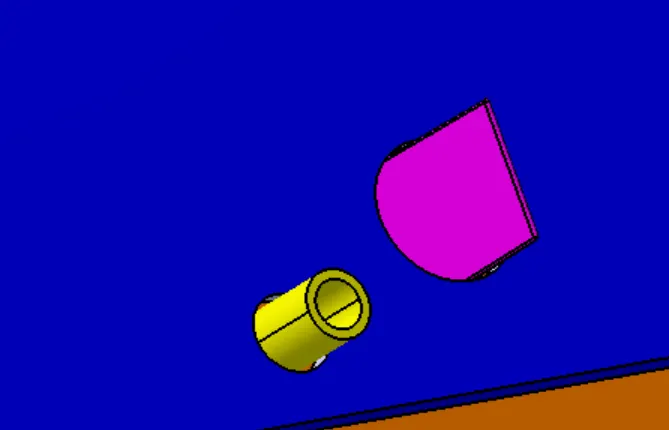
2-way locators mean you prevent movement only at 1 axis on the plane. While creating the locators we need to follow the design rules to create the ribs in order to avoid the sink marks on the cormponents.
Heat Staking is a pulsed-heat process to join two or more parts out of which one at least is made of plastic. The process is to deform the plastic material using heat and force at a set process time. The bond is made by partially de-forming the plastic part in order to fix the other.
Once done with the design of locators and the heat stakes we need to design the counter holes in the mating parts with standard clearances as shown in picture below.
Final view:-
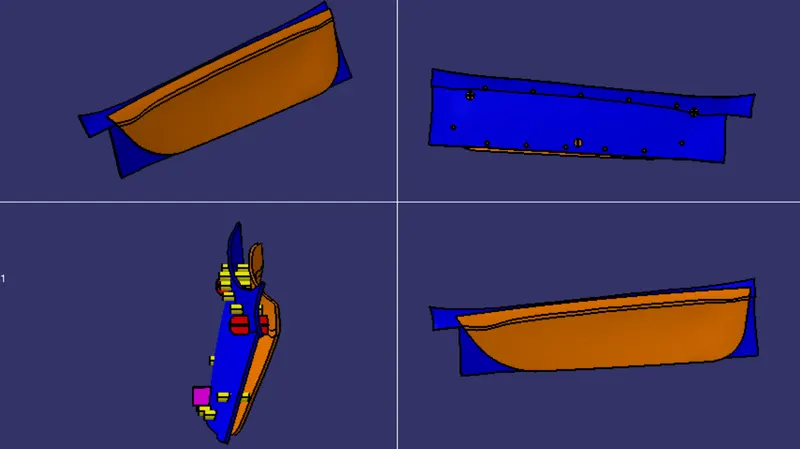
Conclusion:-
- Thus the Door Appligue is developed by using given Class A surface.
- 2 and 4 Way locators has been designed in order to fix the position of the applique with the mating door panel and also designed the heat stakes which used to fix the component with the mating panel by melting.