Week - 9 Material Modeling from Raw Data
Aim: Using the diagram of the true stress-strain curve given for graphite iron casting, create a material model for the Dogbone specimen Validate the material model by performing a tensile test on a Dogbone specimen
Step 1: Data Extraction from the Curve Image: In general, The material test data is collected as
- Force vs Displacement
- Engineering stress vs strain
- Raw data
- The image representing the curve of the data points.
In this case, We got an Image representing a True Stress/ Strain curve with 3 different strain rate, From the graph, we can see The material shows elasto-plastic behavior with the elastic and plastic region. Although many material models exist for elasto-plastic, one of the most robust models is *MAT_024 or *MAT_PIECEWISE_LINEAR_PLASTICITY. This material model is the standard workhorse and is the recommended starting point for elastic-plastic simulation of metals and general plastics since it can also handle viscoelastic behavior (i.e., strain-rate dependency).
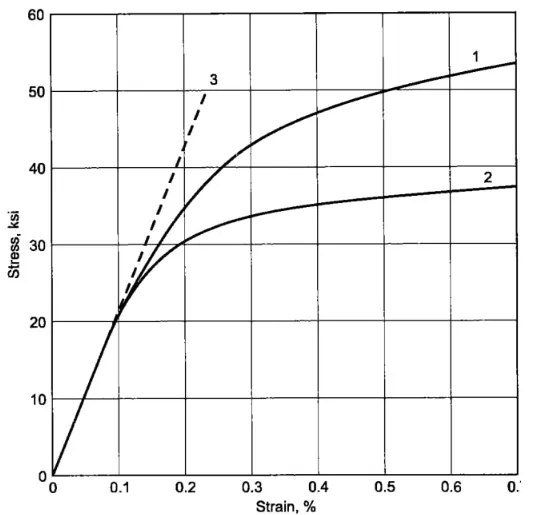
From the above Plot, we will take The curve 2 data point for our material modeling purpose
Using the GRABIT Matlab GUI program, the data points are extracted from an image file.
Data clean up – Curve fitting
The data point extracted from the image is always noisy and the data points are selected manually by picking each point so there will be some human error. And Since, Ls dyna will accept only the monotonically increasing curves we need to clean up the curve and fits the rough data. This is called Curve fitting.
Curve Fitting : Curve fitting is the process of constructing a curve, or mathematical functions, which possess the closest proximity to the real series of data. By curve fitting, we can mathematically construct the functional relationship between the observed dataset and parameter values, etc. It is highly effective in the mathematical modeling of some natural processes. We have performed a curve fitting process using MATLAB code our data points are fitted using SPLITWISE CUBIC PLOYNOMINAL METHOD. Splitwise method is an efficient way to obtain the perfect fit without increasing the degree of the polynomial.
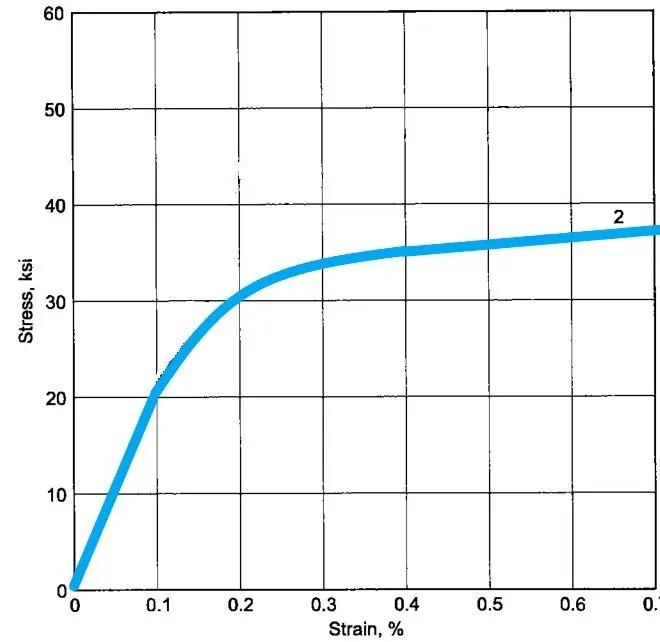
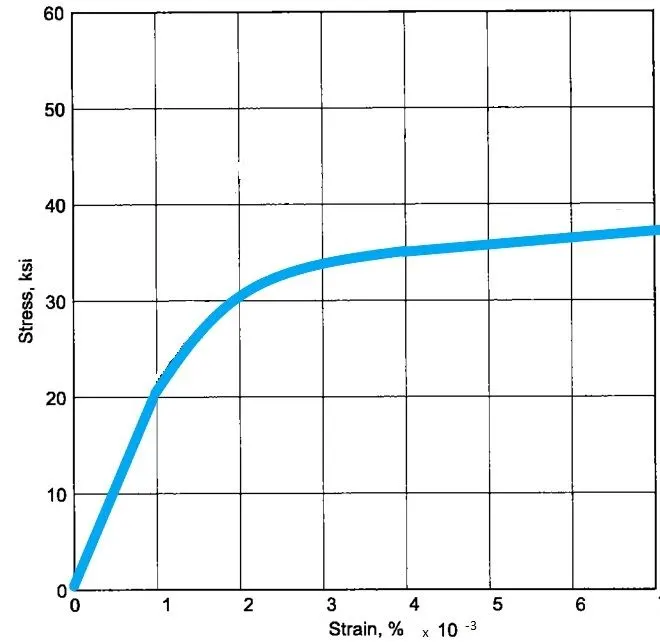
Data/Unit conversion: For the Material card model we are using SI unit i.e Kg/mm/ms but if we noticed from the Stress and Strain graph units are give in ksi and percentage respectively so the unit of stress has to be changed from ksi to GPa and Strain has to change from percentage to actual value.
0.2% offset Yield Strength
Well, the conversion from elasticity to plasticity can be very subtle for many materials so it might not be always very easy to figure out the yield point, that is the point on the stress-strain curve, where elasticity changes to plasticity. In other words, at the yield point, if you let go of the deforming force, the material will not come back to its original form there will be some amount of permanent deformation In this case, the offset yield strength is determined. A line is constructed parallel to the initial portion of the stress-strain curve but offset by 0.002 in/in (0.2%) from the origin. The 0.2% offset yield strength is the stress at which the constructed line intersects the stress-strain curve as shown:
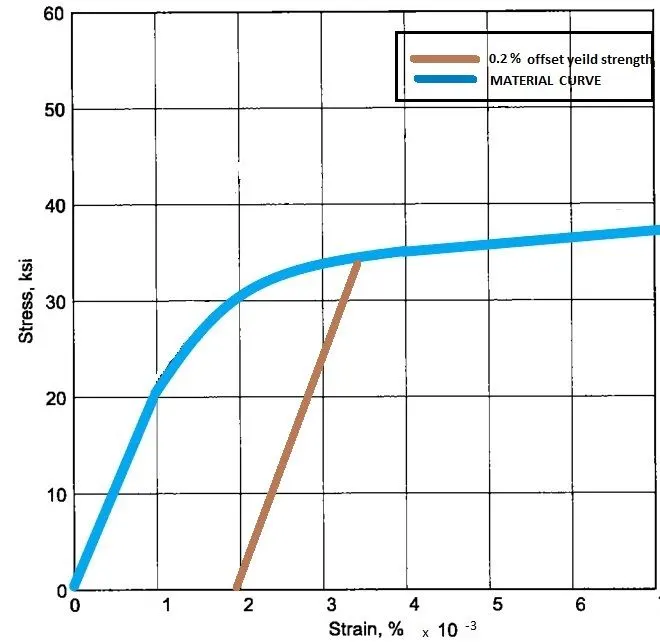
0.2% offset yield strength : 0.22 GPa
Once the unit conversion is done we can see the extracted data are True stress and True strain But to define a Stress-Strain curve in *MAT_24 card, We have to defined it in Effective stress and Effective plastic strain
The true stress and strain values are converted into Effective stress and Effective plastic strain value using the following formula.
Effective stress = True stress
Effective plastic strain = True strain - True stress / E
Young’s Modulus is given for the material as 20.9E+6 psi i.e 144.1001 GPa
As the stress value increases, the recoverable strain (true stress/E) increases as well. For metals, E is very large compared to the yield stress so it's fairly common practice in the case of metals to just subtract off a constant value equal to the strain at initial yield from all subsequent strain values
True Stress / E = 0.000958
The hardening curve which is defined in the material card should start ideally with yield strength and effective plastic strain (at yield strength) as a first point. So, we can remove the elastic region data point from the curve.
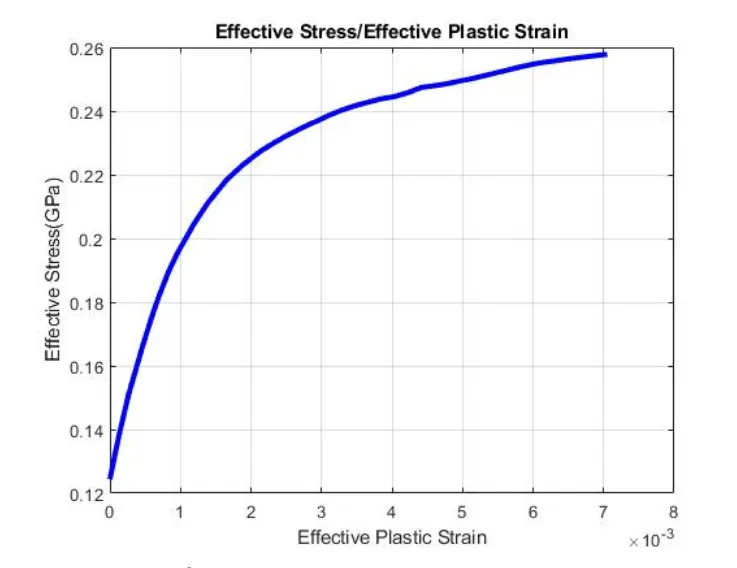
Defining Stress/Strain curve for material model
The stress/strain for the material is now in the form of Effective stress and Effective plastic strain which can be implemented on the MAT_24 material card
These data point for the Stress/Strain curve are inserted *DEFINE_CURVE Card with LCID
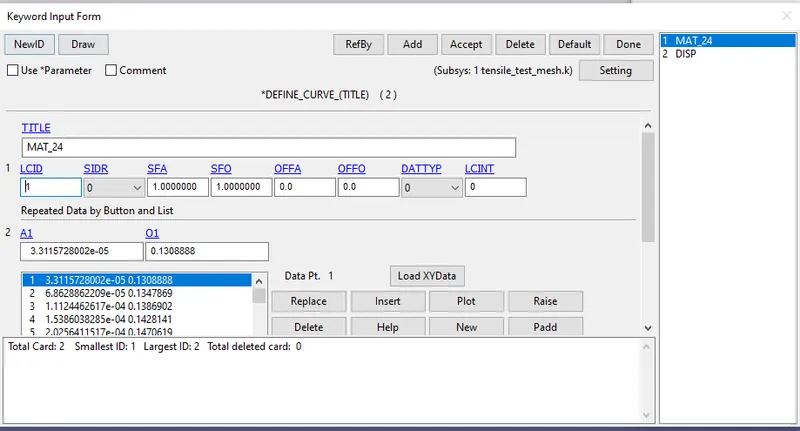
Material Model:
We will use graphite iron casting Properties for defining the material card
MID Material identification. A unique number or label not exceeding 8 Characters must be specified
RO Mass density= 7.100e-06
E Young’s modulus = 144.1001 GPa
PR Poisson’s ratio = 0.3
SIGY Yield stress = 0.229 from 0.2% offset yield strength
LCSS Load curve ID defining effective stress versus effective plastic strain.LCID from Define_curve
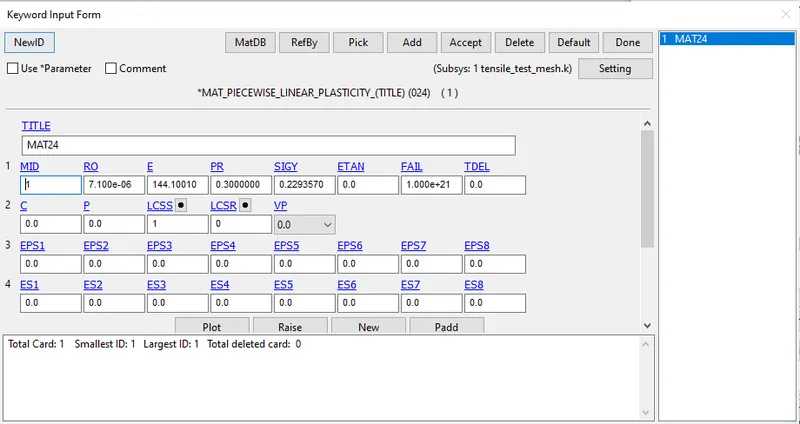
Tensile Test – Pre Processing
Procedure :
Mesh model of Dogbone specimen is imported
The material model we created for graphite iron casting is used here
Section shell card is used with 16: Fully integrated shell element formulation and thickness as 1mm
Boundary Condition
Since we performing a Tensile Test where one end of the specimen is fixed and the displacement is added to the other end so we will use two types of boundary condition on the Specimen
1. BOUNDARY_SPC_SET
To fix one end of the specimen as test procedure we will constraint all the degree of freedom for edge nodes on one end of the specimen.
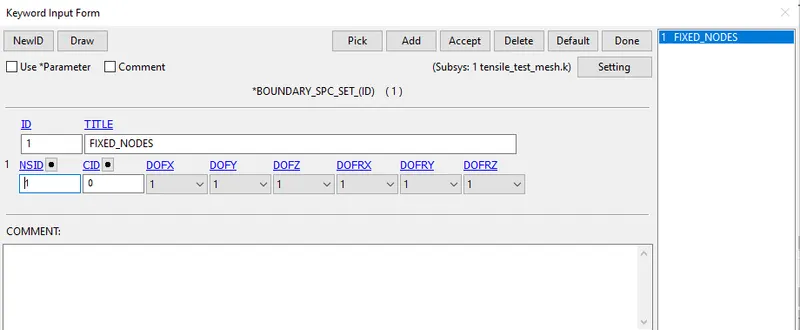
2. BOUNDARY_PRESCRIBED_MOTION_SET
A set of a node is created on the edge specimen in which displacement is applied.
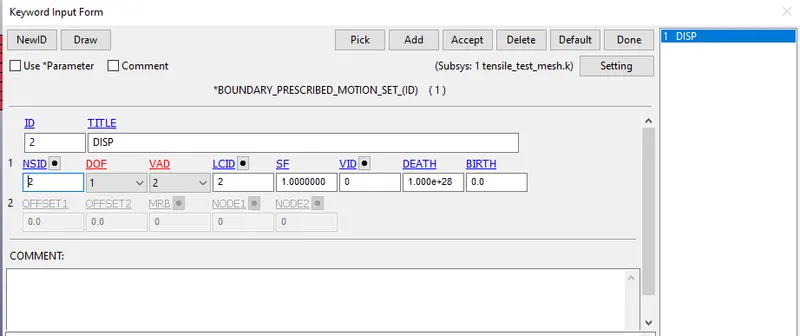
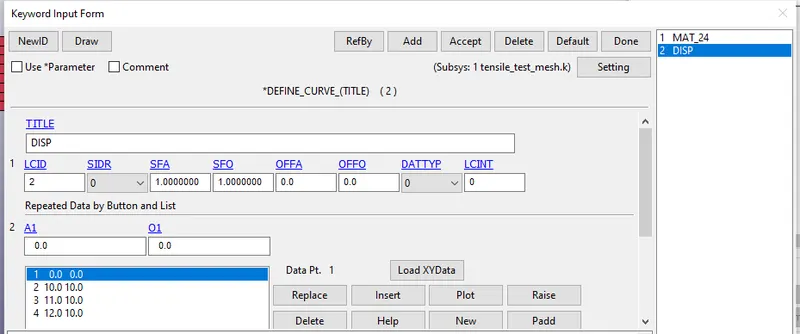
Displacement curve is created using Define_curve Card
DOF in BOUNDARY_PRESCRIBED_MOTION_SET is set to be 1 which means displacement takes place in the X direction and VAD is set as 2 Displacement flag
Control cards: DT-0.01, DT0-0.001, ENDTIME:1.5
1.*CONTROL_IMPLICIT_GENERAL
2.*CONTROL_IMPLICIT_SOLUTION
3.*CONTROL_IMPLICIT_SOLVER
4.*CONTROL_IMPLICIT_AUTO card has been defined to adjusts the time step size automatically.
Database Creation:
*BINARY_D3PLOT
*DATABASE_HISTORY_NODE A nodes on Accel Block of head were defined to measure the acceleration and calculated HIC value
*DATABASE_EXTEND_BINARY - this writes the strain tensor to d3plot when STRFLG is set to 1
ASCII_option keyword: DT-0.001
The output request in ASCII format, The following keyword are Activated
*ELOUT
*GLSTAT
*MATSUM
*SLEOUT
*NODOUT
RESULTS:
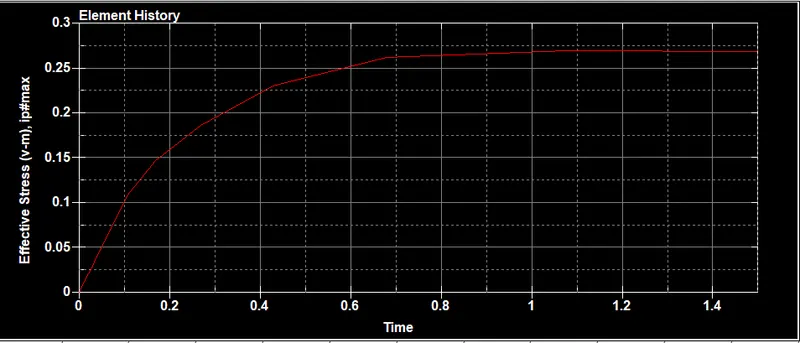
Effective Stress
Max Stress: 0.269 GPa
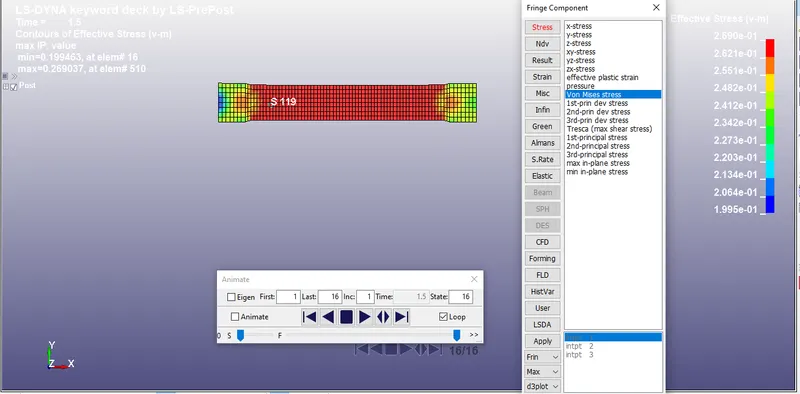
Effective Stress is plotted for the element 510
Effective Plastic Strain
Max Effective Plastic Strain: 0.01095
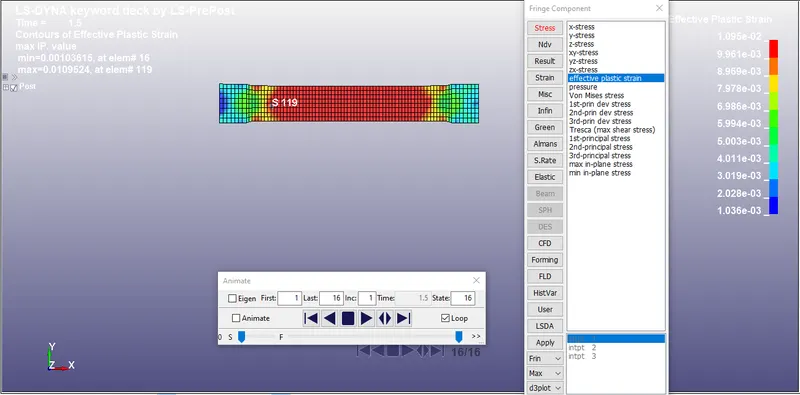
Effective Plastic Strain is plotted for element 119
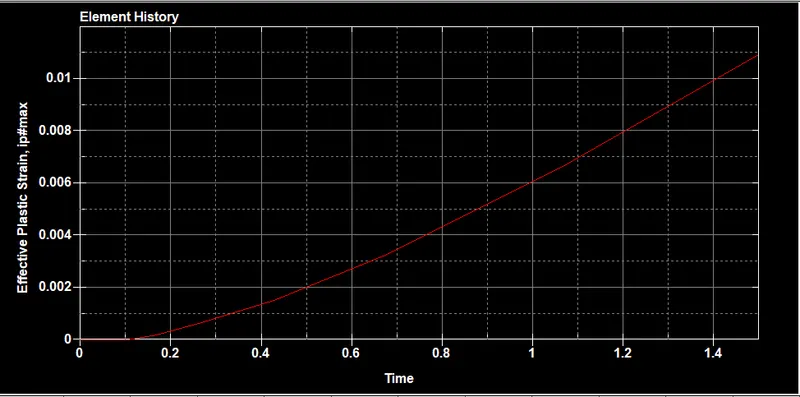
Stress-strain Curve:
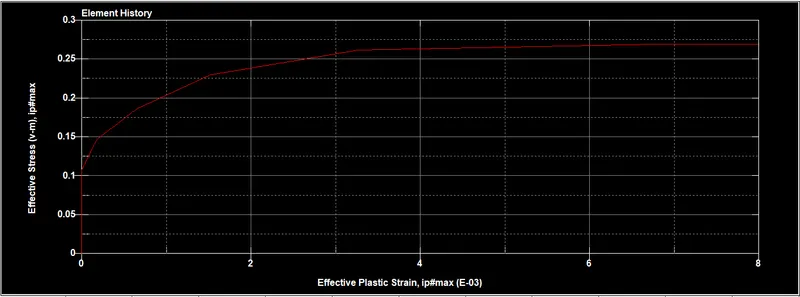
Material defined stress-strain data and simulated stress-strain data are compared . It can be seen that the elastic part is linear . The linear elastic part is calculated directly through the given young’s modulus andThe yielding starts after the first defined yeild point in the hardening curve .
Conuclsion :
The stress-strain data extraced from image is validated with the MAT_024(Piecewise linear plasticity) material model. The stress-strain behaviour after yielding is considered by a hardening curve which is given as an input through MAT_024 card. The MAT_024 material model captures the actual stress-strain behaviour in a similar manner and almost matched the defined stress-strain curve in material model. Also we seen the little variation in the simulation data, which can due to the lack of information like density and Poisson’s ratio for the raw data , Mesh Size of the model or defineing proper strain rate . These variation can be fine tuned by trying different values of these properties and by selecting more data points to better capture the curve feature