Week 9 Machining with Planer Challenge
Objective: The aim of this project is to perform the Explicit Dynamic analysis on the Workpiece with Planer Cutting Tool.
We will perform this analysis with two cases,
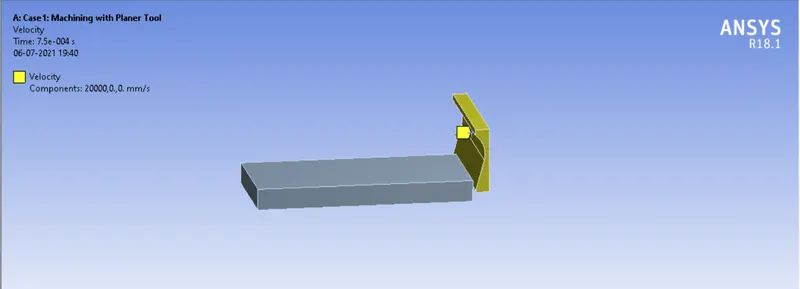
Case1: Cutting Velocity =20000mm/sec.
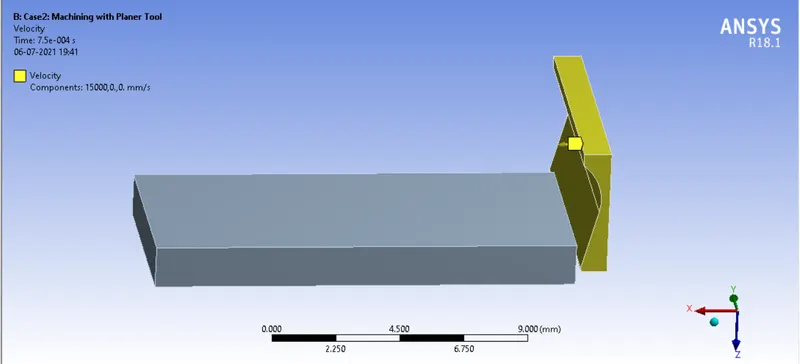
Case2: Cutting Velocity =15000mm/Sec.
Geometry: The assembly consists of two parts 1) Workpiece 2) Cutting Tool.
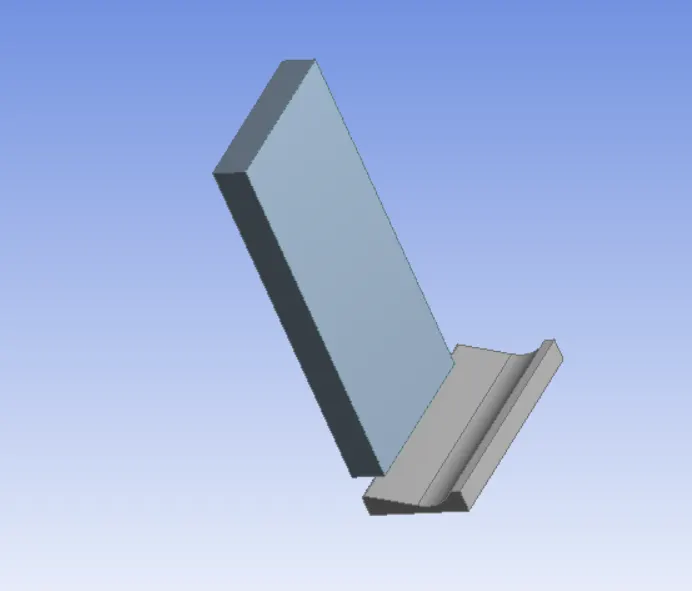
Materials: We use Steel 1006 for the workpiece and Structural Steel for Cutting Tool.
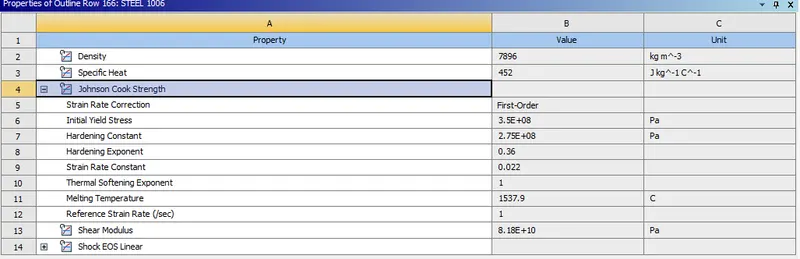
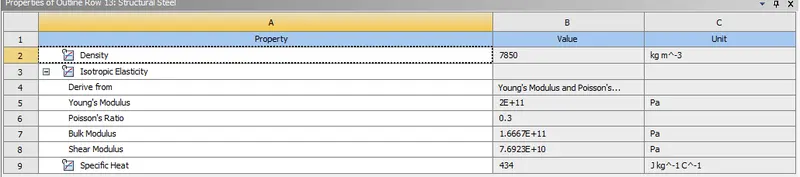
Properties of the material are shown in fig. below.
Steel 1006
Structural Steel
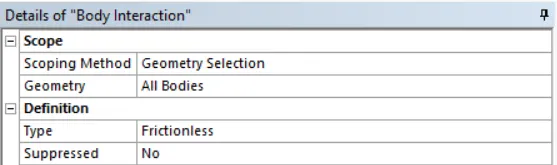
Body Interaction:
In this analysis we are not going to Contacts, instead, we will use the Body Interaction Parameter.
Mesh:
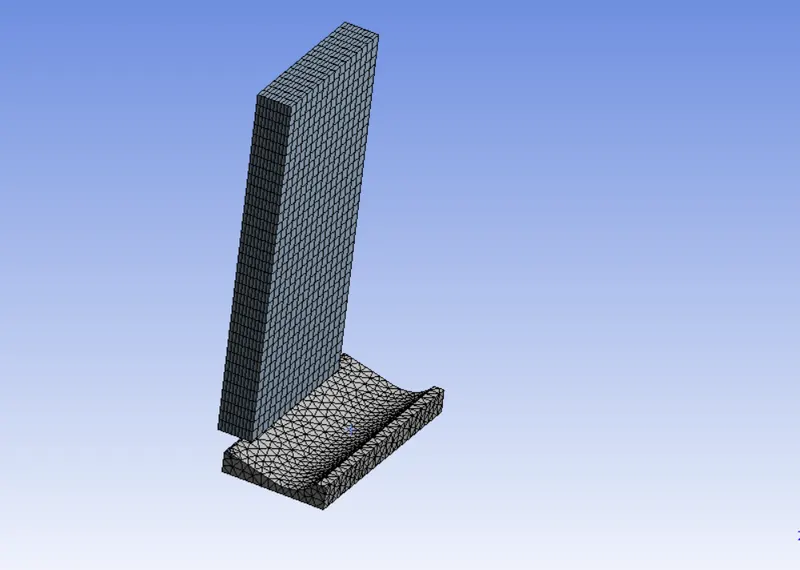
We have deployed the Tetra mesh to the Cutting tool and Edge sizing with 10 divisions to the workpiece.

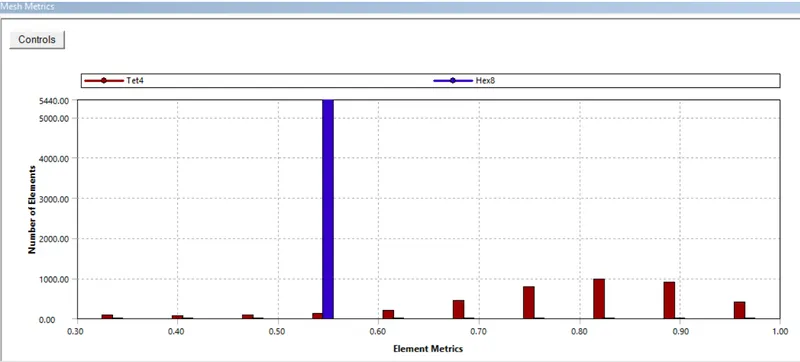
Quality Matrix:
Analysis Settings:
In Explicit Analysis our main focus is on the end time of the simulation. The End-time should be as minimum as possible to capture accurate results. In this case, we have used end time as 7.5e-4 sec.
This particular value is determined by the number of experiments. this can be different for other models.
The analysis settings are as follows.
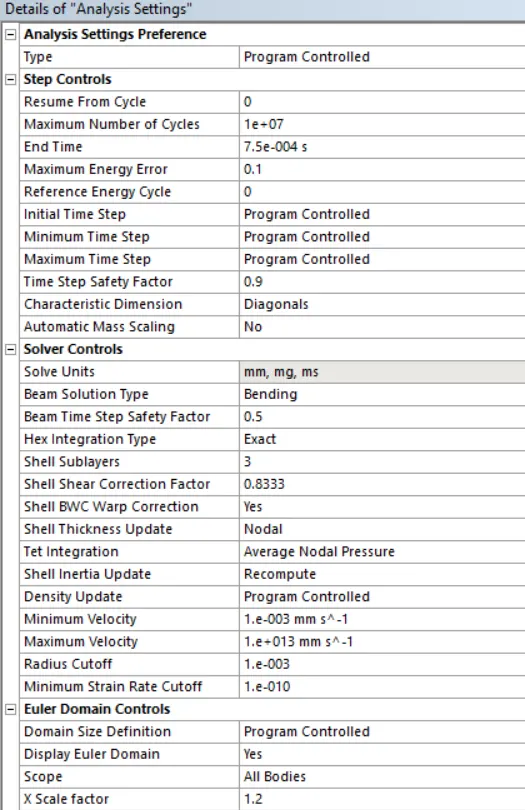
The initial Time Step, Minimum Time Step, and Maximum Time Steps should be program-controlled.
Boundary Conditions:
1) Fixed Support: As it is a Planer operation the Workpiece going to be fixed at one particular location and tool is going to move, Hence in both the cases the Workpiece is Fixed.
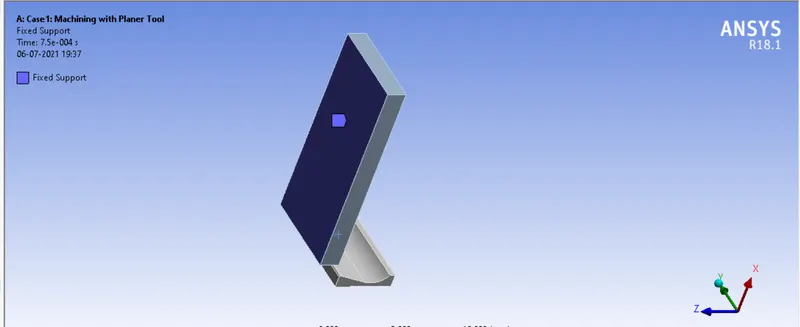
2) Velocity: We will be giving the velocity of 20 m/s (200000 m/sec.) in the first case and 15 m/s (150000 mm/sec.) in the second case.
Case1:

Case2:

Results:
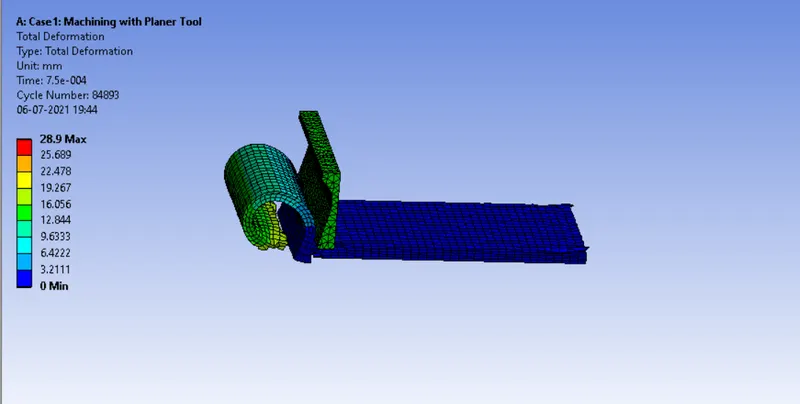
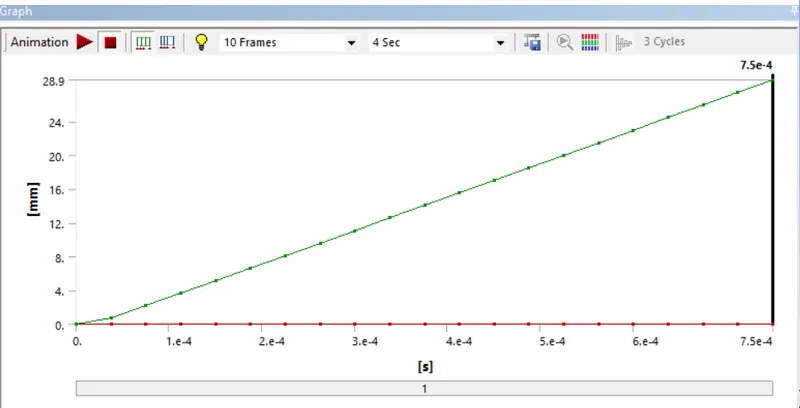
Case1: Cutting Velocity of 20000 m/sec.
1) Total Deformation:
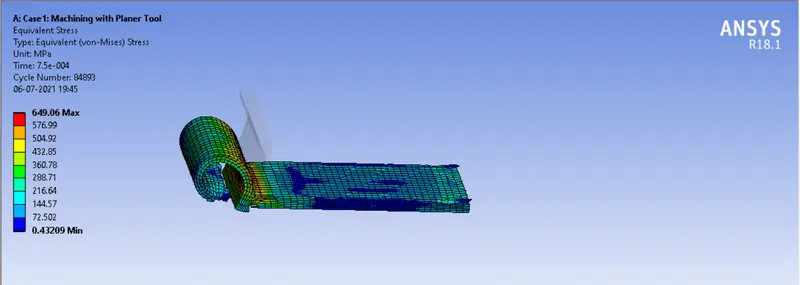
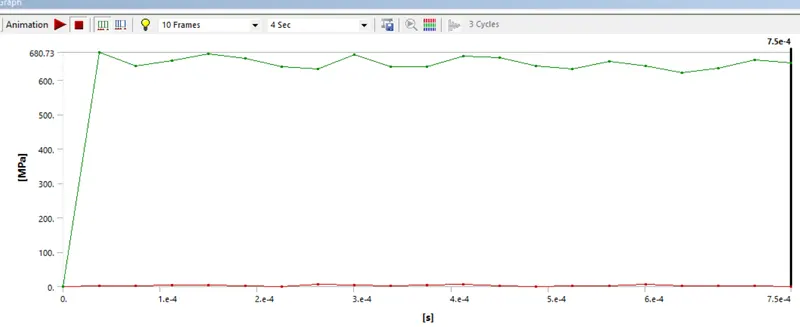
2) Equivalent Stress:
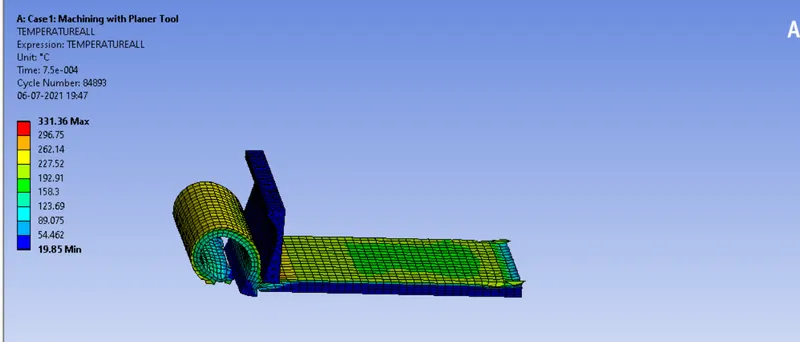
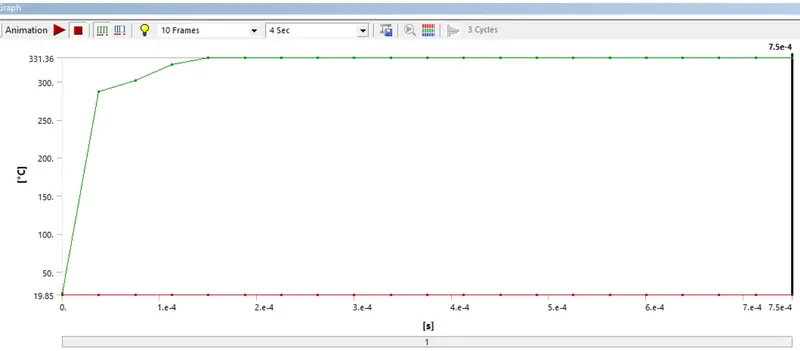
3) Temperature of the Body:
Case2: Cutting Velocity of 15000 mm/sec.
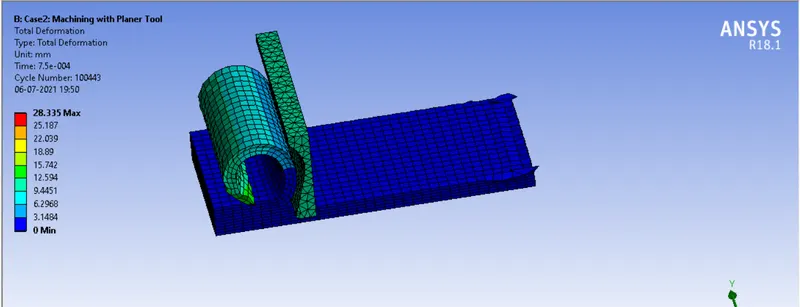
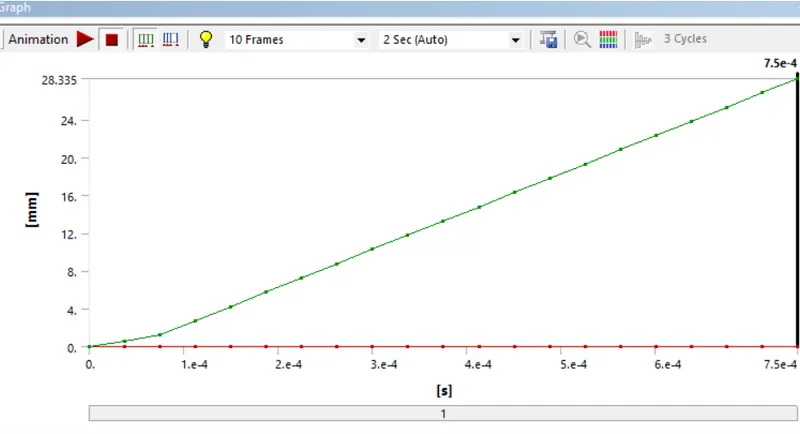
1) Total Deformation:
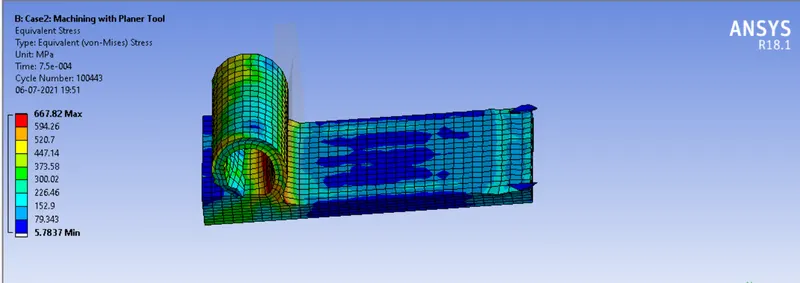
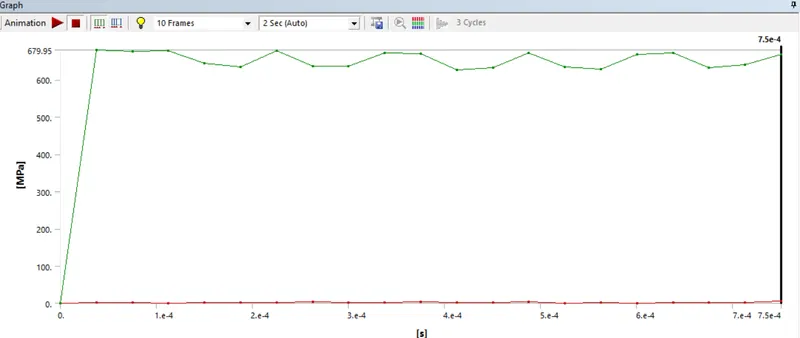
2) Equivalent Stress:
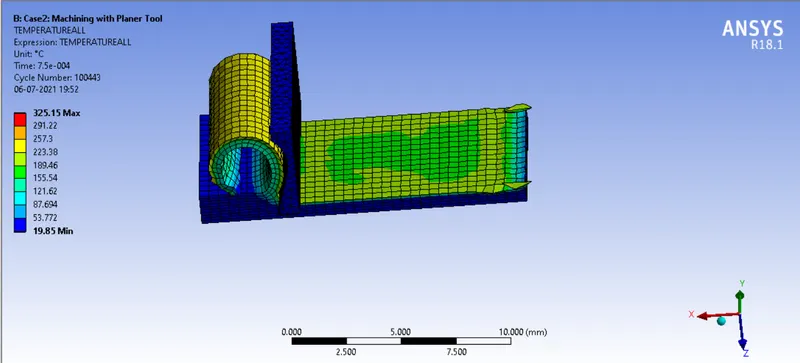
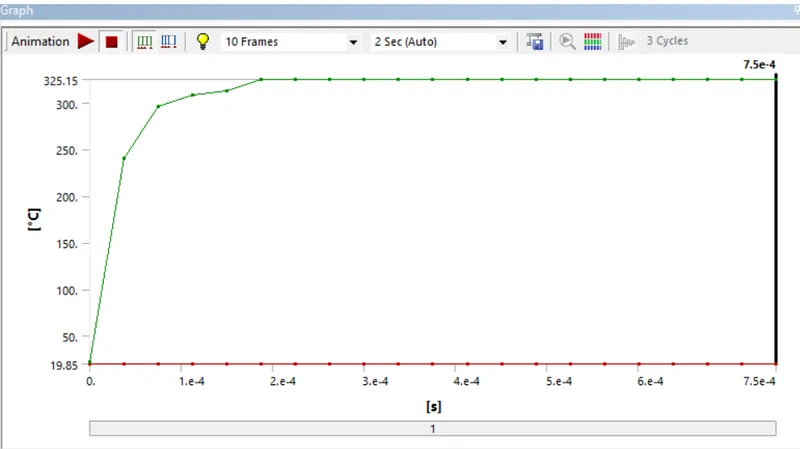
3) Temperature of the Body:
Conclusion:
| Total Deformation in mm | Equivalent Stress in MPa | The temperature in Degree Celcius | |
| Case1: Cutting Velocity of 20000 mm/sec. | 28.9 | 649 | 331.36 |
| Case2: Cutting Velocity of 15000 mm/sec. | 28.335 | 667.82 | 325.15 |
1) Stresses Generated in Case2 are higher than in Case1. This is expected as the cutting tool moves with a lower speed and removes more material.
2) Temperature in case2 is lower than case1. This is expected as cutting tool moves with lower speed.