Week 9 - FVM Literature Review
What is Finite Volume Method(FVM), write down the major differences between FDM & FVM. Also, describe the need for interpolation schemes and flux limiters in FVM. You can use the 1D linear heat conduction equation as an example.
Solution :
In majority of the problem of interest, we need to solve an non linear diffrerential equation to which the analytical soltions may or maynot exists in the nature.
The various methods by which an diffrerential equation or in formal language governing equation of a physical phenomenon can be solved are:
- Finite difference method (FDM)
- Finite volume method (FVM)
- Finite element method (FEM)
Finite differnece method:
FDM are used to solve the differential equations by approximating the derivatives them using difference equations. FDM turns the linear ordinary differential equations (ODE) or nonlinear partial differential equations (PDE) into a a group of equations which can be solved over a uniform grid. In this approcah the dependent variable is evalauted at a single point rather than a volume.
Finite volume method (FVM)
In the FVM methodology the governing equations of interest are integrated over the finite volume and then summed over the entire volume with a specific interpolation schemes. The properties are assumed to be concentrated at the centre area.
In the FVM the for 2D: volume is assumed to be Dx*Dy*1.
In the FVM the flux of an scalar variable entering the finite volume will be equal to the flux of an scalar variable leaving the finite volume. This formulation is more suitable to the conservative form of the equations.
consider the general transport equation:
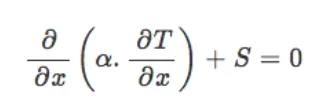
Here
- alpha is the diffusion term
- S is the sourse term
- DT/Dx is the termperature gradient term
The grid structure:
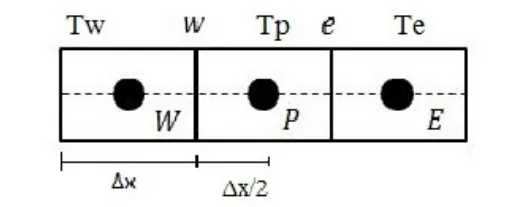
P is the point in the CV where the equation is to be intergrated
E and W are the neighbouring nodes where the temperature is TE and TW.
Integrating the equation over the control volume we have;
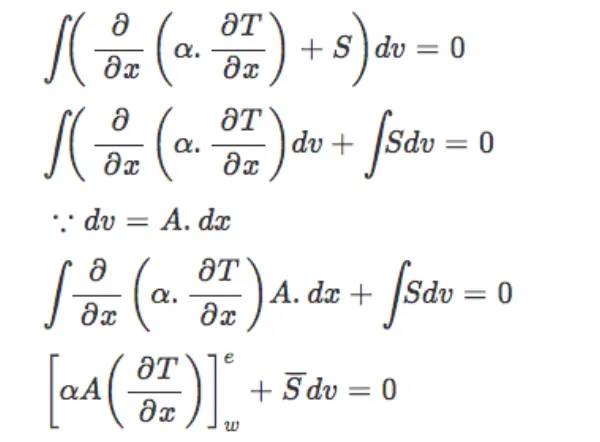
here Sbar is the average source term
If we assume alpha to be constant in a fintie volume we have"

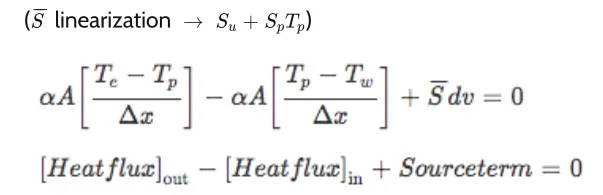
Here the source term linearization is an important factor and the Sp term should be negative for the solution to converge
In the finite volume formulation, evaluation of surface and volume integrals sometimes requires the values of unknown variables at locations other than the computational nodes of the control volume. These values are obtained by employing certain interpolation schemes
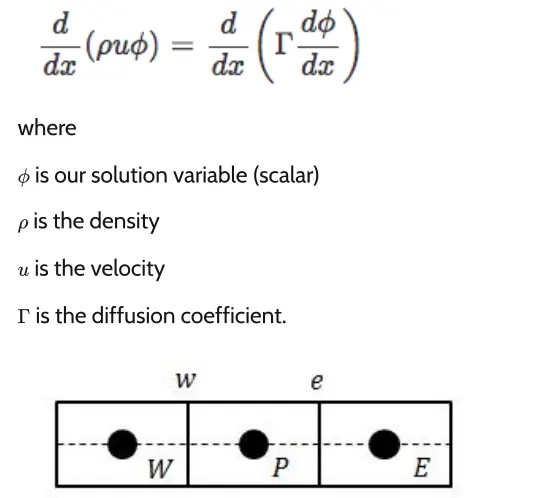
Evaluation of LHS of the above equation requires value of over faces e and w. These values are estimated by employing certain interpolation schemes.
Some interpolation schemes used in CFD are as follows:
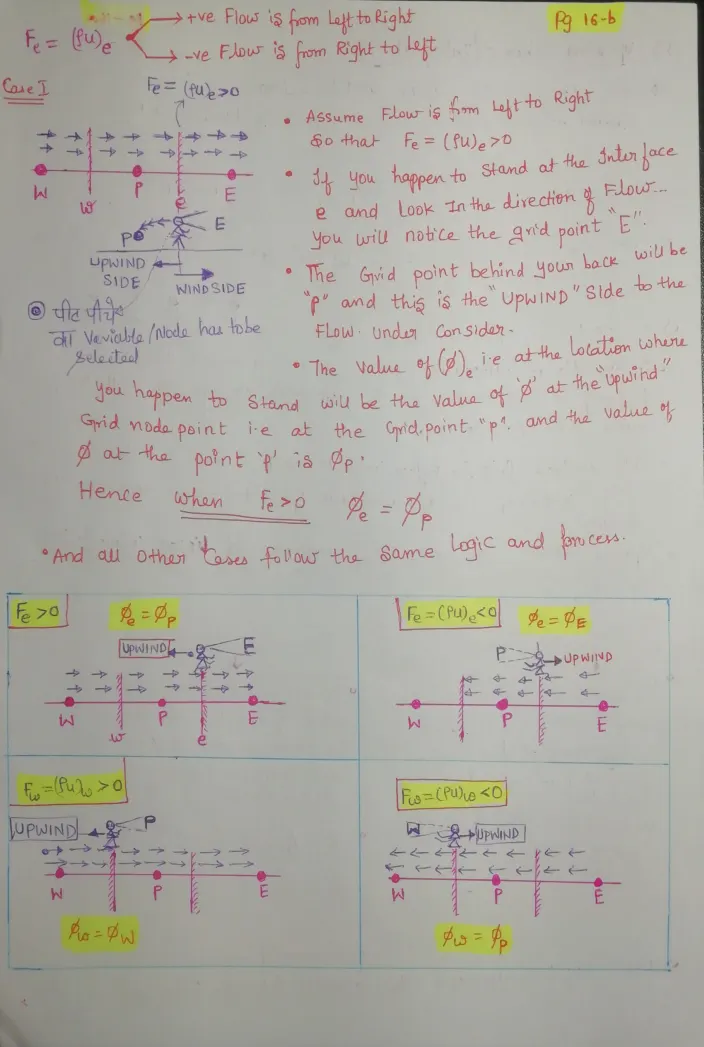
- Upwind interpolation scheme.
- Linear interpolation scheme.
- Quadratic Upwind interpolation for convective Kinematics (QUICK) scheme.
- Hybrid Scheme.
- Total Variation Diminishing (TVD) scheme
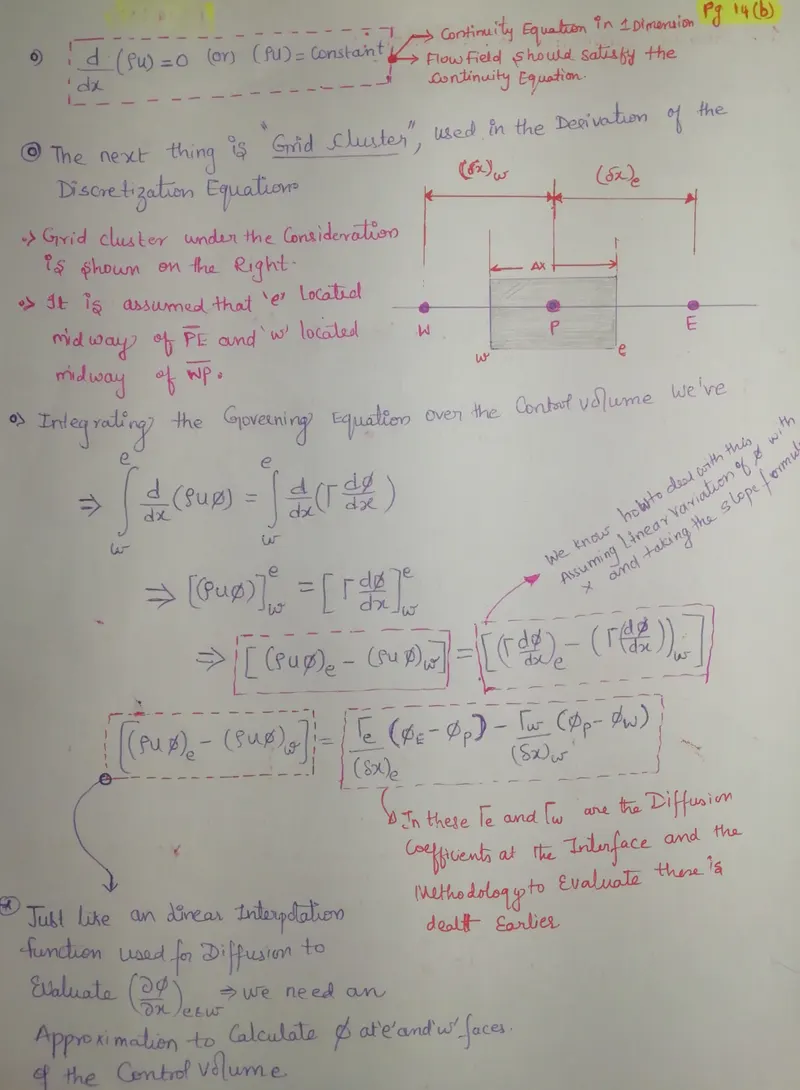
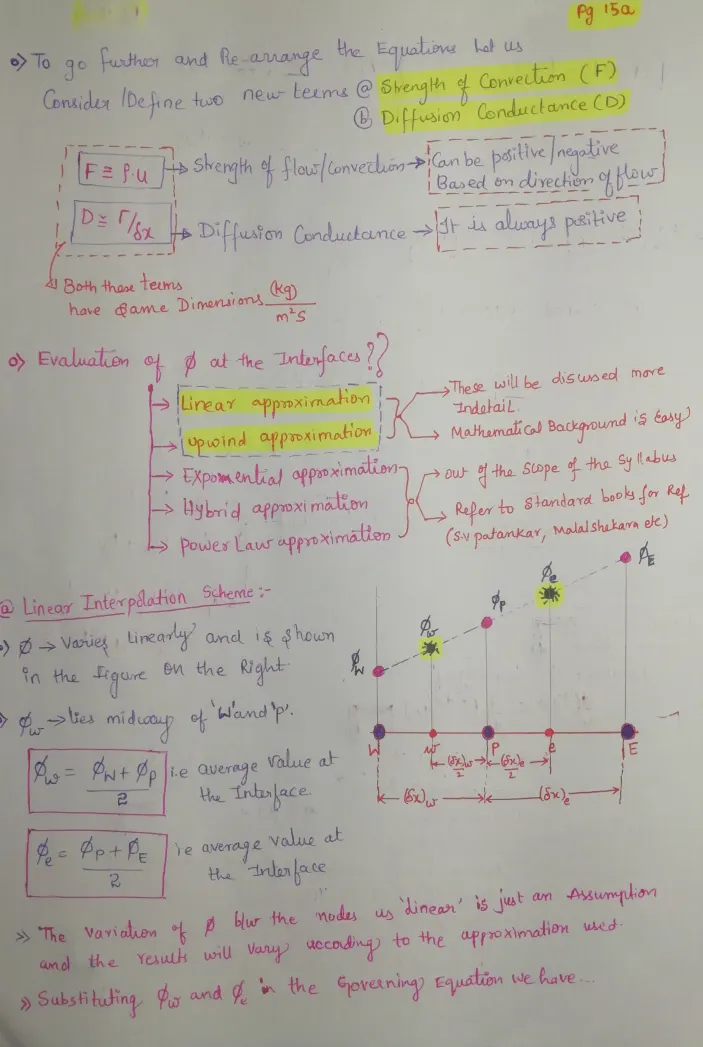
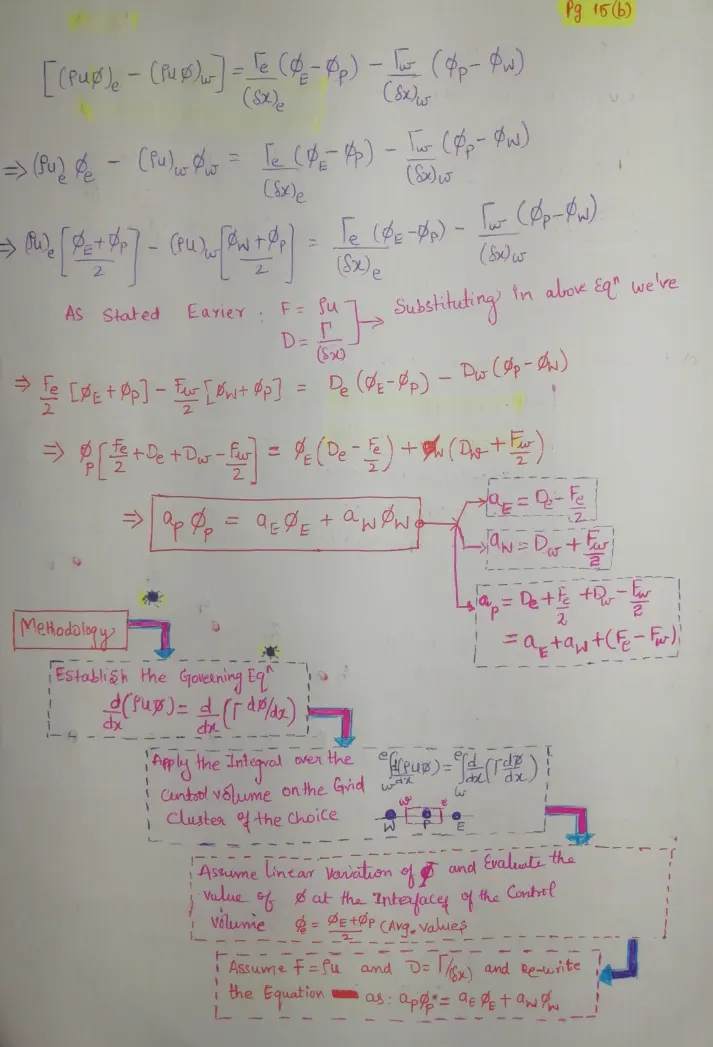
The above scheme is using the differenceing scheme
The famous upwind scheme is also indicated below:
Flux Limiters
Due to the discontinuity in the variables at the interface in the finite volume method, during the evaluation of the gradient it was observed that the values show an chaotic behaviour. Having an flux limitter will dound the output flux and the solution will be stabilized.
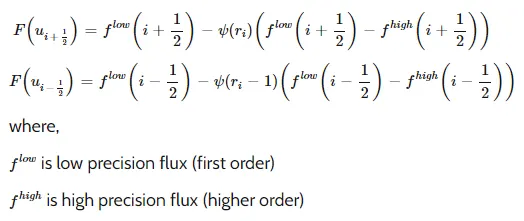
Suppose a flux at face e is calculated using high resolution scheme
Lower_e, represents flux evaluated by the lower order schemes
Higher_e represents flux evaluated by higher order scheme.
Then represents the flux limiter function such that: F_limt_e=Lower_e+ψ(r)*(Higher_e -Lower_e)
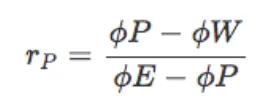 rp is the smoothness parameter
It assumes a value of 0 near discontinuities anda value of 1 away from them. Hence it switches between higher order scheme and lower order scheme for numerical representation of flux, thereby keeping the scheme stable and accurate throughout.
Near the discontinuity, the higer order schemes are unstable but the first order schemes are stable but dissipative in nature. Hence to capture the pheonomenon accurately e.g. shock wave, the flux limitter will fine tune in such a way that, in the flow where the discontinuity is not present higher order shceme is used and near the discontinuity the first order scheme is used.