Week 9 - FVM Literature Review
Aim:
- Define finite volume method
- Difference between finite volume and difference method.
- describe the need for interpolation and flix limiters in FVM.
Finite volume method:
The finite volume method(FVM) is a method for representing and evaluating partial differential equations in the form of algebraic equations. In the finite volume method, volume integrals in a partial differential equation that contains a divergence term are converted to surface integrals using the divergence theorem. These terms are then evaluated as fluxes at the surface of each finite volume. Because the flux entering a given volume is identical to that leaving the adjacent volume, these methods are conservative. Another advantage of the finite volume method is that it can be easily formulated for unstructured grids.
Difference between FDM and FVM:
|
FINITE DIFFERENCE METHOD |
FINITE VOLUME METHOD |
|
Discretization is based on the differential form of governing equation |
Discretization is based on the integral form of the governing equations |
|
The dependent variables are stored at the regular grid points and derivatives are expressed in terms of differences between values on neighboring grid point using expressions derived from truncating Taylor's series |
The domain of interest is divided into a large number of mesh, and the equation of interest is integrated over each cell, The assumption is that the dependent variables are constant over each cell. |
|
This method can only be applied to simple geometries |
The cell can be any shape which allows much more complex geometries to be considered |
|
The discretization results in a system of the equation of the variables at the nodal points and once a solution is found then we have a discrete representation of the solution |
The discretization results in a system of equations of the variable at cell center and if the nodal values are required it can be obtained by interpolation schemes. |
Interpolation schemes:
The approximation of surface and volume integral may require values of the variable at locations other than the computational nodes of the control volume. Values at these locations are obtained using interpolation schemes.
Consider the example of the 1D heat conduction equation.
`(partial)/(partial x)(alpha (partial T)/(partial x))+s=0`
where `alpha` is the thermal diffusivity which depends on the temperature at a point. so it is a function of T.
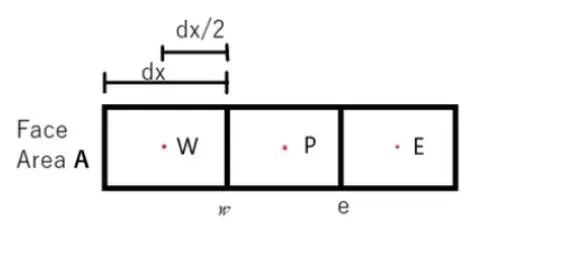
we consider P,W,E as the cell centres of the respective cells. To calculate the temperature at a point P, we take information from the neighboring cells W and E and it is called a gradient scheme.
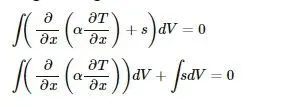
since small volume is equal to area multiplied by dx.

after applying integral limits we have ,
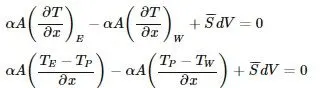
by applying forward and backward differencing for east and west sides we got the above equation.
we know that alpha is the function of T so that equation becomes

so we need the values of `alpha_e`and `alpha_w`for which we need `t_e`and `t_w`to get the values we use interpolation schemes.
The types of interpolation schemes,
- Upwind interpolation scheme
- Central differncing scheme
- Quadratic upwind interpolation scheme
Flux limiters:
Flux lmiters are used in high resolution schemes-numerical used to solve problems in science and engineering, partial fluid dynamics,described by partial differential equations , They are used in high resolution schemes, such as the MUSCL schemes, to avoid the spurious oscillations that would otherwise occur with high order spatial discretzation schemes due to shocks, discontinuities or sharo changes in the solution domain. Use of flux limiters, together with an approximate high resolution scheme, make the solutions total variation diminishing.
some of the flux limiters
- CHARM
- HCUS
- HQUICK
- koren
- minmod