Week 9 - FVM Literature Review
Objective: To explain briefly the Finite Volume Method (FVM) and to describe how it differs from the Finite Difference Method (FDM). The need for the interpolation schemes and flux limiters is to be discussed by taking the one-dimensional heat conduction equation as an example.
Discussion
Finite Volume Method:
Discretization is the process of transforming the governing equations into a system of linear algebraic equations. In CFD, we use few techniques to convert our partial differential equations into their discretized form, namely, Finite Difference Method, Finite Volume Method, and Finite Element Method. The finite volume Method, among the above-said methods, is the one that obeys the conservation law in itself evidently.
Steps involved in FVM discretization:
- Governing equations are written in their integral form
- Gauss-divergence theorem is performed.
- Flux terms are calculated using appropriate methods.
Let's consider a one-dimensional steady-state heat conduction equation.
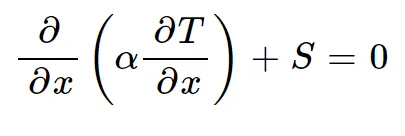
where;
α is the thermal conductivity
T is the temperature along x-direction (dependent variable)
S is the source term (responsible for heat generation)
Now, let's consider a control volume of our interest as given below and the flow quantity is assumed to be taken into account at the cell center.
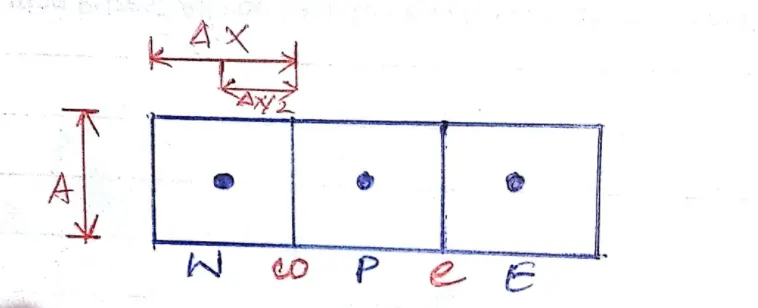
Let's consider a control volume, P, and for which 'w' and 'e' are the junction at its west and east sides respectively. The 1D steady-state heat conduction equation is valid every infinitesimal volumes inside the control volume. Hence for the whole control volume, dv:
`int(del/(delx)(alpha(delT)/(delx))+S)dv=0`
`intdel/(delx)(alpha(delT)/(delx))dv+intSdv=0`
Since, dv = A(area of the face)*dx(grid space)
`intdel/(delx)(alpha(delT)/(delx))(A*dx)+intSdv=0`
Since,
`intdel/dxfdx=f`
`[alphaA(delT)/(delx)]_w^e+overlineSdv=0`
`alpha_eA((delT)/(delx_e))-alpha_wA((delT)/(delx_w))+overlineSdv=0`
`alphaA[(T_E-T_P)/(Deltax)]-alphaA[(T_P-T_W)/(Deltax)]+overlineSdv=0`
Here, the source term is :
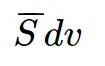
Other terms are flux terms. If the source term added in the cell is a function of temperature, it has to be linearized. Therefore;
`overlineSdv=S_u+S_PT_P`
The heat conduction coefficient term also has to be linearized since it also is a function of temperature.
Difference between FVM and FDM:
- In the case of FDM, the equations are solved at discrete nodal points in the grid but in FVM, the discretized equations are solved for finite control volumes in the mesh grid.
- FDM cannot be applied directly for arbitrarily aligned unstructured mesh geometries.
- In FVM, the concept of conservation of fluid flow is preserved.
- Coding in FVM is complicated and hence needs advanced programming.
Interpolation scheme:
The different interpolation schemes are:
- Linear Interpolation Scheme
- Upwind Interpolation Scheme
- Quadratic Upwind |Interpolation Scheme
- Hybrid Differencing Scheme
- Total Variation Diminishing Scheme
Need for interpolation schemes: In the discretized heat equation above, in order to determine the value of alpha in the heat flux term at the east face, the value of temperature at the east face needs to be computed and this is done with the help of interpolation scheme.
Need Flux Limiter: The higher-order schemes are found to be unstable and exhibit oscillations at discontinuities. Flux limiters are used to overcome this issue for maintaining the first-order accuracy and thus avoid oscillations by fine-tuning spacial derivatives to a reliable value.