Week 9 - FVM Literature Review
Finite Volume Method
The Finite Volume Method (FVM) is a discretization method for the approximation of a single or a system of partial differential equations expressing the conservation, or balance, of one or more quantities. As in the finite element method, a mesh is constructed, which consists in a partition of the domain where the space variable lives. The elements of the mesh are called control volumes. The integration of the PDE over each control volume results in a balance equation. The set of balance equations is then discretized with respect to a set of discrete unknowns. The main issue is the discretization of the fluxes at the boundaries of each control volume in order for the FVM to be efficient, the numerical fluxes are generally conservative and consistent.
Conservative - The flux entering a control volume from its neighbour must be the opposite of the one entering the neighbour from the control volume
Consistent - The numerical flux of a regular function interpolation tends to the continuous flux as the mesh size vanishes
| FDM | FEM | FVM |
| Easy formulation | Rigorous mathematical formulation | Formulation is based on FDM or FEM |
| Requires structures and curved mesh must be transfered to orthogonal co ordinates | Do not exploit explicitly the conservation principle |
Complex geometry are easily accommodated without need of coordinate transformation |
Neumann BC’s are difficult to implement |
Neumann BC’s are easy to enforce |
BC’s implementation is not difficult |
|
Do not exploit explicitly the conservation |
Does not enforce the conservation principle in its original form |
Conservation is guaranteed as it is enforced on each cell through surface integral and normal fluxes |
Need for Interpolation Schemes
The face values appearring in the convective and diffusive fluxes have to be computed by some form of interpolation from the centroid values of the control volumes . To calculate the variables at locations other than the compuataional nodes it is nessecary to solve the problem using interpolation schemes. Some of the interpolation Schemes are :
1. Central Differecing
The face values appearing in the convective flux can be computed as follows,
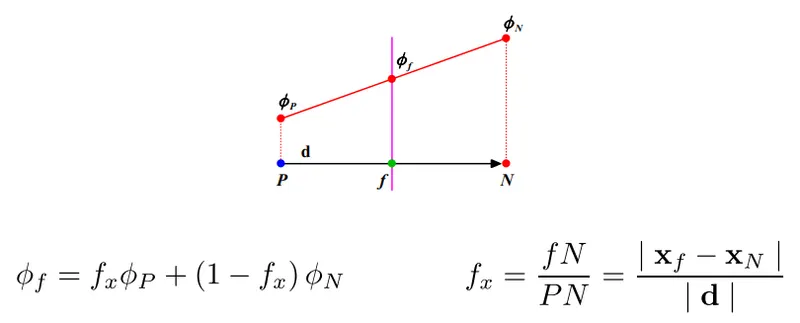
- This type of interpolation scheme is known as linear interpolation or central differencing and it is second order accurate.
- However, it may generate oscillatory solutions (unbounded solutions)
2. Upwind Differencing
The face values appearing in the convective flux can be computed as follows,
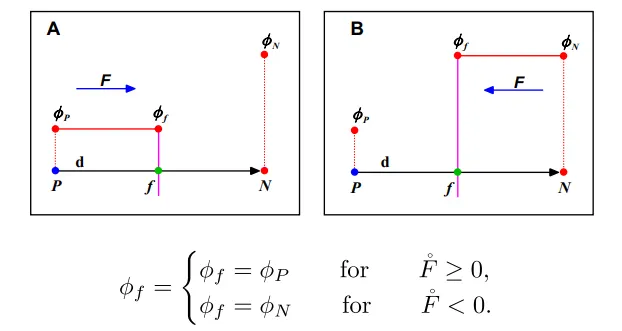
- This type of interpolation scheme is known as upwind differencing and it is first order accurate
- This scheme is bounded (non-oscillatory) and diffusive.
3. Second order upwind differencing (SOU)
The face values appearing in the convective flux can be computed as follows,
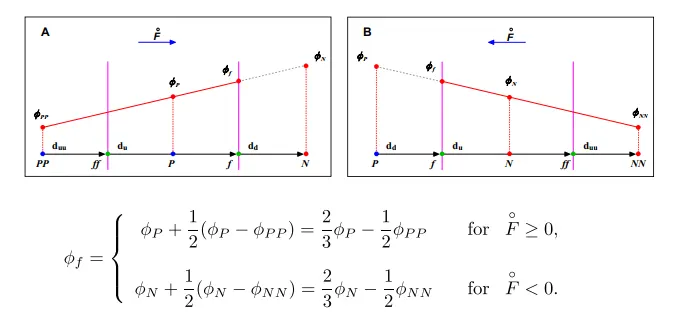
- This type of interpolation scheme is known as second order upwind differencing (SOU), linear upwind differencing (LUD) or Beam-Warming (BW), and it is second order accurate.
- For highly convective flows or in the presence of strong gradients, this scheme is oscillatory (unbounded)
Need for Flux Limiters
- To prevent oscillations in the SOU, we add a gradient or slope limiter function `psi(r)`.
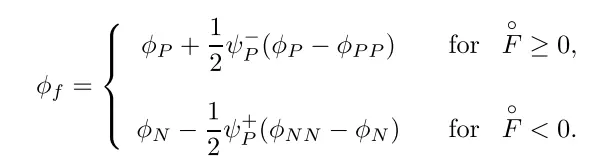
- When the limiter detects strong gradients or changes in slope, it switches locally to low resolution (upwind)
- The concept of the limiter function is based on monitoring the ratio of successive gradients
- By adding a well designed limiter function , we get a high resolution (second order accurate), and bounded scheme. This is a TVD scheme
TVD Scheme
- A TVD scheme, is a second order accurate scheme that does not create new local undershoots or overshoots in the solution or amplify existing extremes (high resolution).
- The choice of the limiter function dictates the order of the scheme and its boundedness.
- The drawback of the limiters is that they reduce the accuracy of the scheme locally to first order.
- The various limiters have different switching characteristics and are selected according to the particular problem and solution scheme. No particular limiter has been found to work well for all problems, and a particular choice is usually made on a trial and error basis