Week 11 - Simulation of Flow through a pipe in OpenFoam
Objective : To Simulate the incomressible laminar flow through a pipe using OpenFoam
- Validate Hydro-dynamic length with the numerical result
- Validate the fully developed flow velocity profile with its analytical profile
- Validate maximum velocity and pressured drop for fully developed flow
- Post-process Shear stress and validate wall shear stress for fully developed flow
- To validate the results with the Hagen- Poiseuille's equations for the fully developed flow.
Theory:
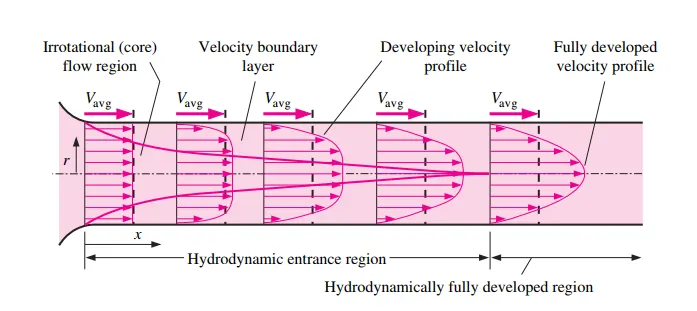
Consider a fluid entering a circular pipe at a uniform velocity. Because of the no-slip condition, the fluid particles in the layer in contact with the surface of the pipe come to a complete stop. This layer also causes the fluid particles in the adjacent layers to slow down gradually as a result of friction. To make up for this velocity reduction, the velocity of the fluid at the midsection of the pipe has to increase to keep the mass flow rate through the pipe constant. As a result, a velocity gradient develops along the pipe.
The region of the flow in which the effects of the viscous shearing forces caused by fluid viscosity are felt is called the velocity boundary layer.
The thickness of this boundary layer increases in the flow direction until the boundary layer reaches the pipe center and thus fills the entire pipe. The region from the pipe inlet to the point at which the boundary layer merges at the centerline is called the hydrodynamic entrance region, and the length of this region is called the hydrodynamic entry length.
The region beyond the entrance region in which the velocity profile is fully developed and remains unchanged is called the hydrodynamically fully developed region.
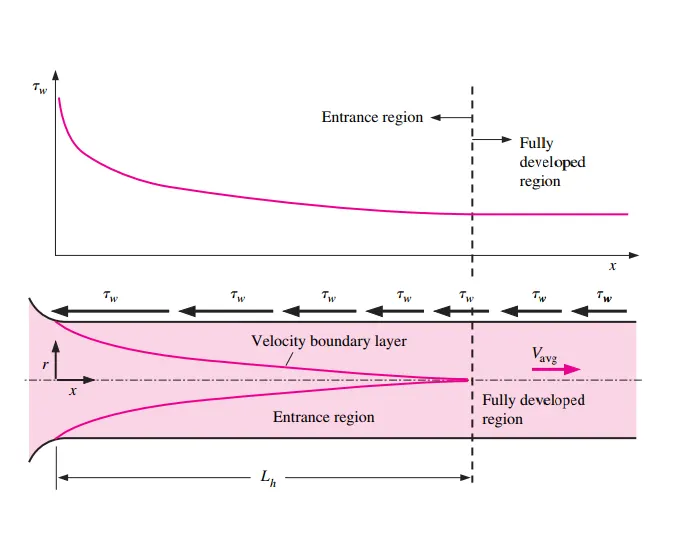
The shear stress at the pipe wall tw is related to the slope of the velocityprofile at the surface. Noting that the velocity profile remains unchanged in the hydrodynamically fully developed region, the wall shear stress also remains constant in that region Consider fluid flow in the hydrodynamic entrance region of a pipe. The wall shear stress is the highest at the pipe inlet where the thickness of the boundary layer is smallest, and decreases gradually to the fully developed value. Therefore, the pressure drop is higher in the entrance regions of a pipe, and the effect of the entrance region is always to increase the average friction factor for the entire pipe. This increase may be significant for short pipes but is negligible for long ones.
Assumptions and Equations from Hagen-Poiseuilles
- Average Velocity (V_avg) = `(Re*mu)/(rho*D) = 0.1054 m/s`
- Maximum Velocity = `2*Vavg = 0.2108 m/s `
- Hydrodynamic Enterance Length `(Le) = 0.05*Re*D = 2.1 m `
- Pressure Drop `DeltaP` = `(8*mu*Vavg*L)/r^2` = 20.8
- Kinetic Pressure Drop `P = DeltaP/rho`= 0.02
- Total Length of the pipe (L) = Le + 0.3 = 2.4 m
- Dynamic viscocity of water `(mu) = 1.002e-3 Pa.sec`
- Kinematic Viscosity of water `(nu) = 1.004e-6 m^2/s`
- Density `(rho) = 998 (kg)/m^3`
- Diameter of pipe `D = 0.02m`
- Wedge angle `(theta) = 4degrees`
- Temperature of working fluid `(T) = 20degree`
Matlab Script
clear all
close all
clc

%Inputs
Re = input('Renolds Number = ');
D = input('Diameter of the pipe =');
L = 0.05*Re*D;%entry length of the pipe
L_p  = L+0.3;%total length of the pipe
r = D/2; %radius of the pipe
theta = input('Angle of the wedge =');
mu = input('Dynamic viscosity =');
rho = input('Density =');

%Hagen Poiseuille flow equations

v_avg = (Re*mu)/(rho*D);
v_max = 2*(v_avg);
del_p = (8*mu*L_p*v_avg)/(r^2);
P = del_p/rho;
kv = mu/rho;


f1 = fopen('blockMeshDict','w');


header1='/*--------------------------------*- C++ -*----------------------------------*\';
header2=' =========                 |                                                   ';
header3=' \\      /  F ield         | OpenFOAM: The Open Source CFD Toolbox             ';
header4='  \\    /   O peration     | Website:  https://openfoam.org                    ';
header5='   \\  /    A nd           | Version:  8                                       ';
header6='    \\/     M anipulation  |                                                   ';
header7='\*---------------------------------------------------------------------------*/';

fprintf(f1, '%s\n', header1);
fprintf(f1, '%s\n', header2);
fprintf(f1, '%s\n', header3);
fprintf(f1, '%s\n', header4);
fprintf(f1, '%s\n', header5);
fprintf(f1, '%s\n', header6);
fprintf(f1, '%s\n', header7);

fprintf(f1, 'FoamFile\n{\n');
fprintf(f1, '%12s \t 2.0;\n','version');
fprintf(f1, '%12s \t ascii;\n','format');
fprintf(f1, '%12s \t dictionary;\n','class');
fprintf(f1, '%12s \t blockMeshDict;\n','object');
fprintf(f1, '}\n');
header8='// * * * * * * * * * * * * * * * * * * * * * * * * * * * * * * * * * * * * * //';
fprintf(f1, '%s\n\n',header8);

fprintf(f1, 'convertToMeters 1;\n\n');

fprintf(f1, 'vertices\n');
fprintf(f1, '(\n');
fprintf(f1, '\t (%d %d %d)\n',0,0,0);
fprintf(f1, '\t (%d %d %d)\n',0,r*cosd(theta/2),r*sind(theta/2));
fprintf(f1, '\t (%d %d %d)\n',0,r*cosd(theta/2),-r*sind(theta/2));
fprintf(f1, '\t (%d %d %d)\n',L_p,0,0);
fprintf(f1, '\t (%d %d %d)\n',L_p,r*cosd(theta/2),r*sind(theta/2));
fprintf(f1, '\t (%d %d %d)\n',L_p,r*cosd(theta/2),-r*sind(theta/2));
fprintf(f1, ');\n\n');


fprintf(f1, 'blocks\n');
fprintf(f1, '(\n');
fprintf(f1, '\t hex (0 1 4 3 0 2 5 3) (%d %d %d)', 300,30,1);
fprintf(f1, 'SimpleGrading (1 0.1 1)\n\n');
fprintf(f1, ');\n\n');

fprintf(f1, 'edges\n');
fprintf(f1, '(\n');
fprintf(f1, '\t arc %d %d (%d %d %d)\n', 1,2,0,r,0);
fprintf(f1, '\t arc %d %d (%d %d %d)\n',4,5,L_p,r,0);
fprintf(f1, ');\n\n');

fprintf(f1, 'boundary\n');
fprintf(f1, '(\n');
fprintf(f1, '\t inlet \n');
fprintf(f1, '\t {\n');
fprintf(f1, '\t\t type patch;\n');
fprintf(f1, '\t\t faces\n');
fprintf(f1, '\t\t (\n');
fprintf(f1, '\t\t\t (0 1 2 0)\n');
fprintf(f1, '\t\t );\n');
fprintf(f1, '\t }\n');


fprintf(f1, '\t outlet \n');
fprintf(f1, '\t {\n');
fprintf(f1, '\t\t type patch;\n');
fprintf(f1, '\t\t faces\n');
fprintf(f1, '\t\t (\n');
fprintf(f1, '\t\t\t (3 5 4 3)\n');
fprintf(f1, '\t\t );\n');
fprintf(f1, '\t }\n');

fprintf(f1, '\t top \n');
fprintf(f1, '\t {\n');
fprintf(f1, '\t\t type wall;\n');
fprintf(f1, '\t\t faces\n');
fprintf(f1, '\t\t (\n');
fprintf(f1, '\t\t\t (1 4 5 2)\n');
fprintf(f1, '\t\t );\n');
fprintf(f1, '\t }\n');

fprintf(f1, '\t front \n');
fprintf(f1, '\t {\n');
fprintf(f1, '\t\t type wedge;\n');
fprintf(f1, '\t\t faces\n');
fprintf(f1, '\t\t (\n');
fprintf(f1, '\t\t\t (0 3 4 1)\n');
fprintf(f1, '\t\t );\n');
fprintf(f1, '\t }\n');

fprintf(f1, '\t back \n');
fprintf(f1, '\t {\n');
fprintf(f1, '\t\t type wedge;\n');
fprintf(f1, '\t\t faces\n');
fprintf(f1, '\t\t (\n');
fprintf(f1, '\t\t\t (0 2 5 3)\n');
fprintf(f1, '\t\t );\n');
fprintf(f1, '\t }\n');

fprintf(f1, '\t axis \n');
fprintf(f1, '\t {\n');
fprintf(f1, '\t\t type empty;\n');
fprintf(f1, '\t\t faces\n');
fprintf(f1, '\t\t (\n');
fprintf(f1, '\t\t\t (0 3 3 0)\n');
fprintf(f1, '\t\t );\n');
fprintf(f1, '\t }\n');
fprintf(f1, '); \n\n');

fprintf(f1, 'mergePatchPairs\n');
fprintf(f1, '(\n');
fprintf(f1, ');\n');

header9='// * * * * * * * * * * * * * * * * * * * * * * * * * * * * * * * * * * * * * //';
fprintf(f1, '%s\n',header9);

fclose(f1);
BlockMeshDict
/*--------------------------------*- C++ -*----------------------------------*\
 =========                 |
 \\      /  F ield         | OpenFOAM: The Open Source CFD Toolbox
  \\    /   O peration     | Website:  https://openfoam.org
   \\  /    A nd           | Version:  8
    \\/     M anipulation  |
\*---------------------------------------------------------------------------*/
FoamFile
{
     version 	 2.0;
      format 	 ascii;
       class 	 dictionary;
      object 	 blockMeshDict;
}
// * * * * * * * * * * * * * * * * * * * * * * * * * * * * * * * * * * * * * //

convertToMeters 1;

vertices
(
	 (0 0 0)
	 (0 9.993908e-03 3.489950e-04)
	 (0 9.993908e-03 -3.489950e-04)
	 (2.400000e+00 0 0)
	 (2.400000e+00 9.993908e-03 3.489950e-04)
	 (2.400000e+00 9.993908e-03 -3.489950e-04)
);

blocks
(
	 hex (0 1 4 3 0 2 5 3) (30 300 1)SimpleGrading (1 1 1)

);

edges
(
	 arc 1 2 (0 1.000000e-02 0)
	 arc 4 5 (2.400000e+00 1.000000e-02 0)
);

boundary
(
	 inlet
	 {
		 type patch;
		 faces
		 (
			 (0 1 2 0)
		 );
	 }
	 outlet
	 {
		 type patch;
		 faces
		 (
			 (3 5 4 3)
		 );
	 }
	 top
	 {
		 type wall;
		 faces
		 (
			 (1 4 5 2)
		 );
	 }
	 front
	 {
		 type wedge;
		 faces
		 (
			 (0 3 4 1)
		 );
	 }
	 back
	 {
		 type wedge;
		 faces
		 (
			 (0 2 5 3)
		 );
	 }
	 axis
	 {
		 type empty;
		 faces
		 (
			 (0 3 3 0)
		 );
	 }
);

mergePatchPairs
(
);
// * * * * * * * * * * * * * * * * * * * * * * * * * * * * * * * * * * * * * //
ControlDict
/*--------------------------------*- C++ -*----------------------------------*\
  =========                 |
  \\      /  F ield         | OpenFOAM: The Open Source CFD Toolbox
   \\    /   O peration     | Website:  https://openfoam.org
    \\  /    A nd           | Version:  8
     \\/     M anipulation  |
\*---------------------------------------------------------------------------*/
FoamFile
{
    version     2.0;
    format      ascii;
    class       dictionary;
    location    "system";
    object      controlDict;
}
// * * * * * * * * * * * * * * * * * * * * * * * * * * * * * * * * * * * * * //

application     icoFoam;

startFrom       startTime;

startTime       0;

stopAt          endTime;

endTime         30;

deltaT          0.01;

writeControl    timeStep;

writeInterval   40;

purgeWrite      0;

writeFormat     ascii;

writePrecision  6;

writeCompression off;

timeFormat      general;

timePrecision   6;

runTimeModifiable true;


// ************************************************************************* //
Initial and Boundary condition Pressure
/*--------------------------------*- C++ -*----------------------------------*\
  =========                 |
  \\      /  F ield         | OpenFOAM: The Open Source CFD Toolbox
   \\    /   O peration     | Website:  https://openfoam.org
    \\  /    A nd           | Version:  8
     \\/     M anipulation  |
\*---------------------------------------------------------------------------*/
FoamFile
{
    version     2.0;
    format      ascii;
    class       volScalarField;
    object      p;
}
// * * * * * * * * * * * * * * * * * * * * * * * * * * * * * * * * * * * * * //

dimensions      [0 2 -2 0 0 0 0];

internalField   uniform 0;

boundaryField
{
    inlet
    {
        type            zeroGradient;
    }

    outlet
    {
        type            fixedValue;
        value           uniform 0.02;
    }


    axis
    {
        type            empty;
    }

    top
     {
        type            zeroGradient;
    }

    front
     {
        type            wedge;
    }

    back
     {
        type            wedge;
    }
}

// ************************************************************************* //
Initial and Boundary condition Velocity
/*--------------------------------*- C++ -*----------------------------------*\
  =========                 |
  \\      /  F ield         | OpenFOAM: The Open Source CFD Toolbox
   \\    /   O peration     | Website:  https://openfoam.org
    \\  /    A nd           | Version:  8
     \\/     M anipulation  |
\*---------------------------------------------------------------------------*/
FoamFile
{
    version     2.0;
    format      ascii;
    class       volVectorField;
    object      U;
}
// * * * * * * * * * * * * * * * * * * * * * * * * * * * * * * * * * * * * * //

dimensions      [0 1 -1 0 0 0 0];

internalField   uniform (0 0 0);

boundaryField
{
    inlet
    {
        type            fixedValue;
        value           uniform (0.1054 0 0) ;
    }

    outlet
    {
        type            zeroGradient;
    }


    axis
    {
        type            empty;
    }

    top
     {
        type            noSlip;
    }

    front
     {
        type            wedge;
    }

    back
     {
        type            wedge;
    }
}

// ************************************************************************* //
Transport Properties
/*--------------------------------*- C++ -*----------------------------------*\
  =========                 |
  \\      /  F ield         | OpenFOAM: The Open Source CFD Toolbox
   \\    /   O peration     | Website:  https://openfoam.org
    \\  /    A nd           | Version:  8
     \\/     M anipulation  |
\*---------------------------------------------------------------------------*/
FoamFile
{
    version     2.0;
    format      ascii;
    class       dictionary;
    location    "constant";
    object      transportProperties;
}
// * * * * * * * * * * * * * * * * * * * * * * * * * * * * * * * * * * * * * //

nu              [0 2 -1 0 0 0 0] 1.004e-6;


// ************************************************************************* //
Output:
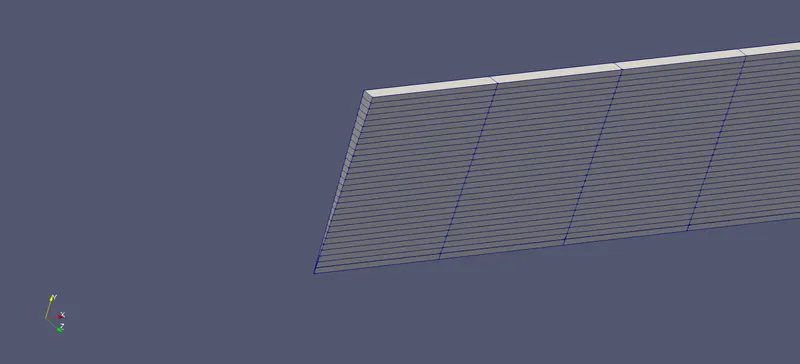
Mesh
Velocity Profile
Pressure Profile
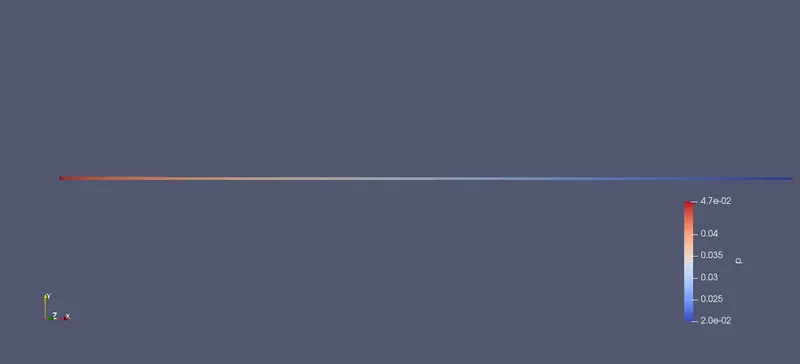
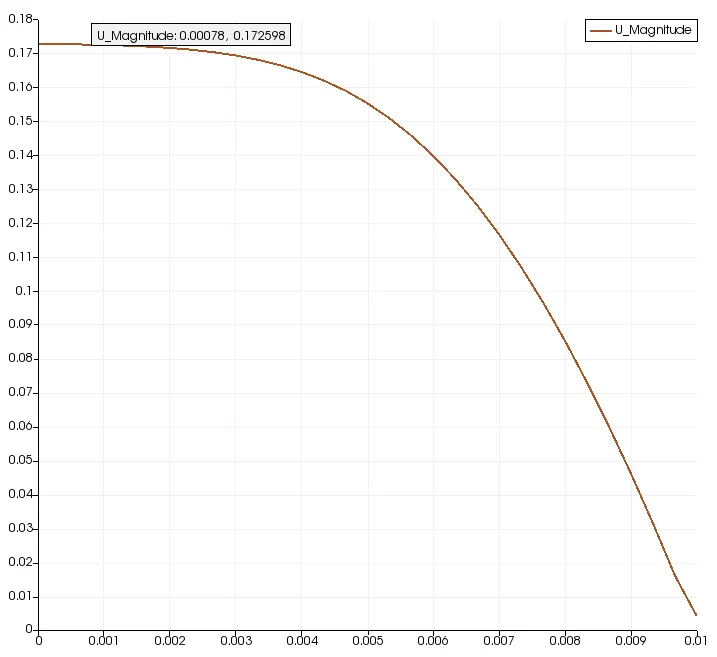
Velocity Profile at different locations
X = 0.5
X = 1.5
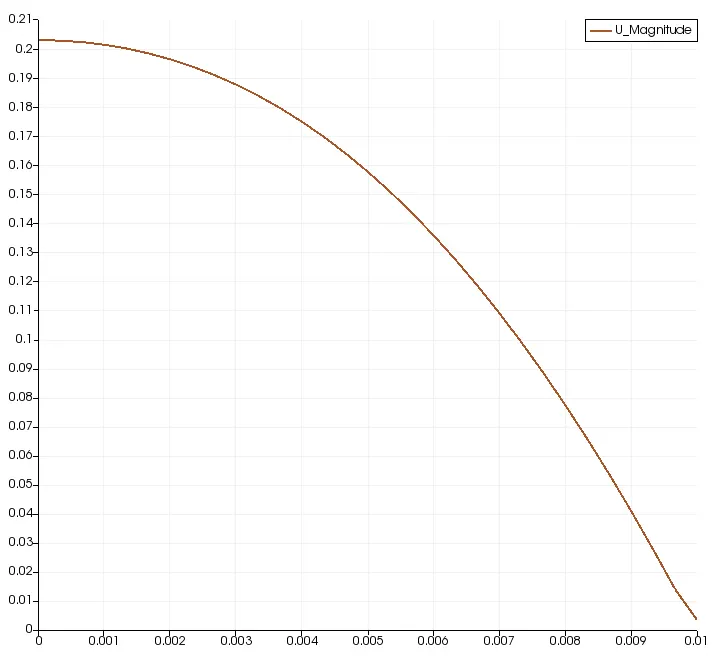
X = 2.3
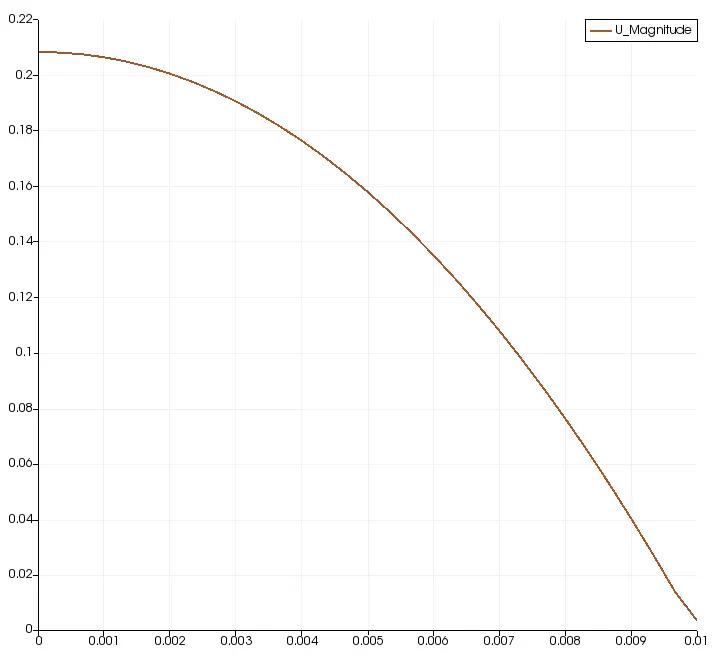
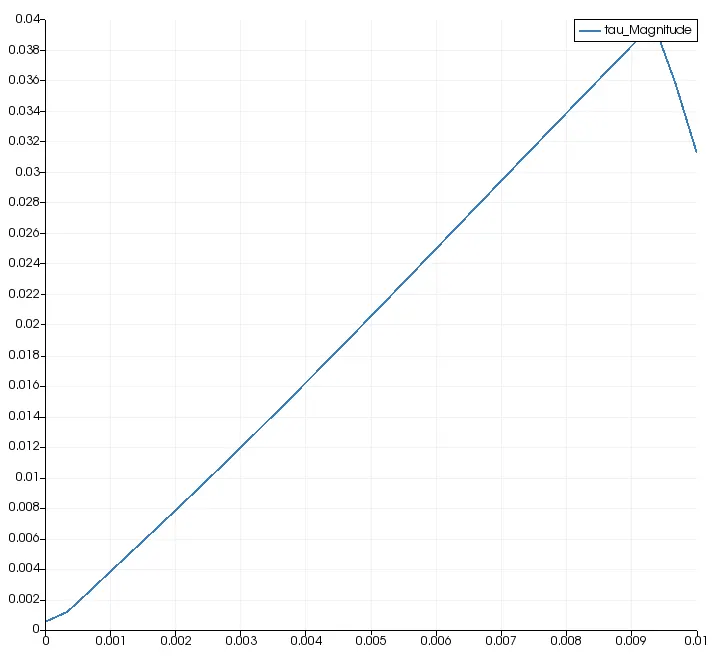
Wall Shear Stress at x = 2
Results and Disccussions:
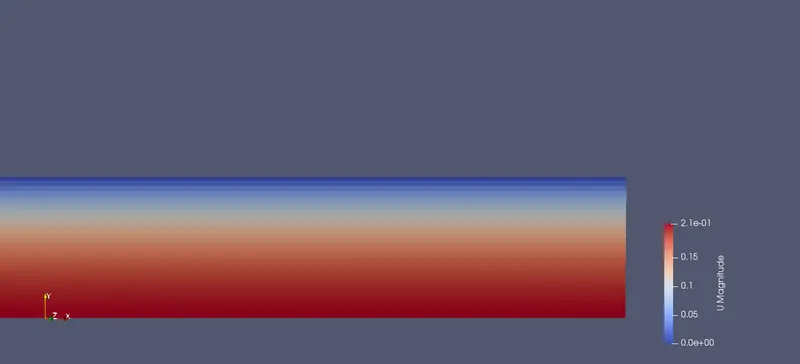
- We can observe from the velocity profiles at different locations along x -axis within the Hydrodynamic entrance length the velocity profile is not fully developed and at x = 2.3 (Hydrodynamicaly fully developed region) the velocity attains it maximum as calculated by Hagen- Poiseuille's equations.
- The wall shear stress is maximum at the walls and nearly 0 at the center of the pipe . Also the wall shear stress is the highest at the pipe inlet where the thickness of the boundary layer is smallest and decreases gradually to the fully developed value is observed .
| Parameter | Simulated Value | Analytical Value |
| Maximum Velocity | 0.21 | 0.2108 |