Week 9 Challenge
Q1. In a river of linear waterway 90 m and design discharge as 700 cumec and having silt factor as 1 . Fix the span and type of foundation if HFL is 3 m from the ground.
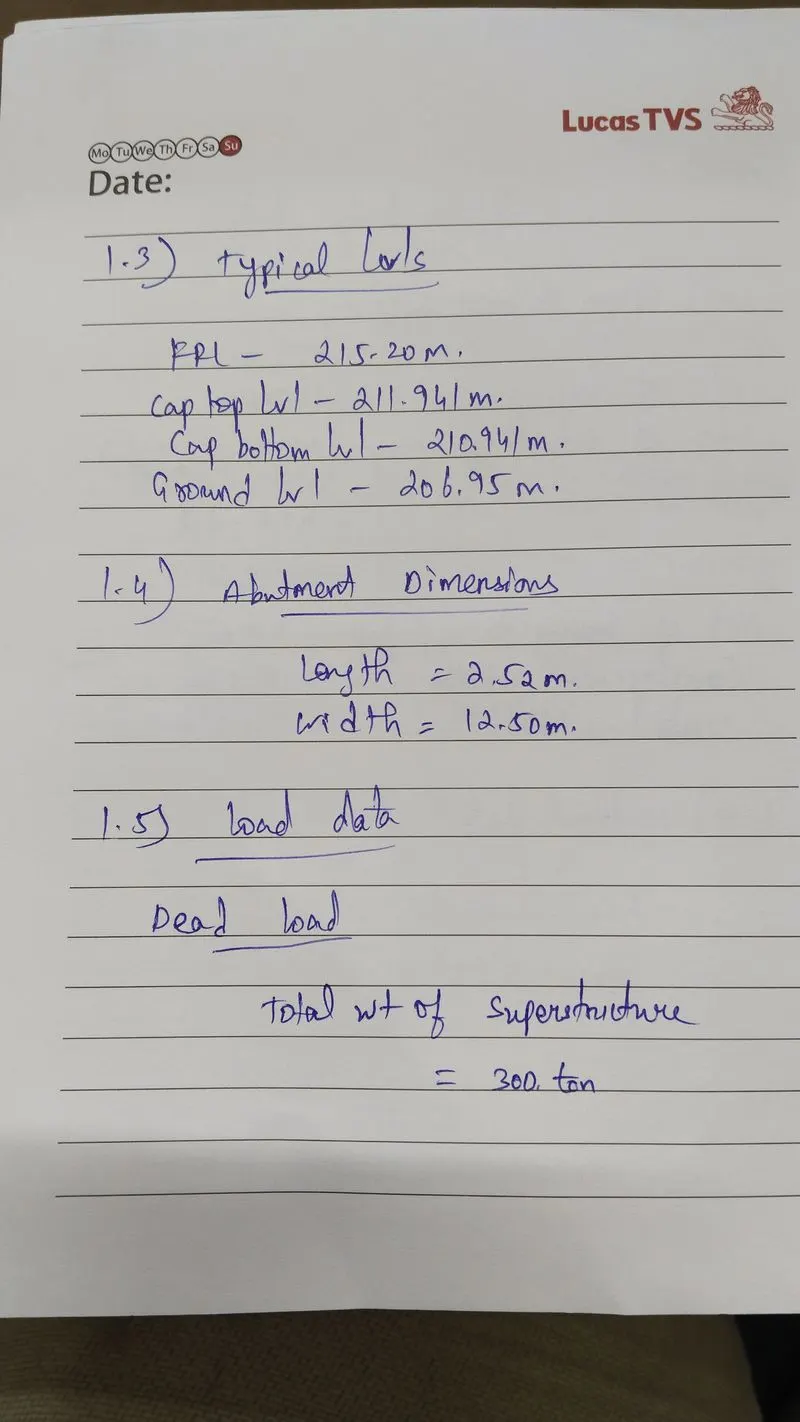
Velocity of water 1.2m/sec
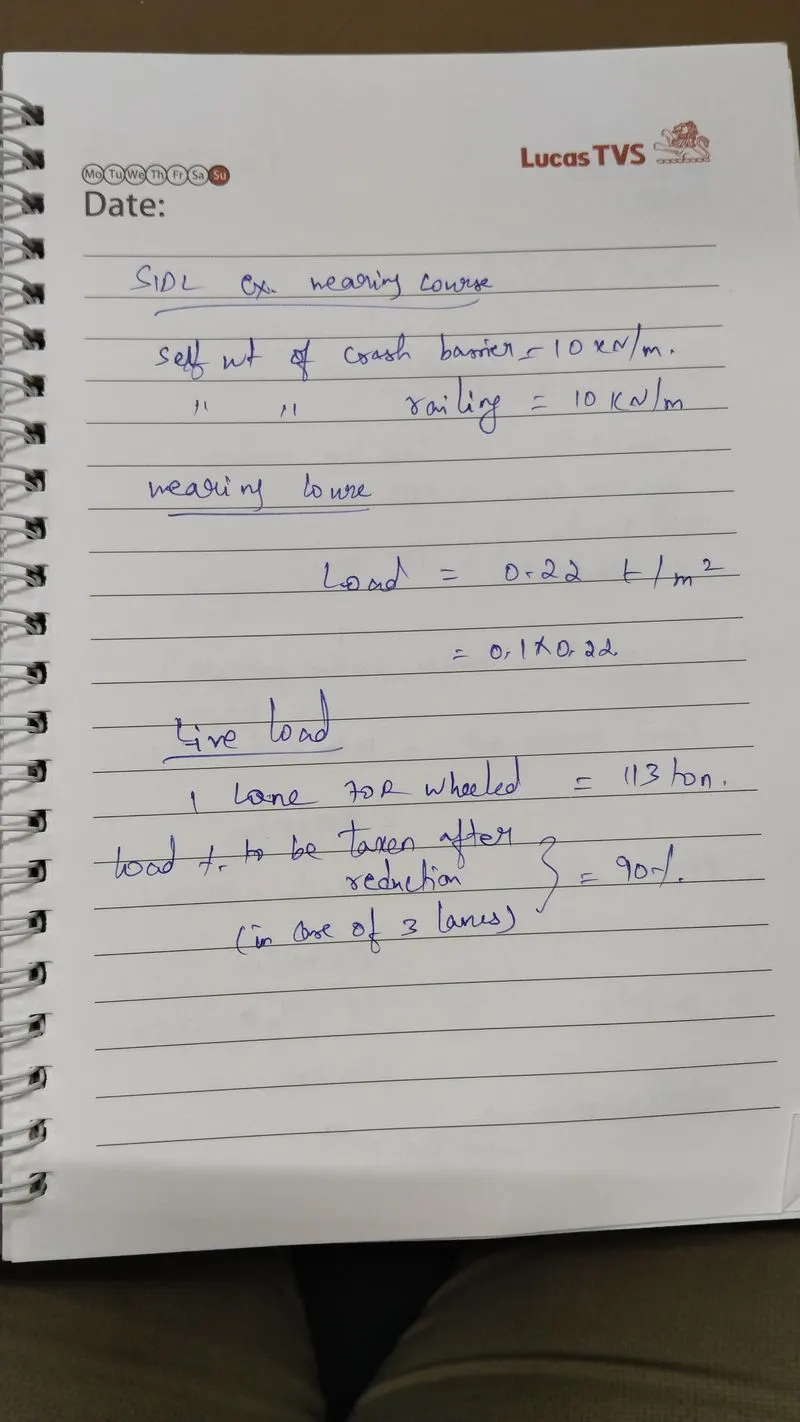
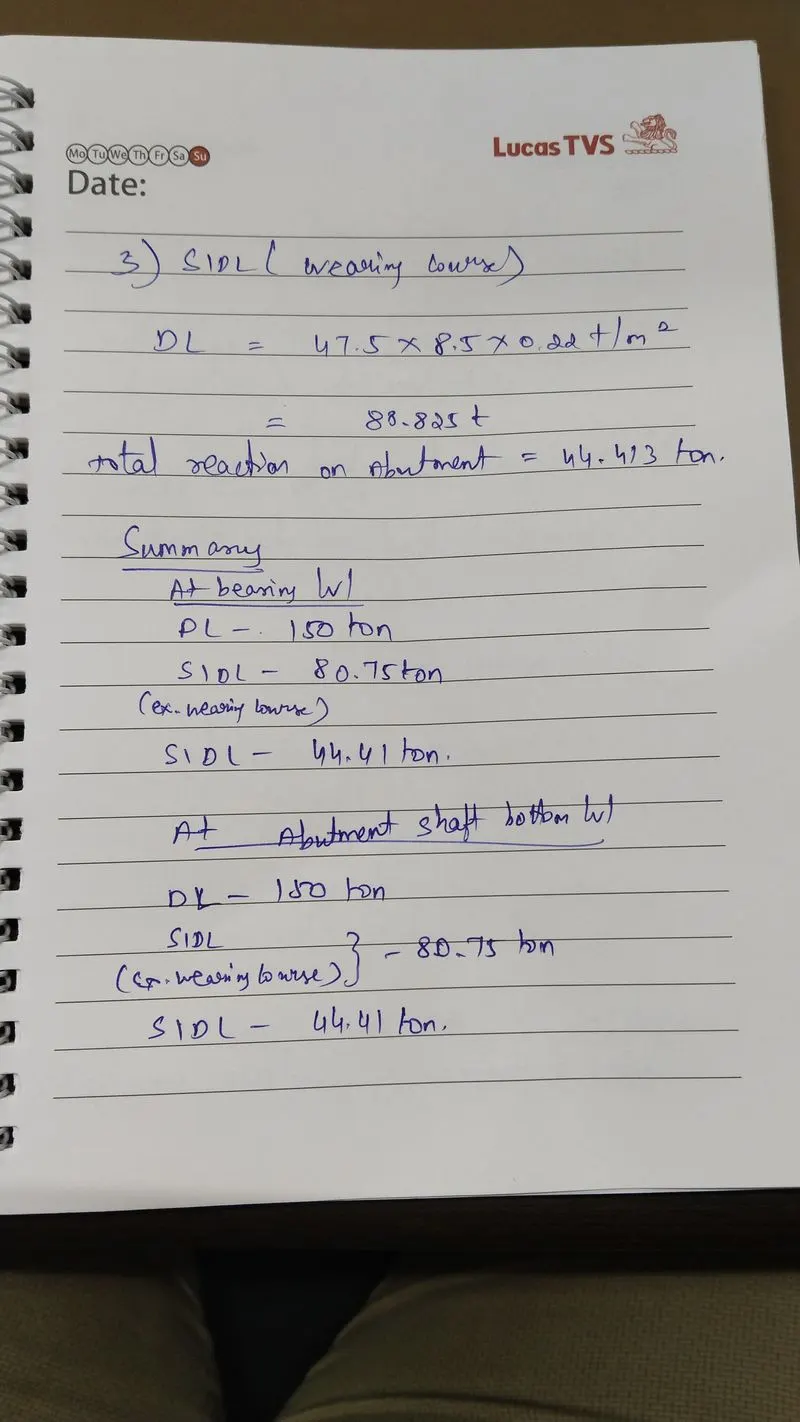
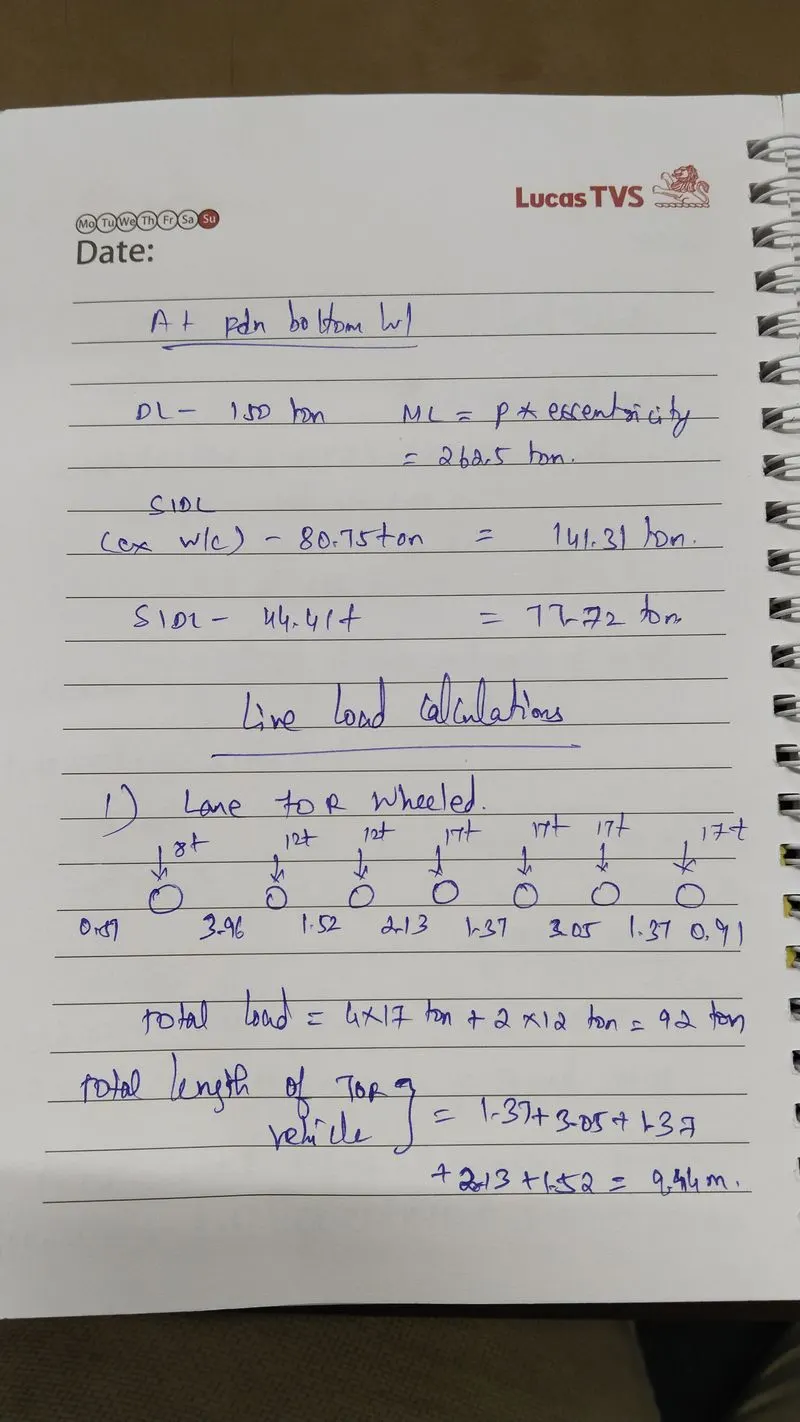
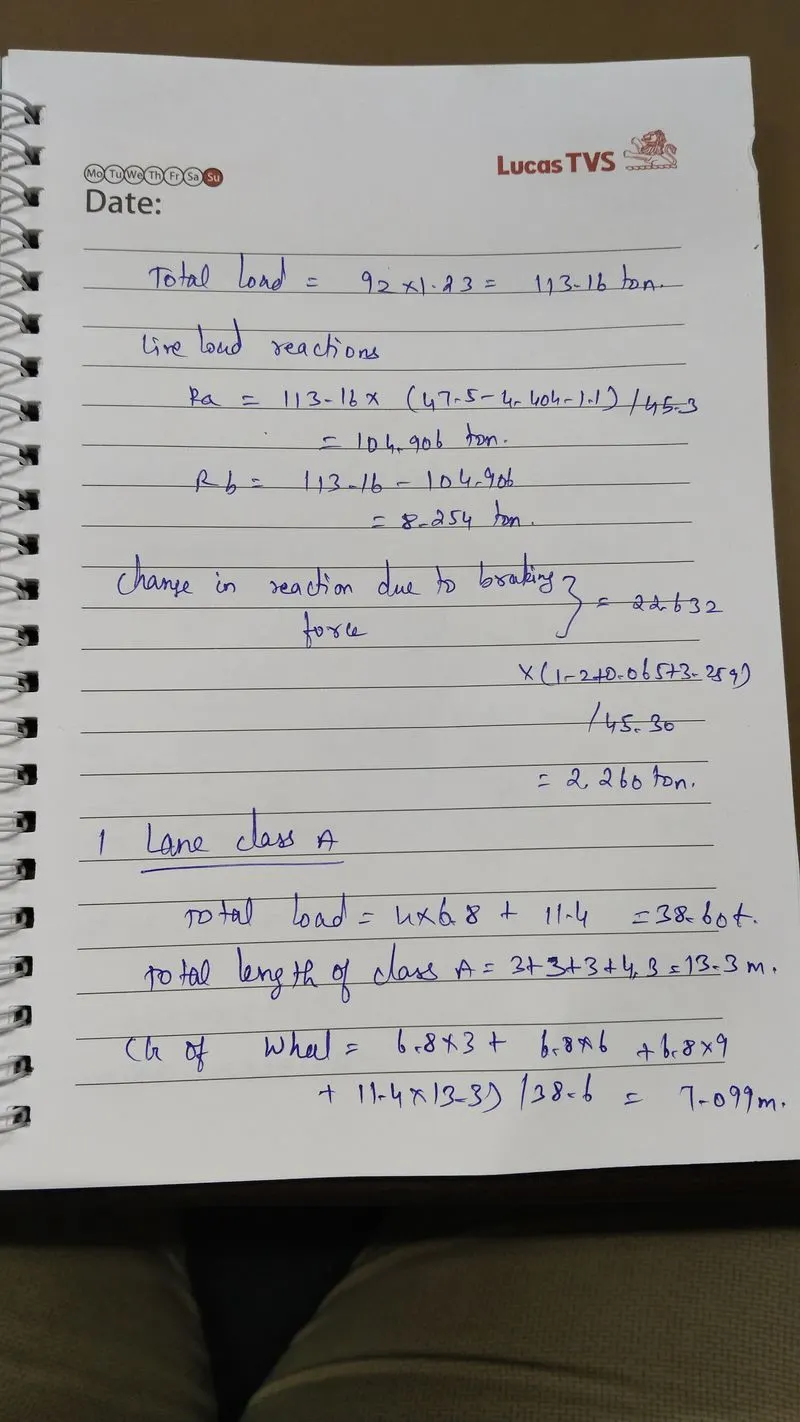
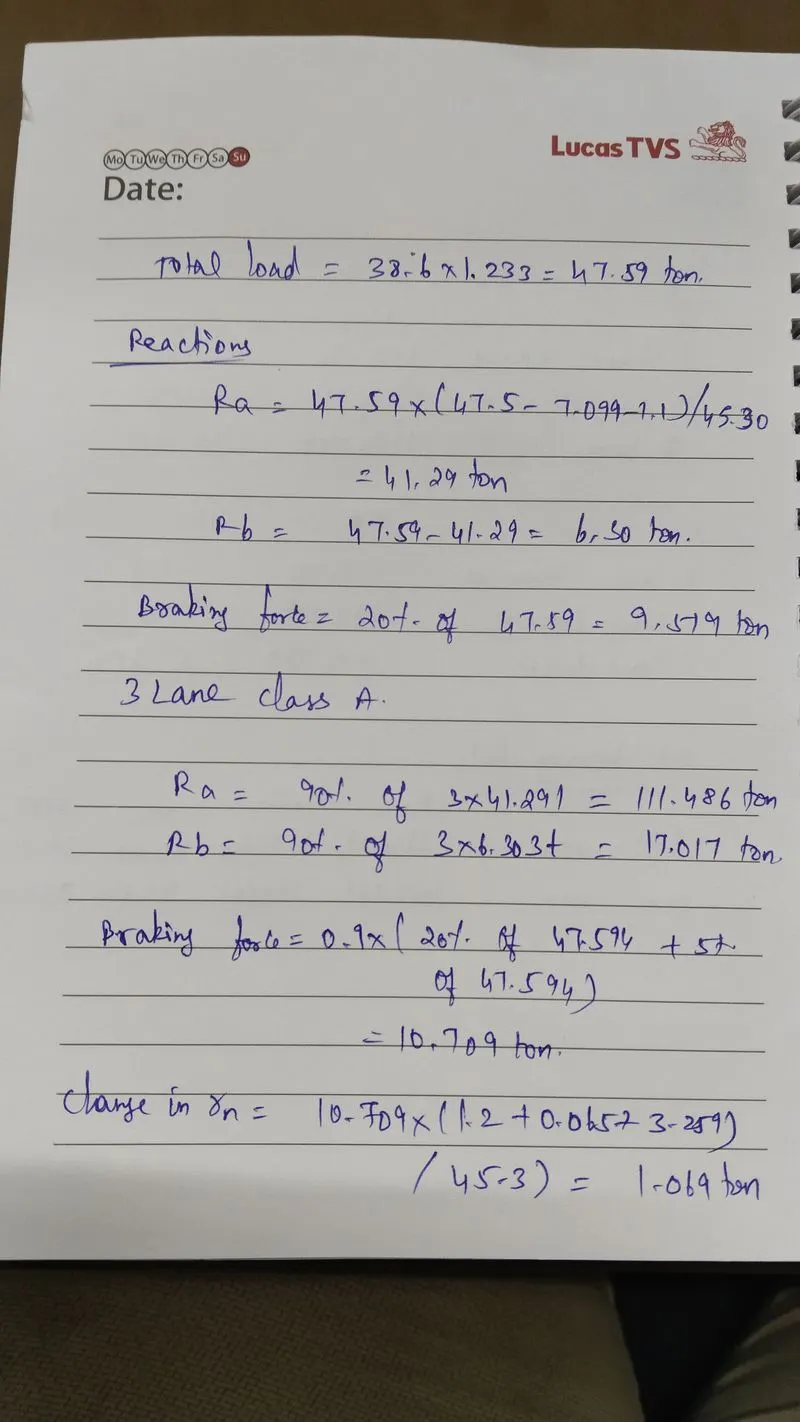
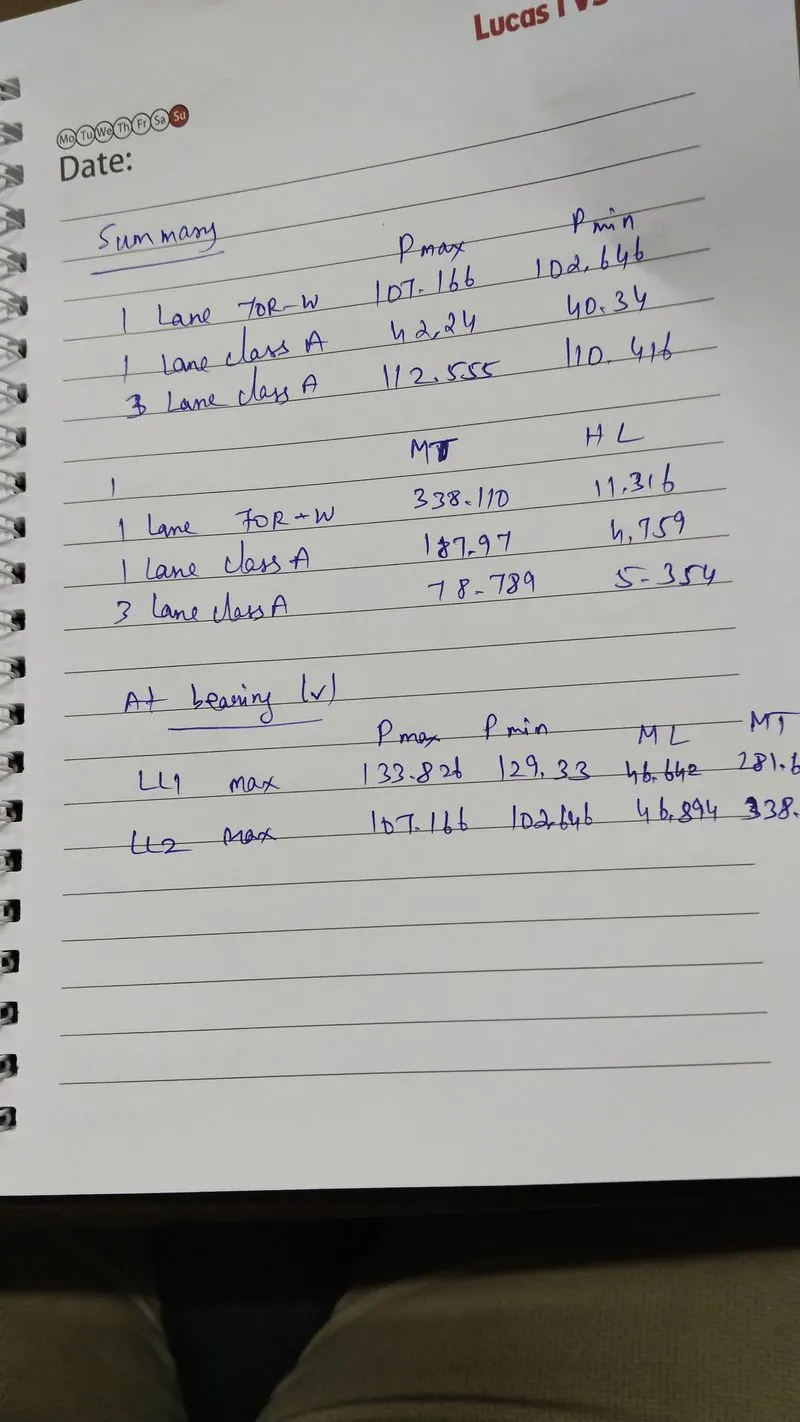
Calculate the forces as per IRC 6 on the foundation and propose the foundation.
- assume simply supported bridges
- continuous bridge.
Top road level-100 m
Ground level-93.5 m
Vertical pile capacity for 1.2 m dia is 250 tonnes horizontal 35 tonnes
Well having 8 m diameter capacity 70 tonnes/m2 6 m diameter 50 tonnes/m2 7 m diameter 60 tonnes
Soln:
Given Data:-
Linear waterway - 90 m
Design discharge - 700 cumecs
Silt factor -1
HFL - 3 m (from the ground)
Velocity of water - 1.2 m/sec.
Top road level -100 m
Ground Level -93.5 m
Diameter of Pile - 1.2 m
Vertical capacity - 250 tonnes
Horizontal capacity - 35 tonnes
Well Diameter = 8 m
Capacity = 70 tonnes,well Diameter = 6 m
Capacity = 50 tonnes,well Diameter = 7 m
Capacity = 60 tonnes.
Calculation of scouring Depth.
Db = (1.3XQ)/L= (1.3X700)/90 = 10.11 m
Ksf = 1
Dsm = 1.34(Db^2/ksF)^2/3 =6.26m
Maximum depth of scour for design of foundation,
For Abutment,
= 1.27 X dsm= 1.27 X 6.26 = 8.41
Depth of foundation below foundation. = 8.41 - HFL= 8.41 - 3= 5.41 m
For Pier,
= 2 X dsm= 2 X 6.26 =12.52
Depth of foundation .
= 12.52 - HFL = 12.52 - 3 = 9.52 m
Conclusion
The depth of foundation for the Abutment is 5.41 m.
The depth of foundation for the Pier is 9.52 m.
From the above calculation, we have to go pile foundation instead of an open foundation because depth is high. As per the given linear waterway 90 m, we can assume that 6 spans of 15-meter distance.



Q2
What is zero shear point and if there is more scour at region what will be the effect of that on zero shear point?
Ans
The points other than the extreme ends of a beam where B.M. is zero
Q3
Define the Liquefaction and its effects, how it can affect foundation. Also list the remedial measures for the same. How it is different from scouring?
Ans
Liquefaction is a phenomenon in which the strength and stiffness of a soil is reduced by earthquake shaking or other rapid loading.
Liquefaction and related phenomena have been responsible for tremendous amounts of damage in historical earthquakes around the world.
Liquefaction occurs in saturated soils, that is, soils in which the space between individual particles is completely filled with water.
This water exerts a pressure on the soil particles that influences how tightly the particles themselves are pressed together.
Prior to an earthquake, the water pressure is relatively low.
However, earthquake shaking can cause the water pressure to increase to the point where the soil particles can readily move with respect to each other.ct
- Effects on the foundation.
The soil liquefication has a disastorus effect on bridges and different structures. The structure built on liquefiable soil may face foundation settlement, crack, tilt, and overturning for the open foundation
For the deep foundation like pile foundation piles may buckle due to seismic force in liquefication soil.
- Remedial measurement for liquefication soil.
Geological studies identify the landfill sediments, and water table in a seismic region. Soil composed of a mix of small and big grains, can safely endure liquefaction, since the smaller grains fill the pores between the larger grains. Thus, the soil strength is maintained. Furthermore, modern buildings are designed to be liquefaction resistant. In a shallow foundation, the foundation constituents are joined to ensure uniform settlement of the foundation. Thus, the induced shear forces are decreased. The soil characteristics may also be enhanced by improving the soil density, strength, and drainage characteristics. Popular mitigation methods to reduce effects of soil liquefaction are:
- Mitigation by deep soil mixing method
- Compaction, Permeation, and Jet Grouting
- Drain Pile technique
- Dynamic compaction and construction of stone columns
- How it is different from scouring?
In the scouring, surrounding soil of structure (i.e. pier or abutment) is washed away due to the flow of water and exposes the foundation of the structure while in case of liquefication, soil behaves like water due to seismic load. The two are very different phenomenas.