Week 9 - Attachment Feature Creation (Ribs & Screw Boss) - Challenge 1
AIM
TO Create Rib and Screw boss for the door handle considering design rules
Objective:
The main aim of this challenge is to create B-side features of the 'Door Trim', with the help of CATIA V5.
Procedure for the projects
- Creating the tooling axis
- Draft analysis of Class A surface
- Creating Class B surface
- Creating Class C surface
- Surface and solid body
- Draft analysis of Solid body
- Engineering features Rib and Screw boss
- Draft analysis of Solid body with engineering features
MATERIAL SELECTIION OF ATTATCHMENT FEATURES OF (RIB&SCREW BOSS)
POLYPROPYLENE
- polypropylene, a synthetic resin built up by the polymerization of propylene.
- One of the important family of polyolefin resins, polypropylene is molded or extruded into many plastic products in which toughness, flexibility, light weight, and heat resistance are required.
MECHANICAL PROPERTIES
- Semi-rigid.
- Translucent.
- Good chemical resistance.
- Tough.
- Good fatigue resistance.
- Integral hinge property.
- Good heat resistance.
RIBS
- Rib is a B-Side Engineering feature which provides a means to economical Stiffness and Strength in Plastic Molded parts without increase in overall wall thickness.
- Rib also facilitates locating and arresting components of an assembly.
- It provides alignment in Mating Parts.
- It acts as Stop and Guides for Mechanisms.
WHY RIB
- They provide strength,rigidity to the part and support to other features like boss.
- Ribs are provided instead in areas to avoid thick walls to avoid plastic defects like sink marks,warps and voids.
Design considersation of the Rib
- BASE WIDTH OF A RIB IS :0.3-0.7T.
- RIB HIGHT :LESS THAN 5T.
- SPACING BETWEEEN THE RIB IS:MORE THAN 4T
- RADIUS ATB BASE OF THE RIB IS:T/8(OR)0.258MM/MAX.
- DRAFT OF THE RIB IS:0.5DEG -2DEG.
- RIB ROOT THICKNESS SHOULD BE LESS THAN 0.4T.
SKETCH OF MAKING RIB
ATTACHMENT FEATURES OF DOOR HANDLE COMPONENT (RIB)
SCREW BOSSES-
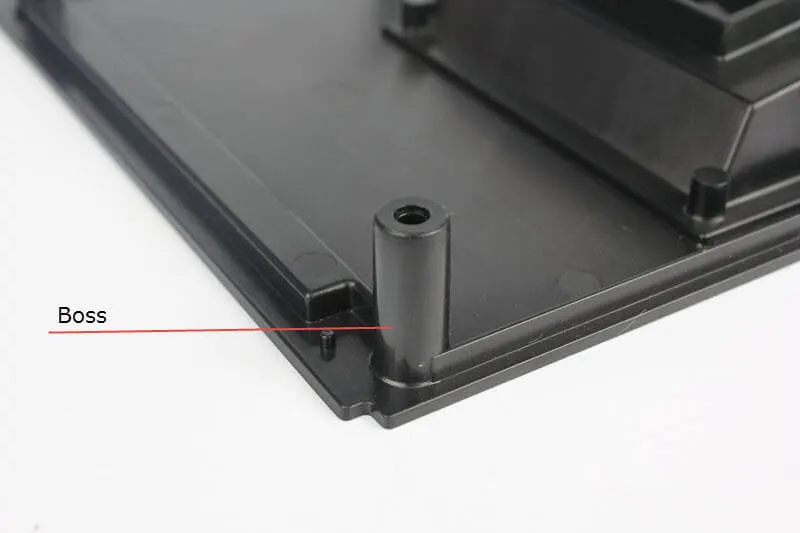
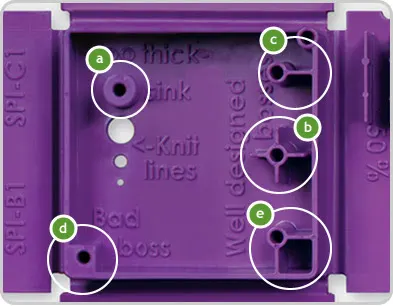
- Bosses are common structures on plastic parts in home appliances and interior and exterior of auto-mobiles, mainly for positioning and fastening.
- The base of bosses often cause sink marks on the back surface of a part, this is because of the large wall thickness.
- The solution is to core out some material at the base.
WHY SCREW BOSS
- They are used to aid in the assembly of molded parts by providing a channel for a screw.
- Designing plastic screw bosses is fairly straightforward but there are a few considerations to ensure a strong connection between parts and mitigate cosmetic defects.
SKETCH OF MAKING SCREW BOSS
ATTACHMENT FEATURES OF DOOR HANDLE COMPONENT (SCREW BOSS)
RIB ROOT THICKNESS
- The thickness of the rib should be approximately 50 to 60% of the general wall thickness of the part.
- Exceeding this value may lead to sink marks on the surface opposite the ribs.
CLASS A SURFACE
- Class-A (or 'Strak') is a term used in specifically in automotive design.
- It describes the final production surface data for the aesthetic parts of the car.
- The term 'Class A' is often misunderstood, but it's generally seen as the 'Holy Grail' of surface modeling.
- Class A surface is used to show to the customer visulization,and it is a aesthetic syurface.
CLASS B SURFACE
- The Class B finish is a quality finish with only minimal imperfections.
- A Class B finish is the most common finish for exterior surfaces.
- It is normally specified on surfaces such as external covers, panels, and parts that are fairly prominent.
- It is a offset surface of A,Which the surface were can not able to see Over the customer.
CLASS C SURFACE
- The Class C finish allows more imperfections than Class A or B.
- Class C is often specified for interior surfaces not readily visible, surfaces that will be covered by another part when assembled, or surfaces which the Customer feels do not need to meet a high cosmetic finish.
DRAFT ANALYSIS
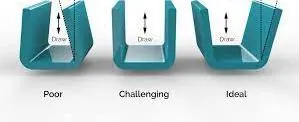
- The draft analysis technique is used to analyze whether our part model created in CAD is manufacturable based on the draft condition applied.
- Here the part should get easily removed from the panel dies .
DRAFT ANALYSIS OF DOOR HANDLE CLASS A
DRAFT ANALYSIS OF DOOE HANDLE FINAL COMPONENT
DRAFT ANALYSIS OF DOOR HANDLE WITH ATTACHMENT FEATURES
CONCLUSION:-
- Class A surface of Door Handle is successfully converted into solid body And all the B side Rib and Screw Boss also created on Class B surface with the correct terminology.
- its passes the draft analysis also means we can conclude that its is manufacturable or Formable.