Week 9 - Attachment Feature Creation - Challenge 2
AIM:
To create the boss and Dog House for the Centre console coin holder considering the design rules
THEORY:
we have created coin holder before and also we have attached ribs since ribs are important in the design of plastics parts because they allow us to make a component rigid without making it too thick.now in this challenge we are going to make screw bosses and dog house as per design specifications.
SCREW BOSS:
The boss is one of the basic design elements of a plastics moulding. Bosses are usually cylindrical because that is the easiest form to machine in the mould and it is also the strongest shape to have in the moulded part.The boss is used whenever we need a mounting point, a location point,a reinforcement around a hole, or a spacer.The boss may receive an insert, a screw, or a plain shaft either as a slide or a press fit.
In other words, the boss is not as simple as it looks. Depending on its use, it may have to stand up to a whole combination as a sliae or a press Tit. In other words, the boss is not as simple as it looks. Depending on its use, it may have to stand up to a whole combination of forces tension, compression, torsion, flexing.shear and bursting - so it must be designed accordingly. We can start with some general design rules, using the principles we have already developed for ribs and walls. The boss can be thought of as a special case of a rib; one that is wrapped round in the form of a tube.
An ideal boss, designed according to rib rules, would not produce sink marks or stick in the mould but unfortunately the tubular form of the boss would not be strong enough in most cases. In real life, most bosses break some rib design rules by necessity.
This means that boss design is a compromise between sink marks and functionality.Rigidity is the simplest aspect of boss design. This can be achieved by supporting the boss with buttress ribs, and often by linking the boss to a side wall. The support ribs can be designed to normal rib rules so that sink marks and stress points are avoided.
General Guidelines for Bosses: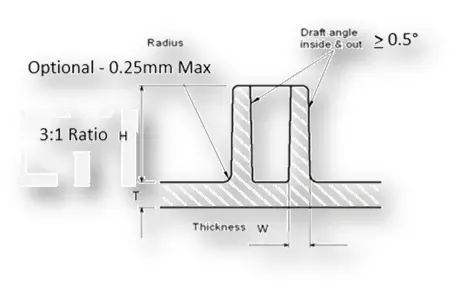
- Draft 0.5 degrees on walls of boss
- Thickness Typically 40%* of the nominal wall at the base.
- .Height to Diameter Ratio 3:1A
- Radii - 0.25mm maximum radii.
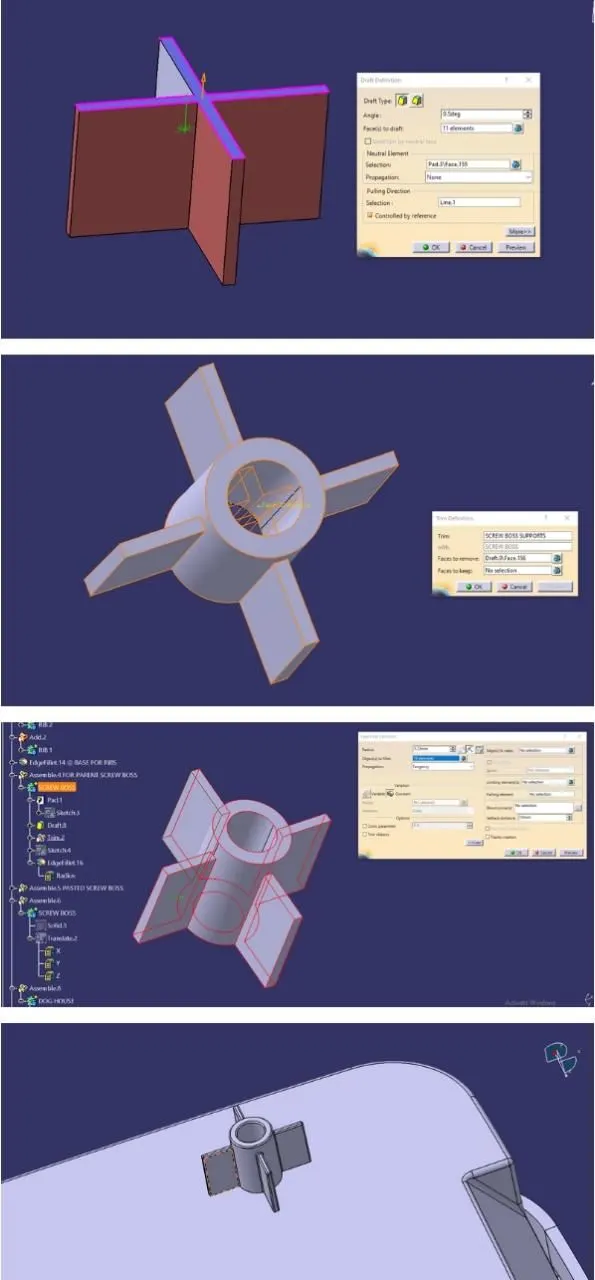
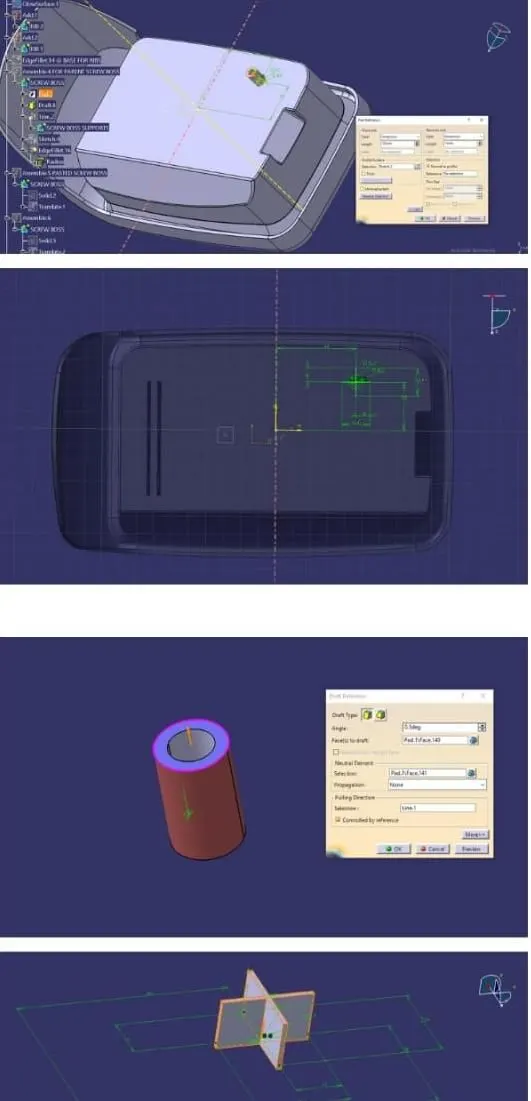
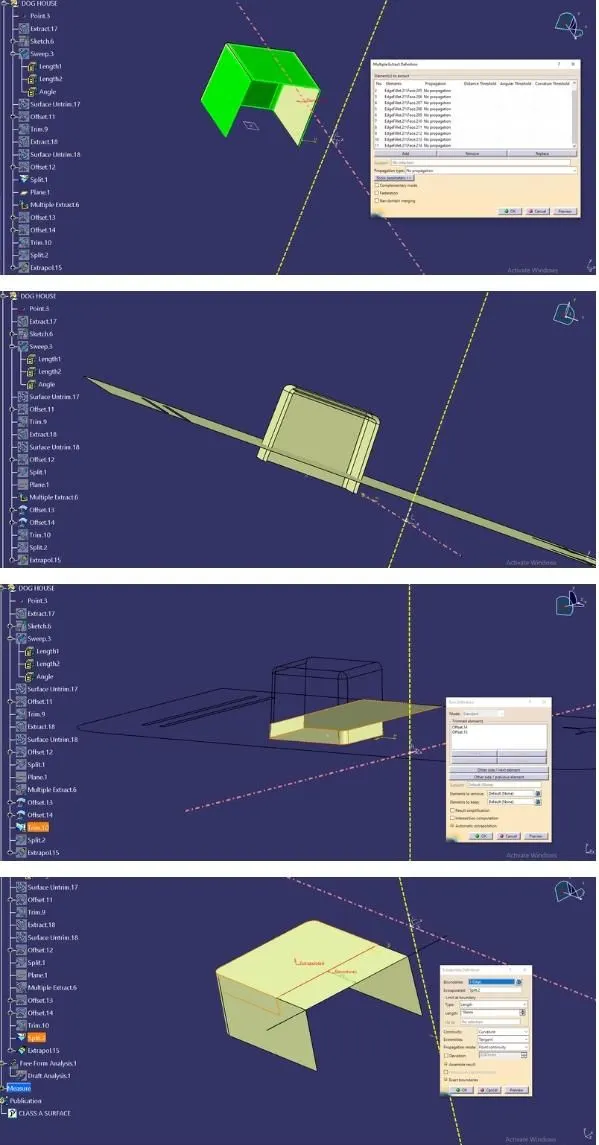
So we are going to make the bosses in part workbech of CATIA and procedure is shown in images below.
DOG HOUSE:
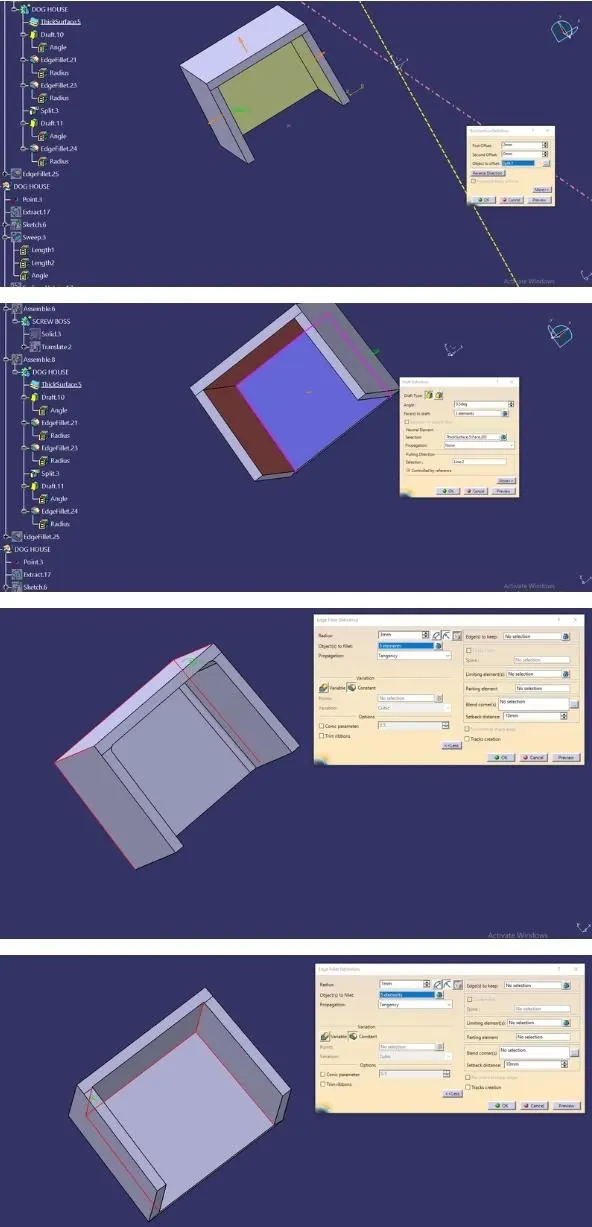
Dog house is an engineering feature used in plastic trim design. Dog houses are used as supporting feature. Sometimes other engineering features like snaps; locators etc. are mounded on them to increase their strength.Dog houses are subjected to draft analysis to prevent breakage of the component during ejection from mould cavity. Dog house and other engineering components are built on B-surface. now we will proceed with creating a dog house and mount the boss on it by following the design rules mentioned below: "C" is where the doghouse contacts the backside of the surface
STEPS INvOLVED IN PERFORMING FEATURE DRAFT ANALYSIS FOR DOG HOUSE:
Draft analysis is performed to check whether the component is drafted completely. Draft is performed for easy ejection of plastic component during the process of injection moulding. Following are the sequence of operation for draft analysis.
STEP 1: Before performing draft analysis note should be made that the VIEW is set to MATERIAL MODE. Select the draft analysis from INSERT -> ANALYSIS -> FEATURE DRAFT ANALYSIS.
STEP 2: select feature draft analysis fromanalysis and select HIDE OR SHOW THE cOLOUR SCALE and set the value of green represents the maximum draft angle.
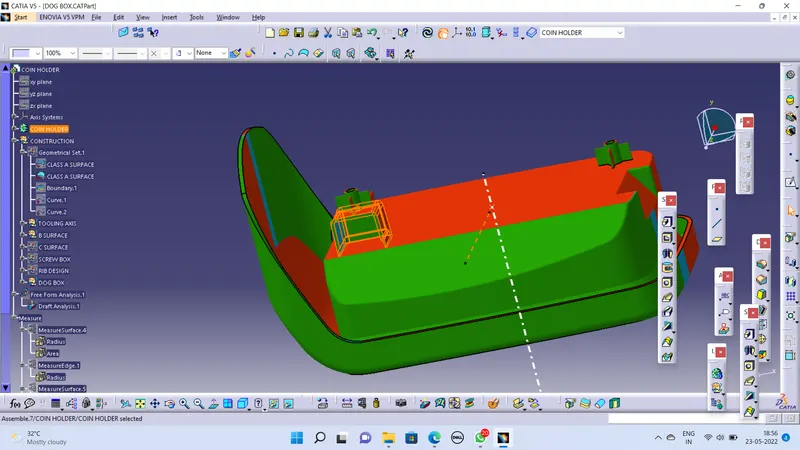
STEP 3: Drag the compass and set it oon the Tooling Direction". Use the compass to select new draft direction and reorient the compass direction then select the solid on which feature draft analysis is to be performed. If the orientation of the compass is inverted select the inverse be performed. If the orientation of the is inverted select the inverse direction command in the draft analysis. The green colour in the figure below represents that the component has cleared draft analysis in the"Tooling Direction direction.
Once the analysis is made the draft analysis is saved in tree as Draft Analysis. under Free Form Analysis.l.
STEP 4: Drag the compass and set it on the "lifter". Use the compass to select new draft direction and reorient the compass direction then select the solid on which feature draft analysis is to be >. If the of the compass is inverted select the analysis. The green colour in the figure direction.Once the analysis is made the draft analysis is saved in tree as Draft Analysis.2 under Free Form Analysis.l.
RESULT:
So finally we have created the boss and Dog House for the Centre console coin holder considering the design rules and performed draft analysis on it.