Week 2:- BiW Fixture Basics Challenge
1)what is the process of project execution activity?
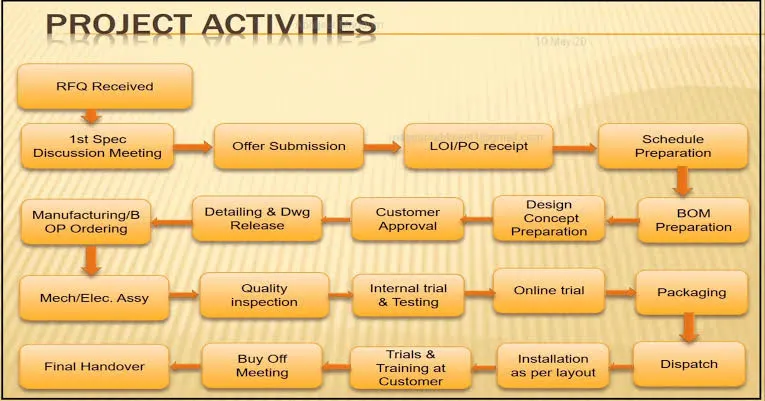
1.RFQ: RFQ stands for request for quotation. Once the RFQ is received from the customer need to study the RFQ and perpare the documents of technical information, production information, time duration to manufacture.
2.1st discussion metting will be held with the designer and the manufacture to estimate the time and cost of the product.
3.then the offer is submitted to the customer. The customer will release the receipt
4.once the LOI/PO receipt is received, the schedule the part production is done. After po from the customer we have to prepare the schedule
5.once the PO released from the customer we will be working on preparation of schedule which should be matched our palnned committment on thr technical offer/ costomer required time.
6.BOM( bill of materials) like cylinder, motors, etc which is required for the project are prepared.
7.•before design concept, we have to study the data of constumer requirement throughly which is carried out in design data study activities.
•during design data study, we will be proceed with rough sketches to get a flow while designing concepts.
8.customer approval: its is also known as design apparoval process. After design concept the customer will review the design concept
9.Detailing& drawing release:
•once the customer approved the process, the detailing of the fixture parts which is to be manufactured has beeen done with giving appropriate dimension and GD&T symbols.
10.manufacturing/ BOP ordering:
The mechanical & electrical parts like sensors, cylinder, etc which needs for fixture are ordered as per design specifications.
11.mechanical/ electrical assembly:
After the materials ordered received to our end. The quality will check the working conditions and technical specs. Which meet our requirment.
12.quality inspection:
After assembly again the quality check is done.
In this all dimension positional accurancy, coordinates are checked using CMM
13.internal trail:
After qc check internal trailsbaee made to check the operation of the fixture. Its first trial taken putting the assembly invthe fixture whether the seating of assembly panel suited correctly.
14.online trail:
Thr trail will done in automatic made through control panel. The process sequence of operation is checked as by the designed way.
15.Packing:
To avoid damage occure in the fixture while transportation which may also leads to affect the aestheic look proper function of fixture packaging has been done.
After the trials taken have to get the qc confirmation whether the panels met the standard given by customer standard
16.Despatch:
After the fixture had been packed for delivery as per standards. Its been despatched ti the customer.
17.Installation as per layout:
As we discussed on design concent preparation, the design of the layout are been prepared at very initial level which gives information of placement of robots and fixture.
18.Trails& training at customer:
In customer trial we have to achieve the confirmed quality of assemblies. Once it is achieved, training, will be given to the operator, staff, engineees who involved in this process.
19.Buyoff meeting:
After trials and training at customer end, buyoff meeting will be held. In the meeting customer will give review about the fixture, sonetimes customer may need/feels better to do some addition work also.
20.Final handover:
The fixture and the documents supporrs the fixture/ production will be haded over. Documents like clamp validation documents, ergo sheets, Bom, charts will be deliveed and handedover to customer.
2)What are the types of joining processes?
• Joining includes welding, brazing, soldering, adhesive bonding of materials.
• They produce a permanent joint between the parts to be assembled.
•They cannot be separated easily by the application of forces.
•They are mainly used to assemble many parts to make a system.
Welding: is a metal joining process in which two or more parts are joined or coalesced at their contacting surfaces by suitable application of heat or/and pressure.
• Some times, welding is done just by applying heat alone, with no pressure applied
. • In some cases, both heat and pressure are applied;and in other cases, only pressure is applied, without any external heat.
• In some welding processes, a filler material is added to facilitate coalescence.
The types of welding used to join automotive parts are:
1. Resistance welding: resistance spot welding, resistance seam welding, and resistance projection welding.
2.Arc welding: shield metal arc welding, MAGwelding, MIG welding and eletrogas arc welding(EGW) .
BRAZING:
•Its is a joining process in which a filler metal is melted and distributed by capillary action between the faying( contact) surface of the metal parts being joined.
• Base material dors not melt in brazing, only the filler melts.
In brazing, the filler metal has a melting temperature ( liquids) above450°c but below the melting point( solidus) of base metal to be joined.
Soldering:
• Soldering is similar to brazing and can be defined as a joining process in which a filler metal with a melting point liquid not exceeding 450°c is melted and distributed by capillary action between the faying surface of metal parts being joined.
• As in brazing, no melting of the base metals occurs, but tge filler metal wets and combines with the base metal to form a metallurgical bomd.
Mechanical fastening:
The most common method of joining many material within the industry. Originally used for metal joining it is also well established for joining plastic to themselves and to other materials. There are teo main categories of industrial fasteners, permanent and Nonpermanet.
Hemming:
Hemming is atechnology used in the automotive industry to join the inner and outer closure panels together. Its the process of bending/folding the flange of the outer panel over the inner one.
Adhesive bonding:
A structure bonding tape with an epoxy- modified acrylic adhesive is used to attach plastic or metal clips to panited or primed body panels.
3.What is Resistance Welding & its application in the automotive sector?
Even though resistance welding is classified under confusion welding the joint is produced by melting ofparent materials due to the application of a large amount of pressure in the welding process. In this process, the heat required for melting of plates is obtained due to the electrical resistance of the circuit. Hence the name is given as resistance welding operation.
Types of resistance welding:
1. Resistance spot welding
2. Resistance seam welding
3. Resistance projection welding
RESISTANCE SPOT WELDING:
Resistance Spot Welding (often just called spot welding) is a cost-effective joining technology that continues to be very popular in the automotive industry where high reproducibility and automation are essential criteria. An additional advantage is that, with a suitable choice of parameters, high quality of joints can be obtained without being dependent on a welder's ability.
Resistance Spot Welding is a pressure welding process. The sheets are pressed together locally with the help of fitte dcopper electrode welding guns that then have a current applied to them. As a result, Joule heating locally melts th ejoining partners at the junction resulting in a cohesive composite once the joint has solidified.
RESISTANCE SEAM WELDING:
Resistance seam welding can be used to make gas- or fluidtight joints in a variety of sheet metal fabrications. Steel fueltanks for motor vehicles are a prime example. It is also used in making tin cans, steel drums, and domestic radiators.
The process lends itself particularly to welding seams which are straight or have a regular curvature: abrupt changes in the weld line in any plane should be avoided.Welding is not possible into internal corners or where other features of a component obstruct access for the wheel electrodes.
Access to both sides of the joint is necessary, and a lap joint configuration is generally required. Components comprising two half-shells may be welded, for example,petrol tanks or domestic radiators. Alternatively, the sheet can be rolled into tubular form and the longitudinal seam welded, as in tin cans or steel drums.
RESISTANCE PROJECTION WELDING:
Resistance projection welding, or RPW, is a form of resistance welding where the electricity, force, and time are concentrated on raised segments (or projections) toj oin items together. This process has the benefit of forcing the welds to occur in very specific and tiny locations and minimizing the dissipation of heat to th erest of the metal sheets.
Resistance projection welding can be found in the automotive industry, where screw-fastener parts such as nuts and studs (see above) are joined to metal shee tcomponents. It is also found in cross wire and bar welding, or in day to day products such as shopping carts.
4.What is fusion welding & types of fusion welding with its application in the automotive sector?
Fusion welding processes can be grouped according to the source of the heat, for example, electric arc, gas,electrical resistance, and high energ8Y.
These processes include:
Arc Welding Processes
Shielded Metal Arc Welding (SMAW), also known as manual metal arc welding (MMA or MMAW), flux shielded arc welding, or stick welding. Suitable for welding ferrous and non-ferrous materials in all positions.
Metal Inert Gas Welding(MIG) and Metal Active GasWelding (MAG)also known as Gas Metal Arc Welding(GMAW). MIG and MAG welding is the most common arc welding process, in which an electric arc forms between a consumable wire electrode and the workpiece leading them to melt and join. Both use shielding gas to protect the weld from airborne contaminants, or oxidation in the case of MIG welding.
Tungsten Inert Gas Welding (TIG) also known as Gas Tungsten Arc Welding (GTAW). This arc process uses a non-consumable tungsten electrode to create the arc between the electrode and the base plate. Inerts hielding gas is used to protect from oxidation or other atmospheric contamination. This process can be used autogenously on thin parts but will require the addition of a wire, rod, or consumable to be added for thicker parts.
Plasma Arc Welding (PAW)
This process uses an electric arc created between an electrode and the torch nozzle.The electric arc ionizes the gas (usually argon) in the chamber creating what is called a 'plasma. It is then forced through a fine bore copper nozzle that constricts the arc and directs it to the workpiece, allowing th eplasma arc to be separated from the shielding gas(which is usually made from a mixture of argon and hydrogen).
Submerged Arc Welding (SAW)
This frequently-used arc welding process uses a continuously fed consumable electrode and a blanket of fusible flux which becomes conductive when molten and provides a current path between the workpiece and the electrode. The flux also prevents spatter and sparks while suppressing ultraviolet radistion and fumes.
Flux Cored Arc Welding (FCAW).
Developed as an alternative to SMAW, this process uses a continuously fed consumable electrode with a flux and a constant voltage or constant current power supply. Sometimes using a shielding gas this process can also just use the flux to provide protection from the atmosphere.
5.What is the 3-2-1 principle?
1)It is also known as a six-pin or six-point location principle. In this, the three adjacent locating surfaces of the blank (workpiece) are resting against 3, 2, and 1 pin respectively, which prevent 9 degrees of freedom.
2)The rest three degrees of freedom are arrested byt hree external forces usually provided directly by clamping.
The 3-2-1 principle states that the six locators are sufficient to restrict the required degree of freedom of any workpiece. In this, motion is restricted using clamps and locators. A three-pin base can restrict five motions and six pins restrict nine motions
1.The workpiece is resting on three pins A, B, and C which are inserted in the base of the fixed body.
2.The workpiece cannot rotate about the axes XXandYY and also cannot move downward.
3.In this way, the five degrees of freedom 1,2,3,4, and 5 have been arrested.
4.Two pins D and E are inserted in the fixed body, in a plane perpendicular to the plane containing pins A, B &C.
5.Now the workpiece cannot rotate about the Z-axis
and also it cannot move towards the left.
6.Hence the addition of pins D and E restrict three more degrees of freedom, namely 6, 7, and 8.
7.Another pin F in the second vertical face of the fixed body arrests degree of freedom 9.
The above method of locating a workpiece in a fixture is called the 3-2-1 Principle.
6.Define Body coordinate system?
The body coordinate system is widely used iautomotive industry for drawing body parts, product,and process design. BCS is called the car line and Bod
line Carlines(Grid linesTo represent the position of BIW car parts, welding fixture and its unit assemblies with its individual part(e.g.mylars(the parts which are in contact with panel))i2D drawings, their respective positions are shown with reference to (X-0,Y-0,Z-0)positions. In short, it showin 2D XY, YZor XZ coordinate position of BIW welding fixture parts or assemblies with reference to originX=0,Y=0,Z=0
Let us consider a situation if an individual fixtur designer starts designing a part or panel on their default axes system then it will be difficult to assembly position the part with respect to each other. So in order to avoid this, all the designer starts designing with respect to car axes system (which is generally at the center of the front axle)
7.Elaborate the Body plane system & its essentials.
1.Body planes can be considered as reference planes in the automotive car.
2. GD&T is applied in the 2D part of the BIW fixtures.
3. There are three mutually perpendicular imaginary planes
Essentials of body plane
1. Define the exact position of each product in the vehicle with respect to a fixed region.
2. Flawless design for assembly.
3. All the design lines carried out relative to the bodyline with respect to fixtures, turntables.
4. Assists in easy location of different parts in a vehicle.
5. Aims in creating a standardized system.
6. Assists in quality checks.