Week 8 - Universal Joint
-
Objective: To perform transient structural analysis on a double universal joint using different material for the joint with spring and compare the equivalent stress and total deformation.
-
Procedure:
Open the transient structural analysis system in the Project schematic. The material used for the analysis is structural steel which is available in the material library. Add the material Stainless Steel and Titanium
Alloy to the material library. Now proceed to import the geometry. Import the Geometry. Open the Geometry in SpaceClaim. Ensure the geometry is properly imported by doing quick visual inspection. The
geometry is properly imported as observed.
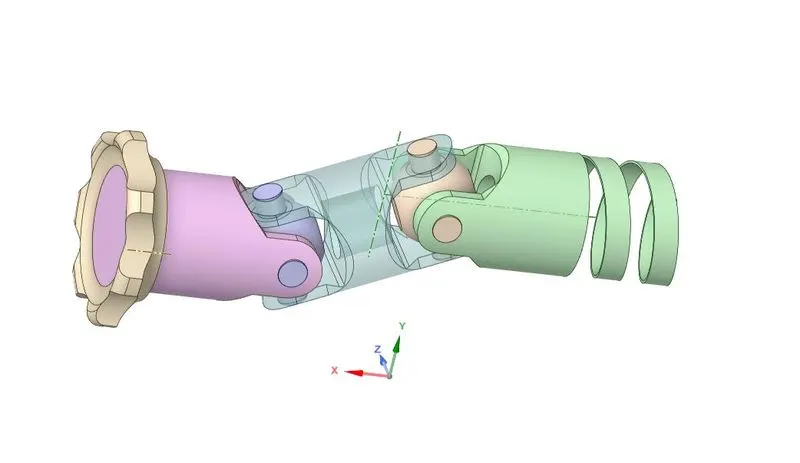
We will rotate the shaft with the gear and fix the end of the coil of the spring on the other side, so as the shaft rotates, the motion will be transferred to the other side via the connecting joint and the spring will
start to coil. Update and open the mechanical module. The material assigned for the model is Structural Steel. The Ansys automatic contact detection has detect some initial contact between the members. Delete
the contacts, since we are not interested in the contact analysis.
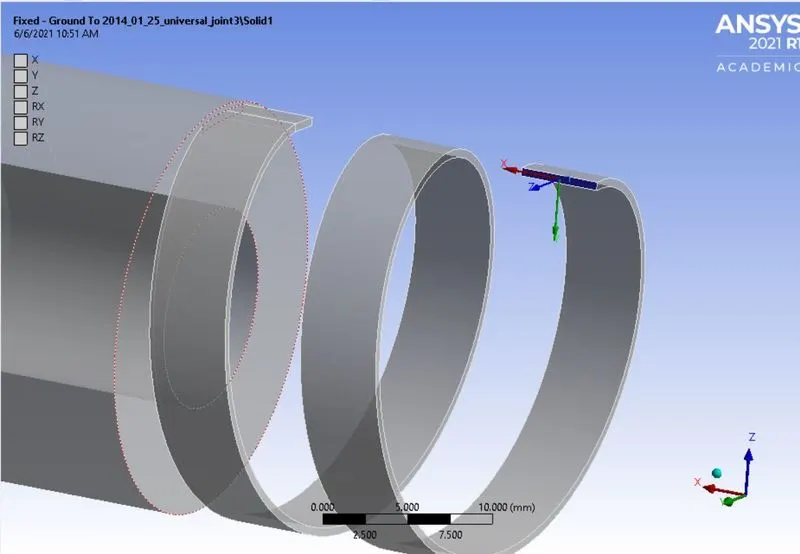
Insert Body- Ground, Fixed joint for the spring end. Go to Connections > Insert > Joint. Select the Displayed surface and fix the end of the spring.
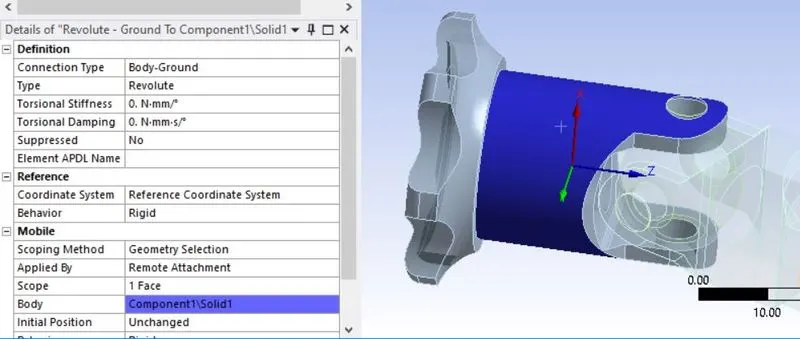
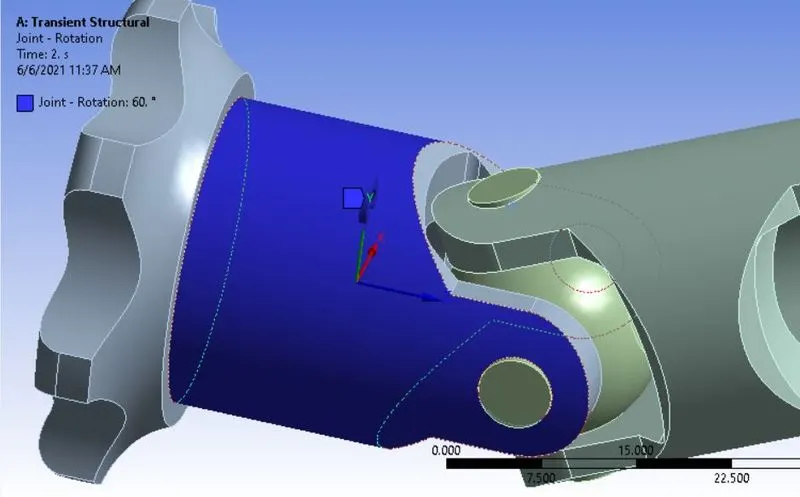
Now, insert Body – Ground, Revolute joint so that the joint on the gear side can be rotated. Go to Connections > Insert > Joint. Select the outer surface of the joint and insert the revolute joint.
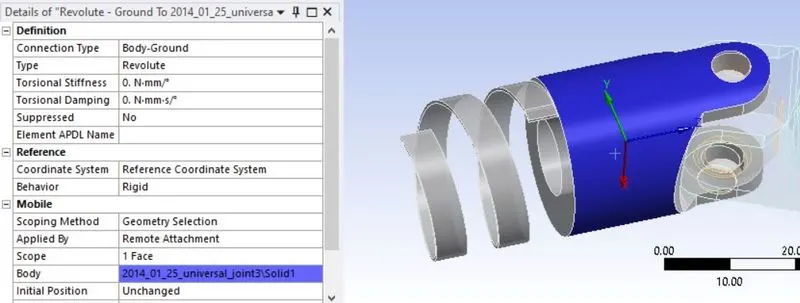
Similarly, insert Body – Ground, Revolute joint for the other joint that will rotate once moment is applied to the first joint. Go to Connections > Insert > Joint. Select the outer surface of the joint and insert the
revolute joint.
Now, the motion is transferred from one end to another end via the joint in the middle. These joints are connected to the end joints through pins. Define a Body - Body type revolute joint between the pins and
the joints on both the sides. This will transfer the motion from one endd to the other end.
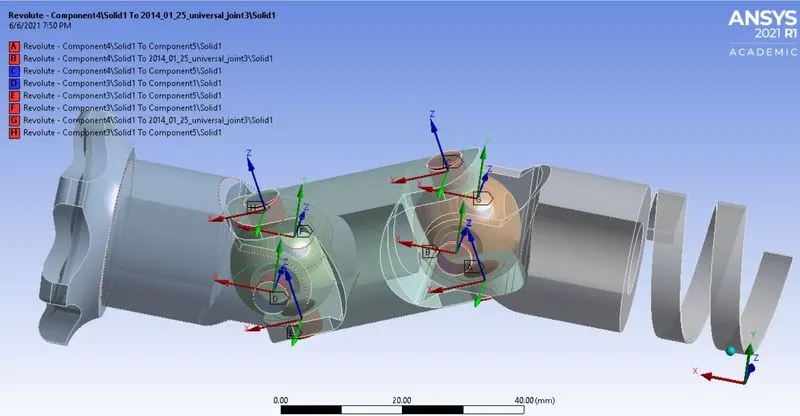
The analysis is to be completed in 5 steps. Go to Analysis settings and enter no. of steps = 5. Weak spring is set to Program controlled and Larger Deflection is turned on. Auto time stepping is turned off and time
step of 0.1 s is used.
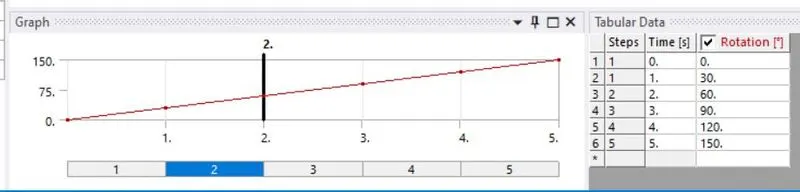
Now insert the joint load for the revolute joint. Go to Transient > Insert > Joint Load. Select the Body -Ground joint on the gear side with type as rotation and enter the magnitude in tabular form as shown below:
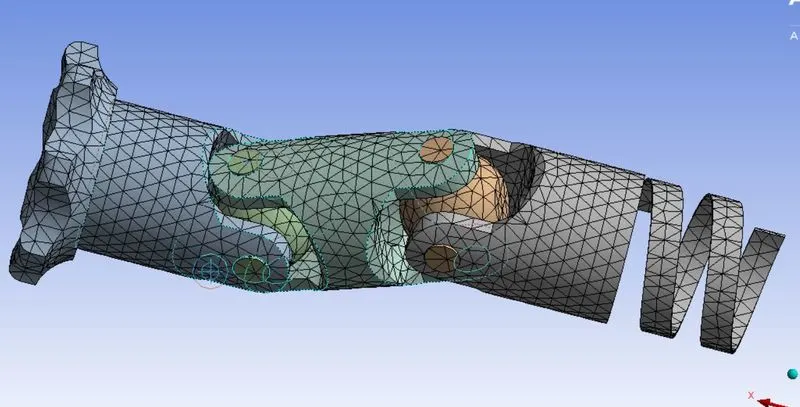
The components are meshed with element size of 2.8mm. Adaptive sizing is turned off.
The case setup is now complete. List the required results and run the simulation.
- Results:
Equivalent stress:
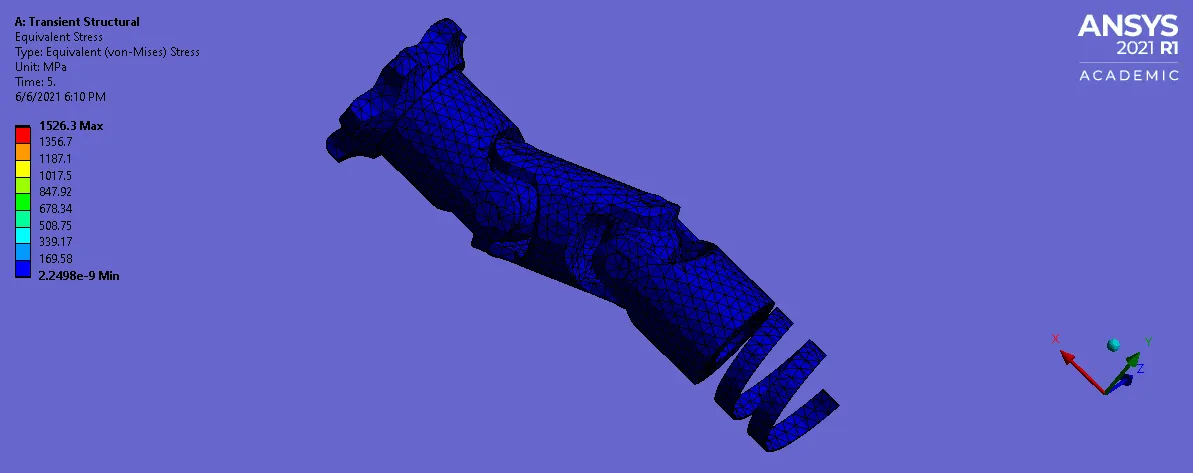
Max stress of 1526.3 Mpa is observed in the spring.
Total Deformation:
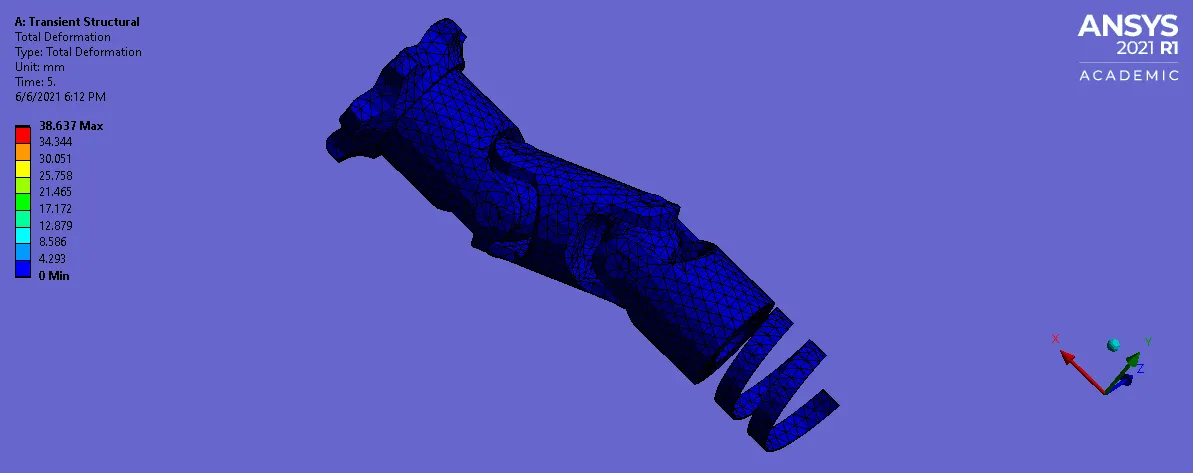
Max deformation of 38.67 mm is observed.
For joint end with Stainless Steel as material, results are as follows:
Equivalent Stress in the model:
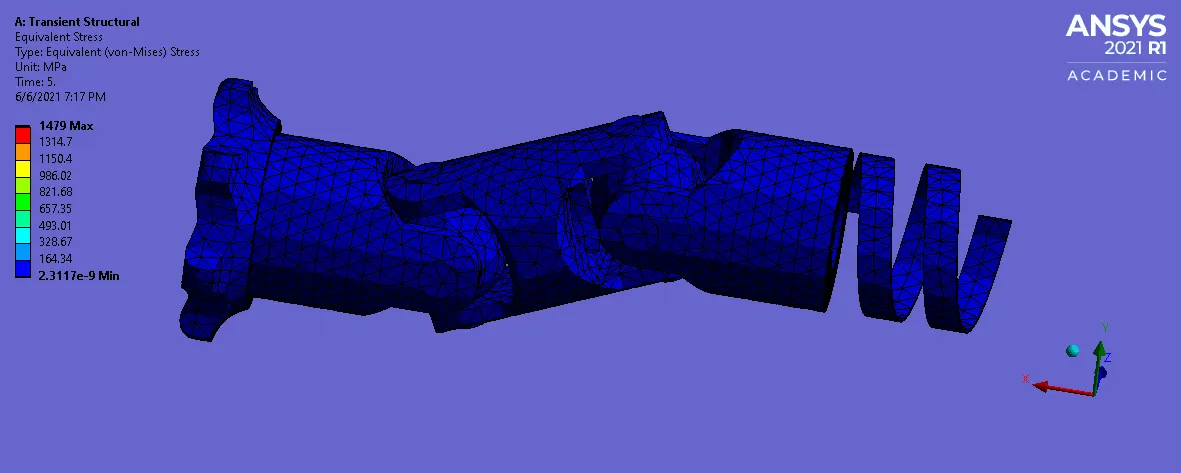
Max stress of 1479 Mpa is observed in the spring.
Total Deformation in the model:
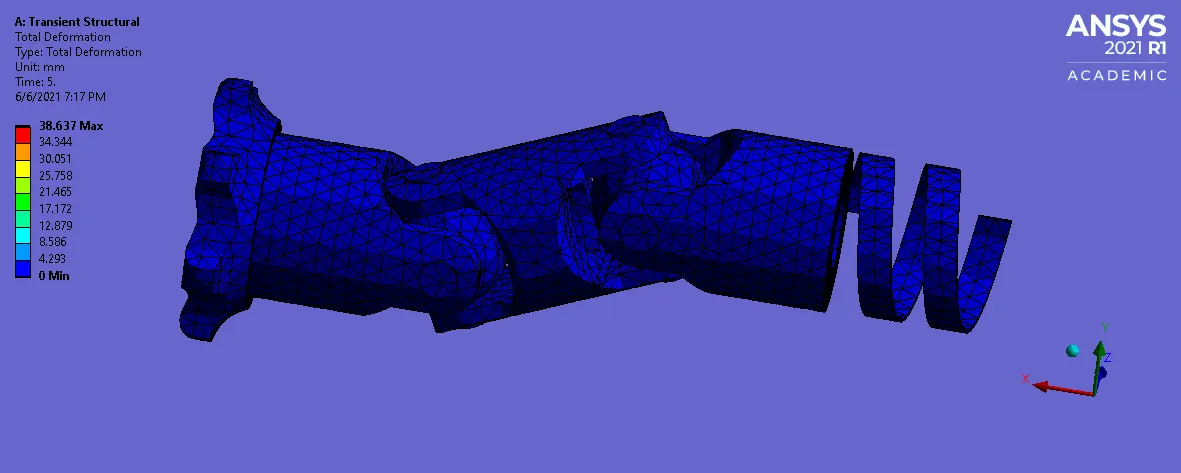
Total Deformation of 38.69 mm is observed.
For Titanalloy alloy as the material for the joint with spring end:
Stress in the model:
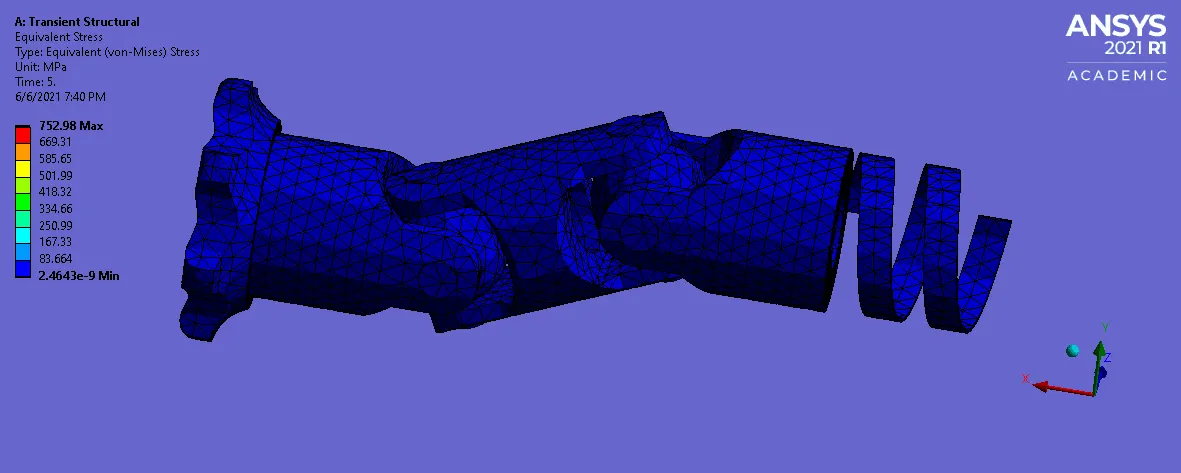
Max stress of 752.98 Mpa os observed in the spring.
Total Deformation in the model:
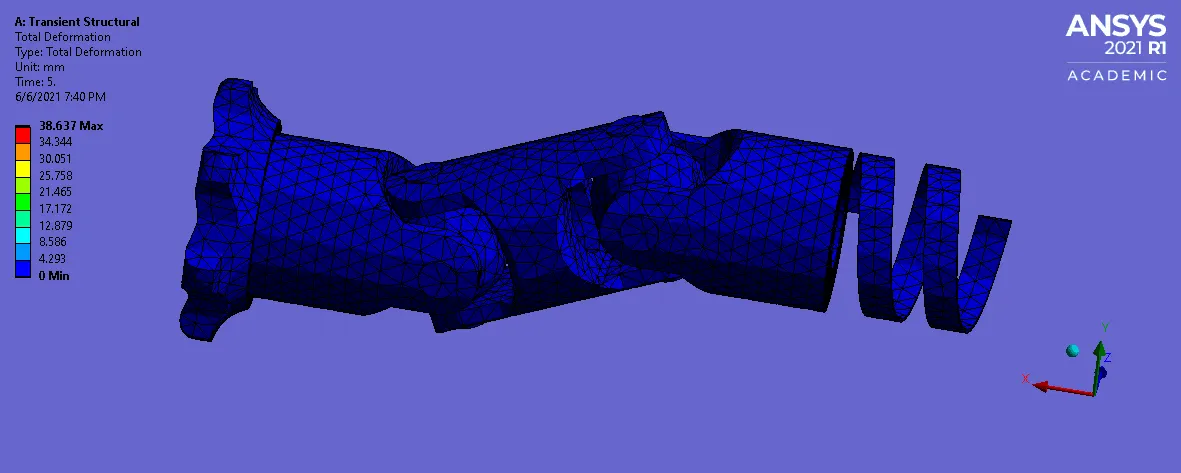
Max deformation of 38.63 mm is observed.
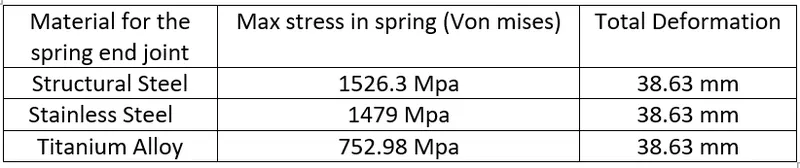
For all the cases, the total deformation remains the same irrespective of the material used. However, a great difference in the stresses induced in the spring is observed. Highest stress is observed for the material
Structural Steel, followed by Stainless Steel and then Titanium Alloy. This difference is due to difference in the material properties such as Young's modulus, yeild strength of the material etc.
- Conclusion: Thus the given challenge is successfully simulated without any converge issue and the application of Body - Body joint for motion transmission betweeen different bodies is learned.