Universal Joint Simulation
AIM:
To perform a transient structural analysis on a double universal joint with a spring using three different materials: Structural Steel, Stainless Steel, and Titanium alloy
INTRODUCTION:
A universal joint (universal coupling, U-joint, Cardan joint, Spicer or Hardy Spicer joint, or Hooke's joint) is a joint or coupling connecting rigid rods whose axes are inclined to each other, and is commonly used in shafts that transmit rotary motion. It consists of a pair of hinges located close together, oriented at 90° to each other, connected by a cross shaft. The universal joint is not a constant-velocity joint.
A Simple Universal joint does not transmit the motion uniformly when shafts are operating at an angle. Because of this, two universal joints are used in a vehicle, one between the Gearbox & Propeller Shaft and other between the
MATERIALS USED
Different cases as per the material difference for the shaft or spring joint are given as below:
CASE_1: Structural Steel
CASE_2: Stainless Steel
CASE_3: Titanium Alloy
Material Properties:
Material Specifications for CASE_1,2 &3 :
Structural Steel
Density: 7850 Kg/m3
Young’s Modulus: 2 E+05 MPa
Poisson’s Ratio: 0.3
Tensile Yield Strength: 250 Mpa
Compressive Yield Strength: 250 Mpa
Tensile Ultimate Strength: 460 Mpa
Stainless Steel
Density: 7750 Kg/m3
Young’s Modulus: 1.93E+05 MPa
Poisson’s Ratio: 0.31
Tensile Yield Strength: 207 Mpa
Compressive Yield Strength: 207 Mpa
Tensile Ultimate Strength: 586 Mpa
Titanium Alloy
Density: 4620 Kg/m3
Young’s Modulus: 96000 MPa
Poisson’s Ratio: 0.36
Tensile Yield Strength: 930 Mpa
Compressive Yield Strength: 930 Mpa
Tensile Ultimate Strength: 1070 Mpa
PROCEDURE:
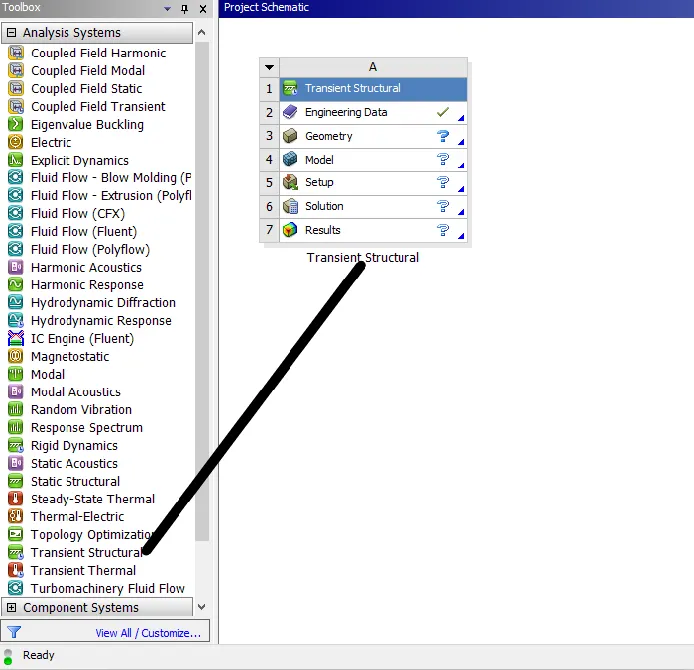
1. Import model in Transient Structural in Geometry section, just drag and drop from toolbox to workspace
2.Now we have to import the geometry and open the geometry in space claim to check for any defects or abnormalities
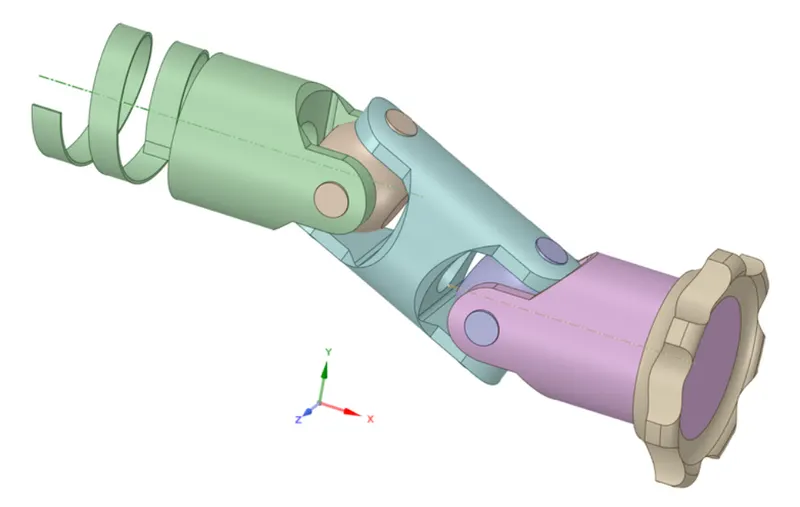
Geometry opened in SpaceClaim
Then go to the Mechanical model section.
Check or Rename the Parts of the setup as “Spring_Joint”, “Gear_Joint”, “Ball_1”, “Ball_2” and “Coupling” as shown in the above geometry image.
Connections:
Joints (For CASE_1, 2 & 3):
Joint_1:
Connection Type: Ground to Spring_Joint
Type: Fixed
Body: Spring_Joint
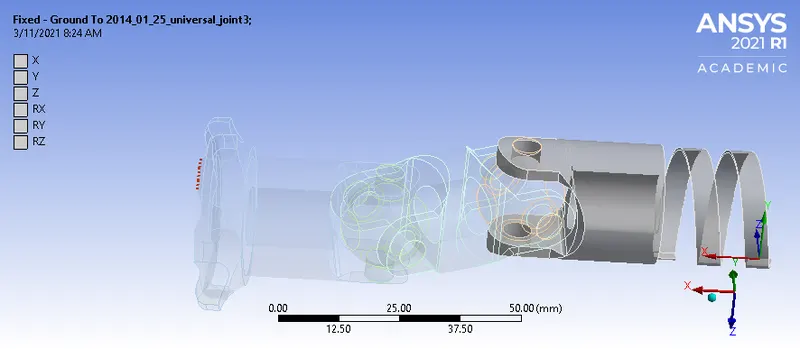
Fixed Joint Definition
Joint_2:
Connection Type: Ground to Gear_Joint
Type: Revolute
Body: Gear_Joint
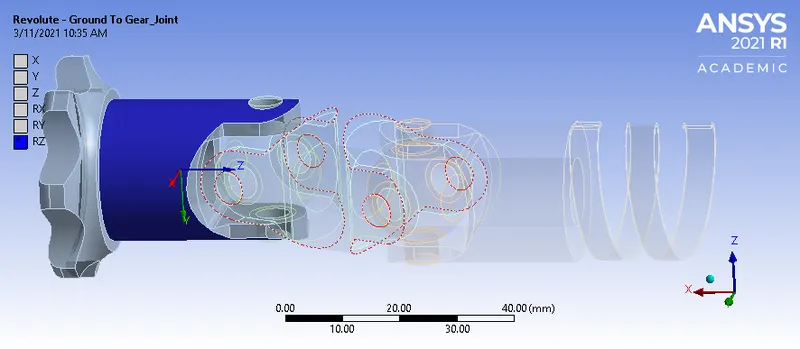
Ground to Gear Joint Definition
Joint_3:
Connection Type: Ground to Spring_Joint
Type: Revolute
Body: Spring_Joint
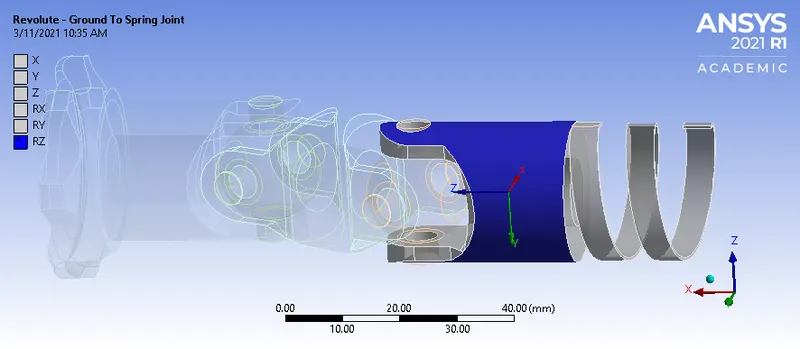
Revolute Joint Definition
Similarly revolute joints were specified between the ball and its corresponding holes. The below are the complete list of joints specified
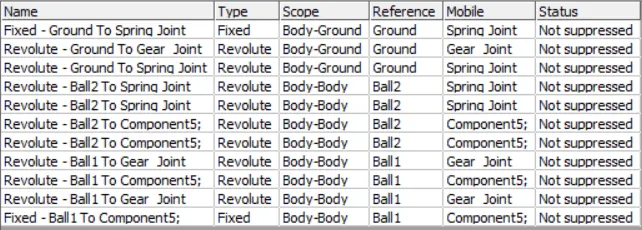
Joints defined
Now we have to mesh the given component. Here we use a mesh size of 2mm where we can get a fine mesh within the student edition limitations
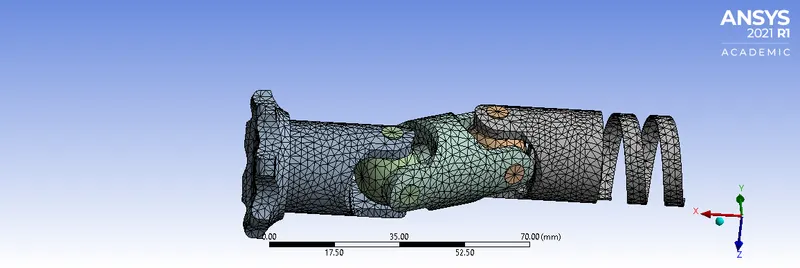
Meshed Model
After the mesh is deployed now we have to define the analysis settings. Here we define a time step of 0.1s
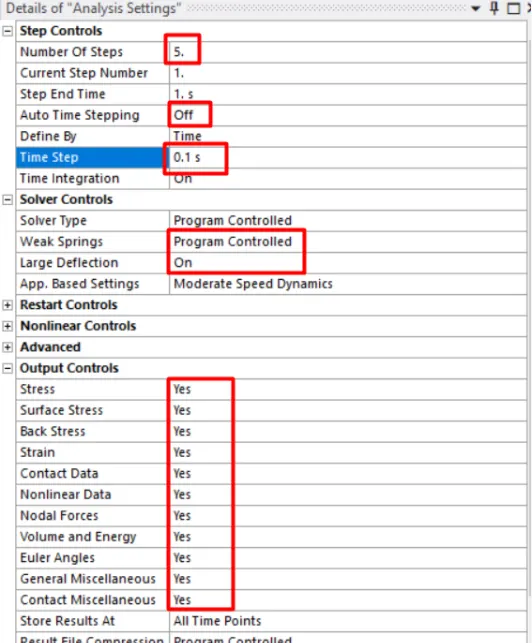
Now we have to set up the boundary conditions. We set up a rotation at the gear joint as ground to ger joint with values via tabular data
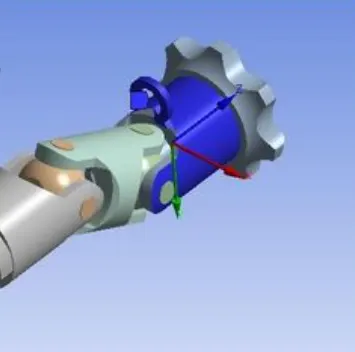
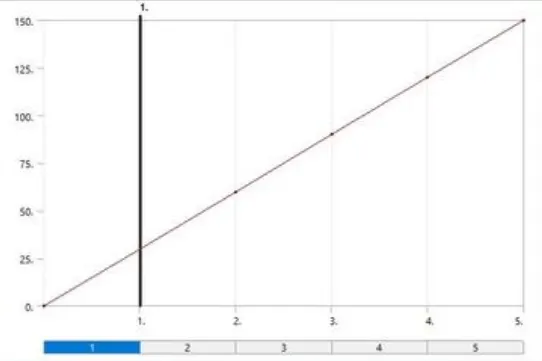
Rotation defined with an increment of 30 from 0 to `150^0`
RESULTS:
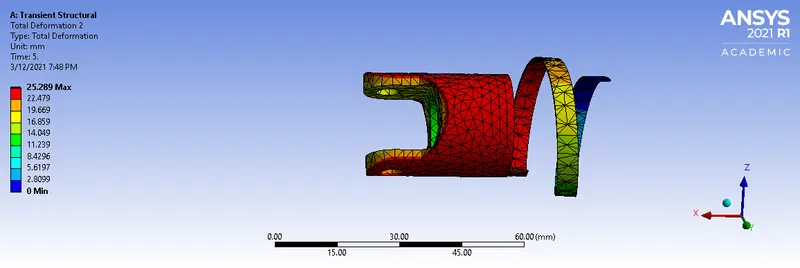
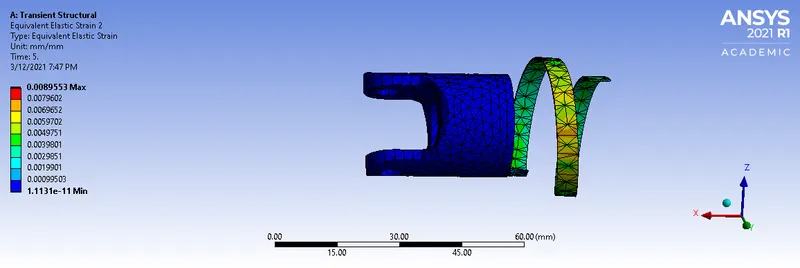
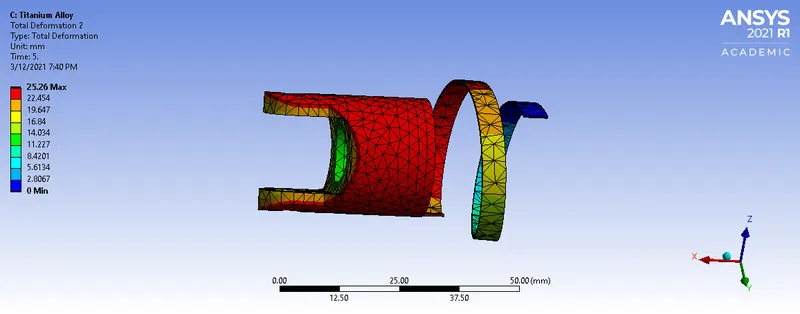
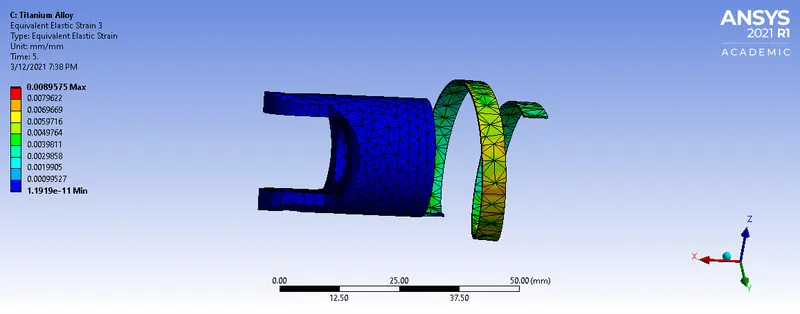
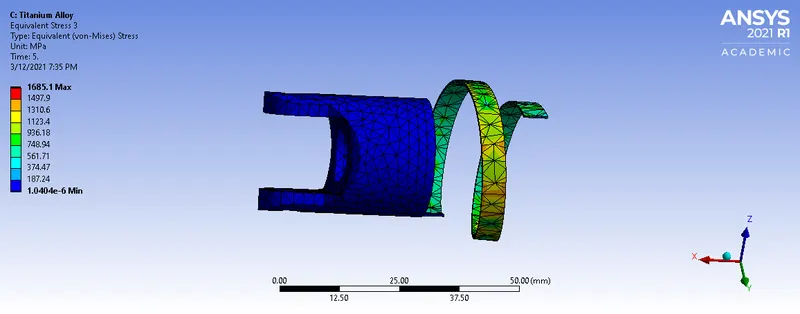
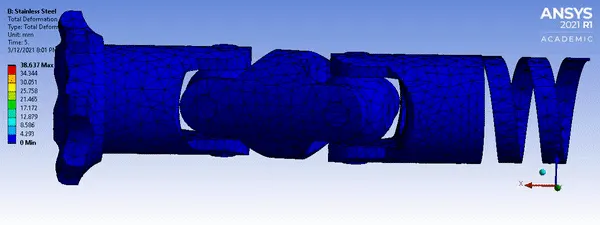
The simulation was run and we request for the total deformation,Von-mises stress and equivalent strain contours respectively from all the case studies
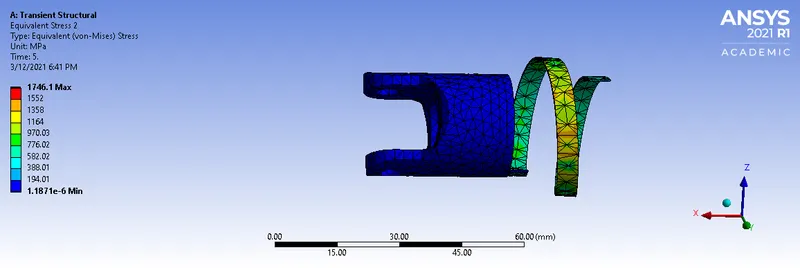
CASE 2:STAINLESS STEEL
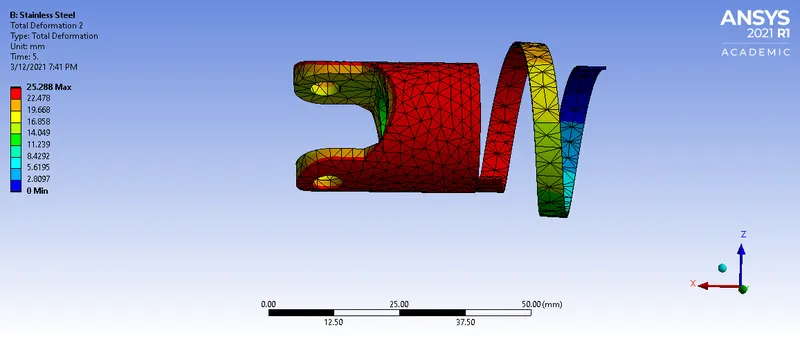
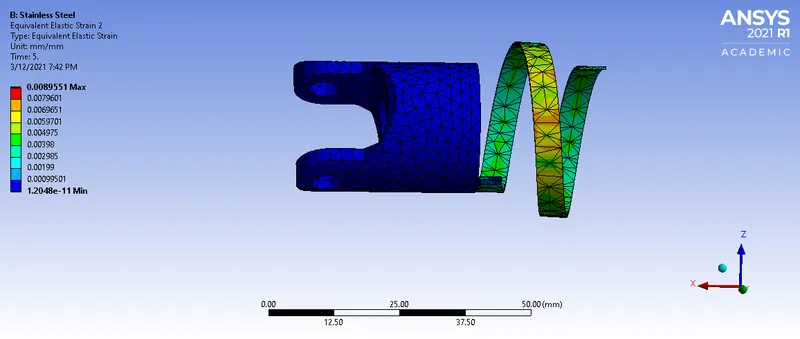
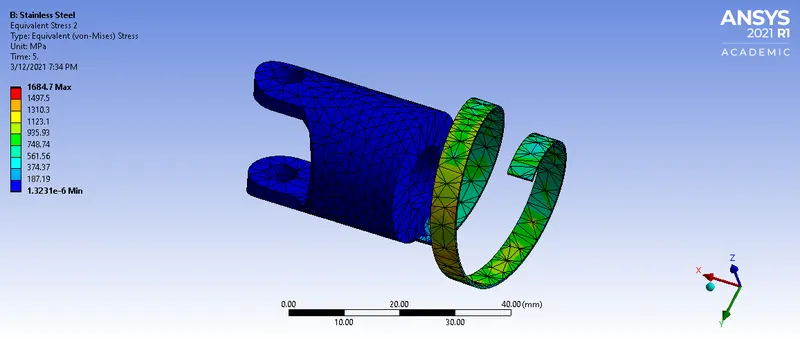
CASE 3:TITANIUM ALLOY
CONCLUSIONS:
The universal joint simulation was run successfully without any errors and respective results were plotted
| CASE MATERIAL | VON-MISES STRESS(Mpa) | EQUIVALENT STRAIN | TOTAL DEFORMATION(mm) |
| STRUCTURAL STEEL | 1746.1 | 0.0089553 | 25.289 |
| STAINLESS STEEL | 1684.7 | 0.0089551 | 25.288 |
| TITANIUM ALLOY | 1685.1 | 0.0089575 | 25.260 |
From the results, we can observe that Structural Steel gives higher stress than Stainless steel and Titanium Alloy . As we know that Titanium Alloy has a density of nearly half of the Structural Steel, so it is lightweight compared to Structural Steel and Stainless Steel, and so it is more flexible.
Also the equivalent strain is minimum for stainless steel compared to the other two materials
Here the maximum total deformation can be seen by the rotation of the joint.Here the rotation of the joint given is the same for all the cases, so we are getting a very minimal change for deformation for all cases
So from the results and observation, we can conclude that Stainless steel is very safe and effective material, which can give high performance and the mechanism of the Double Universal Joint, will be safe and can work longer.