Week 8 - Universal Joint
AIM: We will have to perform a transient structural analysis on a double universal joint with a spring
OBJECTIVE: The main objective of this challenge is to perform a Transient structural Analysis on a double universal joint with a spring using three different materials such as Structural Steel, Stainless Steel and Titanium alloy. And to obtain the Equivalent stress and total deformation for all the three cases and compare them.
INTRODUCTION:
A universal joint (universal coupling, U-joint, Cardan joint, Spicer or Hardy Spicer joint, or Hooke's joint) is a joint or coupling connecting rigid rods whose axes are inclined to each other, and is commonly used in shafts that transmit rotary motion. It consists of a pair of hinges located close together, oriented at 90° to each other, connected by a cross shaft. The universal joint is not a constant-velocity joint.
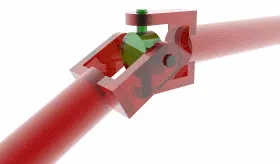
CASE-1: Structural Steel Material
PROCEDURE:
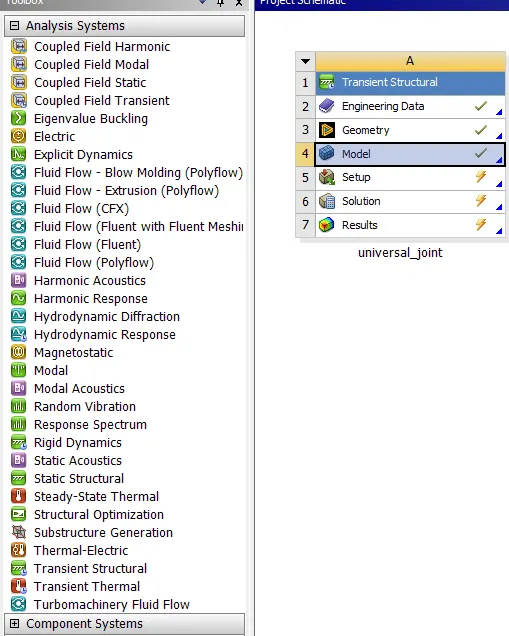
- Start the ANSYS Workbench and double click on Transient structural and rename it "Universal_joint".
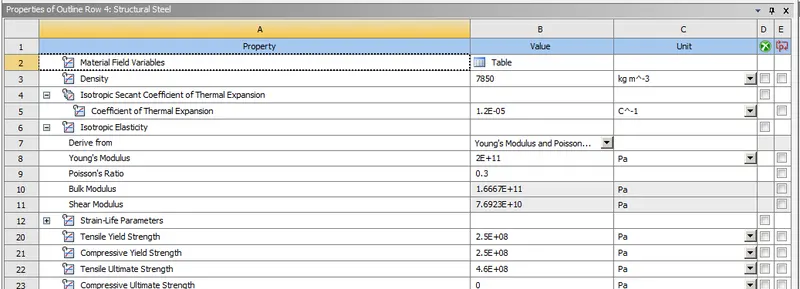
- Now double click on engineering data which is here structural steel as default,here we have to add 2 mode material for 2 cases,but for the first case i am going with structural steel only.
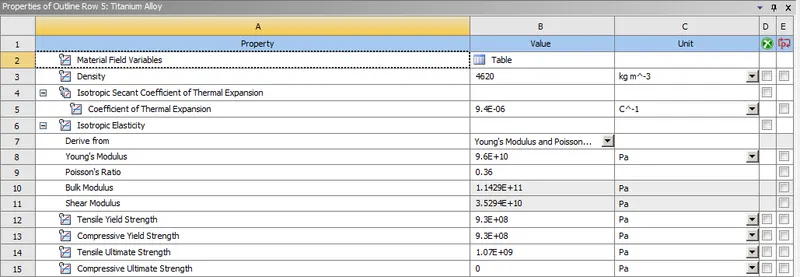
- After that right click on the geometry and import the geometry available in the question. And again right click and select edit in spaceclaim,their no changing required here.
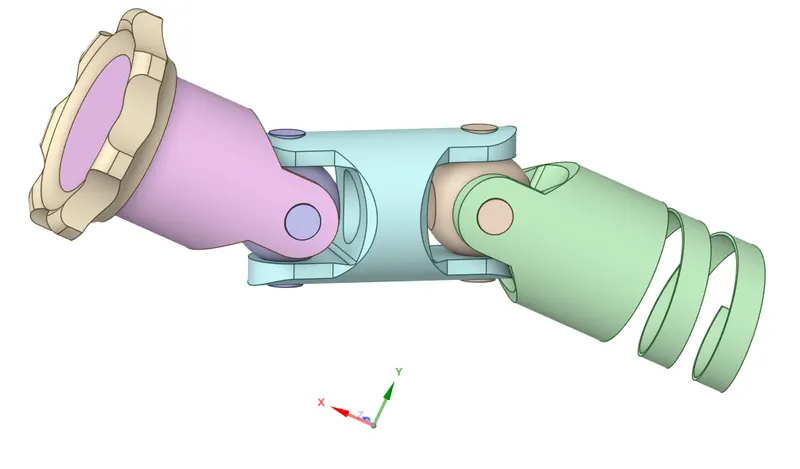
- After that we have to close the spaceclaim and right click on model and click on update,then double click to edit in mechanical.
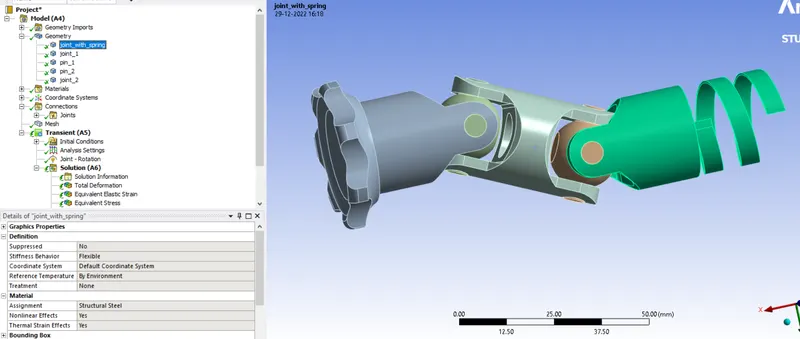
- Now click on geometry and rename it as shown above and change the material of joint_with_spring as structural steel which is here by default.
- Now in the connection part all the default contacts are to be deleted here not required so we directly go for the joints so total we have 11 joints out of them 3 are body to ground and rest is body to body revolute, all the joints are shown below.
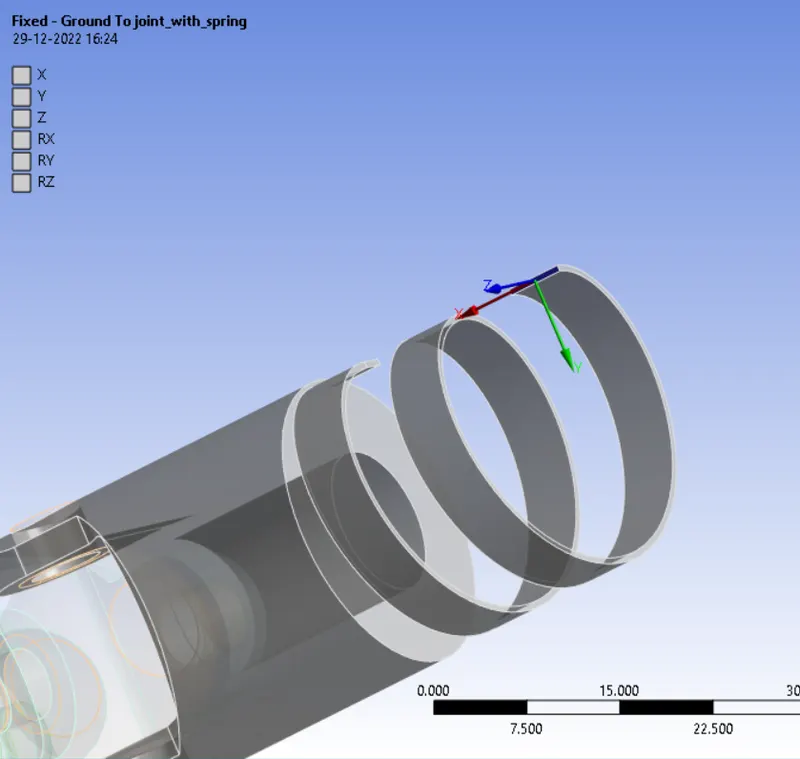
- This is fixed joint.
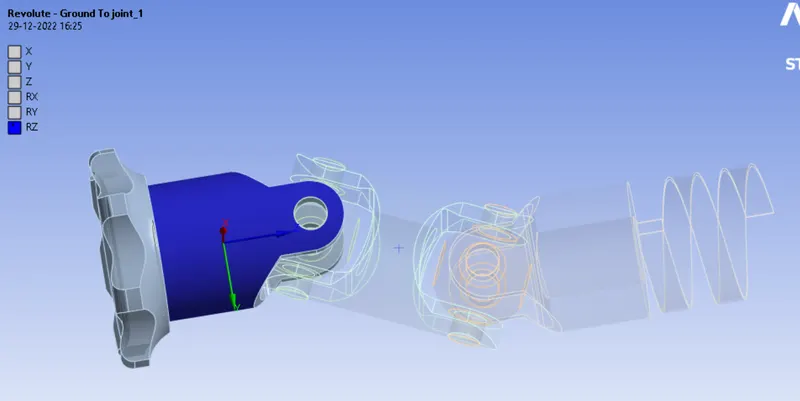
- Body to ground revolute joint.
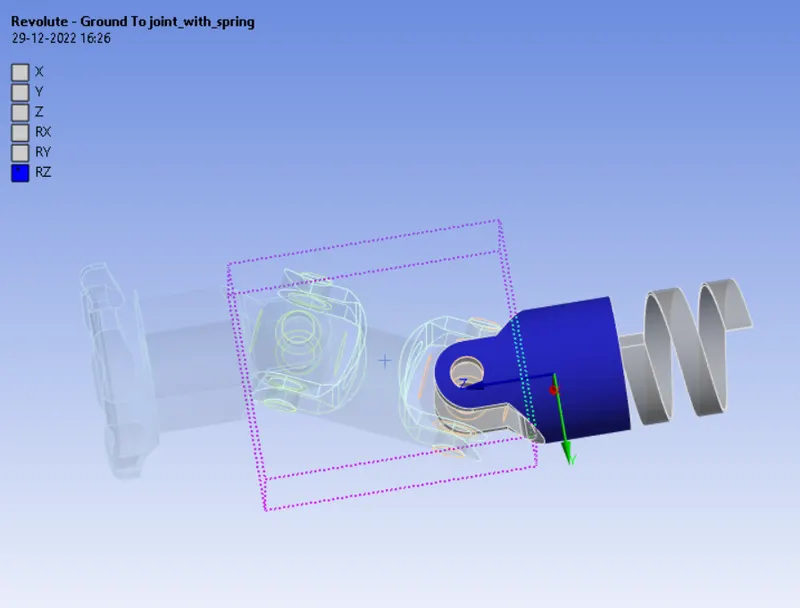
- body to ground revolute joints
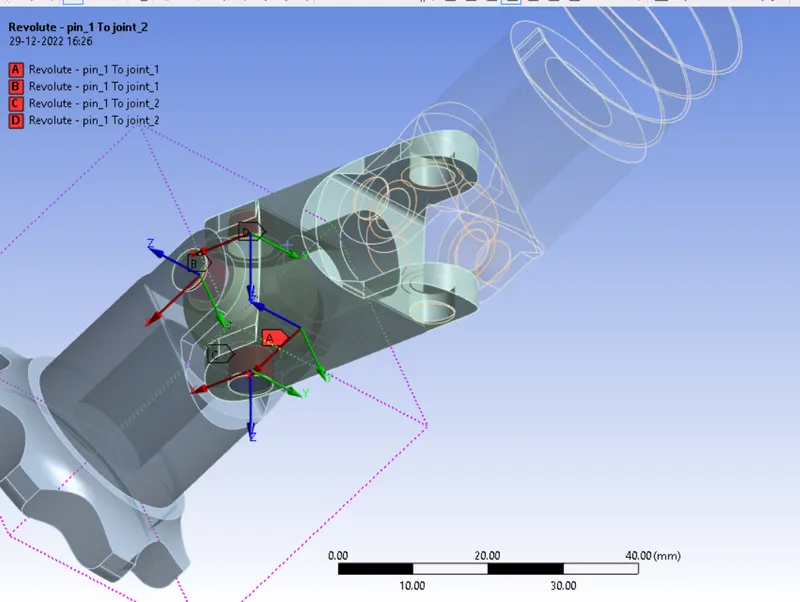
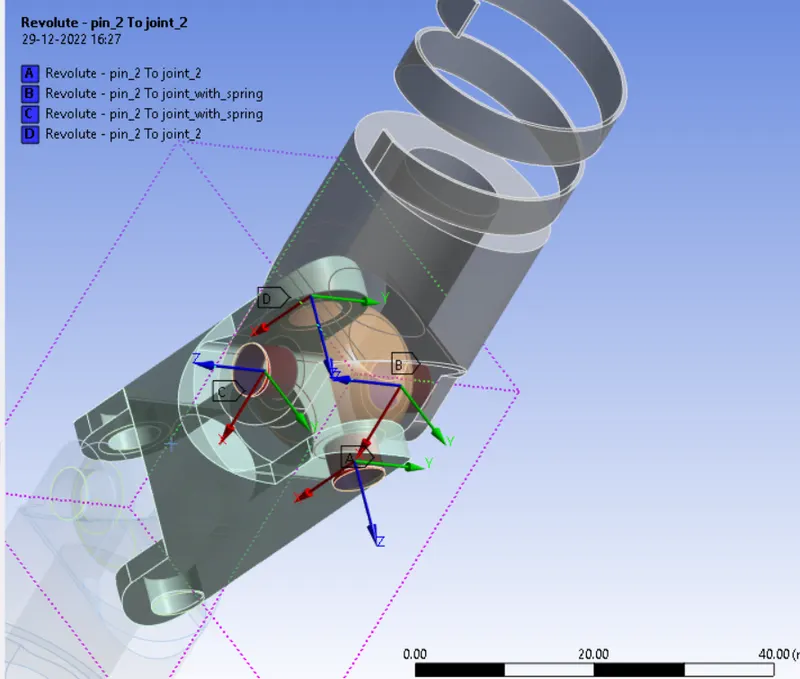
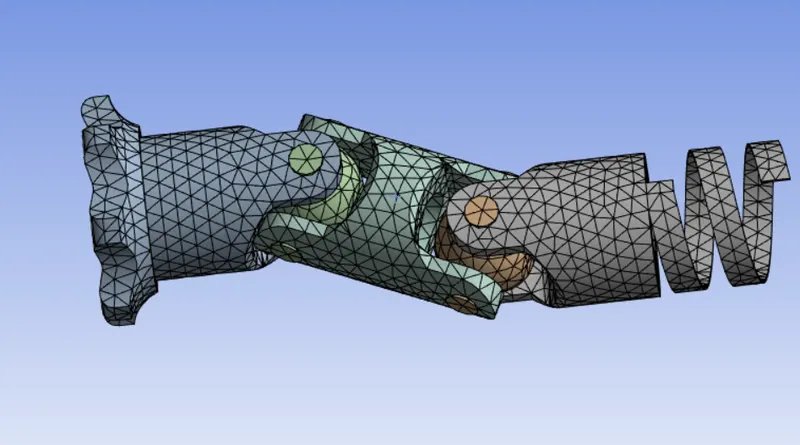
- Now for the mesh part i used here 3mm mesh size and no adeptive sizing and that is under the acadmic version size of element.
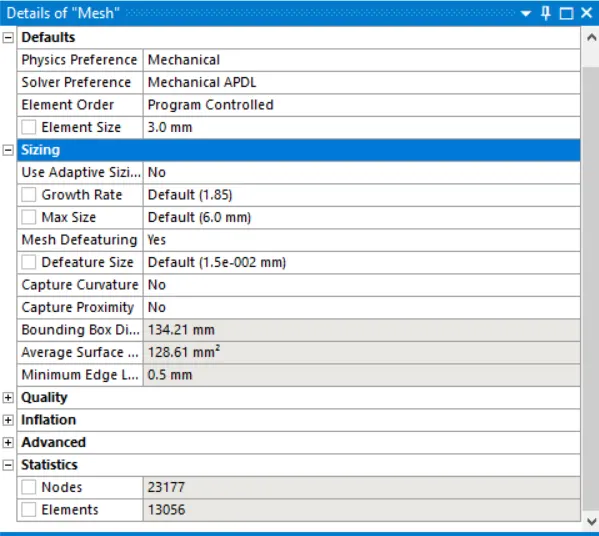
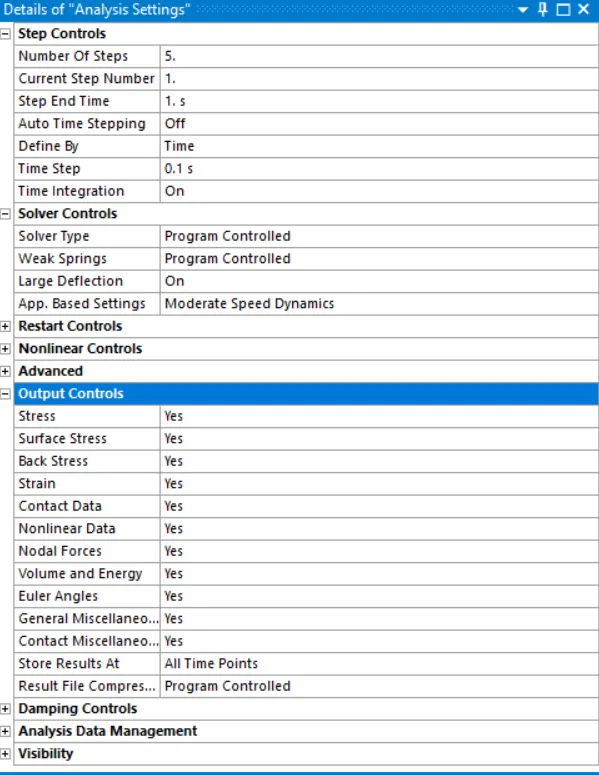
- Then the analysis setting we have taken this into 5 steps and auto time stepping is off here time step is 0.1,all the settings are shown below.
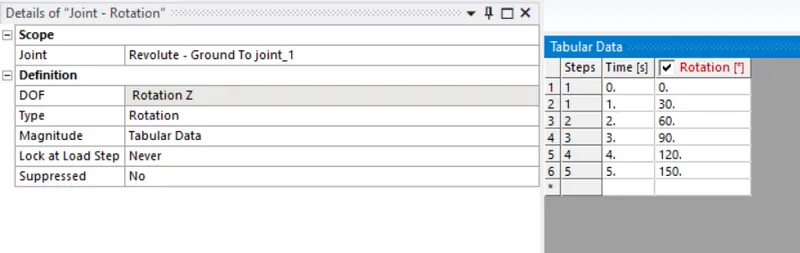
- Then give the boundry condition and here only one input that is rotational joint load to the joint_1 in tabular form.
- After that add all the output results that needed and click on solve.
Results:
Equivalent stress :
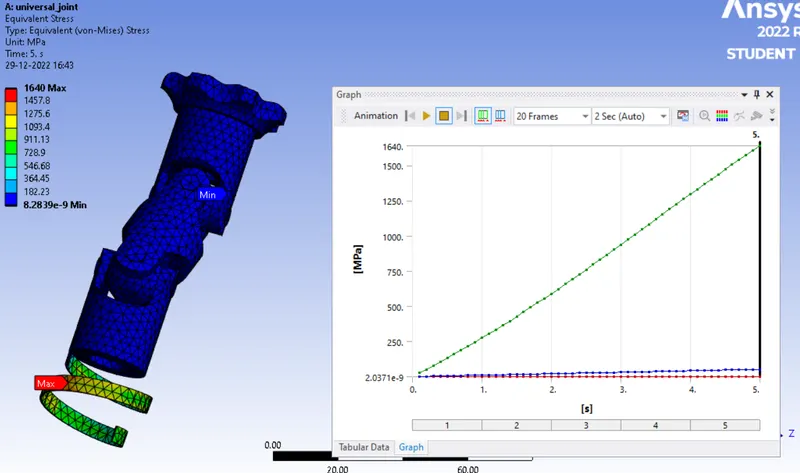
- The max stress generated is 1640 Mpa.
Total deformation:
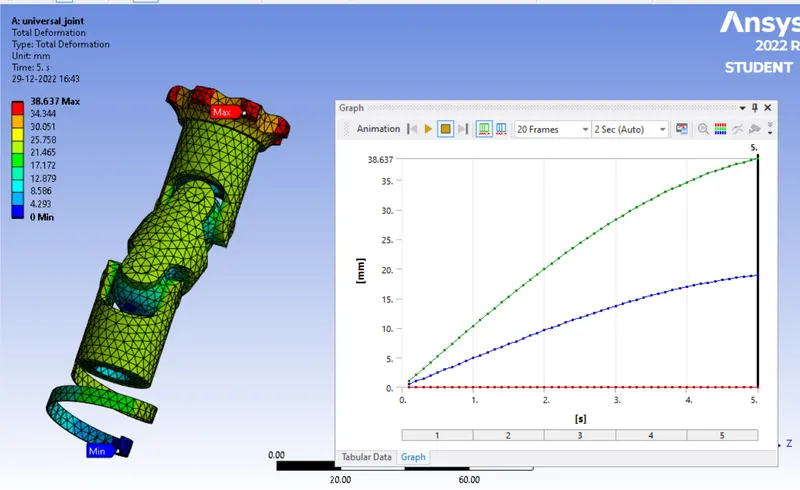
- The max deformation happened in the joint_1 is 38.637 mm.
CASE-2: Stainless Steel Material
Procedure:
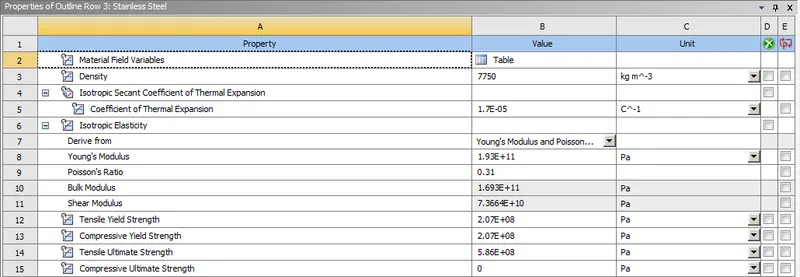
- Procedure is same nothing changed except the material for the "joint_with_spring" is stainless steel as shown below.
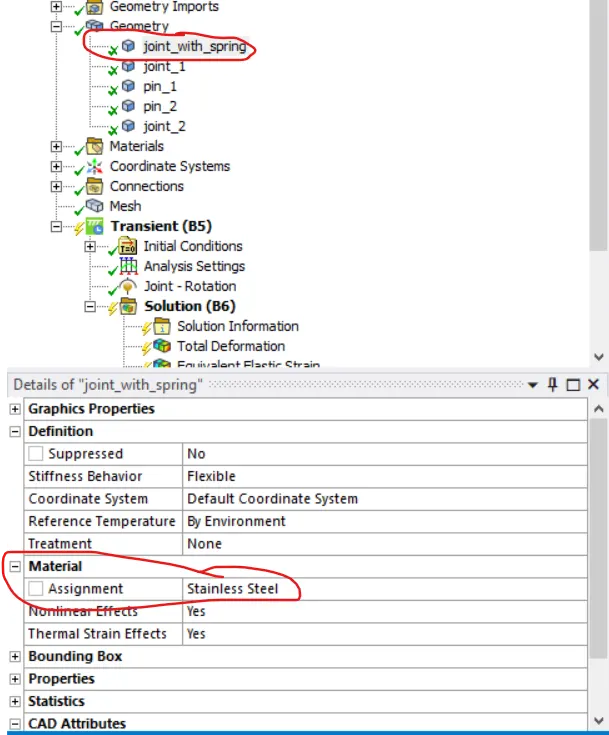
Results:
Equivalent stress :
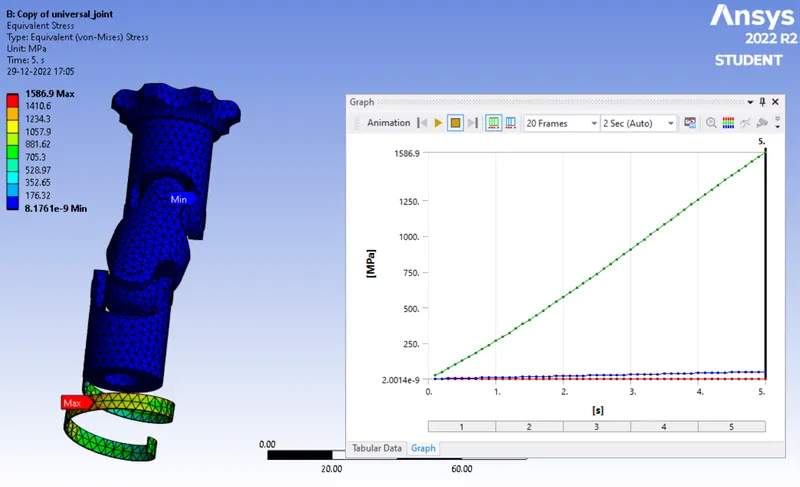
- The max stress generated is 1586.9 Mpa.
Total deformation:
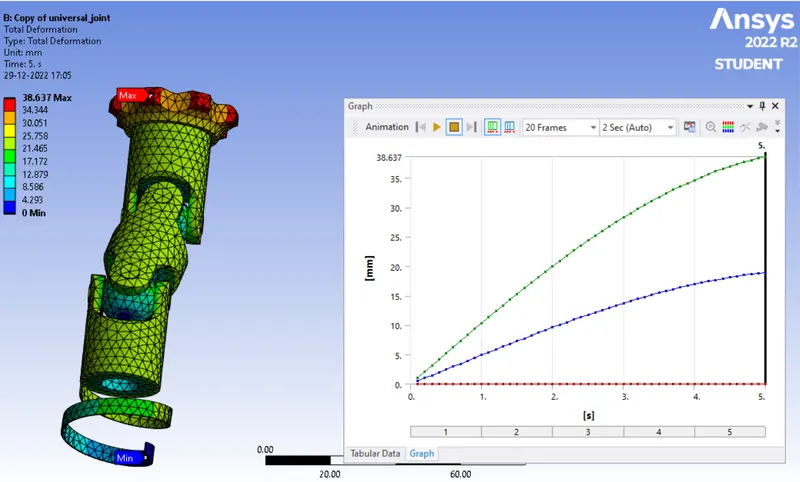
- The max deformation happened in the joint_1 is 38.637 mm.
CASE-3: Titanium alloy Material
Procedure:
- Procedure is same nothing changed except the material for the "joint_with_spring" is Titanium alloy as shown below.
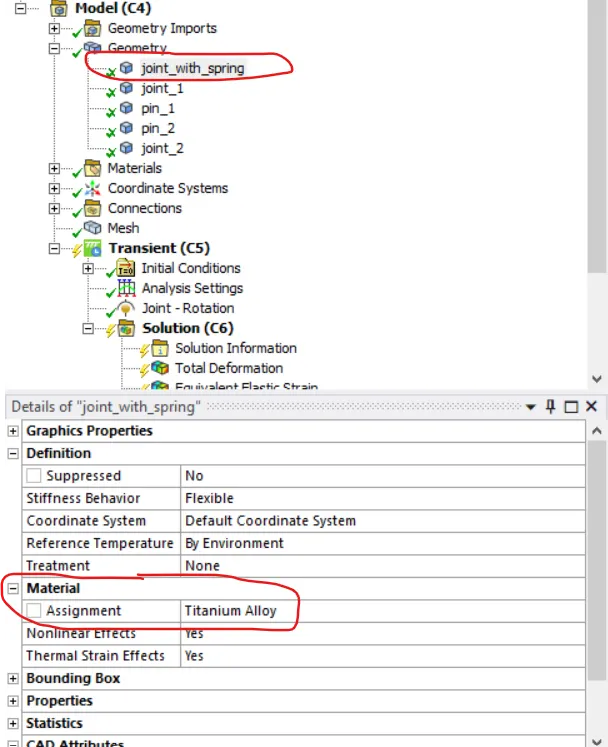
Results:
Equivalent stress :
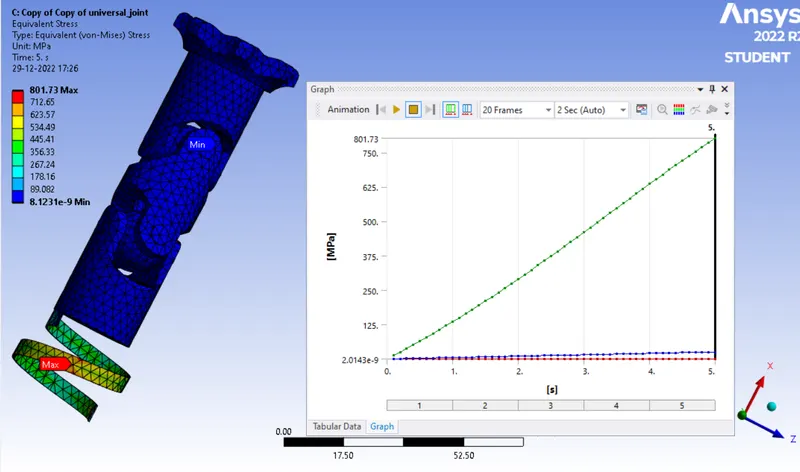
- The max stress generated is 801.73 Mpa.
Total deformation:
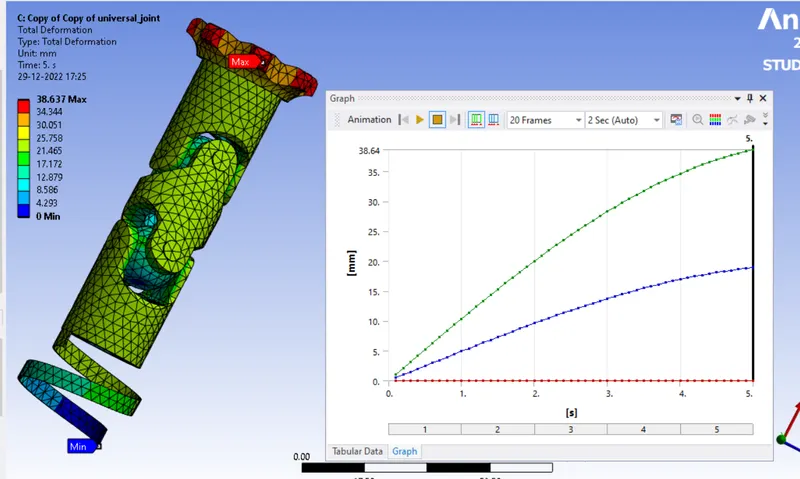
- The max deformation happened in the joint_1 is 38.637 mm.
Discussion:
| Cases | Material Used | Total Deformation (mm) | Max Equivalen Stress (Mpa) |
| Case-1 | Structural steel | 38.637 | 1640 |
| case-2 | stainless steel | 38.637 | 1586.9 |
| Case-3 | Titanium alloy | 38.637 | 801.73 |
- The max stress is generated in the case 1 which is 1640 Mpa where we used structural steel as the material,and lowest stress is generated in the case 3 which is 801.73 Mpa where the material is used for the join_with_spring is tintanium alloy.
- If we talk about the deformation so the deformation value is not affected by changing the material in all case, it is same in all cases which is 38.637 mm.
Conclusion:
- As per the stress generated among all three cases the lowest value of stress in case 3 where the titanium alloy is used as material at the same boundry condition.
- So we can choose the titanium alloy material based on stress generated.