Week 8 - Simulation of a backward facing step in OpenFOAM
Simulation of a backward facing step in OpenFOAM
AIM
To simulate a transient incompressible-laminar-viscous flow through the backward facing step geometry.
To compare the mesh from different meshes created using different grading factor.
CASE STUDIES
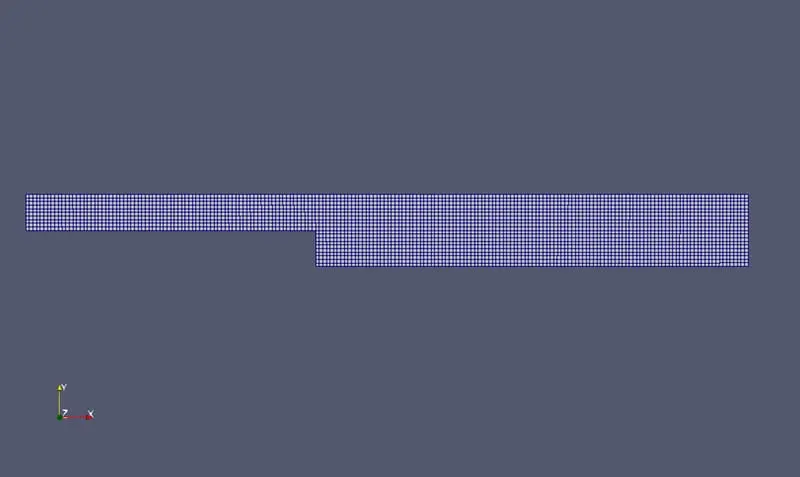
Simulate the flow without using grading factor;GF = 1.
Simulate the flow with grading factor of 0.2.
Mesh specification
- Number of cells along the x direction (longer dimension) = 200
- Number of cells along the longer y direction = 20.
DOMAIN
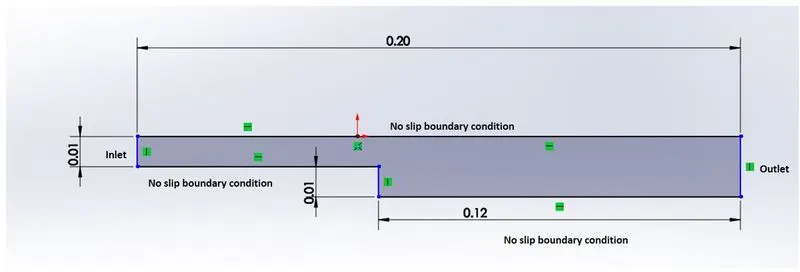
CODE EXPLANATION
First, call the tutorials, incompressible, icoFoam, cavity using the cd and ls command (cd = call directory ls = list).
Then copy the cavity directory from the tutorials to FOAM_RUN to work on it.
Call the FOAM_RUN, and then the system to change the blockMeshDict, controlDict, boundary, P, U the gedit command.
To check the simulation icofoam and PARA-FOAM is used.
CASE: 1
blockMeshDict
Verctices and grading factor are defined here
/*--------------------------------*- C++ -*----------------------------------*\
  =========                 |
  \\      /  F ield         | OpenFOAM: The Open Source CFD Toolbox
   \\    /   O peration     | Website:  https://openfoam.org
    \\  /    A nd           | Version:  9
     \\/     M anipulation  |
\*---------------------------------------------------------------------------*/
FoamFile
{
    format      ascii;
    class       dictionary;
    object      blockMeshDict;
}
// * * * * * * * * * * * * * * * * * * * * * * * * * * * * * * * * * * * * * //

convertToMeters 0.01;

vertices
(
    (0 0 0)   //vertex 0
    (8 0 0)   //vertex 1
    (8 0.5 0) //vertex 2
    (0 0.5 0) //vertex 3
    (8 1 0) //vertex 4
    (0 1 0) //vertex 5
    (20 1 0)//vertex 6
    (20 0.5 0)//vertex 7
    (20 0 0)//vertex 8
    (20 -1 0)//vertex 9
    (8 -1 0)//vertex 10
    (0 0 0.01)//vertex 11
    (8 0 0.01)//vertex 12
    (8 0.5 0.01)//vertex 13
    (0 0.5 0.01)//vertex 14
    (8 1 0.01)//vertex 15
    (0 1 0.01)//vertex 16
    (20 1 0.01)//vertex 17
    (20 0.5 0.01)//vertex 18
    (20 0 0.01)//vertex 19
    (20 -1 0.01)//vertex 20
    (8 -1 0.01)//vertex 21
);

blocks
(
    hex (0 1 2 3 11 12 13 14) (50 5 1) simpleGrading (1 1 1)
    hex (3 2 4 5 14 13 15 16) (50 5 1) simpleGrading (1 1 1)
    hex (2 7 6 4 13 18 17 15) (150 5 1) simpleGrading (1 1 1)
    hex (1 8 7 2 12 19 18 13) (150 5 1) simpleGrading (1 1 1)
    hex (10 9 8 1 21 20 19 12) (150 20 1) simpleGrading (1 1 1)
);

edges
(
);

boundary
(
    inlet
    {
        type patch;
        faces
        (
            (0 11 14 3)
            (3 14 16 5)
        );
    }
    outlet
    {
        type patch;
        faces
        (
            (9 8 19 20)
            (8 7 18 19)
            (7 6 17 18)
        );
    }
    walls
    {
        type wall;
        faces
        (
            (16 15 4 5)
            (15 17 6 4)
            (10 9 20 21)
            (10 21 12 1)
            (0 1 12 11)
        );
    }
);

mergePatchPairs
(
);

// ************************************************************************* //
controlDict
The start and end time is provided here
/*--------------------------------*- C++ -*----------------------------------*\
  =========                 |
  \\      /  F ield         | OpenFOAM: The Open Source CFD Toolbox
   \\    /   O peration     | Website:  https://openfoam.org
    \\  /    A nd           | Version:  9
     \\/     M anipulation  |
\*---------------------------------------------------------------------------*/
FoamFile
{
    format      ascii;
    class       dictionary;
    location    "system";
    object      controlDict;
}
// * * * * * * * * * * * * * * * * * * * * * * * * * * * * * * * * * * * * * //

application     icoFoam;

startFrom       startTime;

startTime       0;

stopAt          endTime;

endTime         10;

deltaT          1e-2;

writeControl    timeStep;

writeInterval   20;

purgeWrite      0;

writeFormat     ascii;

writePrecision  6;

writeCompression off;

timeFormat      general;

timePrecision   6;

runTimeModifiable true;


// ************************************************************************* //
boundary
/*--------------------------------*- C++ -*----------------------------------*\
  =========                 |
  \\      /  F ield         | OpenFOAM: The Open Source CFD Toolbox
   \\    /   O peration     | Website:  https://openfoam.org
    \\  /    A nd           | Version:  9
     \\/     M anipulation  |
\*---------------------------------------------------------------------------*/
FoamFile
{
    format      ascii;
    class       polyBoundaryMesh;
    location    "constant/polyMesh";
    object      boundary;
}
// * * * * * * * * * * * * * * * * * * * * * * * * * * * * * * * * * * * * * //

4
(
    inlet
    {
        type            patch;
        nFaces          10;
        startFace       9770;
    }
    outlet
    {
        type            patch;
        nFaces          30;
        startFace       9780;
    }
    walls
    {
        type            wall;
        inGroups        List 1(wall);
        nFaces          420;
        startFace       9810;
    }
    defaultFaces
    {
        type            empty;
        inGroups        List 1(empty);
        nFaces          10000;
        startFace       10230;
    }
)

// ************************************************************************* //
pressure
/*--------------------------------*- C++ -*----------------------------------*\
  =========                 |
  \\      /  F ield         | OpenFOAM: The Open Source CFD Toolbox
   \\    /   O peration     | Website:  https://openfoam.org
    \\  /    A nd           | Version:  9
     \\/     M anipulation  |
\*---------------------------------------------------------------------------*/
FoamFile
{
    format      ascii;
    class       volScalarField;
    object      p;
}
// * * * * * * * * * * * * * * * * * * * * * * * * * * * * * * * * * * * * * //

dimensions      [0 2 -2 0 0 0 0];

internalField   uniform 0;

boundaryField
{
    inlet
    {
        type            zeroGradient;
    }

    outlet
    {
        type            fixedValue;
        value           uniform 0;
    }

    walls
    {
         type            zeroGradient;
    }
}

// ************************************************************************* //
velocity
/*--------------------------------*- C++ -*----------------------------------*\
  =========                 |
  \\      /  F ield         | OpenFOAM: The Open Source CFD Toolbox
   \\    /   O peration     | Website:  https://openfoam.org
    \\  /    A nd           | Version:  9
     \\/     M anipulation  |
\*---------------------------------------------------------------------------*/
FoamFile
{
    format      ascii;
    class       volVectorField;
    object      U;
}
// * * * * * * * * * * * * * * * * * * * * * * * * * * * * * * * * * * * * * //

dimensions      [0 1 -1 0 0 0 0];

internalField   uniform (0 0 0);

boundaryField
{
    inlet
    {
        type            fixedValue;
        value           uniform (0.02 0 0);
    }

    outlet
    {
        type            zeroGradient;
    }

    walls
    {
        type            noSlip;
    }
}

// ************************************************************************* //
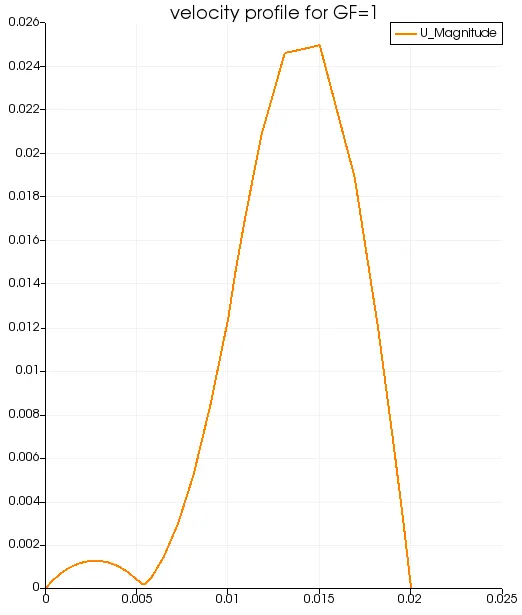
The velocity profile at 0.085 m from the inlet of the geometry
CASE :2
blockMeshDict (for GF = 0.2)
/*--------------------------------*- C++ -*----------------------------------*\
  =========                 |
  \\      /  F ield         | OpenFOAM: The Open Source CFD Toolbox
   \\    /   O peration     | Website:  https://openfoam.org
    \\  /    A nd           | Version:  9
     \\/     M anipulation  |
\*---------------------------------------------------------------------------*/
FoamFile
{
    format      ascii;
    class       dictionary;
    object      blockMeshDict;
}
// * * * * * * * * * * * * * * * * * * * * * * * * * * * * * * * * * * * * * //

convertToMeters 0.01;

vertices
(
    (0 0 0)   //vertex 0
    (8 0 0)   //vertex 1
    (8 0.5 0) //vertex 2
    (0 0.5 0) //vertex 3
    (8 1 0) //vertex 4
    (0 1 0) //vertex 5
    (20 1 0)//vertex 6
    (20 0.5 0)//vertex 7
    (20 0 0)//vertex 8
    (20 -1 0)//vertex 9
    (8 -1 0)//vertex 10
    (0 0 0.01)//vertex 11
    (8 0 0.01)//vertex 12
    (8 0.5 0.01)//vertex 13
    (0 0.5 0.01)//vertex 14
    (8 1 0.01)//vertex 15
    (0 1 0.01)//vertex 16
    (20 1 0.01)//vertex 17
    (20 0.5 0.01)//vertex 18
    (20 0 0.01)//vertex 19
    (20 -1 0.01)//vertex 20
    (8 -1 0.01)//vertex 21
);

blocks
(
    hex (0 1 2 3 11 12 13 14) (50 5 1) simpleGrading (0.2 5 1)
    hex (3 2 4 5 14 13 15 16) (50 5 1) simpleGrading (0.2 0.2 1)
    hex (2 7 6 4 13 18 17 15) (150 5 1) simpleGrading (5 0.2 1)
    hex (1 8 7 2 12 19 18 13) (150 5 1) simpleGrading (5 5 1)
    hex (10 9 8 1 21 20 19 12) (150 20 1) simpleGrading (5 5 1)
);

edges
(
);

boundary
(
    inlet
    {
        type patch;
        faces
        (
            (0 11 14 3)
            (3 14 16 5)
        );
    }
    outlet
    {
        type patch;
        faces
        (
            (9 8 19 20)
            (8 7 18 19)
            (7 6 17 18)
        );
    }
    walls
    {
        type wall;
        faces
        (
            (16 15 4 5)
            (15 17 6 4)
            (10 9 20 21)
            (10 21 12 1)
            (0 1 12 11)
        );
    }
);

mergePatchPairs
(
);

// ************************************************************************* //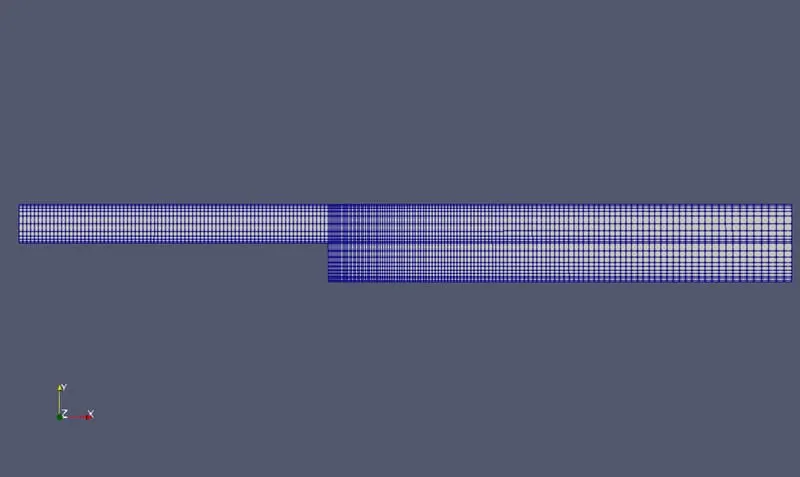
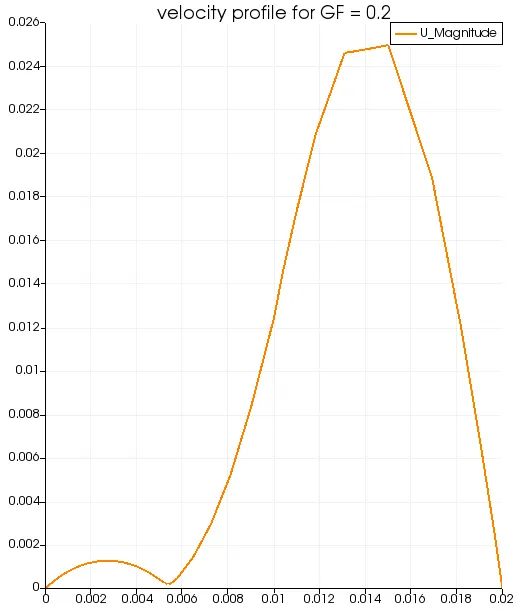
The velocity profile at 0.085 m from the inlet of the geometry
Reason why Grading/Growth factor is essential for meshing
Grading factor helps us to refine or focus on the particular phase where the vectors act instead of focusing on the whole domain.
CONCLUSION
Thus the simulation of a transient incompressible-laminar-viscous flow through the backward facing step geometry for the given domain is done.
Also, the mesh using 2 different grading factors is done and comparing them, we can see that there isn't much difference