Week 8 - Simulating Cyclone separator with Discrete Phase Modelling
Aim :
To perform analysis on cyclone separator and calculate the separation efficiency and pressure drop.
Objective :
- To write a few words about any four empirical models used to calculate the cyclone separator efficiency.
- To perform an analysis on a given cyclone separator model by varying the particle diameter from 1 μm to5 μm and calculate the separation efficiency in each case. Discuss the results. [Use both the velocity's as 3m/sec.]
- To perform an analysis on a given cyclone separator model by varying the particle velocity from 1m/sec to 5 m/sec and calculate the separation efficiency and pressure drop in each case. Discuss the results. [Use particle diameter size as 5 μm for all cases & keep flow velocity same as particle velocity]
Introduction :
Cyclone separator are an economical device for removing particulate solids from a fluid system. Particle along with a working fluid gets introduced via a stream through inlet, the induced centrifugal force is tangentially imparted on the wall of the cyclone cylinder. This force, with the density difference between the fluid and solid, increases the relative settling velocity. The heavier particle tends to slid down and are trapped in the lower outlet pane. Though the cyclone separator are highly efficient, but its efficiency varies given the particle size and flow velocity. The particles sometimes tend to escape with the working fluid making it less efficient.
Working Principle Of Cyclone Separator :
- The feed is introduced tangentially at very high velocity and acquires an intense vortex motion, which is moving downwards into the cylindrical chamber, also known as Barrel
- Due to this high centrifugal force,the heavier particles collides with the walls of the chamber and eventually it slides down to the bottom of the outlet
- The velocity of the stream increases as it reaches the conical base region due to the decrease in area which results in increase of centrifugal forces which in turn creates a low pression region along the axis of the cyclone separator, then the stream(clean air) carrying finer particles with them comes out from the top outlet and the denser particles(dirt) collide with the walls and eventually comes out from the bottom outlet.
Four common Empirical models for Cyclone Separator Efficiency:
- Iozia and Leith Model:
Iozia and Leith logistic Model is a modified version of the Barth (1956) model which is developed based on force balance. The model assumes that a particle carried by the Iozia and Leith logistic Model is a modified version of the Barth (1956) model which is developed based on force balance. The model assumes that a particle carried by the vortex endures the influence of two forces: a centrifugal force Z, and flow resistance, W.
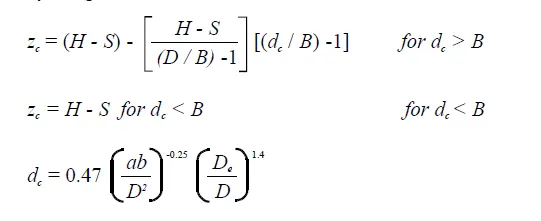
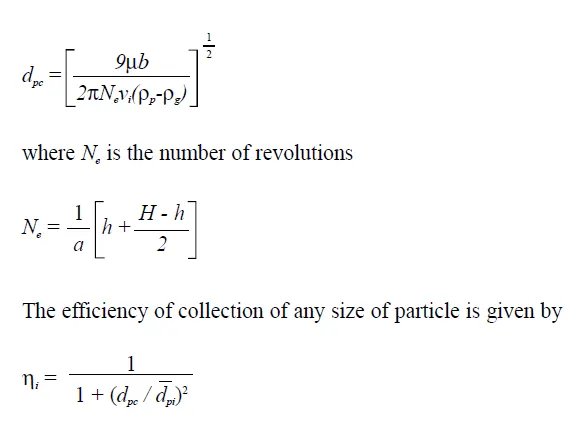
ozia and Leith's additions to the original Barth model are the core length zc and slope parameter expression, which are derived from statistical analysis of experimental data from a cyclone with D = 0.25 m. From the particle diameter, the collection efficiency( ηi) may be derived using the following expression shown below
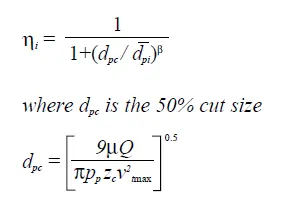
- Li and Wang Model:
The Li and Wang model include particle bounce or re-entrainment and turbulent diffusion at the cyclone wall. A two-dimensional analytical expression of particle distribution in the cyclone is obtained. Li and Wang's model was developed based on the following assumptions.The radial particle velocity and the radial concentration profile are not constant, for uncollected particles within the cyclones.
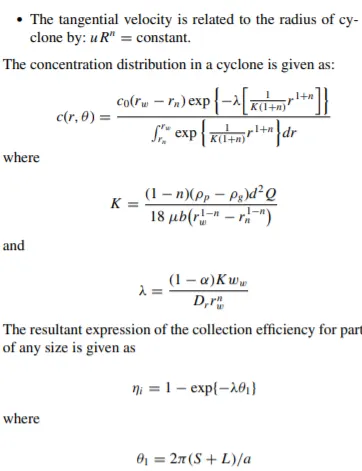
- Koch and Licht Model:
Koch and Licht collection theory recognized the inherently turbulent nature of cyclones and the distribution of gas residence times within the cyclone.
Koch and Licht describe particle motion in the entry and collection regions with the additional following assumptions:
- The tangential velocity of a particle is equal to the tangential velocity of the gas flow, i.e. there is no slip in the tangential direction between the particle and the gas.
- The tangential velocity is related to the radius of cyclone by uRn =constant.
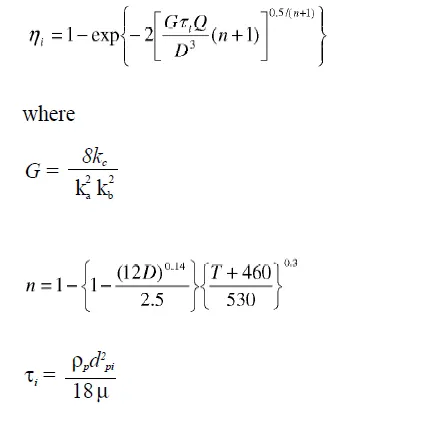
- Lapple Model:
Lapple model was developed based on force balance without considering the flow resistance. Lapple assumed that a particle entering the cyclone is evenly distributed across the inlet opening. The particle that travels from inlet half-width to the wall in the cyclone is collected with 50% efficiency.
GEOMENTRY SETUP :
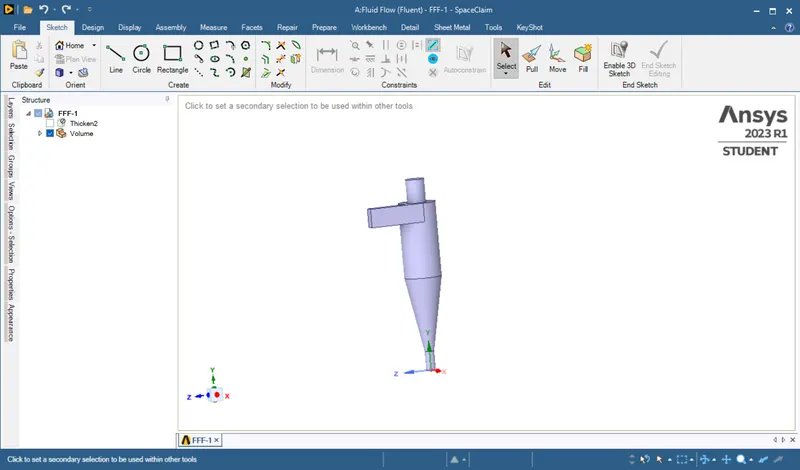
- Just import the model from the problem by opening the space claim .
- Create the fluid volume by selecting the edges with the help of volume extract option under repair menu in the space claim.
- For the outer shell apply the supress for physics, so that we can only have the extracted volume.
MESH :
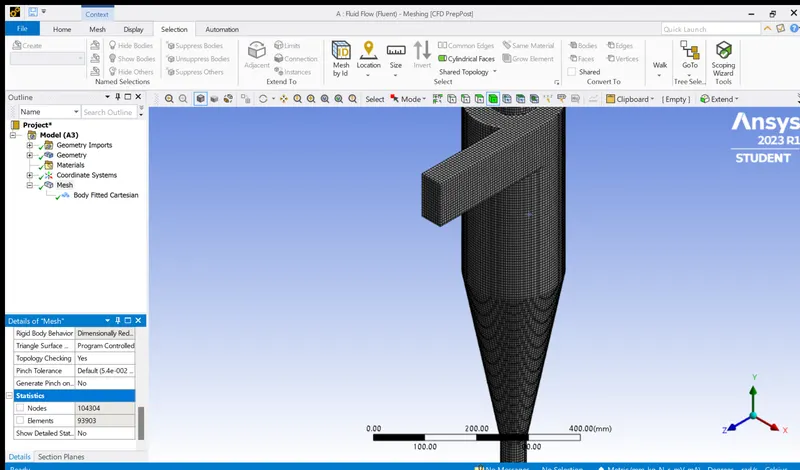
- Created geomentry is opened in the mesh module and give generate mesh.
- Given mesh size is 0.005mm and use the structural mesh which gives the better result, so cutcell meshing (cartesian cell) approach is used .
Mesh - Insert - Method - select full model - switch the element to cartesian
SETUP SOLUTION :
- After the mesh open the set up modul and here we have to set the condition like physics, boundery conditions, type of analysics, Solution setups and the requried output.
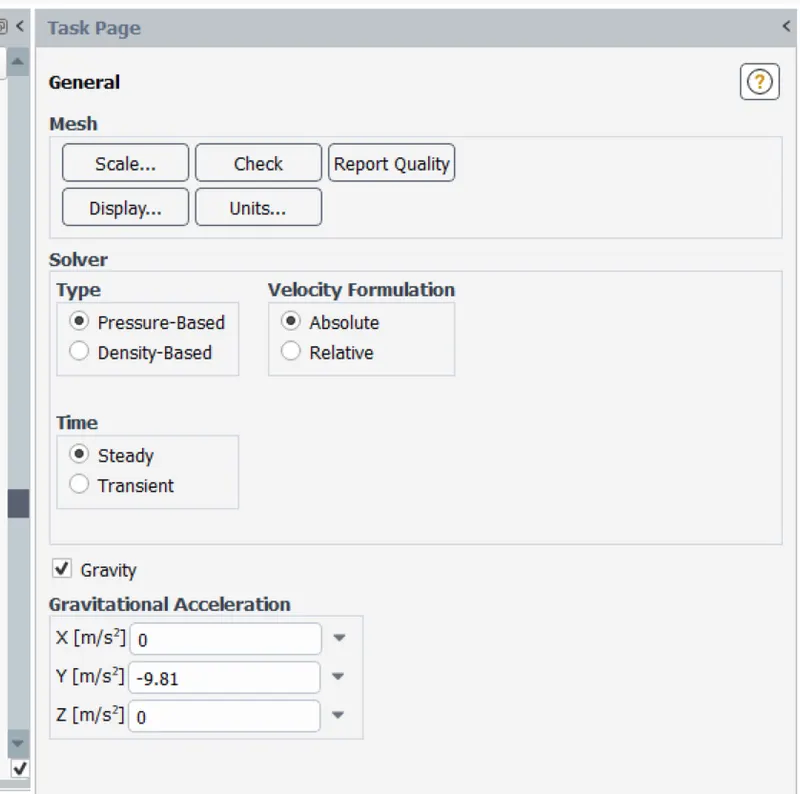
- Here enable the steady state solver because we don't need simulation results for each and every seconds so we need to consider the result of final stage. Pressure based is used because the velocity of air is low ( less than 0.3 of mach number ) and enable gravity with Y axis as -9.81 .
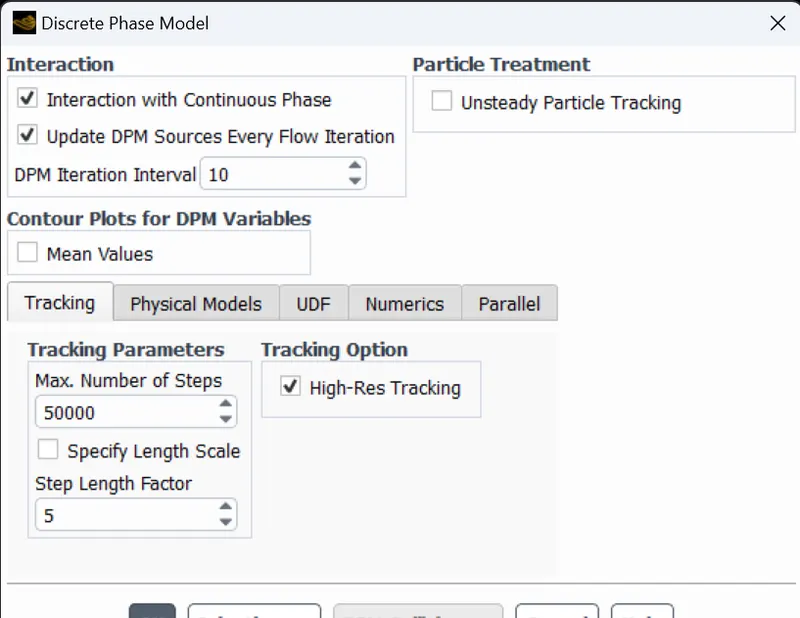
- Select the discrete phase option in the physics tab and enable the continuous phase which is used to exceed the energy between particle and fluid. DPM iteration is set to be default 10.
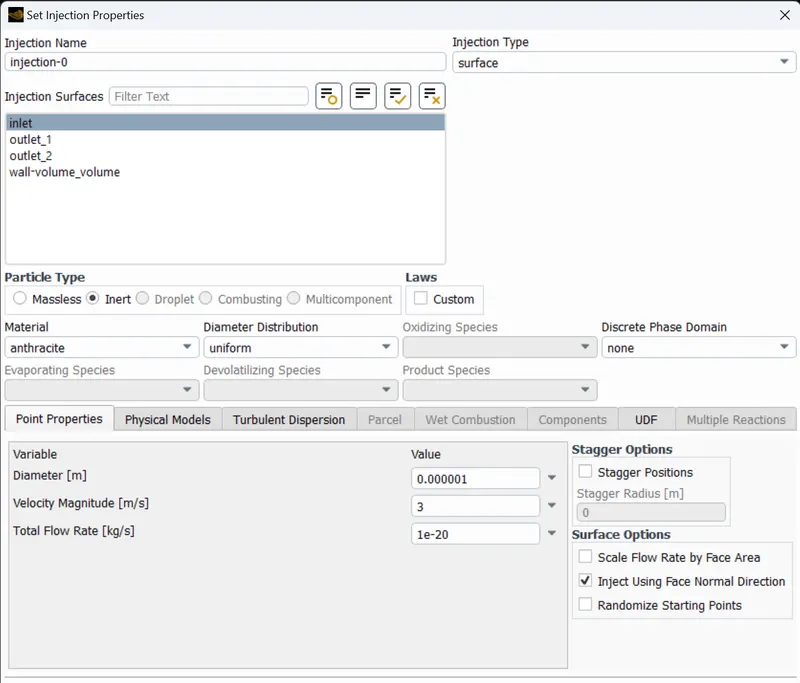
- Select the Injection which is found below the discrete phase tab and create the new injection by selecting the type as surface and surface as inlet and material as anthracite and enable the face normal option and set the particle size and velocity.
Boundary Conditions:-
Inlet - Reflect
Outlet 1 - Escape
Outlet 2 - Trap
- Select the Method and enable the Coupled as we used steady state and choose the second orde in the momentum so that it gives good results but takes more memory and time.
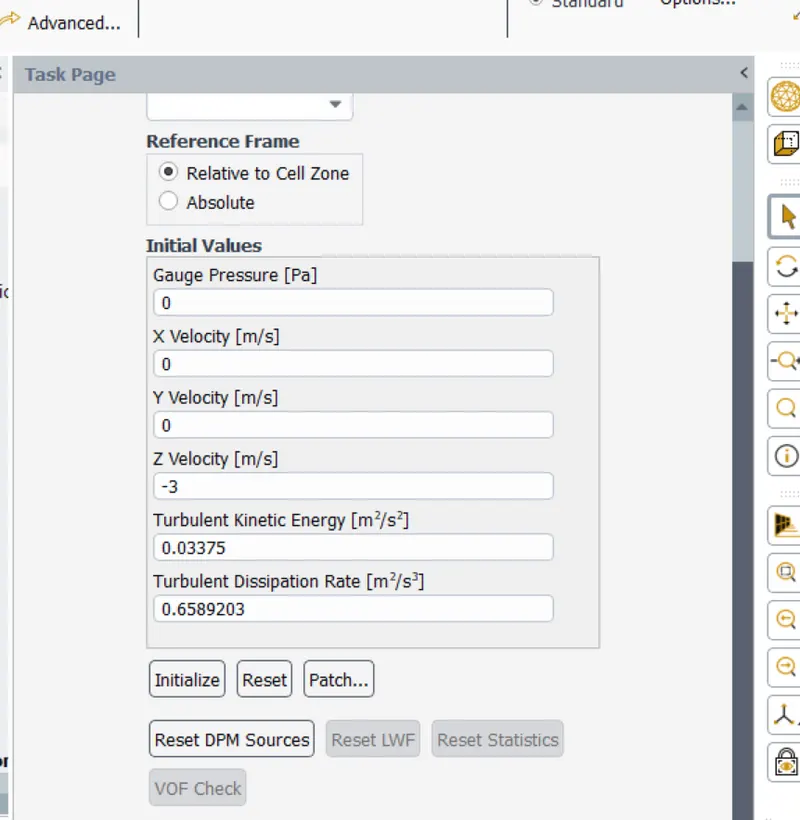
- Initialize with standard initialization as it solve based on the boundaries( select the inlet ).
RESULT :
CASE 1 :
PARTICAL DIAMETER = 1 μm
PARTICAL VELOCITY = 3 m/s
RESIDUAL PLOT :
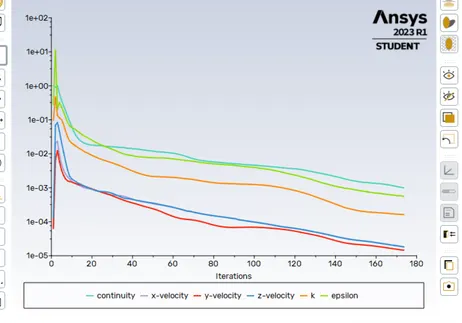
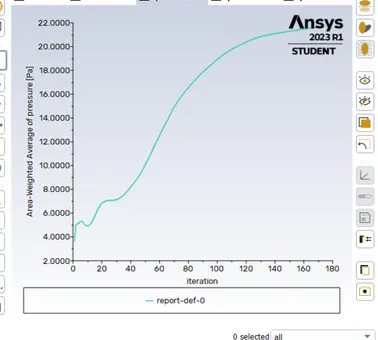
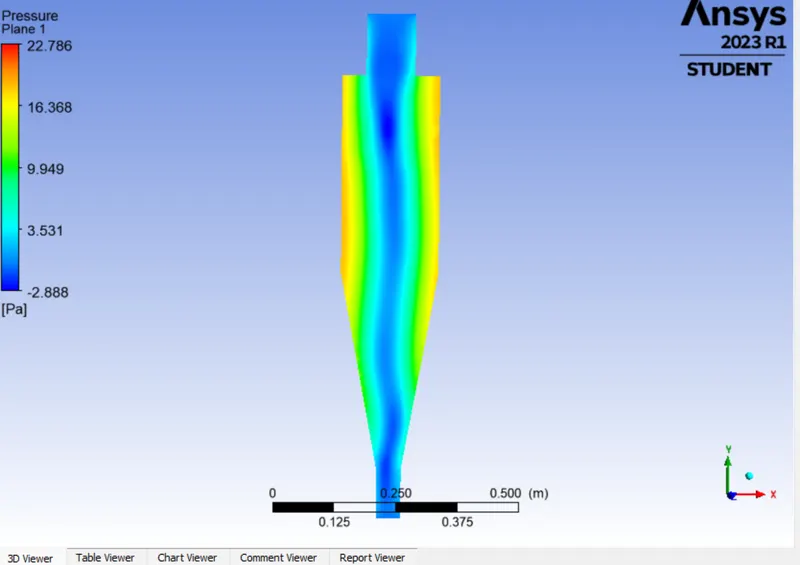
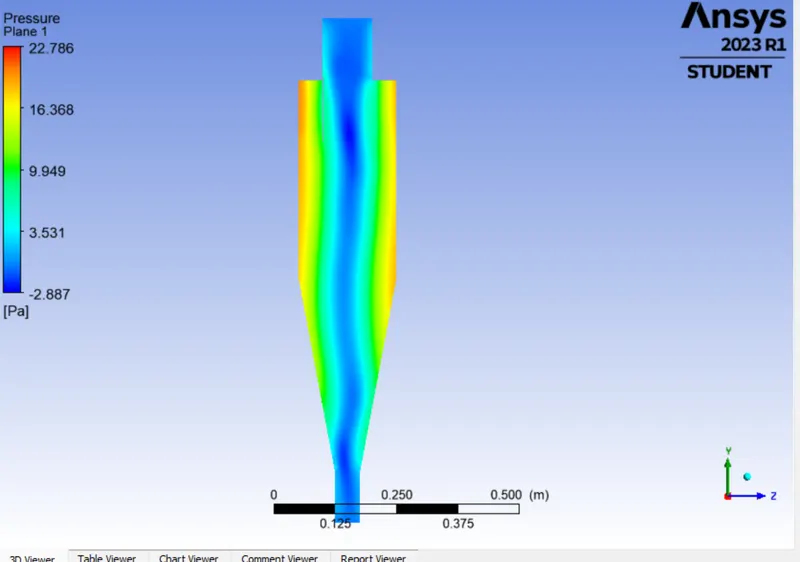
PRSSURE CONTOUR :
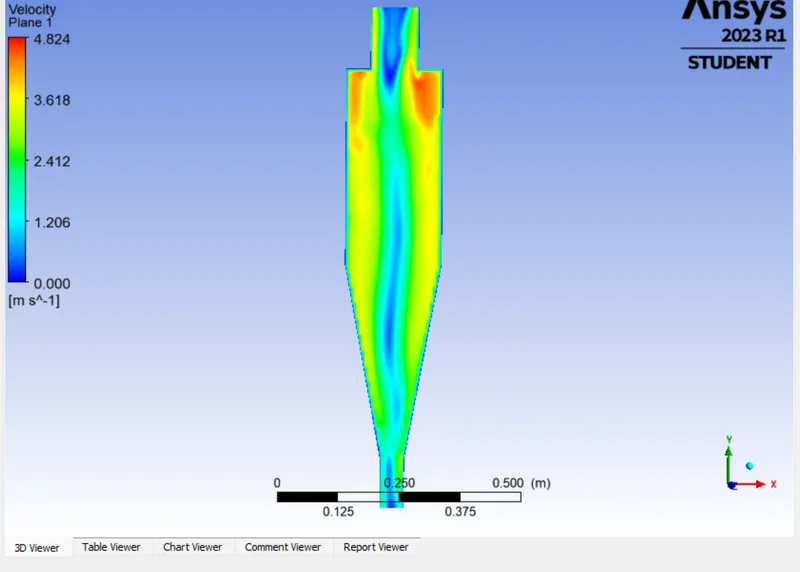
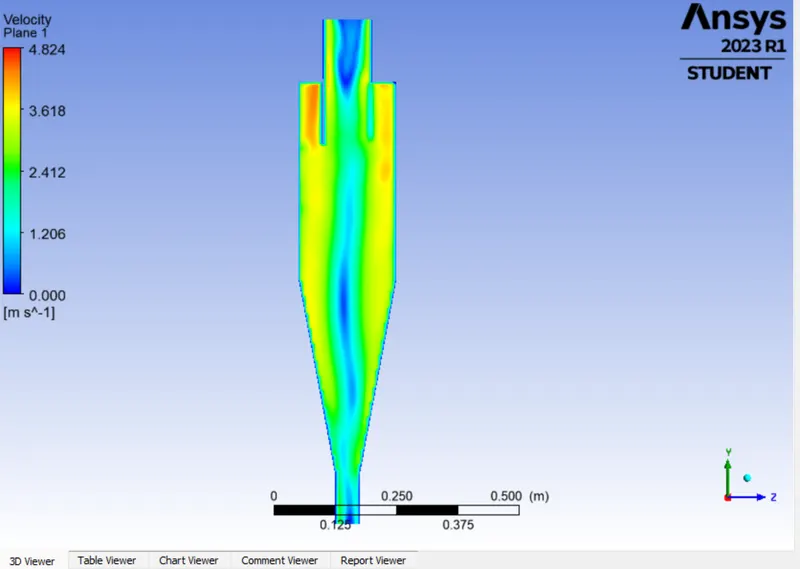
VELOCITY CONTOUR :
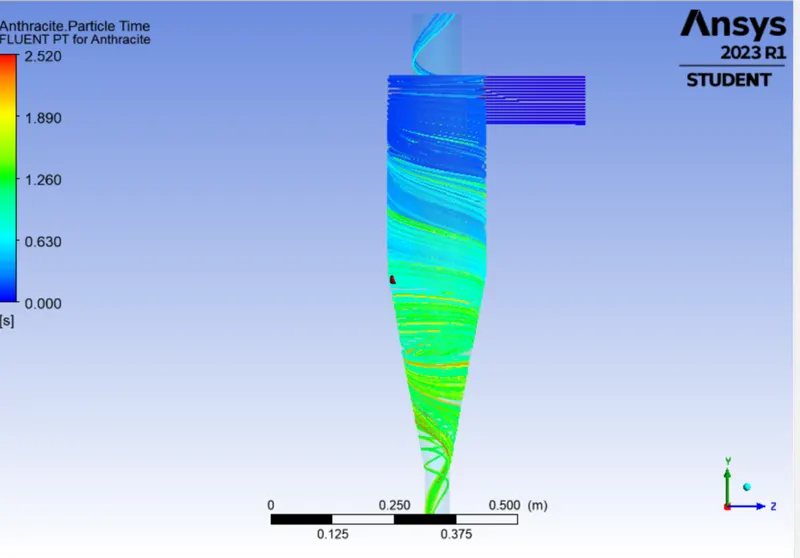
PARTICLE RESIDUAL TIME :
Animation Link :
https://drive.google.com/file/d/1p2mZPRIIg30Dw5T-EgDuKhOsXrJII4ig/view?usp=share_link
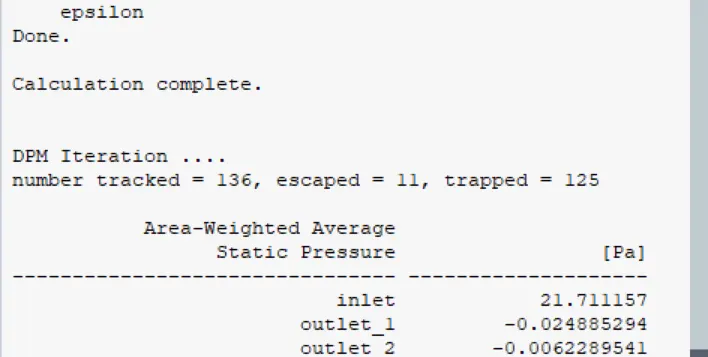
Seperation Efficiency = (No of particles trapped/No of particles tracked)x 100 = (125/136)x100=91.91%
Pressure drop = Inlet pressure - Total outlet pressure
= 21.711157 - (-0.024885294+(-0.0062289541)) = 21.742 Pa
CASE 2 :
PARTICAL DIAMETER = 3 μm
PARTICAL VELOCITY = 3 m/s
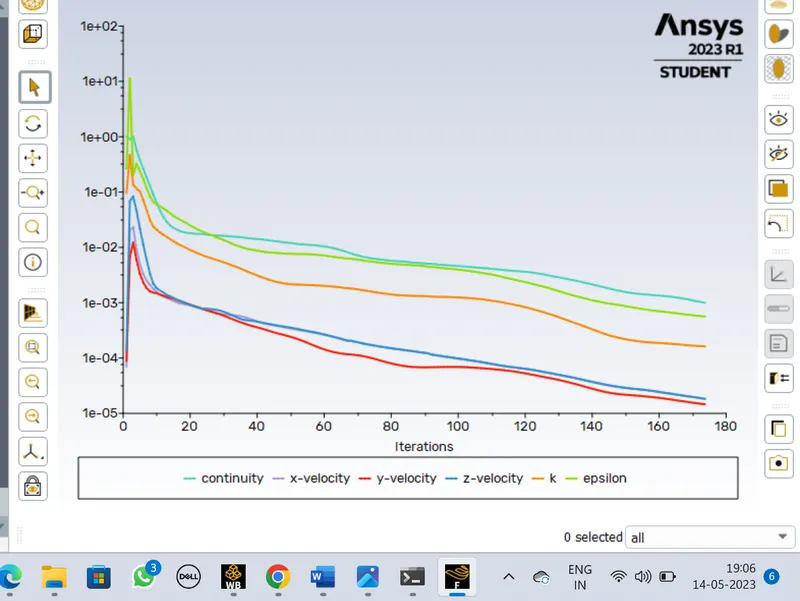
RESIDUAL PLOT :
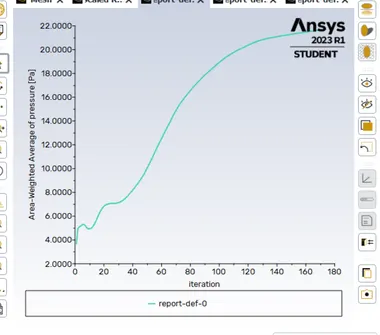
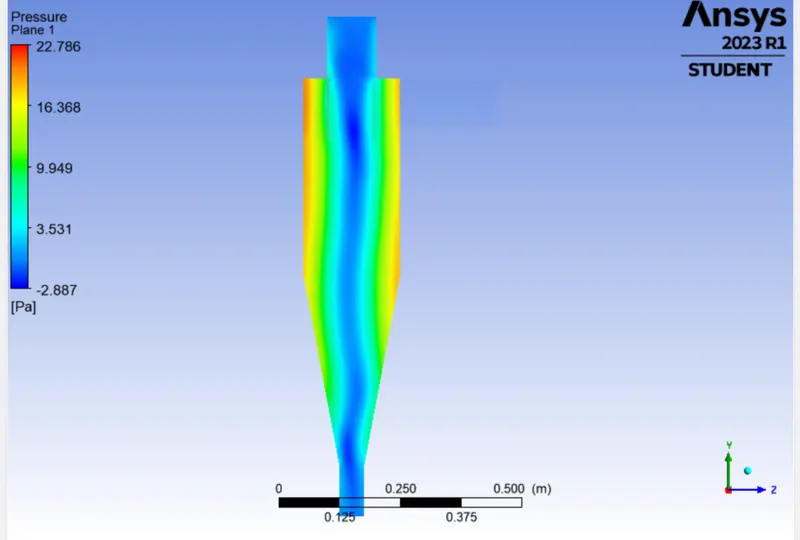
PRSSURE CONTOUR :
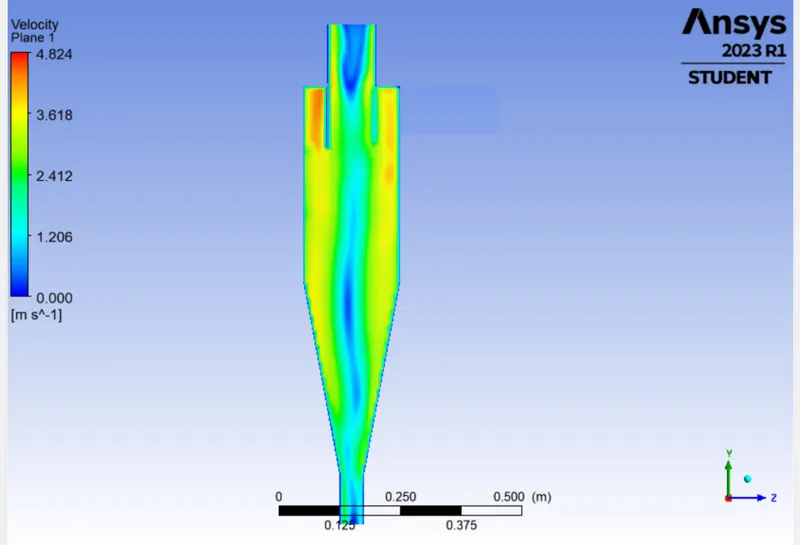
VELOCITY CONTOUR :
PARTICLE RESIDUAL TIME :
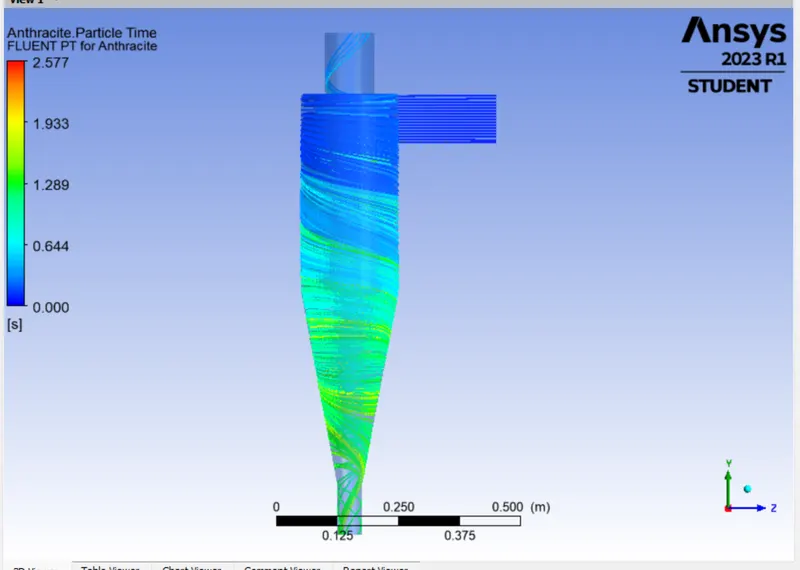
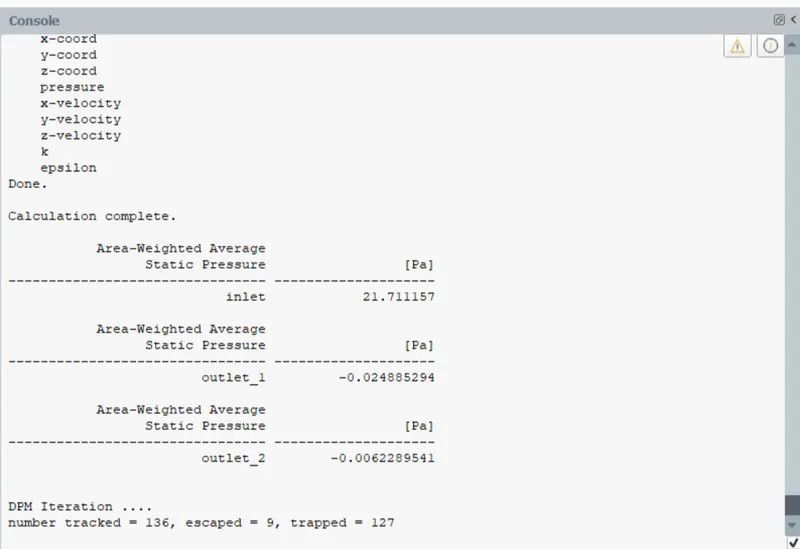
Seperation Efficiency = (No of particles trapped/No of particles tracked)x 100 = (127/136)x100=93.38%
Pressure drop = Inlet pressure - Total outlet pressure
= 21.711157 - (-0.024885294+(-0.0062289541)) = 21.742 Pa
CASE 3:
PARTICAL DIAMETER = 5 μm
PARTICAL VELOCITY = 3 m/s
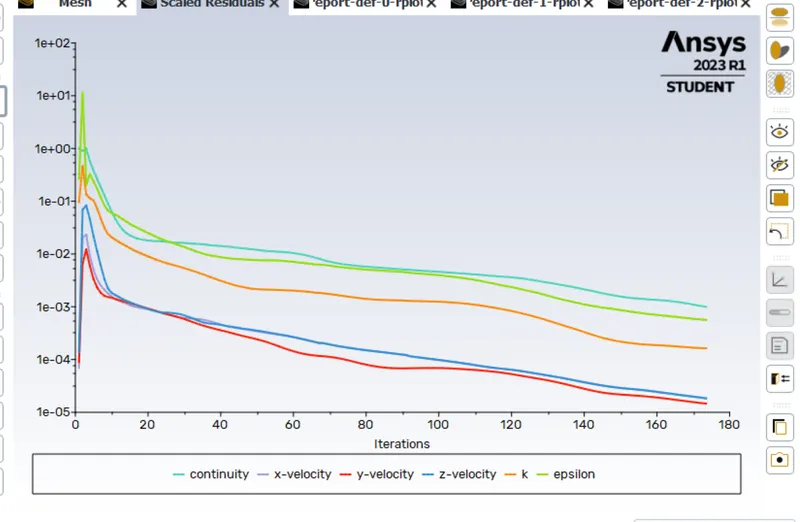
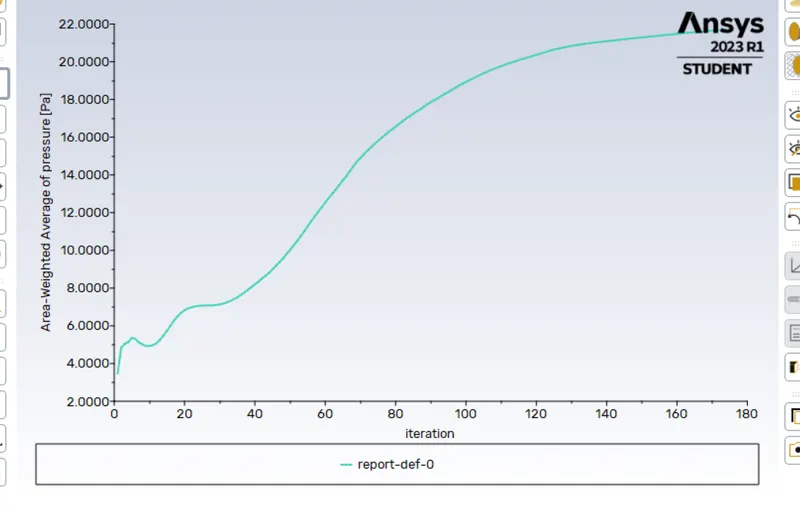
RESIDUAL PLOT :
PRSSURE CONTOUR :
VELOCITY CONTOUR :
PARTICLE RESIDUAL TIME :
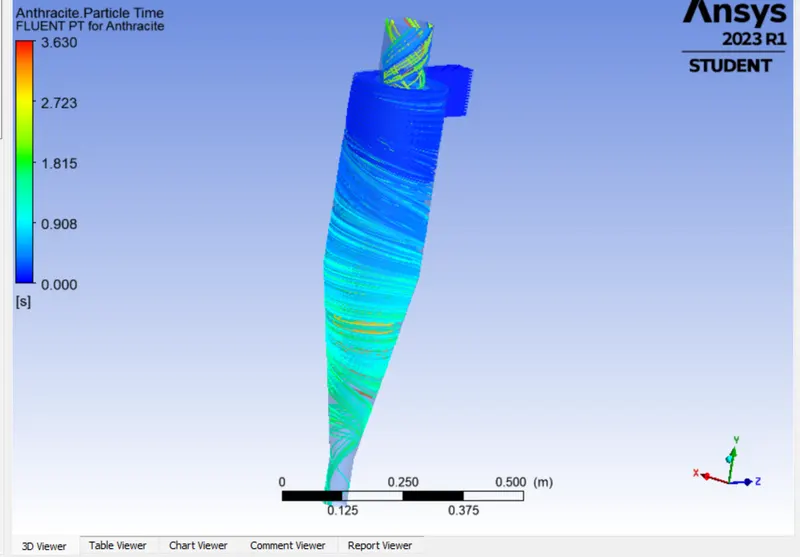
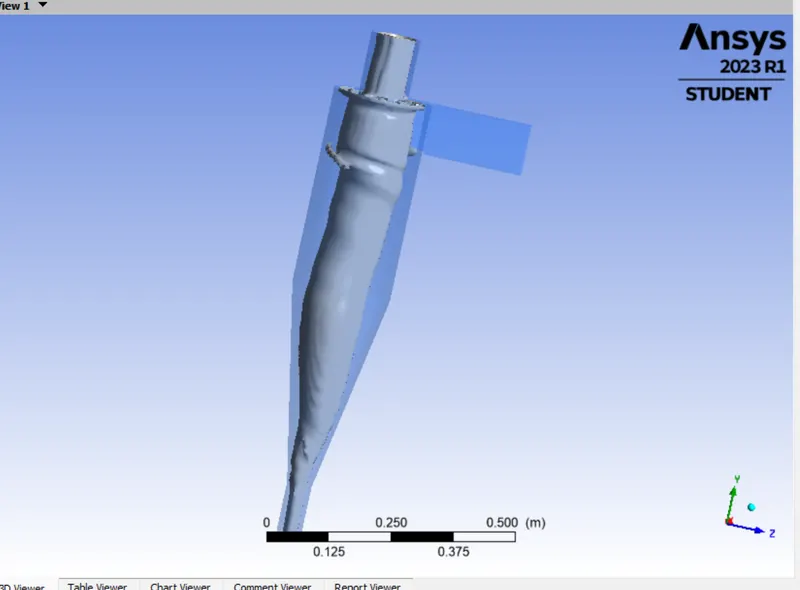
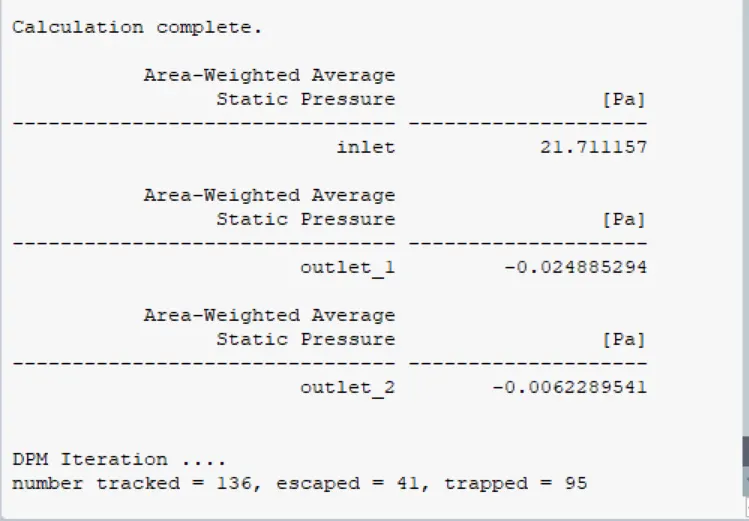
Seperation Efficiency = (No of particles trapped/No of particles tracked)x 100 = (95/136)x100=69.85%
Pressure drop = Inlet pressure - Total outlet pressure
= 21.711157 - (-0.024885294+(-0.0062289541)) = 21.742 Pa
Case 1 :
PARTICAL DIAMETER = 5 μm
PARTICAL VELOCITY = 1 m/s
RESIDUAL PLOT :
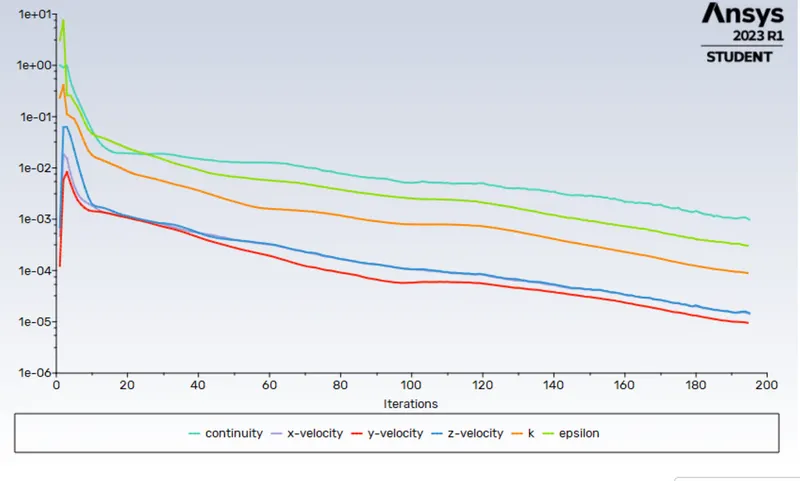
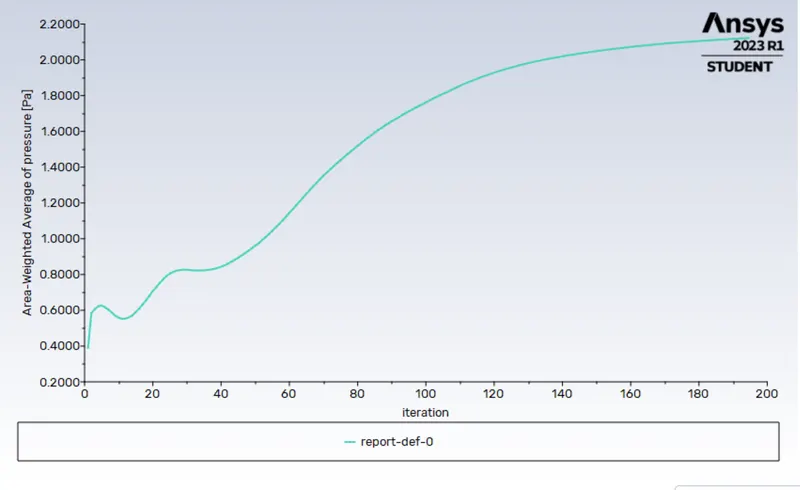
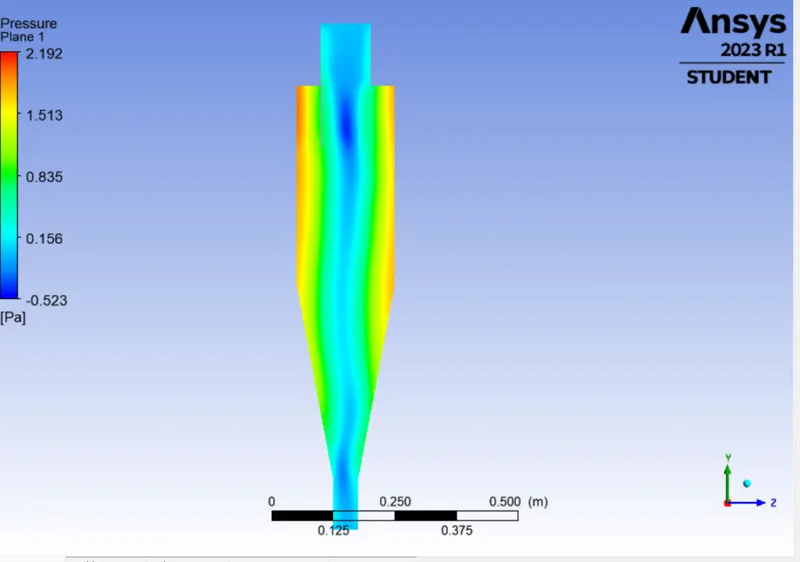
PRSSURE CONTOUR :
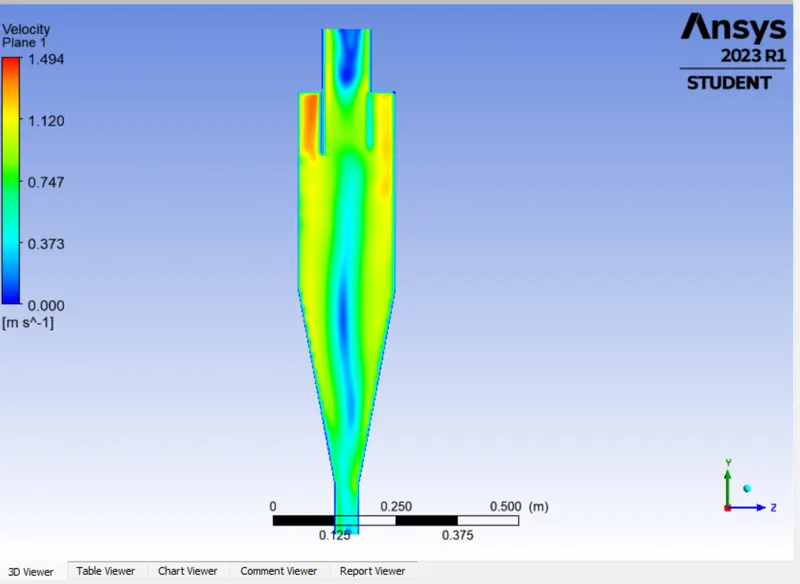
VELOCITY CONTOUR :
PARTICLE RESIDUAL TIME :
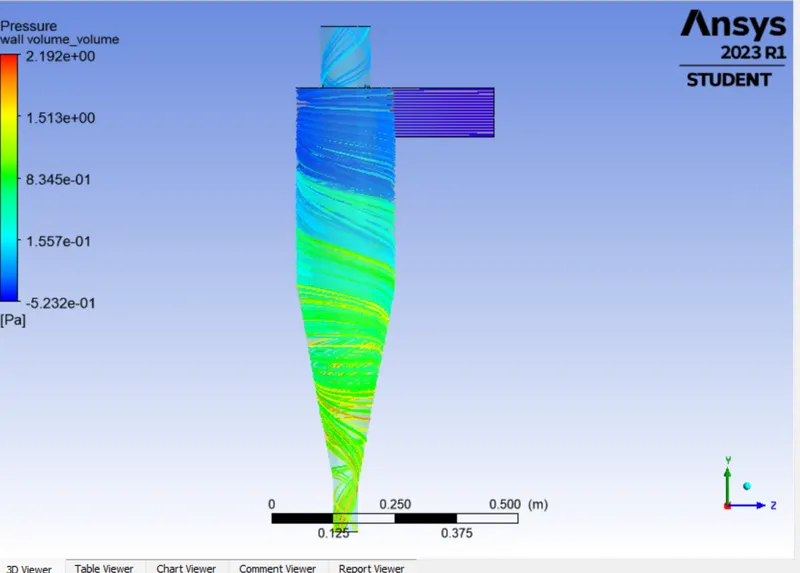
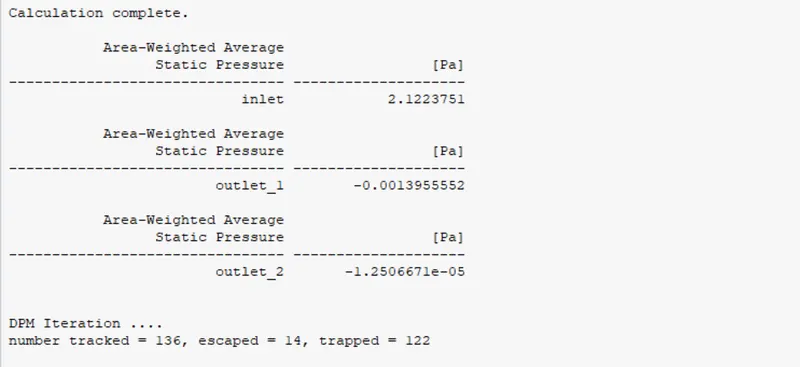
Seperation Efficiency = (No of particles trapped/No of particles tracked)x 100 = (122/136)x100=89.70%
Pressure drop = Inlet pressure - Total outlet pressure
= 2.1223751 - (-0.0013955552+(-1.25066e-05)) =2.132 Pa
Case 2 :
PARTICAL DIAMETER = 5 μm
PARTICAL VELOCITY = 3 m/s
RESIDUAL PLOT :
PRSSURE CONTOUR :
VELOCITY CONTOUR :
PARTICLE RESIDUAL TIME :
Seperation Efficiency = (No of particles trapped/No of particles tracked)x 100 = (95/136)x100=69.85%
Pressure drop = Inlet pressure - Total outlet pressure
= 21.711157 - (-0.024885294+(-0.0062289541)) = 21.742 Pa
Case 3 :
PARTICAL DIAMETER = 5 μm
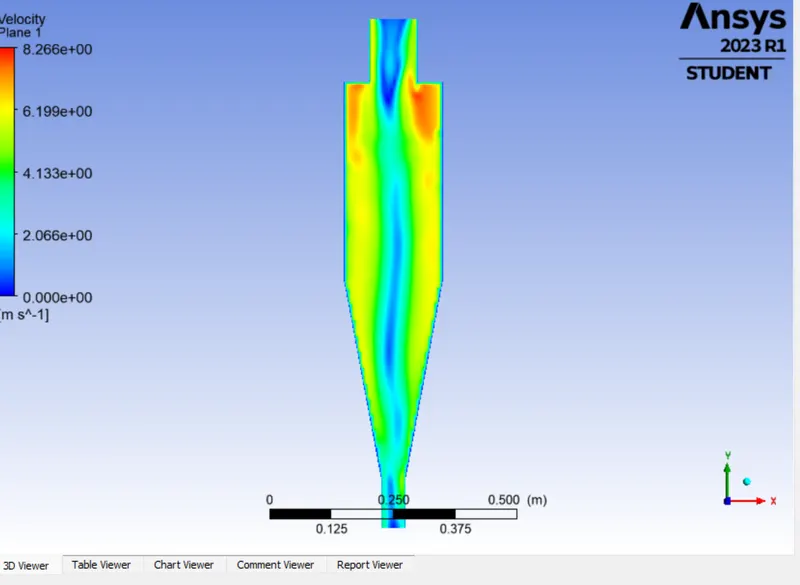
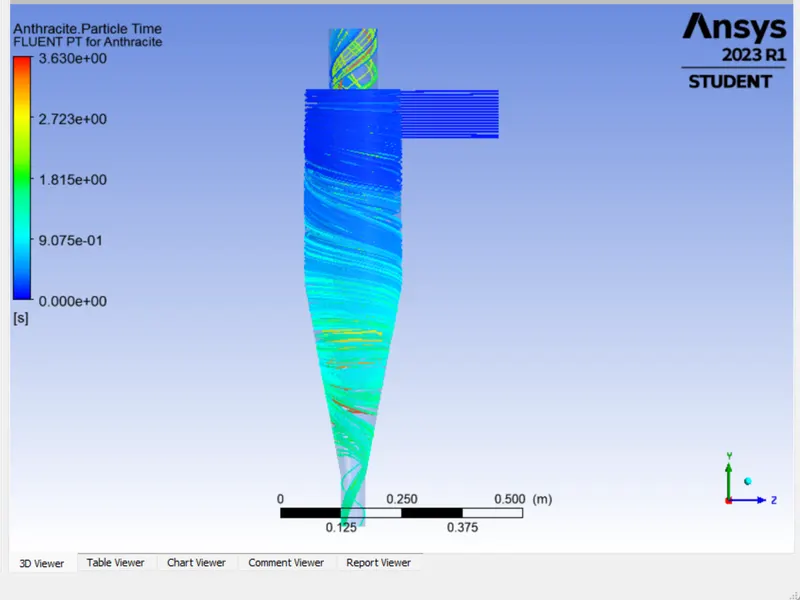
PARTICAL VELOCITY = 5 m/s
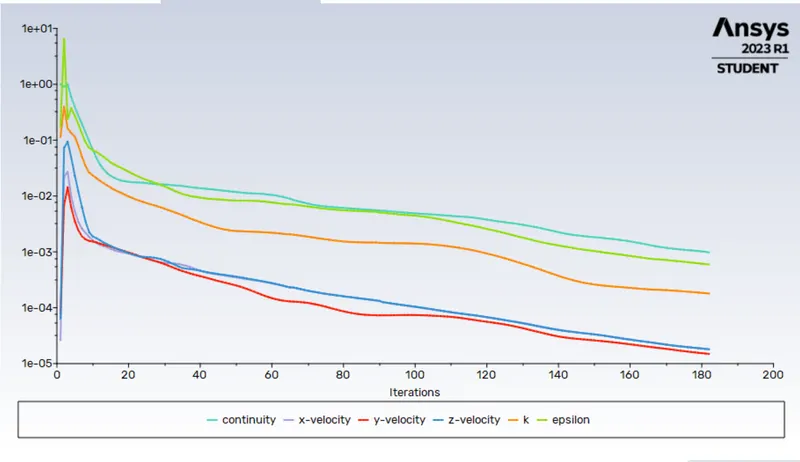
RESIDUAL PLOT :
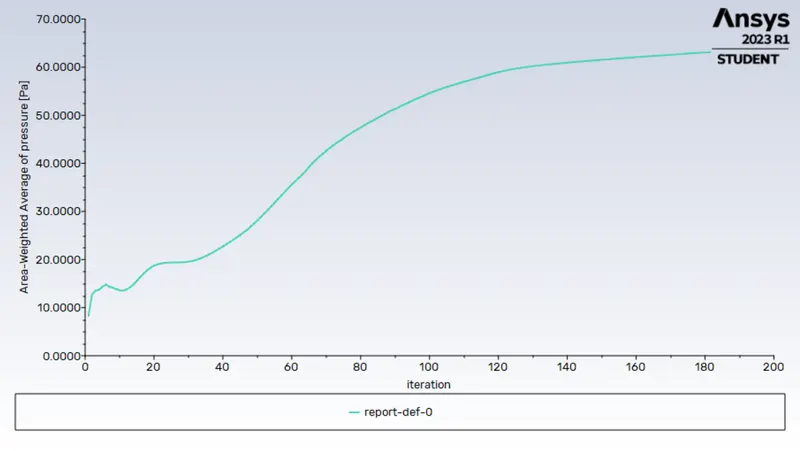
PRSSURE CONTOUR :
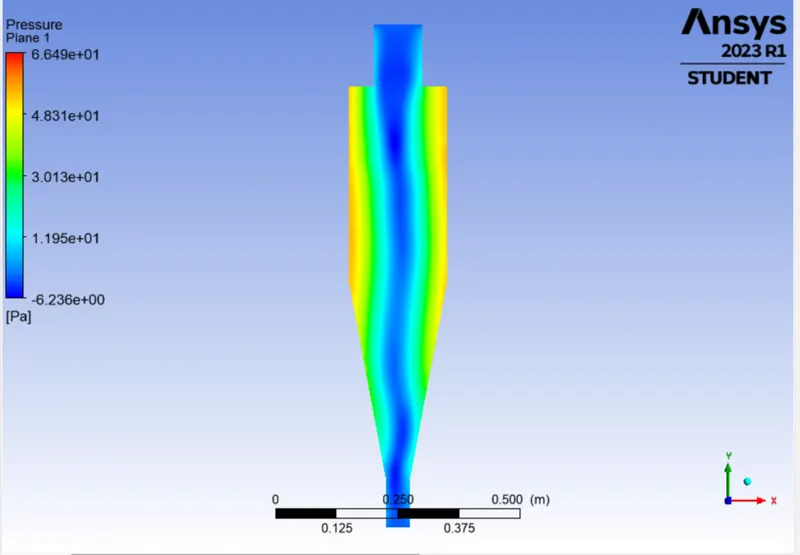
VELOCITY CONTOUR :
PARTICLE RESIDUAL TIME :
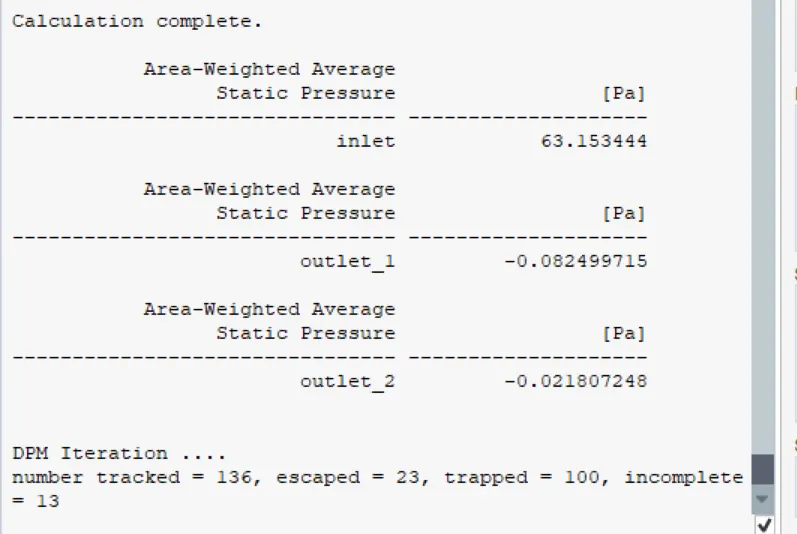
Seperation Efficiency = (No of particles trapped/No of particles tracked)x 100 = (100/136)x100=73.52%
Pressure drop = Inlet pressure - Total outlet pressure
=63.153444 - (-0.082499715+(-0.021807248)) = 63.25 Pa
Results
|
Diameter(µm) |
Velocity(m/s) |
Particles Tracked |
Particles Trapped |
Particles Escaped |
Particles Incomplete |
Separation Efficiency |
Pressure Drop(Pa) |
|
1e-6 |
3 |
136 |
125 |
11 |
0 |
91.91 |
21.742 |
|
3e-6 |
3 |
136 |
127 |
9 |
0 |
93.38 |
21.742 |
|
5e-6 |
3 |
136 |
95 |
41 |
0 |
69.85 |
21.742 |
|
Diameter(µm) |
Velocity(m/s) |
Particles Tracked |
Particles Trapped |
Particles Escaped |
Particles Incomplete |
Separation Efficiency |
Pressure Drop (Pa) |
|
5e-6 |
1 |
136 |
122 |
14 |
0 |
89.70 |
2.132 |
|
5e-6 |
3 |
136 |
95 |
41 |
0 |
69.85 |
21.742 |
|
5e-6 |
5 |
136 |
100 |
23 |
13 |
73.52 |
63.25 |
Conclusion:
- From the observations of both the cases, we can conclude that the Separation efficiency of the Cyclone Separator depends on both Diameter of Particles and also on the Particle Velocity.
- Also, we can conclude that in the 2nd Case, there are more efficient results. So the Velocity is a more effective variable for higher efficiency.
- The efficiency of a Cyclone Separator has a direct effect on the Pressure Drop. Higher efficiency Cyclones have the highest Pressure Drops.
- Higher the Velocity, hence higher the Pressure Drop, and higher the Efficiency.
- Also we can observe that, with increases in the Diameter of the Particle and Velocity of the Particle, Particle Resident Time decreases. So, when less Resident Time is taken by the Particles, the efficiency of the Cyclone Separator can be high.