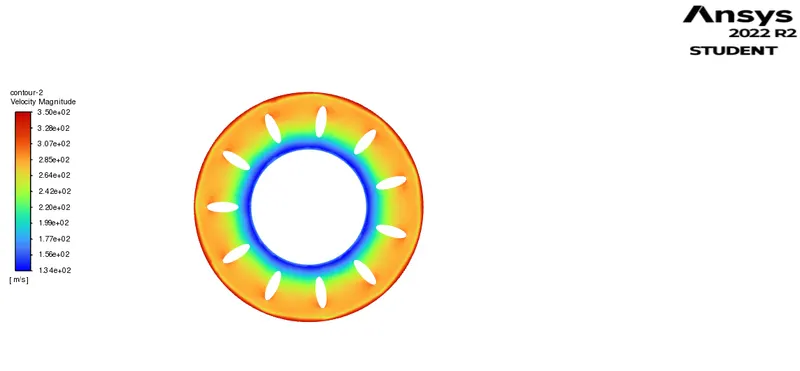
Week 8- Moving zones approach in Fluent
Tere are two types of motion encountered in fluid flow, they are rectilinear and rotary.
There are two approaches to model rotary motion:
- Moving reference frame
- Moving mesh appraoch.
Moving refernce frame:
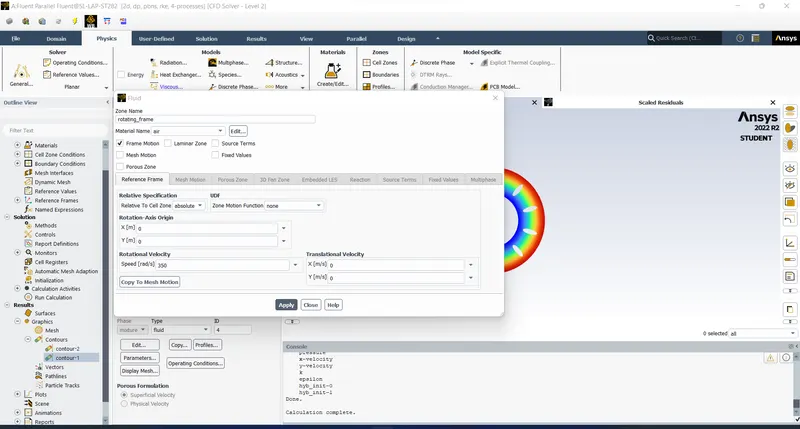
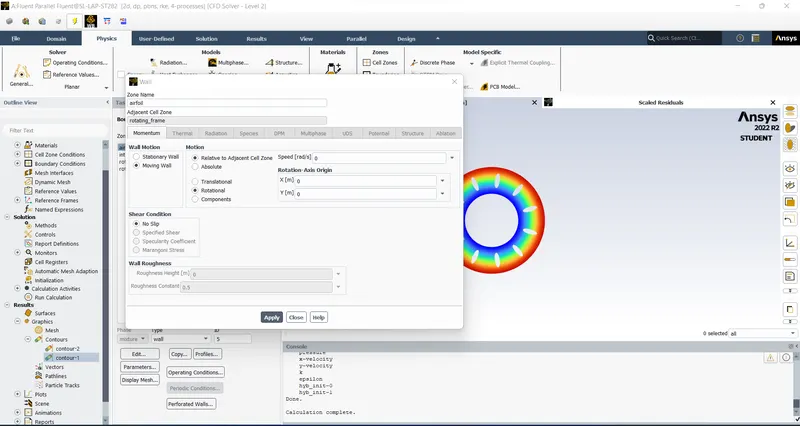
A Moving Reference Frame (MRF) is a relatively simple, robust, and efficient steady-state, Computational fluid dynamics modeling technique to simulate rotating machinery. For example, the rotors on a quadcopter can be modeled with MRFs.
The principal reason for employing a moving reference frame is to render a problem which is unsteady in the stationary (inertial) frame steady with respect to the moving rame. For a steadily rotating frame (i.e., the rotational speed is constant), it is possible
to transform the equations of fluid motion to the rotating frame such that steady-state solutions are possible. By default fluent permits the activation of a moving refernce frame with a steady rotational speed. If the rotational speed is not constant, the transformed equations will contain additional terms which are not inclkuded in fluent formulation. unsteady simulations can be studied in moving refernce frame with constant rotational speed.
wo approaches for multiple zones. It is a steady-state approximation in which individual cell zones can be assigned different rotational and/or translational speeds. The flow in each moving cell zone is solved using the moving reference frame equations If the zone is stationary ( ), the equations reduce to their stationary forms. At the interfaces between cell zones, a local reference frame transformation is performed to enable flow variables in one zone to be used to calculate fluxes at the boundary of the adjacent zone. The MRF interface formulation will be discussed in more detail in Section
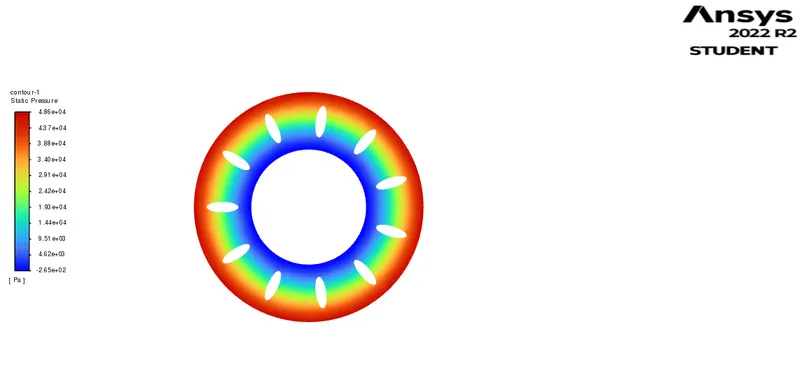
It should be noted that the MRF approach does not account for the relative motion of a moving zone with respect to adjacent zones (which may be moving or stationary); the mesh remains fixed for the computation. This is analogous to freezing the motion of the moving part in a specific position and observing the instantaneous flowfield with the rotor in that position. Hence, the MRF is often referred to as the "frozen rotor approach."
While the MRF approach is clearly an approximation, it can provide a reasonable model of the flow for many applications. For example, the MRF model can be used for turbomachinery applications in which rotor-stator interaction is relatively weak, and the flow is relatively uncomplicated at the interface between the moving and stationary zones. In mixing tanks, for example, since the impeller-baffle interactions are relatively weak, large-scale transient effects are not present and the MRF model can be used.
Another potential use of the MRF model is to compute a flow field that can be used as an initial condition for a transient sliding mesh calculation. This eliminates the need for a startup calculation. The multiple reference frame model should not be used, however, if it is necessary to actually simulate the transients that may occur in strong rotor-stator interactions, the sliding mesh model alone should be used.