Week - 8 Mass Scaling
Mass Scaling
Aim:
- Use mass scaling to reduce the run time of a model while ensuring the stability of the solution.
- Compare the changes in solution runtime with the application of implicit solver.
Explanation:
The solution of the model is conducted by two methods:
- Explicit Solver
- Implicit Solver
1. Explicit Methodology
An explicit solver is used for solving the problem. As most of the keywords utilized in the problem are not required to be addressed, hence not included in the report, and only necessary information of the model (relevant to the challenge) is included in the report. The explanation of the problem is as follows:
1. 3D Model
An arbitrary problem is selected for the purpose and the 3D model of the problem is shown as follows:
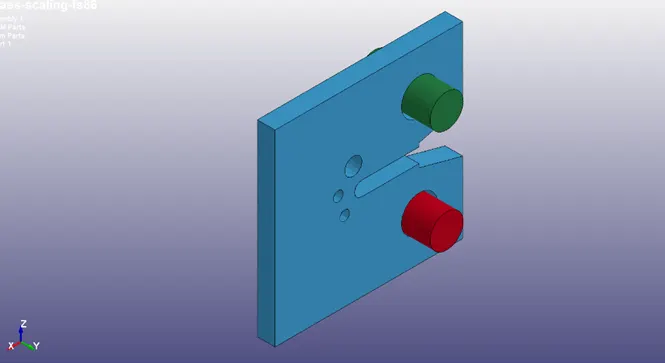
Figure 1 3D model of an arbitrary problem.
2. Control Termination
The control termination time for the model is selected to be 600 units of time, as shown in the figure below:
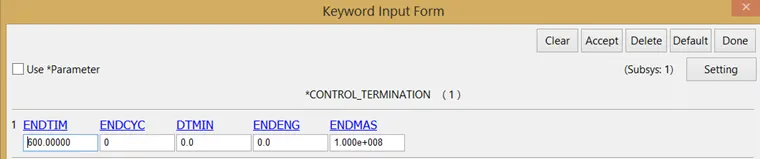
Figure 2 Control termination card
3. Control Timestep
The objective of the challenge is to input the parameters of this card so as to control mass scaling, and hence the runtime of the solver.
These parameters are varied so as to control the mass scaling of the problem. The selected parameters are:
- TSSFAC
- DT2MS
- DTINIT
- TSSFAC
This parameter is used as a scale factor for the computed time step (according to courant’s criteria) in the problem. This parameter is used as a safety factor, so as to avoid numerical instability during solving the problem. The limits for the parameter is more than 0 and less than 1, however practically this parameter is varied between 0.5 and 1, and its default value is 0.9.
- DT2MS
This parameter is used to control the amount of mass scaling. If the value of computed timestep by the solver (according to courant’s criteria), drops below this value, mass scaling occurs to compensate the difference by artificially increasing the density of element, so as to increase the timestep to nullify the difference. The higher the difference between DT2MS and computed timestep, more will be the mass scaling required to nullify the difference.
- DTINIT
This parameter is used to select the initial timestep size, and is not of much importance in the challenge, for altering the solver runtime. If DTINIT = 0, this means the initial step size is determined by the solver.
Different cases are considered in the explicit solution, where the above parameters are varied to control the mass scaling, and hence the solver run time.
|
Case No. |
|DT2MS|*10-5 |
TSSFAC |
DTINIT |
DT *10-5 |
Clock time (sec) |
Added Mass * 104 |
%age increase |
|
1 |
3.5 |
0.9 |
0.001 |
4.4 |
121360 |
0 |
0 |
|
2 |
Control Timestep card is omitted |
4.9 |
107738 |
0 |
0 |
||
|
3 |
3.5 |
0.9 |
0 |
4.4 |
120122 |
0 |
0 |
|
4 |
3.5 |
1 |
0 |
4.89 |
112568 |
0 |
0 |
|
5 |
4 |
0.9 |
0 |
4.4 |
121360 |
0 |
0 |
|
6 |
4.5 |
0.9 |
0 |
4.4 |
120122 |
0 |
0 |
|
7 |
5 |
0.9 |
0 |
4.5 |
118787 |
0.037501 |
0.0013179 |
|
8 |
5.5 |
0.9 |
0 |
4.95 |
109090 |
0.28552 |
0.01 |
|
9 |
6 |
0.9 |
0 |
5.4 |
98989 |
0.64667 |
0.023 |
|
10 |
6.5 |
0.9 |
0 |
5.85 |
98835 |
1.64 |
0.0579 |
|
11 |
7 |
0.9 |
0 |
6.3 |
85714 |
4.0678 |
0.14296 |
|
12 |
10 |
0.9 |
0 |
9 |
59940 |
182.77 |
6.4233 |
|
13 |
10.5 |
0.9 |
0 |
9.45 |
57719 |
305.83 |
10.748 |
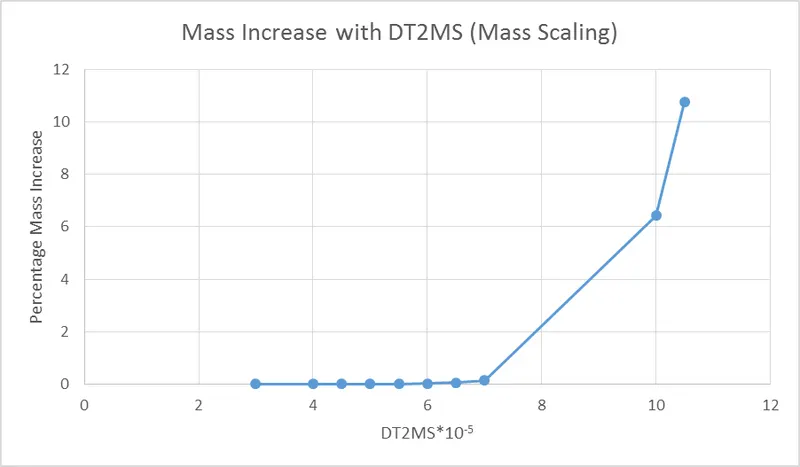
Figure 3 Percentage Mass increase with DT2MS
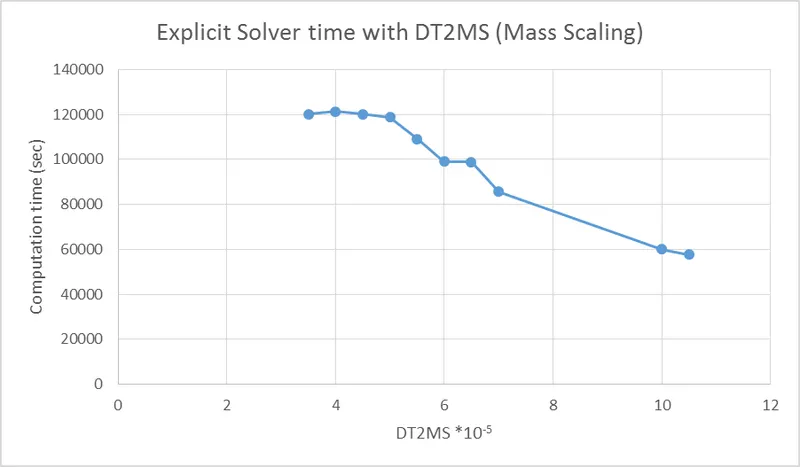
Figure 4 Computation time with DT2MS
2. Implicit Methodology
In implicit solver, there is no significance of defining mass scaling, as the solver time step can be directly controlled by user and is independent of courant’s criteria.
Considering the above model example, the Implicit solver is called using IMFLAG = 1 & the initial timestep (DT0) is setup as 1
Conclusion
For explicit solver, a percentage mass increase of 8% was acting as a limit to mass scaling, hence further mass scaling could not be applied as the solution will deviate from the actual result on further mass scaling.
With the above-stated limit on percentage mass increase, the computation time has been halved with mass scaling (from 3 hrs to around 16 hrs),
We can conclude from the plots (as the percentage limit of mass increase is 8%), that the optimum value of DT2MS for reducing computation time is around 10-4 and the value of TSSFAC can be varied for stability, however, to safely minimize the computation time TSSFAC is set to 0.9.
For implicit solver (with DT0 = 1), the total time required to solve the problem in implicit solver with the above settings is around 100 seconds, which is far lesser in comparison with explicit solver!
However, the convergence of the solution using an implicit solver (with DT0 = 1), is still questionable, and further settings may be needed if the convergence problem occurs, which may lead to increased computation time of the problem.