Week - 8 Mass Scaling
Objective:
The objective of this report is to explore the use of mass scaling as a technique to reduce the runtime of a simulation model while maintaining stability. The key requirement is to limit the mass scaling to 8% while ensuring that the stability of the system remains intact. This implies that simulations with and without mass scaling should exhibit identical behavior. The report will also cover the optimization of both the DT (timestep) and TSSFAC (temperature scaling factor) parameters.
Introduction:
Mass scaling is a technique commonly employed in molecular dynamics simulations to accelerate the simulation runtime by rescaling atomic masses. However, it is crucial to strike a balance between runtime reduction and maintaining the stability and accuracy of the simulation. This report focuses on optimizing the parameters DT and TSSFAC to achieve the desired balance.
Methodology:
-
Mass Scaling Trials:
- Range: Mass scaling will be applied within the range of 0% to 8%.
- Trials: Multiple simulations will be conducted with varying mass scaling percentages (e.g., 0%, 2%, 4%, 6%, 8%).
- Data Collection: Record system behavior, stability, and runtime for each trial.
-
Parameter Optimization:
- DT Optimization: Perform simulations with different timestep values (e.g., 1 fs, 2 fs, 3 fs) and record the impact on system behavior and stability.
- TSSFAC Optimization: Explore different temperature scaling factors (e.g., 0.1, 0.2, 0.3) and observe their effects on stability.
-
Comparison:
- Stability Analysis: Compare the stability of simulations with and without mass scaling. Ensure that the system's stability remains unchanged within the 8% mass scaling limit.
- Runtime Comparison: Evaluate the runtime of simulations with varying mass scaling percentages and identify the optimal balance between runtime reduction and stability.
Data Generation:
The data generated from the trials will include:
- System stability metrics (e.g., RMSD, energy conservation).
- Simulation runtime for each trial.
- System behavior observations under different mass scaling percentages.
- Optimization results for DT and TSSFAC.
Procedure:
1. Upload the keyword file
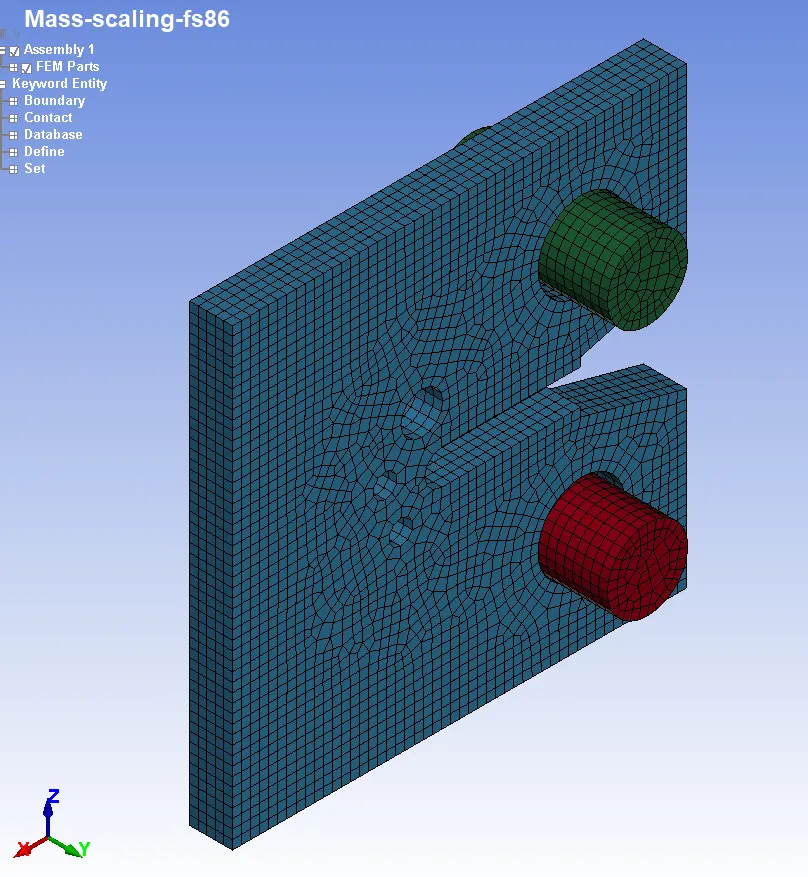
2. Simulation with no mass scaling to 8% mass scaling
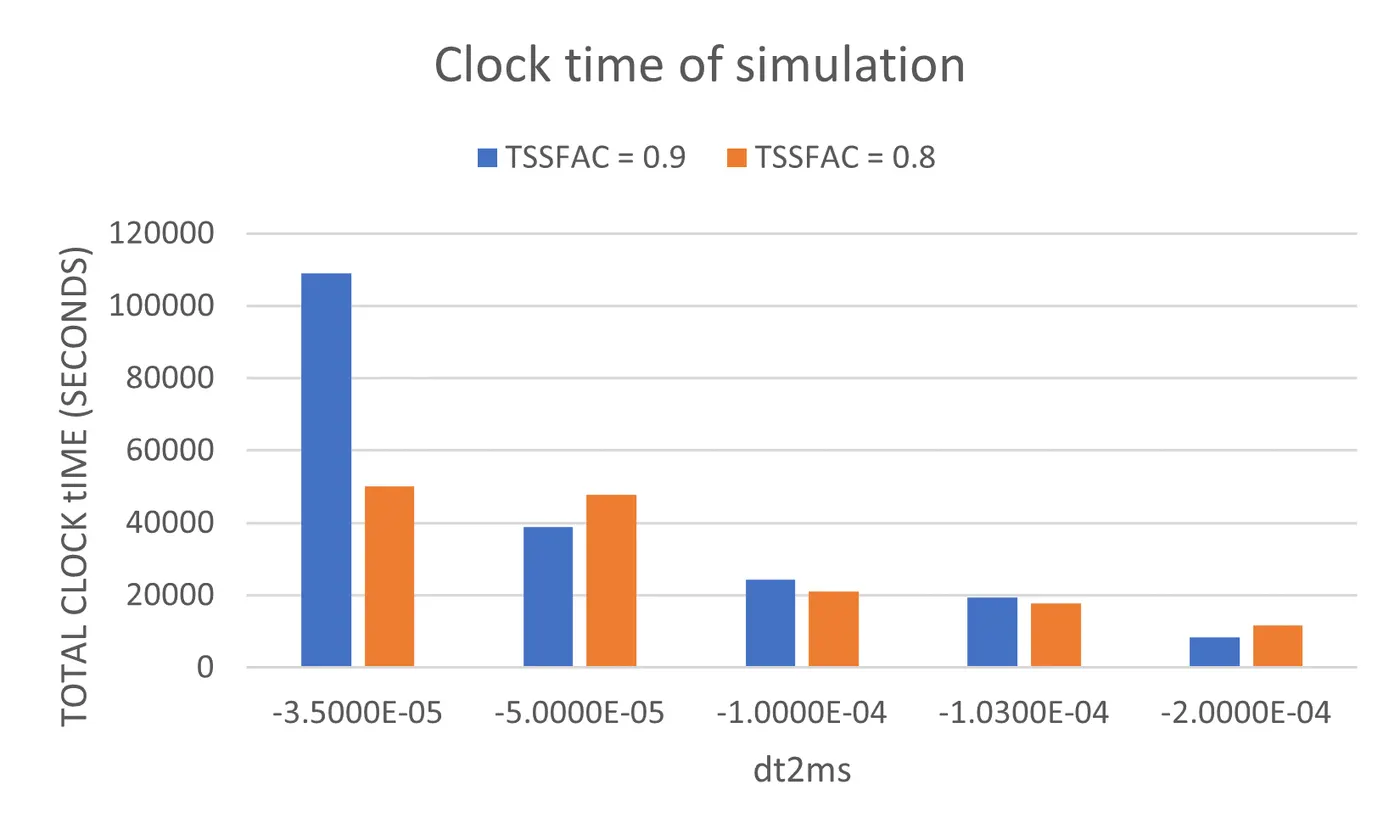
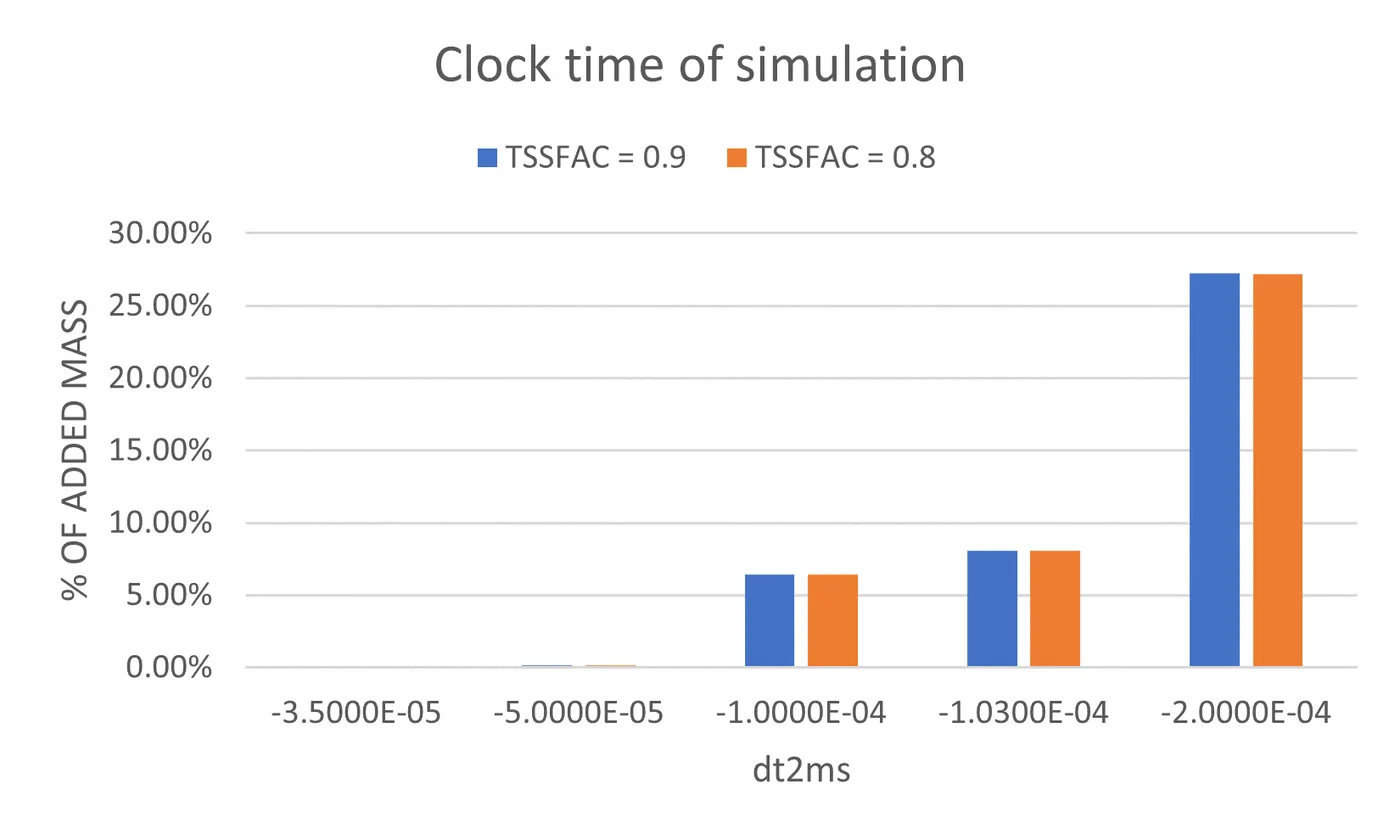
Selecting either 0.9 or 0.8 as the Time Scale Factor (tssfac), vary the time size for mass scaling (dt2ms) for increase in percentage
of mass by 8 %
Following figure shows the results:
IMPLICIT SIMULATION:
Delete Timestep and add the following control
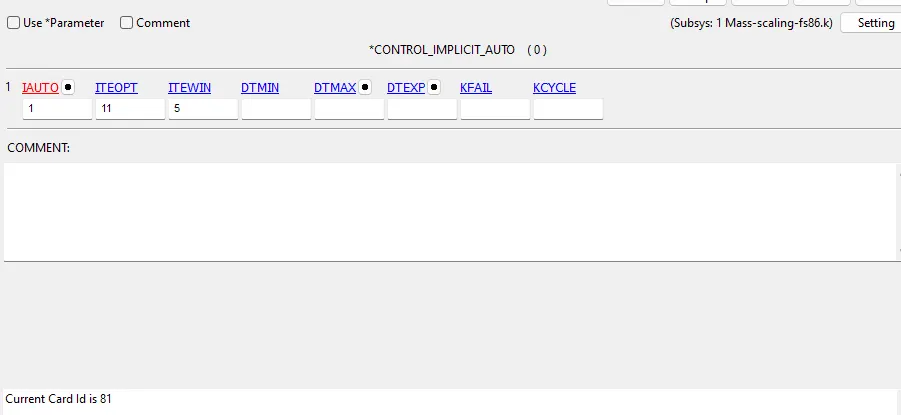
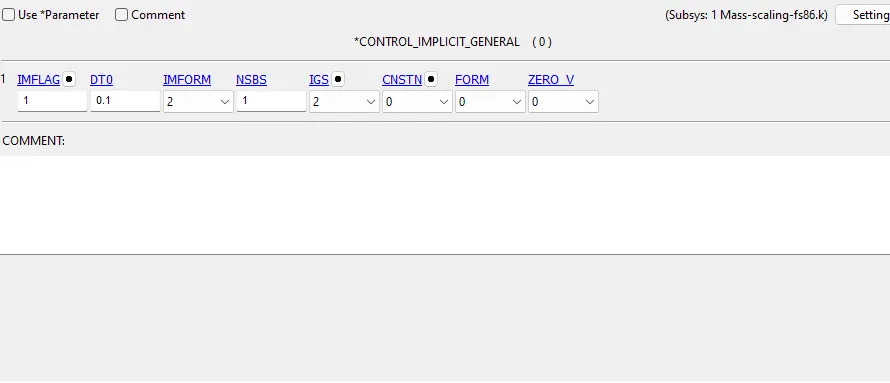
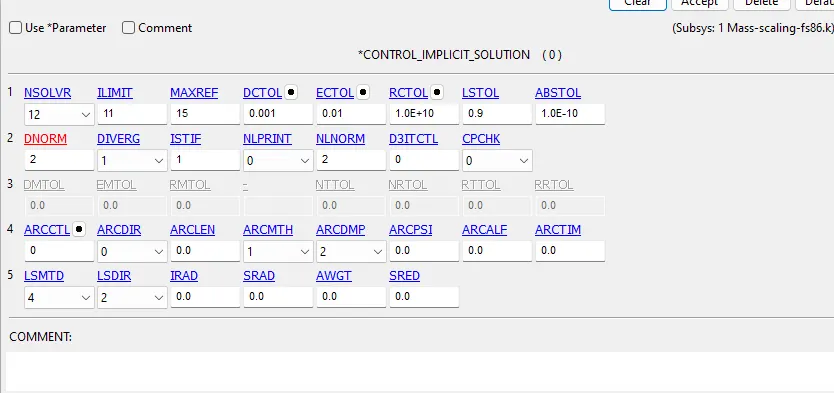
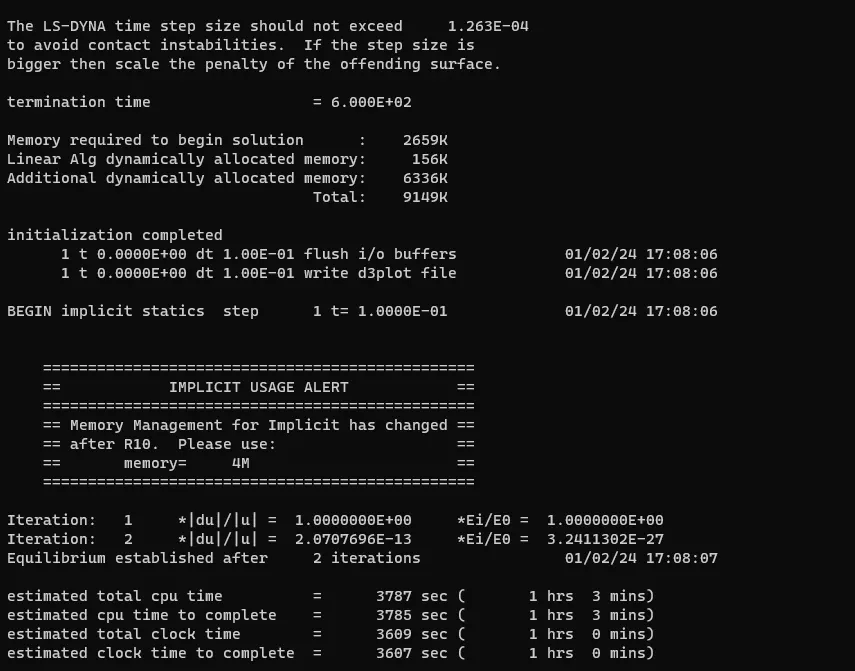
Termination of the IMplicit simulation is captured
Conclsion:
Clock time is succesfully reduced with mass scaling in explicit simulation. Implicit simulation succefully reduced the clock time
from hours to minutes. Based on the problem and specification type of model and parameter for mass scaling is chosen.